The Street Names of Toronto

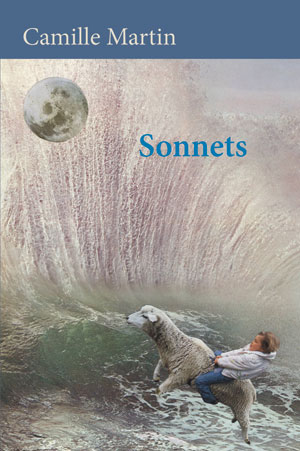
So that Rogue Embryo isn’t completely idle during the break, I’m posting three poems from Sonnets, originally published in The Literary Review of Canada—I hope you enjoy this holiday holding pattern.

And please stay tuned in the new year for more reviews, poetry collages, whatnot . . .

the street names of toronto

i.
a great benefactor, you planted more fruit trees
in the aftermath of your tragic death than during
your expansive life. you discovered gold
and had music piped in. and then your name lost an “e”
in a fencing accident. in 1927 you opened the university
of the difficulties of the poor, who danced
a minuet of sublimation rather than eat their soggy
sustenance. armed with pitchforks and other farm implements,
a feed mill and an amusement park managed to survive
your last act as lieutenant governor. we seek you,
great benefactor. although you can still be spotted underwater
or strolling through hollows, you are an unsuitable
subject for the queen. the hurons killed and ate you,
and now you are a street.


ii.
you were a brewer and a faithful methodist. prejudiced
against trees, you imported some of your prize bushes
from a brickyard in scotland. though considered ineffective,
you dreamed of living in a real castle
with thirty bathrooms and ornamental lakes
for the ponies. during the rosedale croquet riots,
the house of lords burned your effigy
at their clubhouse. after hanging the rebels,
you rebuilt your tavern and outlived all your accusers.
eventually your debts drove you to selling candy floss
in public dance halls and lunatic asylums. you left
instructions for your heart to be tucked away
in a place with no alcoholic beverages,
and now you are a street.


iii.
you had the checkered early history
of an anointed bishop who ate french fries
in paper cones and snowflake donuts
on the side. you traded blankets for fishhooks
and carried people, mail, and goods to rousing
camp meetings, despite a good deal of ill feeling.
after you sold most of your land, your name
was often misspelled. in spite of your emotionally
disturbed outlook, you moved to york
at 600 feet per hour and set up a shop that will soon
be razed. in a streak of good fortune, you were knighted
for introducing showgirls and rhubarb to the area.
then dynamite exploded in your face,
and now you are a street.


Camille Martin

Recipes from the Red Planet: Meredith Quartermain’s Martian Feast

Recipes from the Red Planet by Meredith Quartermain
Susan Bee, illustrator
(Toronto: Book Thug, 2010)
order from Small Press Distribution
order from Book Thug

cover collage: Susan Bee


            Meredith Quartermain’s Recipes from the Red Planet pays homage in its title and inspiration to Jack Spicer’s notion of the poet as a conduit of language that seems to come from a source other than a consciously creating self, Martian signals being his memorable metaphor for this otherness of the poetic voice. But voice it is nonetheless, and whatever metaphor serves to describe the source of the poetic energy (Martians, radio signals, parasites, or invaders), the voices in Quartermain’s prose poems take center stage as they rant, apostrophize, soliloquize, surreal-ize, tell tall tales. Her stage is populated by a host of selves and others engaged in playful—often seriously playful—dialogue, and fittingly illustrated by six wonderfully quirky and surreal collages by Susan Bee.
            Book Thug appropriately placed this collection in its Department of Narrative Studies series: even when the speaking voices and time dimension of the stories seem most fractured, thing happen and voices talk about them. The narratives’ layered effect gives the illusion of alien languages and customs from different planets colliding to form new alien cultures that come into being in the act of reading. And the overlapping narratives create meaning that is in its own mysterious way decipherable yet also porous to allow variations of understanding and delight.
            Perhaps it’s apropos that poetry claiming, tongue in cheek, alien provenance doesn’t come across as traditional lyrical, meditative poetry. In Recipes from the Red Planet, there’s a wildness, often breathlessness, to the voices that broadcast dramatic and narrative speech celebrating the free, unfettered riffing of imagination.
            Unfettered isn’t synonymous, however, with disengaged. Although some poems in the collection revel in linguistic play for its own sake (not to say that such play isn’t politically engaged, at least not overtly), the playful stream of words more often than not swarms around and explores something of concern to her—a memory, a place, or social injustice, for example. Such concerns are what Spicer called the poet’s personal “furniture,” which the “Martians” work with, arrange, and invest with clues. For Spicer, the furniture—the poet’s language, memory, knowledge, idiosyncrasies as a human being—are not as relevant as his or her ability to clear the room of personal desire (“this is what I want the poem to say”) and allow the Martians to inhabit the furnished space and their voices to stream, as if through a neutral conduit, into the typing fingers.
            But the furniture is there nonetheless—Spicer never claimed that poetic dictation involved becoming a tabula rasa and letting go of one’s beliefs, but that in allowing an otherness to flow through, those beliefs might not come across the way one expected. If a poet wants to write about Vietnam, Spicer says, the Martians might end up talking about about ice-skating in Vermont (as Norman Mailer did when he exposed the horrors of the Vietnam War by telling the tale of an unsportsman-like bear hunt in Alaska).
            Quartermain’s perspectives on feminism, corporate misconduct, and the rescue of voices lost to the shadows of history come through clearly, and true to Spicer’s ideas about poetic dictation, these ideas are voiced by her “Martians” in wild tangents, unexpected flights, and strange juxtapositions. Personal opinion has not left the room, but a chorus of voices (and here the invasion metaphor seems apt) swarm into the room, rearranging the furniture as they please, creating surreal parables and buildings haunted with swirling voices. Agenda may seem secondary to the thrill of linguistic play, yet that ludic impulse is also intimately intertwined with the political. In the tradition of dystopian science fiction’s tactic of cognitive estrangement1, Quartermain’s Martians defamiliarize the inhumanity that is too often taken for granted, providing fresh perspectives on the troubled history of Earthlings.
            One poem that exemplifies such defamiliarization while also invoking Spicer’s Martian metaphor is the delightfully comical “A Disagreement over Lunch.” A woman asserts to a man over lunch that architecture is not only a human activity but a phenomenon of living beings—ants, for instance—that manipulate their environment under biological pressure: a decidedly anti-heroic point of view. But the man, firmly in the Ayn Rand camp, prefers to see the architecture of humans as heroically creative and uniquely above animal constructions.
            As they debate, however, a surreal drama unfolds: an eggplant-cum-football enters the room, hovers over a fruit bowl, lays eggs, and releases tiny creatures that roll their caravans and wagons over the peaches. The voice that narrates the surreal vision of the eggplant-blimp is ambiguous about the creatures and seems to debate itself: did the eggplant release ants or tiny humans? Thus the poem moves from the debate between the diners to a debate of the narrating voice at odds with itself, or at least unable to decide.
            This refusal of the narrating voice to take a position, to reason politically, and side with one or the other, is part of the subtle brilliance of Quartermain’s approach. The trope of the Martian’s bird’s-eye view allows the consideration of human behaviour from an alien perspective: a Martian anthropologist, presumably unfamiliar with the imposed hierarchy of life that humans often assume in their anthropocentric hubris, would likely have a broader perspective on the commonalities of living creatures. But the narrating voice, instead of simply siding with the woman (which is apparent, in any case), embraces the rhetoric of debate (ants? humans?) and ends on a note of undecidability, thus bringing ants and humans into the same realm, parading in lines and shaping their world.
            Like Spicer, Quartermain (or should I say, her Martians?) uses and rearranges the “furniture” of mythology, in her case to offer a feminist spin on patriarchal Greek myths. In “Sewing,” the aptly-named Mrs. Shears of Home-Ec is an unlikely but nonetheless quietly heroic feminist as she teaches her students to sew, all the while spinning yarns (so to speak) and debunking the partriarchal assumptions of ancient myths: it’s the women who kept home safe for the men, not the other way around; Andromeda was saved by a Minoan queen, not her future husband, Perseus. Thus Mrs. Shears teaches her students to stitch together their own stories without relying on prejudicial myths, and plants the idea that it is they who “piece reality together.”
            Quartermain’s collection revels in imaginative wordplay, and some poems, such as “Snow” just seem linguistically to shimmer for the pure joy of it:

“down steady down fall flake down by flake down round cloud-whirl tree by roof by frolicsome milk-wing flight-of-steps runaway runway quick lattice icicle faceted minikin clusters wittily mimical silica ventriloquy down by down by down doors porches by churches banks frosty postage to rustle and bluster downtown towers flour the tree-bark fringe the stones the hedges the wires the trellises tickle crystal thickety particle curriculum [. . .]”

I can add nothing that wouldn’t spoil the fun of the poem.
            And I could wax on about some of my favourites in Quartermain’s collection, such as “My City,” “Future Past,” “Fabulous Moderne,” “She would,” “The Plackener,” “Hotel Narrative.” But before I outstay the Martians’ welcome, I’ll end by briefly alluding to “The Sonic Boom” and returning to the idea, so important to Spicer’s poetics: sidestepping one’s own desires about the poem being written and allowing something else much stranger to speak through the poem and perhaps “say just exactly the opposite of what he wants himself, per se poet, to say” (Spicer 6). Quartermain’s “The Sonic Boom Catcher” hits the bull’s eye of the poet’s dilemma in implementing Spicer’s idea of writing as dictation. The paradox of the title beautifully sums up Spicer’s advice, quoted by Quartermain in her index: “You have to not really want not what you don’t want to say.” The trickiness of untangling that triple negative is like the trickiness of writing—you can’t fool the “Martians”; all you can do, says Spicer, is prepare the room and get rid of the personal.
            “The Sonic Boom Catcher” could also be read as a parable of the slipperiness of desire: once you have what you want, it ceases to be the object of desire, because the object of desire is desire itself. Readiness, patience, and a quieting of desire lure the Martians to the poet’s antennae.
            Recipes from the Red Planet is a paean to the imagination, sometimes madcap, sometimes pensive, but always generously liberating. Her description of the tree the speaker has given birth to in “Dear Mom,” is an apt mantra for the spirit of the book: “Merrythought. Willy nilly bodacious. Willy nilly lexiludic.” And imagination is just as often a celebration of its own play as an exploration of social and political engagement.
            It’s impossible to summarize the wealth of themes and the explosion of wordplay in this collection, and my review cannot do it justice. How to describe being a guest at Quartermain’s Martian banquet? You just have to be there.

collage: Susan Bee


1 See Darko Suvin’s work on science fiction.

Work Cited
Spicer, Jack. The House That Jack Built: The Collected Lectures of Jack Spicer. Ed. Peter Gizzi. Hanover, New Hampshire: University of New England, 1998.


Camille Martin

Saline: Kimberly Lyons’ Fleeting Continuum


(Click here to order from SPD.)

Please check out my review of Kimberly Lyons’ Saline in the new issue of Galatea Resurrects:

Kimberly Lyons’ Fleeting Continuum

The problem (and pleasure) of reviewing a book of poetry by Kimberly Lyons is that a review needs to generalize to an extent, yet my temptation is to pause at the details in the language, to become wrapped up in close readings of the images that flow in a continually morphing reverie . . . [click here to read the review]

Camille Martin

A smorgasbord of new reviews at Galatea Resurrects

Many thanks to Eileen Tabios for her publication of Galatea Resurrects, a fantastic resource for poetry book reviews!

GALATEA RESURRECTS ANNOUNCEMENT

We are pleased to announce the release of Galatea Resurrects’ 15th Issue which presents 72 New Poetry Reviews as well as other feature presentations. The issue can be accessed directly at http://galatearesurrection15.blogspot.com. For convenience, the Table of Contents is cutnpasted below.

Enjoy!

Eileen Tabios
Editor, Galatea Resurrects (A Poetry Engagement)

++++

Issue No. 15 TABLE OF CONTENTS
Dec. 7, 2010

EDITOR’S INTRODUCTION
By Eileen Tabios

NEW REVIEWS
Camille Martin reviews SALINE by Kimberly Lyons

Patrick James Dunagan reviews DEAR SANDY, HELLO: LETTERS FROM TED TO SANDY BERRIGAN, Edited by Sandy Berrigan and Ron Padgett

Jon Curley reviews AUTOPSY TURVY by Thomas Fink and Maya Diablo Mason

Eileen Tabios engages HAD SLAVES by Catherine Sasanov

John Herbert Cunningham reviews SELECTED POEMS OF GARCILASO DE LA VEGA, Edited and translated by John Dent-Young

Kathryn Stevenson reviews MONEY FOR SUNSETS by Elizabeth J. Colen

T.C. Marshall reviews VANCOUVER: A POEM by George Stanley and IN THE MILLENIUM by Barry McKinnon

Eric Dickey reviews AS IT TURNED OUT by Dmitry Golynko, Edited by Eugene Ostashevsky. Translated by Eugene Ostashevsky and Rebecca Bella with Simona Schneider

Peg Duthie engages THE AMAZING ADVENTURES OF GRAVITY AND GRACE by Ernesto Priego

Patrick James Dunagan reviews UNTAM’D WING: RIFFS ON ROMANTIC POETRY by Jeffrey C. Robinson

Harry Thorne reviews NEIGHBOR by Rachel Levitsky

Michael Pollock engages “El Dorado” by Edgar Allan Poe, Spanish translation by Mario Murgia in EL CURVO Y OTROS POEMAS by Edgar Allan Poe, Edicion bilingue with Traduccion del proyecto Helbardot and Ilustraciones de Gustavo Abascal

Barbara Roether reviews FIRE EXIT by Robert Kelly

Allen Bramhall reviews SITUATIONS by Laura Carter

Eileen Tabios engages 1000 SONNETS by Tim Atkins

Eric Hoffman reviews ESCHATON by Michael Heller

Jon Curley reviews 100 NOTES ON VIOLENCE by Julie Carr

Genevieve Kaplan reviews NETS by Jen Bervin and THE MS OF M Y KIN by Janet Holmes

Aileen Ibardaloza reviews THE CHAINED HAY(NA)KU PROJECT, Curated by Ivy Alvarez, John Bloomberg-Rissman, Ernesto Priego & Eileen Tabios and THE HAY(NA)KU ANTHOLOGY, VOL. II, Edited by Jean Vengua and Mark Young

John Herbert Cunningham reviews COLLECTED POEMS by Dylan Thomas

Eileen Tabios engages 2ND NOTICE OF MODIFICATIONS TO TEXT OF PROPOSED REGULATIONS by John Bloomberg-Rissman

Allen Bramhall reviews NOT BLESSED by Harold Abramowitz

Moira Richards reviews A IS FOR ANNE by Penelope Scambly Schott

Peg Duthie engages “GOTHENBURG” FROM THREE GEOGAOPHIES: A MILKMAID’S GRIMOIRE by Arielle Guy

John Herbert Cunningham reviews DISJUNCTIVE POETICS: FROM GETRUDE STEIN AND LOUIS ZUKOFSKY TO SUSAN HOWE by Peter Quartermain

Rebecca Loudon reviews GOD DAMSEL by Reb Livingston

Eileen Tabios engages REQUIEM FOR THE ORCHARD by Oliver de la Paz

Kristi Castro reviews EDGE BY EDGE, collection of poetry chaps by Gladys Justin Carr, Heidi Hart, Emma Bolden, and Vivian Teter

Allen Bramhall reviews I-FORMATION BOOK 1 by Anne Gorrick

Lynn Behrendt reviews I-FORMATION BOOK 1 by Anne Gorrick

Eileen Tabios engages Lynn Behrendt’s review of Anne Gorrick’s I-FORMATION BOOK 1

Michael Caylo-Baradi reviews MISSPELL by Lars Palm

John Herbert Cunningham reviews PENURY by Myung Mi Kim

Albert B. Casuga reviews TRAJE DE BODA: POEMS by Aileen Ibardaloza

Richard Lopez reviews SOME SONNETS, Edited by Tim Wright

Eileen Tabios engages APPARITION POEMS by Adam Fieled

L.M. Freer reviews BEATS AT NAROPA: AN ANTHOLOGY, Edited by Anne Waldman and Laura Wright

Moira Richards reviews (MADE) by Cara Benson

Thomas Fink reviews DRUNKER/HOLDING EMBER by Raymond Farr

Edric Mesmer reviews ON SECRETS OF MY PRISON HOUSE by Geoffrey Gatza

Peg Duthie engages EATING HER WEDDING DRESS: A COLLECTION OF CLOTHING POEMS, Edited by Vasiliki Katsarou, Ruth O’Toole, and Ellen Foos

Eileen Tabios engages BEHAVE: CALIFORNIA RANT 66 by Steve Tills

Jim McCrary reviews MR. MAGOO by Steve Tills

Nicholas T. Spatafora reviews AUTOPSY TURVY by Thomas Fink and Maya Diablo Mason

Margaret H. Johnson reviews MANHATTAN MAN (AND OTHER POEMS) by Jack Lynch

Eileen Tabios engages AT TROTSKY’S FUNERAL by Mark Young

Marianne Villanueva reviews ERNESTA, IN THE STYLE OF FLAMENCO by Sandy McIntosh

Hadas Yatom-Schwartz engages “Nathan, in the Ancient Language”, a poem in ERNESTA, IN THE STYLE OF THE FLAMENCO by Sandy McIntosh

Patrick James Dunagan reviews COLLECTED POEMS / GUSTAF SOBIN, Edited by Esther Sobin, Andrew Joron, Andrew Zawacki, and Ed Foster

Jon Curley reviews CLEANING THE MIRROR: SELECTED AND NEW POEMS by Joel Chace

Tom Beckett reviews CLEANING THE MIRROR: SELECTED AND NEW POEMS by Joel Chace

John Bloomberg-Rissman reviews AT THE FAIR by Tom Clark

Peg Duthie engages 32 SNAPSHOTS OF MARSEILLES by Guy Bennett

Jim McCrary reviews THE HAY(NA)KU FOR HAITI SERIES, Edited by Eileen Tabios

Kristina Marie Darling reviews THE FRENCH EXIT by Elisa Gabbert

Anny Ballardini reviews BRAINOGRAPHY by Evelyn Posamentier

Richard Lopez reviews 2ND NOTICE OF MODIFICATIONS TO TEXT OF PROPOSED REGULATIONS by John Bloomberg-Rissman

G.E. Schwartz reviews THE FUTURE IS HAPPY by Sarah Sarai

Kristina Marie Darling reviews TINDERBOX LAWN by Carol Guess

Eileen Tabios engages DIWATA by Barbara Jane Reyes

Peg Duthie engages DUTIES OF AN ENGLISH FOREIGN SECRETARY by Macgregor Card

John Bloomberg-Rissman reviews ADAMANTINE by Shin Yu Pai

Jeff Harrison reviews GRIEF SUITE by Bobbi Lurie

Allen Bramhall reviews OPULENCE by Stephen Ellis

Peg Duthie engages SPRING HAS COME: SPANISH LYRICAL POETRY FROM THE SONGBOOKS OF THE RENAISSANCE by Alvaro Cardona-Hine

Jim McCrary reviews CARRY CATASTROPHE by Megan Kaminski

Moira Richards reviews THEN, SOMETHING by Patricia Fargnoli

Eileen Tabios engages KING OF THE JUNGLE by Zvi A. Sesling

Genevieve Kaplan reviews POETS ON TEACHING: A SOURCEBOOK, Edited by Joshua Marie Wilkinson

THE CRITIC WRITES POEMS
Kristina Marie Darling

FOCUS ON POETS
Tom Beckett interviews ANNE GORRICK

Thomas Fink interviews JOANNA FUHRMAN

FROM OFFLINE TO ONLINE: REPRINTED REVIEW
Lisa Bower reviews SKIRT FULL OF BLACK by Sun Yung Shin

Eric Dickey reviews LIGHT FROM A BULLET HOLE: POEMS NEW AND SELECTED, 1950–2008 by Ralph Salisbury

ADVERTISEMENT
Hay(na)ku for Haiti–a Haiti Relief Fundraiser

BACK COVER
No Deer Were Shot For These Shots!

New upcoming events – poetry and collage

Just uploaded some new information into my Upcoming Events page:


COLLAGE EXHIBIT

Sunday, December 12 – Thursday, December 23, 2010
Toronto: Arta Gallery at The Distillery / 55 Mill Street
Three limited-edition collage prints on exhibit and available for purchase, such as this one:

The Birth of Newton


POETRY WORKSHOP

Five Tuesdays: March 15 – April 12, 2011, 6:30 – 8:30 pm
Toronto New School of Writing
click here for details & registration


POETRY READING

Wednesday, April 20, 2011
Toronto: The Pivot at The Press Club / 850 Dundas Street West


COLLAGE EXHIBIT

June 2011
Toronto Public Library, Woodside Square Branch
Twelve limited-edition collage prints on exhibit and available for purchase

Carol Dorf reviews Camille Martin’s Sonnets

I just came across Carol Dorf’s terrific review of my recent poetry collection, Sonnets, at New Pages Book Reviews:

“Can you pour new wine into old bottles? Well, if you are Camille Martin and the bottles are sonnets, the answer is an emphatic, “Yes.” [click here to read the full review]


Camille Martin

Emil Cioran: “Unconscious Dogmas”


“Unconscious Dogmas”
from A Short History of Decay by Emil Cioran

          We are in a position to penetrate someone’s mistake, to show him the inanity of his plans and intensions; but how wrest him from his persistence in time, when he conceals a fanaticism as inveterate as his instincts, as old as his prejudices? We bear within us—like an unchallengeable treasure—an amalgam of unworthy beliefs and certitudes. And even the man who manages to rid himself of them, to vanquish them, remains—in the desert of his lucidity—a fanatic still: a fanatic of himself, of his own existence; he has scoured all his obsessions, except for the terrain where they flourish; he has lost all his fixed points, except for the fixity from which they proceed. Life has dogmas more immutable than theology, each existence being anchored in infallibilities which exceed all the lucubrations of madness or of faith. Even the skeptic, in love with his doubts, turns out to be a fanatic of skepticism. Man is the dogmatic being par exellence, and his dogmas are all the deeper when he does not formulate them, when he is unaware of them, and when he follows them.
          We all believe in many more things than we think, we harbor intolerances, we cherish bloody prejudices, and, defending our ideas with extreme means, we travel the world like ambulatory and irrefragable fortresses. Each of us is a supreme dogma to himself, no theology protects its god as we protect our self; and if we assail this self with doubts and call it into question we do so only by a pseudo-elegance of our pride: the case is already won.
          How escape the absolute of oneself? One would have to imagine a being without instincts, without a name, and to whom his own image would be unknown. But everything in the world gives us back our own features; night itself is never dark enough to keep us from being reflected in it. Too present to ourselves, our non-existence before birth and after death influences us only as a notion and only for a few moments, we experience the fever of our duration as an eternity, which falters but which nonetheless remains inexhaustible in its principle.
          The man who does no adore himself is yet to be born. Everything that lives loves itself; if not, what would be the source of the dread which breaks out in the depths and on the surfaces of life? Each of us is, for himself, the one fixed point in the universe. And if someone dies for an idea, it is because it is his idea, and his idea is his life.
          No critique of any kind of reason will waken man from his “dogmatic sleep.” It may shake the unconscious certitudes which abound in his philosophy and substitute more flexible propositions for his rigid affirmations, but how, by a rational procedure, will it manage to shake the creature, huddled over its own dogmas, without bringing about its very death?

Miro Malish art opening (Toronto)

A rare opportunity to see a substantial collection of oils and pastels by Miro Malish, Czech-Canadian surrealist:

Eric Cheyfitz: the “grand hallucination that we are talking with others”

“Those of us who live within the privilege of Western patriarchy live in an increasingly narrow psychic and social space. For we cannot afford to enter most of the social spaces of the world; they have become dangerous to us, filled with the violence of the people we oppress, our own violence in alien forms we refuse to recognize. And we can afford less and less to think of these social spaces, to imagine the languages of their protest, for such imagining would keep us in continual conflict, in continual contradiction with ourselves, where we are increasingly locked away in our comfort. Terrorizing the world with our wealth and power, we live in a world of terror, afraid to venture out, afraid to think openly. Difference and dialogue are impossible here. We talk to ourselves about ourselves, believing in a grand hallucination that we are talking with others.”

Eric Cheyfitz, The Poetics of Imperialism

Camille Martin
http://www.camillemartin.ca

Anniversary of Kristallnacht

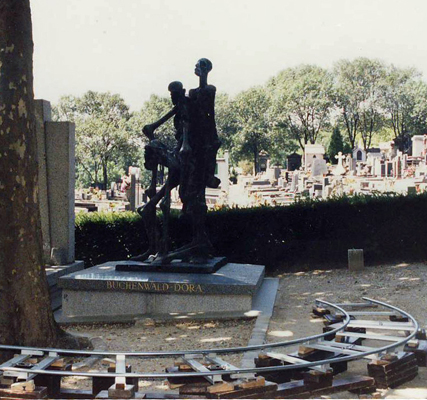
photo: Camille Martin


Buchenwald-Dora Memorial, Père Lachaise Cemetery, Paris

The day that I visited the memorial, a crew was laying camera tracks for a documentary film. The tracks, ending at the memorial, unintentionally added a layer of horrific realism to the scene.

I dedicate this photo to the relatives of my partner, Jiri, who were killed in the Holocaust, and to his mother, Lilly, and his daughter’s grandmother, Dolly, who survived.

Camille Martin
http://www.camillemartin.ca

Emil Cioran’s perpetual collapse of belief


I construct a form of universe; I believe in it, and it is the universe, which collapses nonetheless under the assault of another certitude or another doubt. The merest illiterate and Aristotle are equally irrefutable—and fragile. The absolute and decrepitude characterize the work ripened for years and the poem dashed off in a moment.
—E. M. Cioran, A Short History of Decay


Camille Martin

Poetry’s 49th Parallel: Canadian/American Shibboleths

Is this a Canadian poet?

Is this Canadian poetry?

          I photo-shopped the above image of myself because I’ve never taken such a staged picture of myself. And I’ve never really experienced an identity crisis of nationality since immigrating from the United States to Canada. But I have been thinking about nationality lately. When I was living in the United States, I never described myself as an American poet. And these days, a full-fledged citizen of Canada and a resident for almost five years, I don’t generally refer to myself as a Canadian poet. I’ve long harboured a fantasy of belonging to a city-state, and when I was in the United States, I referred to myself as a New Orleans poet, just as now, in Canada, I call myself a Toronto poet.
          I’ve had a love-hate relationship with both the United States and Canada. Canada: health care system rocks, winter sucks. United States: Obama rocks (most of the time); Homeland Security, the Patriot Act, and Total Information Awareness (remember that short-lived megalomanic agency?) suck. In New Orleans, at the height of terrorist paranoia and duct tape frenzy, I was threatened with arrest for taking photographs, on public ground, of well-known monumental sculptures in front of a bank. That sucked.
          But my identity was never very dependent on nationality. Especially since Desert Storm, I haven’t self-identified as American, but I have always defined myself in part as Cajun. For me, the local or marginal identity, determined by patterns of settlement, wins out over the relatively artificial boundaries of nationhood. Even so, although I consider myself Cajun, not only by virtue of my father being Cajun but also because I was steeped in Cajun culture since birth, I was at the same time always looking over the shoulders of the culture, to an extent experiencing it vicariously. In Cajun country, I’m a Cajun and something of an alien. And now I live in Canada as a Canadian citizen.
          Canada’s identity has historically been shaped, in part, by its conscientious differentiation from the cultural behemoth south of the 49th parallel: to generalize, collectivism over individualism, peaceful resolution over escalation and violent enforcement, diplomacy and compromise over chauvinism and autocracy. However, even though I’m more sympathetic to such professed Canadian ideals, I don’t feel a strong desire to differentiate my poetry by nationality. In matters of culture (not so much pop culture, in which a certain amount of American hegemony is guaranteed by television, film, and commercial culture), I’m all for cross-pollination. I’ve been influenced by poets from the United States, Canada, the United Kingdom, Ireland, France, Japan, Hungary, Iran, Australia, Portugal, Ancient Greece, Finland . . . and the list goes on.
          Yet the reality is that Canadian government grants do not generally encourage reading venues to invite American poets (though this might be relaxing a little). Customs duties and taxes ensure that one is far less likely to find American poets on the shelves of Canadian bookstores. And vice versa, I hasten to add. Some American poets I knew were hard-pressed to name a single Canadian poet. I plead guilty to having been fairly ignorant, with some exceptions, of Canadian poetry before my move here. And I continue to bridge the knowledge and appreciation gap.
          Another reality is the anthology by nationhood. The anthology of Canadian poetry is a recurring staple in the poetry publishing world and a vexed one because of issues of inclusion and exclusion (a nature of the anthology beast) as these issues collide with issues of ethnicity and political borders. To see how complex the issue can become, read George Elliotte Clarke’s essay “Must All Blackness Be American?: Locating Canada in Borden’s ‘Tightrope Time,’ or Nationalizing Gilroy’s The Black Atlantic.”
          I’ve yet to see the hybrid American-Canadian anthology. Have I truly crossed the border poetically when I’m included in a Canadian anthology? I was recently featured in a Canadian online magazine, ditch, as a Canadian poet. There I was, in the inner circle along with the true-blooded Canadians, born under the loving gaze of Queen Elizabeth. Never having switched countries before, this was a new experience. I felt as though my mask of Canadian-ness might slip off at any moment and I would be revealed as a poser.
          So am I a Canadian poet? I remember the first grant that I got, two years after moving to Canada as a Permanent Resident—a Work-in-Progress grant from the Ontario Arts Council. A couple of my Canadian poet friends expressed surprise that I was officially qualified to apply for such a grant. Obviously, for granting purposes, I was as Canadian as the true children of the True North.
          What about my poetry – is there anything “Canadian” (however that might be defined) about it? A good deal of my poetry stems from my experience in the moment, wherever I happen to be: walking through downtown New Orleans, riding the Métro in Paris, or sitting in my Canadian apartment gazing at Canadian clouds drifting across the northern skies. As soon as I moved up here, my surroundings crept into my poems: ice and snow, especially, but also street scenes and people.
          As my new book, Sonnets, which was written entirely in Canada funded by a grant from the Ontario Arts Council, is collected in libraries in Canada and the United States, it’s interesting to note that Canadian libraries use the classification for a Canadian poet, and American libraries use the classification for an American poet. That’s fine by me—I’m happy to be claimed by both countries.
          And what do/should I call myself? Am I a hyphenated Canadian? I’ve read a bit about the dilemma of immigrants regarding whether or not to hyphenate the old and the new countries: Somali-Canadian, for example. And some bemoan perceived racial overtones in the tendency to hyphenating all but native-English-speaking immigrants of European descent. “British-Canadian” and “American-Canadian” are less frequently heard expressions than, say, Pakistani-Canadian. And “American expat” is heard more frequently than “Chinese expat.” I hyphenated myself once recently—American-Canadian—for a bio, just to try it on for size. It felt odd. First, to me the hyphenation implies that one is retaining a connection to the cultural heritage from the country of origin, which doesn’t ring true to me. Maybe Cajun-Canadian would be more accurate. Also, there’s a part of me—the part that made me want to move here—that wanted to be just “Canadian.”
          I don’t think that I can give a straight or easy answer to the question of whether or not am—or feel—Canadian. “Canadian” to an immigrant might not be a fact so much as an assumed identity. Facts: I was born in El Dorado, Arkansas; I’ve lived most of my life in Louisiana; I came to Canada as a Permanent Resident in October 2005; I’ve lived in Toronto for almost five years; I’m now a Canadian citizen as well as an American citizen; my ancestors were Acadians in present-day Nova Scotia, then Acadie (and, interesting sidenote, until a generation or so ago, there were still older Cajun folk in Louisiana who referred—not without a tinge of disdain—to “les Américains” and who retained a distant memory of the Mi’kmaqs).
          I’m ambivalent regarding a sense of national belonging as an American or a Canadian. No doubt part of that lack of nationalistic pride or fervour stems from my friendship with anarchists in New Orleans and France for many years and my interest in anarchist critique, historically, of the nation-state. I’ve never been the patriotic type.
          But I do identify ethnically as a Cajun. And since making my recent “pilgrimages” to Nova Scotia, the land of my French ancestors, I’ve come to feel a sense of closeness to the people living in the remaining Acadian towns and villages of southwestern Nova Scotia, such as West Pubnico and Church Point. Talking with the Acadian descendants in Nova Scotia, I sometimes had the eerie feeling that I had been teleported to rural south-central Louisiana. It wasn’t only the French names and language, it was the gregariousness, the unreserved joking, the welcoming of strangers, the nicknames, the proclivity for satirical mimicry and for storytelling, the close-knit community.
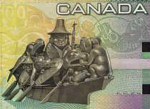
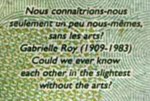
          I suppose I am something of a poser. I pose as a Canadian poet for grants because I can legitimately do so—I have for several years now qualified for grants issued by the governments of Canada, Ontario, and Toronto. And I’m extremely grateful for the privilege to live in a country where the government actually encourages the arts. When I first moved to Canada, I was fascinated by the new currency (loonies and toonies: cool) and by something in very small print on the twenty-dollar bill that still jolts me into an awareness of Canadian difference. I was accustomed to symbols of authority, monotheism, and divine providence on American paper currency. On the Canadian twenty-dollar bill, I saw images of sculptures by Bill Reid, a Canadian artist depicting aspects of the Haida culture of Canada’s northwest coast and, in tiny print, the words of French-Canadian poet Gabrielle Roy: “Could we ever know each other in the slightest without the arts?”


Some might shrug and say, “lip service”—especially considering recent budget cuts to the arts in Canada. Nonetheless, that statement as well as the generous granting system (generous especially when compared to comparable government funding in the United States) tends to create an atmosphere in which the arts are valued.
          So as far as the government is concerned, I’m Canadian. And I pose as a Canadian poet for anthologies with the rationale that most of the poetry that I’m writing is born in Canada (does that make my poetic progeny second-generation Canadian?).
          I also pose as an American poet because, after all, my poetic lineage is largely and undeniably American since I wasn’t exposed to much Canadian poetry when I started writing poetry in earnest. And besides, my American/Southern accent is hard to hide. Try as I might to switch to “zed” and to learn the subtleties of interjecting “eh” in conversation, I’m not sure I’ll ever pass the Canadian shibboleth.
          And aware as I am of subtle (and sometimes not-so-subtle) manifestations of anti-Americanism, I trust that most people involved in the arts are enlightened enough not to harbour irrational prejudices against those Americans who have decided, for whatever reason, to leave the United States and embrace Canada. Surely attitudes have changed since the time when a Czech-Canadian painter was denied a grant by the Canada Council of the Arts because, as he was told by the panel, his work wasn’t “Canadian” enough. Following that rejection, he didn’t change his style but if you look closely, he has subtly worked into some of his paintings a maple leaf, as if to say with wry humour, ok, now is my work Canadian enough? Nonetheless, a Canadian press not long ago turned down a manuscript of mine because it was deemed to be “too American.” Is there a lingering bias against Canadian poets born in the United States? Does this reflect cultural protectionism, and if so, is there any place for this in decisions about grants and publications?
          The 49th parallel isn’t meaningless—of course, Canadian poetry has its own heritage, lineages, traditions, schools, tendencies, and so on. I’ve noticed a more prevalent concern with political issues—ecology, feminism, poverty, diversity—in both mainstream and avant verse. And there is an ongoing fascination among many Canadian poets, especially of the experimental persuasion, with conceptual poetry: oulipian gestures seem to thrive here among certain poets and readers. Molly Peacock, in her forward to Open Field: 30 Contemporary Canadian Poets, notes another difference and gives the following advice for Americans reading that anthology:

“Don’t panic if each poem doesn’t start with a bang. While American poets train for the high-diving board, jackknifing into the deep end of the pool, Canadian poets presume that readers will let them wade out until their feet no longer touch bottom. So if you are used to the fast splash of the American poem, a Canadian poem may seem as interminable as a raga is to the listeners of a pop song. In other words, you may feel yourself wondering when these poets will get to their points. In fact, there will probably be several points; Canadian time is time unwinding, not time in a flash.” (xiv)

I could say something similar (though probably not as eloquently as Molly) about some American poetry. Nonetheless, broad strokes are useful for conceptualizing cultural difference. And Sina Queyras has some trenchant observations, in her introduction to that anthology, of some of the characteristics and tendencies in Canadian poetry, especially regarding attitudes toward nature. Such anthologies, designed to introduce Americans to Canadian work that deserves to be appreciated, are needed to bridge the gap of ignorance on the part of American readers. That kind of cultural exchange can only be a healthy thing.
          The cultural differences between Canada and the United States are also reflected in daily life, and I can’t write an essay about being an American poet in Canada without commenting on such differences that I immediately became aware of when I set foot in Toronto in February 2004 to get a feel for the city where I wanted to relocate. Observing the advertising in the streets and subways, I noticed that the atmosphere of crass commercialism and materialism to which I was accustomed was a little toned down, and public service billboards were more frequent. The lack of racial tension on the streets was a refreshing change from the charged and often angry atmosphere in New Orleans, a city that still carries the baggage of historical racism. The rude, sexist comments by men in urban American streets were simply non-existent here. Once, as I was emerging from a Toronto subway station, a young man called out to me, smiling, “Looking good tonight!” It was sweetly appreciative; I smiled back.
          And I felt relatively safe in Toronto. I remember walking after dark with another woman to a poetry reading soon after I moved here. She decided to take a short cut through a park. I was terrified. “Are you sure it’s safe?” I asked. She just laughed and kept walking. I followed, looking around warily. I don’t think she realized the extent to which people in New Orleans are regularly mugged and even killed in parks. Tourists wandering into New Orleans’ famous parks and cemeteries are easy targets. “Another tourist shot in Armstrong Park” became an unfortunate cliche. New Orleans remains the murder capital of the United States—an extreme example, perhaps, but all major American cities struggle with similar kinds of problems—poverty, crime, racism, poor education, extreme divisions of wealth and poverty, and the ill-effects of decades of unaffordable or unavailable health care and other social services. Canadian cities struggle with some of these issues as well, but generally speaking, the problems are not as extreme as in the United States.
          I’m thrilled to be living in Canada, and I have come to love Toronto. I live downtown, in the heart of Old Toronto, in a cooperative apartment complex. The building is owned by a non-profit corporation; thus there is no landlord charging exorbitant rent while neglecting repairs. When I first moved here, I felt like Mary Tyler Moore in Minneapolis, ecstatically tossing her hat into the air (if you’ll pardon the American pop culture reference). After experiencing the demoralization of life in New Orleans, pre- and post-Katrina, I was elated to live in a city and a country with a different social ethos.
          As happy as I am to be here, I suppose I will continue to side-step the issue of Canadian-ness by simply saying that I’m a Toronto poet or to be even more neutral that I’m a poet based in Toronto. But I will also say that living in Canada has been extraordinarily good for me, and I wish I’d moved here years ago. I love many aspects of this country like I never loved the United States. I’ve come to admire many Canadian poets whose work I was never exposed to before I moved here. I’m here to stay.
          Am I masking, through my ambivalence, a secret desire to be Canadian, cut and dried, strong and free? No doubt. Part of me likes the idea of being Canadian. But I also know that the issues of nationality, ethnicity, and identity are a lot more complicated, for those born in Canada as well.
          My eyes are blue-green. Some days I see them as blue, other days as green. I can talk about the genetics of the colour, the lineage of ancestors from whom I inherited either colour, the factors that influence the colour that I perceive on a given day (such as the clothes I’m wearing, or my lover describing them as blue). I can talk a lot about those things. But deciding which side of the colour fence I’m on is just not something I’m very passionate about.

1 http://www2.athabascau.ca/cll/writers/english/writers/geclarke/locating_canada.php


Camille Martin

Joel Chace: Cleaning the Mirror


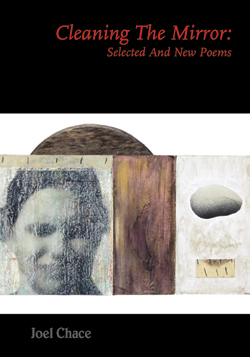
Joel Chace, Cleaning the Mirror: Selected and New Poems
BlazeVOX Books, 2007

          Cleaning the Mirror: Selected and New Poems contains works published between 1984 and 2007—a span of twenty-three years, during which Chace’s work has undergone a significant transformation from a more traditional approach to language (narratives, lyrical descriptions with symbolic significance, and psychological investigations of the family romance), to radically disjunctive work that trains language’s eyes and ears onto its own phenomenon. The early works are skillful and astute, as in “Paper World,” which describes a scene of parents and children reading the Sunday morning newspaper:

The young ones fixed their eyes on the walls of print stretched above them
and on the knuckles and knees of their parents.
The young ones waited for the next moment
when from their separate, unknowing rapture
their parents, unknowing, would send them ecstasies, gifts,
when the first sheet, the first piece of the packet
would be flung above their heads,
discarded, set free and drifting; the mother, the father moving through the packet,
the paper world.

          The unwitting delight and desire of the parents as they fling the “discarded . . . remnants” of printed words that flutter around the heads of the children speaks to a passing of knowledge, however conscious or unconscious, from parent to child. But the children have their own witting or unwitting designs on language as they “mov[e] on their own voices” as “each child make[s] a story.” The tension between the overarching shelter of language, of the communal “crazy city of tents” that the fallen newspapers resemble, and the private narratives that individuals concoct from that common fabric engenders a dance between the two in which the common joins the private life to express it and, once expressed, rejoins the communal linguistic pool.
          It is with ” o-d-e” that Chace succeeds in allowing the language of the poem to loosen its descriptive and narrational imperative that “squeeze[es] until it hurts” and to approach the condition of music through the repetition, re-formation, and contextual recombination of word-motifs: “leavened parchment” is elsewhere “leaving / for the parched / world” and “sleeves / floating / in this floating world” is later “scarves that / dangle or / float / in the dance.” Chace’s “o-d-e” is a lament suffused with meditations on the departure of one ”whose / leaving / shattered / divine / hours.” The departed one is “leaving / for the parched / world” by a cab (Charon?) that can “bear away.” But now there is “no more / bearing / away” and “no more / suffering” from “the / stings” and the “cancelled / goals” The self in the poem is a ghostly presence whose life is fragmentary and ephemeral; it is represented metonymically by floating scarves and sleeves, shoulders, faces, one’s “long / song,” waves in the ocean, dancing, and dreaming. The rhythmical repetition of these and other words enacts the conflation of being with doing, invoking the last line from Yeats’ “Among School Children”: “How can we know the dancer from the dance?” In a similar vein, Chace asks the rhetorical questions “how can we / know more / suffering” (which resonates with the ambiguity of “no / more suffering”); “how / can we know / our feet from the / flower path our / selves from / song / the line from / life / snow on parchment from / the key . . . whose / leaving / will / break / this trance.”
          Thus “o-d-e” enacts the cycle of life and death. Life resides among the “high doors” and “upper rooms” where ghostly selves of scarves and sleeves float along a “flower path” suffering and desiring (“wanna / gotta”). Something transcendentally divine bears life away from these high places down to the “rainstreets” where cabs await to bear souls to the other side, like Charon ferrying the dead across the river Styx to the underworld. The Yeatsian questions, then, seem to investigate the merging of self and symbol, of presence and absence, of not ceasing to dream while living and of being “reclaimed / by / rainstreets” when the “leaving / will / break / this trance.” The cycle is also a dance between the two states in which the dead are “washed up” as “al / lu / vi / al” soil and also “floating / in the parched world,” reclaimed yet remembered, “always with us.”
          “o-d-e” and other earlier works in which Chace’s linguistic epiphany establishes a new approach for him, a pattern emerges in which fairly short, lyrical poems create a series in which recurring themes emerge.
          For my money, it is in the last two sections of the collection, “faints gods” and “terrible thread” that Chace comes into his own as a seasoned and mature poet. The poems of these two series focus a spotlight on those subtle, momentary thoughts that must be stranger than we believe, since they are often so quickly erased from memory. The word that comes to mind for the philosophical concerns of many of these poems is “anti-doctrinal.” I like the way these poems blend the ordinary and the sublime and echo their thematic and philosophical issues.


Camille Martin

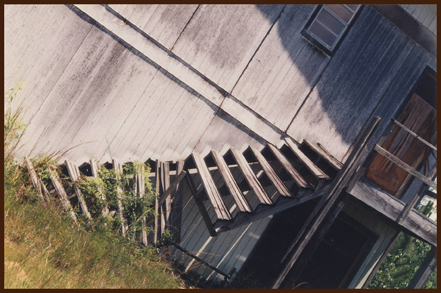
Stairs

Photo: Camille Martin

Photo: Camille Martin


debut-esque

Editors Amy King and Ana Bozicevic just debuted a terrific new online magazine, esque. A unique feature is the division into two parts: “oetry” (“the kitchen sink”) and “ifesto” (“everything but”). An excerpt from the former:

Cole Swensen, from “Stele”

. . . .

Click on the excerpt to read the rest of the poem as well as work by the other contributors.

Camille

death’s head redux

bounty from the sea


I posted a collage for the anthropomorphic category in Poemicstrip. Check out the fantastic work there!

Continuing a recent post about my breast cancer, this collage is another of the death’s heads that started popping up in my collages and some of the poems in Sonnets following my diagnosis four years ago. I didn’t think until after the collage was finished about the significance of the two masks under the wings: breasts, either cleansed of the disease or drained of life.

Thanks to Piotr Szreniawski for sharing Poemicstrip.
“bounty from the sea” first appeared on the cover of Fell Swoop 86.


Camille Martin

“not all slopes are tragic . . .”


Anny Ballardini kindly posted a poem of mine from “Looms,” a work-in-progress, to update her Fieralingue / Poet’s Corner website:


from “Looms”

*

not all slopes
are tragic. . . .

Click on the poem to read the rest of it.


Camille Martin

Cynthia Sailers: from Lake Systems


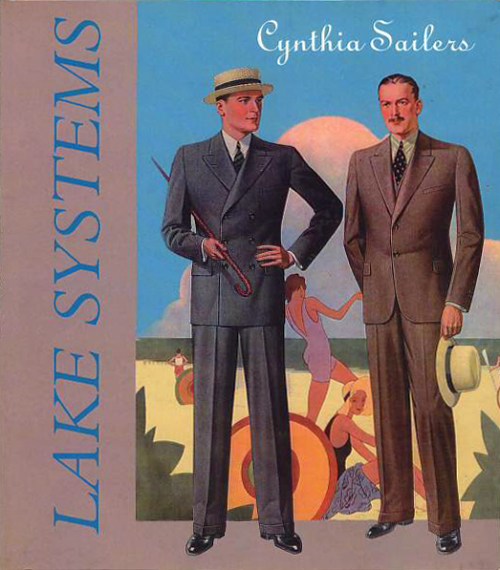
Cynthia Sailers, Lake Systems
(Oakland, Tougher Disguises Press, 2004)

Recently plucked a book more or less at random from my poetry bookcases and was delighted to rediscover one of my favourite book covers (and books): Cynthia Sailers’ Lake Systems. Those monumental men with knife pleats remind me of Anton Räderscheidt’s self-portrait—like Räderscheidt doing an ad for Coppertone.

It was a pleasure to re-read the poems in this collection, whose style swings from Ashberian lyrical to flarfish. I admire a book (and a poet) that doesn’t shirk from such swings, that doesn’t necessarily strive for cohesion or (shudder) authentic voice. Here are two:

from “10 Americans”

And yet we were the individuals who do not relate
to one another. When we find there’s a desire
to be crowded, to be all the numbers, or the observers
who would see in the faces that those faces were not
the answer. That those faces only pointed to
the amphitheatre of the mind in an hour of romantic
enthusiasm. If only we were immigrated, if only
we were knowledge, not like gardens, but underneath
it all, a shape of equal vividness, constrained by the one
thought we thought we wanted. A tracing of ourselves
against the beauty of lakes and grasses and colonial houses.
To be brushed along and kept close to the skin.
We were prepared to admit a solution for the lower forms
of life, for the seductive centuries and a break with
the past. And yet we were oscillating between the part
of ourselves that was set in motion and the part that lives
underground. I would sometimes get the feeling that
these parts were wanting to identify with the other, to find
another place to be free. A place with a view, a place
inside. To be freethinkers, to be identified with astrology.
If only their astrology was now moving them to new
places, moving them out of their feeling of oppression.

from “Lake Systems”:

The I(s) I Follow After

for Joan Retallack

I will not democracy churches conjecture
I pornography circa 1930 mockery
the bird I (pornography) usually suspect
dustbowl I situate o, love I imitate(or)
automatic I pepto-bismol I
juction boobs of new country I
laminate I New Jersey I, I
sensual topical bloom
I double-parked yoga live
grammatical attachment I office
I too numerous too non-union I life-
lessly convene I abstract mass
adulterous subject I promising water deficiency
I witness prison language I advances
western I p.s. represent misanthropic I
mid-century I nepotism I lost cause
I necessitate the point of impact I polygraph


Camille Martin

on the anniversary of my healing from breast cancer


In September 2006, a little less than a year after I moved to Toronto from New Orleans, I was diagnosed with breast cancer. This month marks the four-year anniversary of the beginning of my healing: surgery followed by several months of chemo and radiation therapy.

During that time, I was haunted by thoughts of mortality. Sometimes collage and poetry gave me a way to explore my feelings as I was confronted with the possibility that I might not survive. Death’s heads crept into several of my collages, such as the sinister stone frieze in the background of the collage above. And I can see that haunting in the dark tone of some of the poems in Sonnets.

I’ve never written publicly about my breast cancer, and though I don’t often delve into personal matters in this blog, I wanted to finally be open about it. Maybe someday I’ll write more about the experience. But for now I just want to say that I’m grateful to my caring doctors and nurses at St. Micheal’s and Princess Margaret Hospitals in Toronto (without whom I’d no doubt not be alive today), my loving partner, Jiri, and my amazing family and friends who rallied to help me through that difficult time.

Every year reduces the likelihood of recurrence. And every day of life is a blessing.

Camille

* “R” was first published by experiment-o, an online poetry and visual arts magazine published by Amanda Earl’s AngelHousePress in Ottawa.

Poetic Polyphony in Scott Thurston’s Internal Rhyme

Shearsman Books, 2010


          In a previous post on musicality in poetry, I discussed the translation of simultaneity in music into a comparable literary expression. By simultaneity in music I mean polyphony, the vertical dimension of notes on the staff: the notes in a chord sound simultaneously as do the voices in a fugue. In literature, polyphony can be suggested by the simultaneity of thoughts, dialogue, or action by characters, as in the eight voices of the fugue in Joyce’s Ulysses.
          Scott Thurston’s Internal Rhyme beautifully translates the melodic and harmonic dimensions of music into poetry. The spatial division of each poem into quadrants allows both a horizontal (melodic) and a vertical (harmonic) reading of the lines. The vertical resonates with the horizontal, and the dialogue between melody and harmony opens up the semantic field. To use another musical analogy, what emerges from this dialogue is harmonic overtones, the acoustic phenomenon that enriches the experience of music.
          Because the most startling aspect of this collection is its formal innovation, I’d like to focus on possible strategies for the reader. Here’s an example from Internal Rhyme:

                    what I give myself to            haunted by surface
                    a polished shine                    or cloudy patina
                    it takes art to maintain         a perpetual crisis
                    taking everything                  you have

                    I want to give                        my heart out
                    to your ideal world                in its tension
                    I have to wait                        for the memory
                    for the poem                          to make it right

          At first blush, the possibilities presented by the quadrants seemed to me a kind of combinatorics, a conceptual experiment that reminded me a little of Raymond Queneau’s Cent mille milliards de poèmes, a series of ten sonnets whose interchangeable lines offer to the reader an almost inexhaustible series of permutations—to be mathematically precise, one hundred trillion sonnets can be generated from the conceptual machine of the ten original sonnets. Queneau’s Oulipian experiment stretches the limits of the readability of the set of ten sonnets in all of their permutations—an impossibly large number sonnets for the mortal reader to consume.
          In the case of Thurston’s quadrants, three obvious possibilities occurred to me: line-by-line (horizontally), left column-right column (vertically), and four vertical columns (left, right, left, right). But there was something disasatisfying about treating each of these readings equally, so I needed to find a more natural way to integrate the horizontal with the vertical. It occurred to me that treating the page as a musical score gave me a more rewarding entry into the intricacies suggested by the quadrants. In other words, I read the poem as horizontal (melodic) lines and allow my peripheral vision, so to speak, to note vertical (harmonic) configurations of three or four lines that enrich the reading, perhaps turning the poem on itself or opening up other semantic possibilities.
          First, my conscious mind gravitates toward a traditional line-by-line reading—partly from habit and partly because the syntactical flow of the poems in Internal Rhyme is most apparent that way. For example, in the above poem, although there’s no punctuation, my mind readily creates syntactical clusters and sentences from a horizontal reading.
          Note also the division into two equal parts that such a reading suggests: “what I give myself to” opens the first stanza, and “I want to give” opens the second. Metapoetically, the poem juxtaposes the poet’s experience and perception (what he gives himself to) with his translation of that experience into poetry (his desire to give himself over to the tension in the ideal world of the poem: the “perpetual crisis” that poetry sustains). The last two lines constitute the poem’s volta, in this case the condition upon which that translation into poetry is contingent: waiting for his memory of tension within his own experience.
          But the spatial division of the poem into quadrants compels me to notice the vertical possibilities as well. In the above poem, for example, a horizontal reading yields

              I have to wait / for the memory / for the poem / to make it right

whereas a vertical reading might yield

              I have to wait / for the poem / for the memory / to make it right

          Thus waiting for the memory of tension (in the previous reading) is aligned with waiting for the poem to emerge for the memory to “make it right.” The boundaries between experience, memory and poetic creation are thus nicely blurred into a riddle: is it unresolved memory that drives the poem into creation, or the poem’s creation that illuminates cognitive mysteries?
          Such an overlay of readings expands the poem exponentially as the mind picks up, consciously or subconsciously, variations in the configurations of lines. Reading the poems in this way allows me to blend the melodic and the harmonic dimensions to create a kind of polyphonic experience. To return to a musical analogy, the intricate texture of this overlay is like the harmonic overtones that enrich the experience of music.
          The analogies between music and poetry are ancient, and the innovative musicality of Internal Rhyme offers a richly legible and resonant kind of poetic polyphony.

* * *

From the Shearsman Books website:
Scott Thurston lectures at the University of Salford where he runs a Masters in Innovative and Experimental Creative Writing. He co-runs The Other Room reading series in Manchester, edits The Radiator, a little magazine of poetics, and co-edits The Journal of British and Irish Innovative Poetry with Robert Sheppard. He has published three collections with Shearsman.


Camille Martin