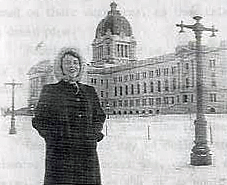
Camille Martin, Beatriz Hausner, and Claire Lacey at AvantGarden (Toronto)

Please join Beatriz Hausner, Claire Lacey, and me next Tuesday, June 7, for our AvantGarden reading at The Ossington (Toronto).

I’ll read never-before-aired poems from my new manuscript “Looms.” Copies of my recently-published Sonnets (Shearsman Books, 2010) will be available for purchase.

A big thanks to hosts Liz Howard and Shannon Maguire!

Time: Tuesday, June 7, 6:30 pm—9:30 pm
Location: The Ossington (61 Ossington Avenue, Toronto)

Beatriz Hausner’s (Toronto, ON) poetry is rooted in the legacy of international surrealism, especially its Spanish American expression. Hausner’s extensive work as a translator has focused on the writers of that literature, including Rosamel del Valle, Enrique Molina, Olga Orozco, César Moro, the poets of Mandrágora, among many others. Hausner’s work has been anthologized and published in journals both in Canada and internationally, in French, Spanish and Portuguese translation. Recent publications of her poetry include: The Wardrobe Mistress (2003), Towards the Ideal Man Poems (2003), The Stitched Heart (2004), The Archival Stone (2005) and Sew Him Up (2010). Hausner is one of the publishers of Quattro Books (www.quattrobooks.ca). She works as a public librarian in Toronto.

Camille Martin, a Toronto poet, is the author of three books of poetry: Sonnets, Codes of Public Sleep, and Sesame Kiosk. Her work has been widely and internationally published in journals and translated into Spanish and German. Her current works in progress are “Looms,” a collection of layered narratives, and “The Evangeline Papers,” a poetic sequence based on her Cajun/Acadian heritage.

Claire Lacey blogs as poetactics. Claire studied English language and literature at Glendon College then headed west to cause a ruckus as a patagrad at the University of Calgary, where she writes poetry about linguistics and birds and bridges. Claire spent the last year working as writer-in-residence at a Calgary high school to convince students that poetry isn’t boring. Claire is poetry editor of Dandelion magazine.


Camille Martin

National Poetry Month Cento Contest – send your patchwork poems!

I’m excited to be one of the judges in the 2011 National Poetry Month Cento Contest! Here are the rules, courtesy of Danielle Pafunda, the organizer of the contest:

Announcing the 2011 National Poetry Month Cento Contest! Dreamed up and launched by Danielle Pafunda, while she has the keys to the Academy of American Poets Twitter feed, and with the gracious help of 36 poet judges.

This Thursday April 21st, I’ll Tweet under the generous umbrella of the Academy of American Poets at
http://twitter.com/POETSorg

All day long, I’ll Tweet lines of poetry from the Academy’s Poem-A-Day Archive. To enter the contest, assemble some of these lines into a cento, and by noon on April 23rd post your cento at the contest blog:
http://napomocento.blogspot.com/

Our 36 poet judges join me to choose 3 winners, each of whom will receive a selection of the judges’ signed books. Absolutely anyone can enter.

The complete contest guidelines can be found here:
http://napomocento.blogspot.com/2011/04/guidelines-for-napomo-cento-contest.html

The list of judges can be found here:
http://napomocento.blogspot.com/2011/04/judges-for-napomo-cento-contest.html

Please forward this email to friends, colleagues, students, and anyone else you think might like to play along! Questions? Please post them at the blog:
http://napomocento.blogspot.com/2011/04/guidelines-for-napomo-cento-contest.html

Thanks!
Danielle Pafunda


Camille Martin

Influencied!

photo: rob mclennan


I’ve been Influencied! Last Wednesday, Sonnets was the focus of Margaret Christakos’ Influency class at the University of Toronto’s School of Continuing Education. After Margaret’s warm-up introduction, students read reflections on the book and rob mclennan gave a talk about it (which can be read here). I read from the book (and from my manuscript “Looms”) and then there was a general discussion.

What a brilliant idea, this class! In a few weeks, I’ll be on the other side of the magnifying glass as I give a talk on Kaie Kellough’s Maple Leaf Rag. I’m especially looking forward to hearing Kaie again. I read with him in Montreal a couple of years ago—he’s a mind-blowing performer!


Camille Martin

Sonnets “torqued high”


Check out this new and excellent review of Sonnets by Marianne Villanueva in Galatea Resurrects #16.

Villanueva’s take: Sonnets is “rigorous and uncompromising . . . intellectually fearsome . . . torqued high.”

Click here for links to distributors that carry Sonnets.


Camille Martin

Gimme! (for National Poetry Month)

Gimme, one of my ransom note collages, is featured today on the National Poetry Month website, curated by Amanda Earl. This year, the focus is on visual poetry. Every day, an image by a different visual poet will be uploaded on her site.

Here’s a peek:

Click here to see the whole paean to greed.


Camille Martin

Camille Martin, Paul Vermeersch, and Jonathan Bennett at the Pivot


If you’re in Toronto on Wednesday, April 20, come to the Pivot Series to hear me read along with Paul Vermeersch and Jonathan Bennett.

I’ll read a little from Sonnets but mostly new stuff from two books in progress, Looms and The Evangeline Papers.

It’s my first reading in T-dot in over a year . . . please come!

Camille Martin (Sonnets)
Jonathan Bennett (Civil and Civic)
Paul Vermeersch (The Reinvention of the Human Hand)

The Pivot Reading Series
The Press Club
850 Dundas Street W.
8 PM
PYWC


Camille Martin

Influency 10: A Toronto Poetry Salon (starts April 6!)

I’m excited that Margaret Christakos has invited me to participate in Influency 10: A Toronto Poetry Salon, a lecture-reading series at the University of Toronto School of Continuing Education.

It starts soon, so if you’re interested, click here to register through the University of Toronto School of Continuing Education.

Here’s the schedule:

April 6 opening evening (For MC and registrants)

April 13 rob mcclennan speaking on Camille Martin’s Sonnets

April 20 Daniel Scott Tysdal speaking on Larissa Lai’s Automaton Biographies

April 27 Larissa Lai speaking on Mark Truscott’s Nature

May 4 Mark Truscott on Daniel Scott Tysdal’s The Mourner’s Book of Albums

May 11 Camille Martin speaking on Kaie Kellough’s Maple Leaf Rag

May 18 Kaie Kellough speaking on rob mcclennan’s Wild Horses

May 25
A combined evening at a venue not on U of T campus, also open to public (for a door fee).
Rachel Zolf on Erin Moure’s Pillage Laud AND Erin Moure on Rachel Zolf’s Neighbour Procedure

No class June 1

June 8 Final potluck and Student Intertexts on Influency 9 authors and books (important! please attend!)

Classes are facilitated by Margaret Christakos.

Influency 10: A Toronto Poetry Salon
April 6- June 8 2011 (no class June 1)
Wednesday evenings, 7-9:30 pm (we begin promptly at 7:05 and make every effort to end by 9:30; some classes may extend to 10pm).

For readers and writers alike. A powerful way to reconnect with poetry, to build bridges into the contemporary poetry scene, and to deepen critical engagement with poetry. Many writers and literature buffs attend this course; the class is equally welcoming to people with a beginner’s level of experience with reading poetry. Adults from 18-1000 years welcome. Approximately half the registrants in any given session have taken previous sessions of the class; and each session we welcome newcomers. The course may count towards a certificate in creative writing, or be taken for pleasure. Registrants compose readerly critical responses to books weekly, and write a final “Intertext” reflecting on two or more of the books studied, for presentation. Registrants also take turns in small groups introducing guests and bringing along snacks and non-alcoholic beverages to produce a congenial social environment for each evening.

Influency: A Toronto Poetry Salon has run twice annually from Fall 2006. In each session, 8 accomplished poets working in distinctive styles will appear as both guest readers and peer critics in this unique lecture-reading series hosted by Margaret Christakos. Each poet’s critique of a colleague’s work will be followed with a reading by the poet under discussion. A group discussion led by Christakos will follow. Students will accumulate critical vocabulary to discuss more fluently the divergences of approach, motive, process and product typical of Toronto’s multitraditional literary culture. The 8-book package under discussion will be available in class for $130. Register a week prior to course beginning if possible to facilitate smooth running of a complex course! Note this spring’s session is 9 in-class meetings, with an extended evening on May 25 at an off-campus location.

The course has also spawned a fledgling online magazine called http://www.influencysalon.ca; please visit to see some of the essays and responses presented at some of our earlier classes.

* * *

For more info and registration, click here to visit the website of the University of Toronto School of Continuing Studies.

Location: Rm 108, St George Campus Health Sciences Building, University of Toronto (one block west of University, south side of College St. Queen’s Park subway station at College and University)

Course number 1777 – 010
Register at http://www.learn.utoronto.ca
University of Toronto School of Continuing Studies Creative Writing program. No prerequisite.

Course $249 plus $130 book fee (8 poetry books). Fee is paid at first class by personal cheque or cash.


Camille Martin

Sonnet Workshop to begin Tuesday, March 15!

My “sonnet shakedown” workshop will run from March 15 to April 12.

Join us as we explore the kaleidoscopic history of the sonnet, from Petrarchan to Oulipian, from blazon to flarf and beyond. We’ll also write our own sonnets – using, throwing out, and writing our own rules of engagement with the “little song.” The sonnet is dead. Long live the sonnet!

Seating is limited, but there are still openings in the class—click here to sign up at the Toronto New School of Writing (TNSOW) website.

Here’s the info:

Sonnet Workshop (Mar 15 – Apr 12, 2011)
Instructor: Camille Martin


Duration: 5 weeks (Tuesdays), 15 March – 12 April 2011, 6:30 – 8:30pm

Capacity: 12 students

Combining a historical overview of the sonnet form (or as Hollo once called it, the sonnet state of mind) with creative writing assignments, this course offers students the opportunity to experience the sonnet as a traditional and experimental network of possibilities.

Through a series of Reading/Writing sessions focused around various “sonnet-inspired models,” participants will deepen their appreciation of the evolution of the sonnet across history as well as generate their own sonnets, investigating relationships between the rubrics of tradition and form and content and meaning, while continuing the momentum of the “little song’s” enduring popularity.

Required Texts: Sonnets by Camille Martin, as well as a selection of readings that will be provided.

Click here to register for the class at the TNSOW website.


Camille Martin

Sampling Jay Millar’s Other Poems


Gibsons, BC: Nightwood Editions, 2010
Order from Nightwood Editions

          I could wax on about Jay Millar’s contributions to the Toronto poetry community and beyond as publisher of BookThug, co-founder of the Toronto New School of Writing, and poetry instructor (at TNSOW and George Brown College). And he probably wears more hats than I’m aware of. In short, a tireless and generous opener of doors for poetry to happen.
          But Millar is also (and to my mind, first and foremost) a wonderful poet, one of the few whose work I keep returning to for inspiration. I’m most familiar with the last four books of this already prolific poet: ESP: Accumulation Sonnets, False Maps for Other Creatures, The Small Blue, and Other Poems. And it’s from his latest that I want to offer a sample.
          Though I’m not really doing full-fledged reviews in my “Sampling” series, I’d like to mention just a couple of things that I admire about Other Poems. First is the subtle but pervasive theme of impermanence and mortality, which owes much to his understanding of natural cycles of creation and erosion, emergence and decline. To break the eligiac spell, Millar occasionally offers bouts of pure playfulness, as in “TRANSLATIONS FROM THE THE” (below).
          Also, although Millar’s lyric voice often flows in a conversational diction, he’s also an artist of the beautifully sculpted sentence, as in

How to desire that crackle trees half
empty of leaves crackle?

And:

Or could you possibly hear how
long the walk to chorus-less songs the lingual tics
are as likely as any to empty into.

No mere exercises in parsing (though that’s a pleasure in its own right), the complex and quirky syntax of these sentences draws us closer, in the act of unraveling them, to the heart of the matter. “Crackle” as both a noun and a verb draws attention to itself as the sound of autumn’s decay (as does “half / empty”), which makes the juxtaposition of “desire” with such decline even more jarring. And there’s something tautological about “the crackle that trees crackle.” The circular structure emphasizes decay as a natural and inevitable process in the cycle of life.
          And in the second sentence, “how / long the walk” meshes with the long and rather twisted syntax of the sentence, both of which speak to the mysterious and largely unknowable journey between thought and utterance (and poem).
          One more reason to get the book: Rob Lemon’s fantastical bestiary of images on the cover and throughout the book.
          Here’s a sampling of poems:

WOOD PAGES

I
How to desire that crackle trees half
empty of leaves crackle? A mind that
will run their minimalist instincts
through an environment only to
build nests into the whole of the sky. So
ghostly I recall some talk about
their presence, like names for mammals,
truncated communication that
listens carefully to the dispersed.
To listen to the wind is to see
a love, the feeling of settling love.

II
Autumn: some landscape the edges of the sky pulled
toward the earth for leaves to kick up the wind.

Can you sense the moment leaves halt for a fleeting
distraction of silence? Walk listens aloud

for the sound. What all the nameless creatures name. Some
relationship between two species in which one

obtains nutrients from the bodily function
of the other. Or could you possibly hear how

long the walk to chorus-less songs the lingual tics
are as likely as any to empty into.
 
 
BOX MAINTENANCE

after Robin Blaser’s “The Medium”

I wandered around in the woods
all day thinking of the ‘you’

in so many poems camaraderie invented
hung from the trees, their threads

any community that existed only in minds
anything I might address a poem to, but don’t

what’s out there and never will be
a space between the trees filled with insects or air
images for the future to unravel
or imagine they may have caught
a glimpse of simply
by reading the scripts

What points to itself inwardly,
and whispers. We want to participate,
speak for the dead, care for them,
care about them, tell them ‘we believe’—

the characters deep mirrors of broken text
lead you expertly suspended

I wandered around all day.
Whose woods is this? What lives here?
Will anyone record their thoughts?
Who will maintain the boxes?

Surely no one could invent themselves
without somewhere to store the keys.

I’ve never been handed the invitation.
I’ve slept, it’s true, but never dreamed here—
What would be the point?

This place is not sacred
enough to speak to anyone
as long as I’m thinking of you.
 
   
from “ENTROPIC: A NARRATIVE”

2
Driving the machinery deep into the landscape
Had been slotted into a very particular slot because it—
The whiteness—hurts my eyes most days.
Perhaps it was selfish, or a little unsettling,
How this particular light cast our shadows
Considering the weight of darkness
Was certainly quiet, how you say
The trying to figure out all the angles
That morning we gathered near the beach to ask
How the sun could bother to raise again, the impression
So hard against those who arrived.
Meanwhile, we are gathered here in a fashion
All the others wrote for us, and they keep on writing—
If anything it is a wondrous distraction.
I can only say this because
When the time came to interpret the script we saw
Water continue to erode the rock.
 
 
TRANSLATIONS FROM THE THE

Some modern song a trophy
Mock sprocket undergarment triad

Forces jibe, people wander,
The hotsprings bike an awful

To the point. Meanwhile, there’s
A decent ruckus with the flab.

Pot lid. Stereophonic drywall.
The basement denies the haircuts.

Five or six melons? I’ve rooms
Enough for mechanical tarts,

No vague limp television morph—
Titanic invasion again. Death toll

Blue shirt and trouser roll. Heard
The new bowl? It’s deep. Round

Here chirp clunk and garble.
Give it effort. Give it a home.


Camille Martin

Sonnet Workshop at TNSOW!

Less than two weeks before my five-week Sonnet Workshop begins! Here’s the info:

Sonnet Workshop (Mar 15 – Apr 12, 2011)
Instructor: Camille Martin

Duration: 5 weeks (Tuesdays), 15 March – 12 April 2011, 6:30 – 8:30pm

Capacity: 12 students

Combining a historical overview of the sonnet form (or as Anselm Hollo once called it, the sonnet state of mind) with creative writing assignments, this course offers students the opportunity to experience the sonnet as a traditional and experimental network of possibilities.

Through a series of Reading/Writing sessions focused around various “sonnet-inspired models,” participants will deepen their appreciation of the evolution of the sonnet across history as well as generate their own sonnets, investigating relationships between the rubrics of tradition and form and content and meaning, while continuing the momentum of the “little song’s” enduring popularity.

Required Texts: Sonnets by Camille Martin, as well as a selection of readings that will be provided.

Click here to register for the class at the TNSOW website.


Camille Martin

“If cosmic conditions were even slightly different”: Prayer of my freethinking mother

          I’d like to honour my mother’s gift for language and her free spirit by offering what she called her “Freethinker’s Prayer,” which I first heard her recite in the mid-60s when I was a child.
          She married into a large Catholic family. At holiday gatherings, someone at the table usually said a Christian grace, which didn’t reflect my mother’s own beliefs. So she made up her own prayer, which she began to recite at clan feasts at our home. I remember some of the relatives being politely dumbfounded. I thought it was pretty creative and gutsy of her.
 
Freethinker’s Prayer
by Melba Martin


          Let us be grateful that forces in the universe have situated our planet, whether by chance or by design, in the unique place it occupies in the vastness of space and allowed it to be conducive to the creation and propagation of life.
          And let us be ever mindful that if cosmic conditions were even slightly different, neither we, nor the food that we are about to eat, nor anything else for that matter, would be here.

Melba Martin in Regina, Saskatchewan


Camille Martin

Collages by Derrick Tyson

          Thanks to Derrick Tyson for referring me to his wonderful collages—below are some of my favourites You can see more of Tyson’s photos and collages here.
 
 
dream sequence
dream sequence
 
 
Ozymandias Complexitus


[untitled]


Camille Martin

Maxine Gadd: Subway under Byzantium


Subway Under Byzantium: Poems, 1988-1996
Vancouver: New Star Books, 2008
order from SPD
New Star Books ordering page

it’s only Saddam is mad. oh, Max, they say, thinking yu know what they
mean this time          go meek as a lamb bred to roast on a sunday.          the
next thing yu know
they’ve got yr liver on a hook
flying in the breeze to snag
steel blue pterodactyls
      —from “Boatload to Atlantis”

          I met Maxine Gadd at my KSW reading in Vancouver last year. I didn’t know her poetry then, but nudged by Jordan Scott, I dove into her work and with a jolt of excitement recognized an edgy poetic voice that would be equally at home exploring the Gothic underbelly of the Deep South—Louisiana poet Jessica Freeman comes to mind as a counterpart, like Flannery O’Connor to Alice Munro.
          But regardless of that ring of kindred Southern irony in my ear as I read her poetry, I’d be a Gadd aficionado. Below are a few gems from Gadd’s 2008 collection, Subway Under Byzantium.

ferry weather feeling

ferry weather feeling
konked by a head-on collision
carroted into trans-substations
bad ice
agitated pre-sys-bitarian volcanic subtext

where do yu go to pay yr bills
little while flowers like flour over the wall
styrofoam lawnmowers

ok, we made a loop
now start hooking
 
 
for starchild

sticks and stones, bricks and bones; hated history
twittering a transcendent chant on the bridge
over the murky dawn
laying down a route that’s a rout
roar humbly on dear pack-lovers
tearing apart various entities
configurating rain fr ten a.m.

mud forever, fervent misery
knowing yr bred out diamond
suit ya fine
this little hole
        lined with
        reeds
 
 
Lac La Lack

is it a puddle yu jump in to splash the dry friends yu want as lovers
is it a dark pool into which houses dissolve in the infrared eyes of dogs and deer
is it a black lagoon with hieroglyphs spinning laughter
is it the blue green lantern of a pulp mill feeding the fish
about the blue about the green about to yellow about to redden the wail
the coyotes avoid,
that i wld avoid
if only the lonely
could park wild with a full deck of golden oldies
eh, yeah
fear of the old frontier, my deer
the fresh thing that’s happened to man and disappeared

its surely yr own deep liquid drained by the dry gulch of history
salt crusted around yr eyes but yr here at the lake, placed
to meet the tribes and sixty year old tourists not so different from yourself
as to clarify a Greek under the pines

a reputation away hang shiny cookies of thought
and just below the surface of emerald jelly
drowned theoreticians, smile up, fascinated still

sylph sylvie sits on rocks and combs her hair
a truckdriver buckles in the dark
grabs onto a green light hanging over the highway
and stops, leaving the truck on the centre line he jumps out
leaving the door open, goes to the lake
pours oil on troubled waters
relieves himself in it
calls it his queen
 
 
Subway Under Byzantium

IN AND OUT OF THE MOUTHS OF THE POOR, THE
        MARQUISE OF MAD MARCHE
demands good cookin, the bodies of the children and
“the poor just love it:go
wee wee wee wee wee weeeee
WE WE WE WE WE
            WE

we

(ah, oui)

love fingering our dream time, lifting it, high and dry
as the bird hung out on the wire, befallen
into the heat of our veins, in the subway under byzantium
teeming with Russian spies of love in each clean canadian house
hiding under the leopard skin tails of Great Aunt Ida
talking thru the night / talking to the night

here is an inheritance / snowballs light up the balls

still, they’re trying to do us in
they have fled the ditches with lilies that will eat us and all our crap
meld, marl us into mold, light and furry like
fairy hair and
merry
malty
we’ve already flown

Secret

we share this little secret
bergamot and eggs in the bottomless abyss
great to be so faithful

my lies open to the white
organized perpetuity
foolish gaze

truck stops on a giant spiderweb
the lazy warehouse
of the lost dog

yark my shoes, Jack
i’m as woozy as sedge
mind chimes to chizzy tiers

wild deer ness
once open for the armed
as i with spam

next spring yr tripudiating thru gnarled trees
the sweet breath of fungus
hauling yu down

yu break up
safe and sucked and hungry
and spent


Camille Martin

One for the Neglectorino Project*: Florine Stettheimer

* Click to see the Neglectornio Project
 
          An aside before the main attraction: I’ve been hard at work/play editing “Looms,” my poetry manuscript that I describe as a series of layered narratives. So with my energy going into this and other creative projects, I’m taking a break from writing reviews and close readings and for the time being I’ll just post poems from books that I’m reading, with book cover scans and where possible, links to sites where the books may be purchased.
         I might come back to these books or poems and write more about them at another time, but for now . . . pure poetry! I hope you enjoy my selections.
 

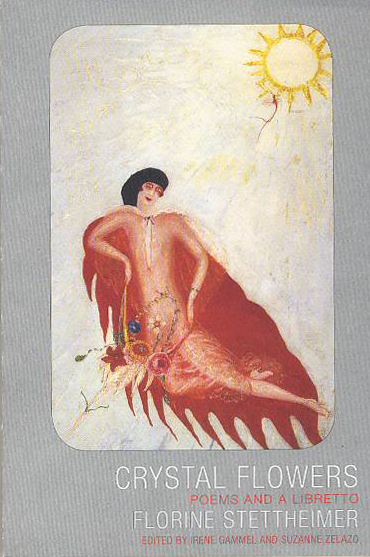
Crystal Flowers: Poems and a Libretto
Florine Stettheimer
Edited by Irene Gammel and Suzanne Zelazo
Toronto: BookThug, 2010
order from BookThug
order from SPD Books

         First, just out from BookThug, Crystal Flowers, a collection of short poems and a libretto resurrected from a relatively unknown American modernist poet and artist, Florine Stettheimer (1871 – 1944). Irene Gammel and Suzanne Zelazo compiled and edited this collection, which includes a generous and helpful introduction to her work.
         These deceptively simple poems—sometimes reminiscent of nursery rhymes—are often tinged with Stettheimer’s signature sardonic humour and her sense of the gendered complexities and imbalances of her time. There is something reminiscent also of Japanese poetry traditions in her ability to limn vivid images within succinct verses and to subvert the set-up emotional reaction with a hairpin turn.
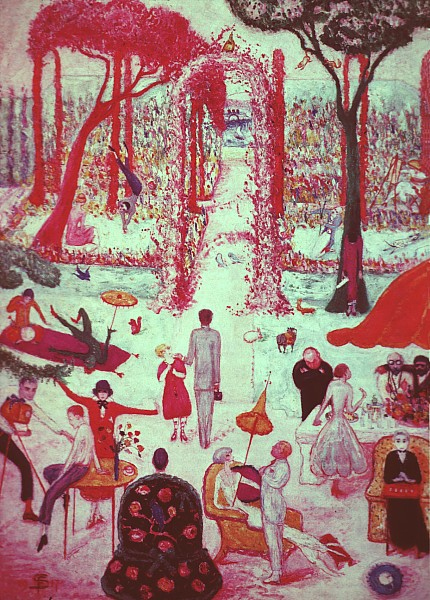
         I’m including a couple of her paintings following the poems.

Ephemère

I broke the glistening spider web
That held a lovely ephemère
I freed its delicate legs and wings
Of all the sticky untidy strings
It stayed with me a whole summer’s day
Then it simply flew away—
 
 
[Occasionally]

Occasionally
A human being
Saw my light
Rushed in
Got singed
Got scared
Rushed out
Called fire
Or it happened
That he tried
To subdue it
Or it happened
He tried to extinguish it
Never did a friend
Enjoy it
The way it was
So I learned to
Turn it low
Turn it out
When I meet a stranger—
Out of courtesy
I turn on a soft
Pink light
Which is found modest
Even charming
It is a protection
Against wear
And tears
And when
I am rid of
The Always-to-be-Stranger
I turn on my light
And become myself
 
 
[I found pink hearts]

I found pink hearts
soft to the touch
stuffed with fragrance
nestling among her underthings
I gently stole one
jammed it
full of pins
and hung it up
                    my Saint Sebastian.
 
 
Adventure in Larchmont

Scaredly cackling the stray white hen
Hopped up the steps of the kitchen stoop
Chased by a sleek green-eyed cat—
I saved the chicken from attack
Altho’ my taste was that of the cat.
 
 
The 13th of October

A black butterfly
with a long black shadow
was there
in my room
when I switched on the light
In the very middle
planted
on my coppercolored carpet . . .
It was motionless
it looked permanent
it thrilled me
with horror . . .
The grey walls
grew icy
the Japanese prints
did harakiri . . .
In my chill terror I make a vow:
I shall do my room
in white and gold
and paint gay flowers
on the walls
and honey bees
and white butterflies
and the song of birds
and the sun’s bright rays!

Florine Stettheimer, Family Portrait, II (1933)


Florine Stettheimer, Sunday Afternoon in the Country (1917)


Camille Martin

Scissors and paper and glue—oh my!

          The photos below are from a collage workshop that I recently facilitated for a fifth grade class at Homestead Public School. The students were so excited and absorbed in their “hand art”—what a privilege it is to see children’s minds at work!
          Many thanks to the students’ teacher, Ms. Danforth, and principal, Ms. Norman, for making my visit possible; to Alexus for her smart and on-target interview questions; and to each member of Ms. Danforth’s class for sharing their creations with me.

Beautiful!

The students displaying their colourful "hand-art"

interview with Alexus


Camille Martin

Om Kalsoum: A rare live recording of the Nightingale of Egypt


          Years ago a friend slipped me a cassette of a young Om Kalsoum recorded live in what sounds like a cafe full of spontaneously appreciative audience members.
          I’ve never heard Kalsoum sound so secular and sexy. The sound quality of the recording isn’t that great, but who cares? Her voice is youthful, sultry and exquisite.
          I made a cd of the cassette (about 38 minutes long) and managed to create a .wav file—it’s pretty large, but available for the downloading here:

http://www.freefilehosting.net/omkhalsoum_1

          It grows in intensity, so it pays to listen to it to the end.


Camille Martin

he-you-i: Who’s thinking, anyway?

Review of Every Day in the Morning (Slow) by Adam Seelig
Vancouver: New Star Books, 2010

          Adam Seelig’s Every Day in the Morning (Slow) is a savvy cross-genre poetic narrative that gets inside the head of Sam, a composer facing a crisis of creativity. Sam’s meandering morning thoughts reveal his frustration about his blocked creativity and his diminishing prospects for fame and money in an economy that he views as encouraging style, sentimentality, and the shallow repetition of the comfortable and familiar. These thoughts intertwine with Sam’s conflicted emotions about his mother, who died giving birth to him; his wealthy father, who has little understanding for Sam’s musical endeavours; and his wife, whose supportive words only send Sam into a spiral of guilt because of his lack of income.
          The book is a deceptively easy read: because of the liberal use of space on the page, it can be read in less than a couple of hours. But what makes it so extraordinary is Seelig’s seamless interweaving of the complex psychological, sexual, economic, and aesthetic themes within Sam’s reveries, the way that he guides the reader smoothly from one plane of thought to the next and demonstrates the interrelatedness of the themes flowing through Sam’s consciousness. For me the greatest pleasure is in re-reading the text, revisiting passages to experience at a slower pace the subtleties of their music. And there really is something musical—ironically enough, given Sam’s compositional block—in the thematic development and variations and in the rhythmic expressiveness aided by the use of space on the page, which reads something like a musical score: Sam’s elusive magnum opus, perhaps?
          Seelig’s striking use of space on the page places the text in a liminal genre between prose narrative and poem. The lineation and zigzagging left margin might seem daunting at first—quite a bit of eye hockey required—but an expressive rhythm emerges that, like a song by Janacek, aligns with speech patterns and with the emotional hesitations and associative streams of thought characteristic of the internal monologue. Here’s an excerpt from a page in which Sam contemplates the possible compromises a composer might make in an economy that rewards the commercialization of art:

The arrangement of the words emphasizes Sam’s bemoaning the correspondences between art, power, and money: like a capitalist bottom line, “sell” keeps hitting the left margin as a reminder of the hard economic realities of being an artist. Also, the repetition of words echoes the use of repetitive motifs and rhythms by composers of minimalist music, whom Sam views as a prime example of selling out in contemporary music. And the cheesy rhyming of “sham” and “ham” foreshadows his rant on the following page that “the cheesier the style the more it sells.”
          What might at first blush seem like an arbitrary scattering of words on the page is in reality a very smart use of space on the page—positions, margins, repetition—effectively scoring Sam’s thoughts. This use of space is a kind of stylistic signature of the book, but far from being what Sam sees as the vapid triumph of style, Seelig’s spacial manipulation meshes with and emphasizes the intricate interplay of ideas and emotions in Sam’s monologue. And the lineation produces a seamless quality, not only because of its cohesive effect on the whole, but also because the spatial patterns give the meandering thoughts the continuity that allows the reader to make connections among them, for example, between his troubled relationship with his wealthy father and his feelings of disgust toward the commercialization of art.
          But what is perhaps easier to take for granted in Every Day is the intricate and sophisticated shifting of perspective—thus the “he-you-i” in the title of this review. Although long passages of Sam’s internal monologue are written in the first person, the point of view shifts almost without the reader being aware of the change. The opening of the narrative shows just how Seelig glides from a third person narrator’s prologue:

*****
This is what happens in the morning of course many things happen to many people in the morning but this is what happens when Sam wakes up . . .
. . .
he puts on some shaving cream picks up his razor blade and starts shaving in the yellow light he’s flicked on a slightly yellow light that flickers at first above the mirror that reflects him
*****

to the second person:

*****
well what else can a mirror do but reflect and what else can you do in the mirror but face your face and reflect on how you used to believe you could write music to make a living simply make a living from writing your own God how naive you were to believe that back then . . .
. . .
while he does fine all the same because whatever Father wants Father gets with all the money he has for what for sitting for sitting on his rump all day as if his fat all shits bills all day long a trumpet call of bills from his ass as if from out of his fat ass pops one long trumpet that toots bills all day long just sitting since he sits on his ass all day
*****

and finally to the “i” of Sam’s internal monologue:

*****
like me i guess a little like me so what if i also sit when i work i really work i don’t just sit and get fat if anything i’m getting even thinner
*****

          The conversational “well” that opens the shift to the second person shows how subtly Seelig accomplishes the transition toward the internal monologue. Moreover, the “you,” which could be apprehended at first as an indefinite pronoun (a “you” out there, perhaps also the reader), presages Sam’s internal dialogue shaving before a mirror, addressing himself as “you” and responding as “i,” wondering whether he should latch onto a trademark, like the minimalists’ use of repetition, to become a famous composer. At the end of this passage, he agrees with his internal questioning voice, rejecting the prospect of becoming a “famous bore”:

*****
maybe one note is all it takes why not like Cage one note to be like John Cage or Riley repetitive like Terry Riley why is Terry Riley so repetitive a bore like Reich take a bore like Steve Reich is Philip Glass as repetitive you wonder as you shave in the mirror is one note all it takes for me to be the next Glass or Reich or Riley or Cage sure if what you want is to be a bore a famous bore mind you but a bore all the same why are they all the same and why is one more repetitive than the next is it to bore me to death
*****

          These subtle shifts in perspective enhance the seamless quality of the narrative, which is written so skilfully that a reader might marvel at the effect without at first being aware of how it was accomplished.
          Seelig’s shifting points of view remind me of Apollinaire’s “Zone,” a poem whose alternations among first, second, and third points of view have been associated with cubism. Some have interpreted these shifts as symptomatic of the modernist rupture of the self into expressions of self-alienation brought about by cultural forces of urbanization and technology. I’ve always felt that this argument is insufficient to explain the fracturing of the traditionally consistent point of view into modernist literature’s prismatic investigation of subjective experience. Call me an optimist, but I’m drawn more to Mary Ann Caws’ interpretation of the shifting points of view in “Zone”: “the pronominal zig-zags vibrate within the text, creating a warmth of contact between narrator and reader, drawn into the poem” (52).
          And to me, this is the effect of Seelig’s shifting points of view in Every Day, as the “he-you-i” flow at the opening demonstrates, for the reader is implicated in Sam’s dialogic “you.” Thus the boundaries between points of view are permeable, as are the resulting boundaries between narrator, character, and reader.
          In Every Day Seelig takes seamlessness, a quality associated with stream of consciousness writing, to another level through the musicality of the writing. And like hearing the music that Sam would probably like to compose, reading his thoughts is a hypnotic experience.

Work Cited
Caws, Mary Ann. “Strong-Line Poetry: Ashbery’s Dark Edging an the Lines of Self.” The Line in Postmodern Poetry. Eds. Robert Frank and Henry Sayre. Urbana: University of Illinois Press, 1988.


Camille Martin

The More The Merrier


Please tune in on Saturday, January 22 from 1 – 2 pm EST to CIUT 89.4 FM or listen live at http://cuit.fm

I’m excited to be reading on Donna G’s radio show, The More The Merrier, along with three other guest writers: Adam Seelig, Souvankham Thammavongsa, and Daniel Tysdal.

I’ll read from Sonnets and something from my new manuscript, Looms, maybe the one about mockingbirds announcing the arrival of hominids, or the one about the slug-fest inside Robin’s head, or the one with the “slicker lunacy” refrain . . .

Bill Knott’s strong-lined sonnets


Bill Knott, Fifty (Rhyming) Sonnets: A Selection from 1969-2009

          I recently received two gorgeous hand-made books from Bill Knott featuring his original art on the covers, front and back, including the above Fifty Sonnets. I’ve been wanting to feature some of his works on Rogue Embryo, and given my predilection for sonnets, I’ve chosen four from this collection, reproduced below.
          Normally skeptical about contemporary poetry that rhymes, I have no such reservations about Knott’s formal excursions. The rhymes are woven into the poems in such a way that they might be perceived only subliminally at first.
          That effect of seamlessness has something to do, I think, with the lineage of these sonnets from Metaphysical poetry’s “strong lines”: the complex, elliptical syntax with its hierarchy of nested dependent clauses; the use of sustained metaphor or conceit; and the intellectual stance, delighting in irony and paradox. The diction is often densely musical, turning alliterative Hopkinesque phrases with compound adjectives (as in “gallant-grieved angels’-armor” and “brief bloomed steam-sheaf”). The serpentine syntax and compressed music of some of these sonnets recall the complexity of poets like Donne: difficult nuts to crack, but rewarding.
          Bill Knott is famously as open about his work (most of which is self-published or posted online) as he is reluctant to allow publishers to assemble selections. I hope the latter changes, but meanwhile it’s wonderful to have these tangible and lovingly assembled books with his original art on the covers.
          SPD carries two titles by Knott: Stigmata Errata Etcetera and The Quicken Tree. His 2006 collection The Unsubscriber is also available from Farrar, Straus and Giroux.
          Check out more of Bill Knott at his poetry blog, his prose blog, and his art blog.

THE HUNGER (enneasysyllabics)

If a path to the Gingerbread House
could be established by breaking crumbs
off its edifice and sprinkling them
so as to find what lies behind us

across the featureless fairytale
void of childhood: yet how very quick
that trick wears out when the story’s track
takes hold, takes toll, a far-older trail

prevails, we’re forced to give up this lost
cause; and the fact is that every last
morsel was gone long before the you

or I might totter our way back here
to try to dissuade all these other
Hansel-Gretels hollering in queue.

AFTER BORGES’ “TO A MINOR POET OF 1899”

Who sought that sad height and that constant change
Laboring on an extraneous verse
Which through the dispersion of universe
Might elect one second whose spectrum’s range

Was so capricious it broke the scholar
Caught in daily efforts to confine the eye
Pursuant of ceruleanesques that lie
Against each longong to fling a color

As brief as my life if I am alive
And am the one destined to undergo
Any authorship of the words that show
Whether such vexacious tints can survive—

You must judge, ancient friend! what I’ve seen
Or accept as real the illusion I mean.

WINDOWBEAM

Ray that overturns every pane,
force that first invades but then

is pervaded: sunstripe penetrant!—
what made your phalanx fail: why can’t

its gallant-grieved angels’ armour
avert our dirt: must the conqueror

convert his ways, the savour adope
savage customs? The slaves currupt

all bright kings—each mote of us
holds abject thought that blots with dust

your gold-shed greatness: shadow
breaks your arc and essence. How

transient the transparency
your brandished here so recently.


OCT-NOV (MICHIGAN MEMORY #4)

The bacon of the ankles crackles, and the sky
Perks up birds this coldsnap morning—very
breath sheds a breath-effect, brief-bloomed steam-sheaf . . .
Puddles huddle in frost. Past the barn the path

Shoots hill-pastures which rose to winter early
And sun-shucked clouds blast-off from: migrants that fly
South—mouths that wet-nurse icicles—hatch forth
A form, a furious precision I sloughed

At birth, preferring life. And like the wind
Can reduce anything to description—
Running to finish my chores, beneath my scarf

I’ll feel my chinbone seek my collarbone,
As if the flesh has ceded and the skeleton
Now must precipice itself against all warmth.


Camille Martin

Robert Zend: Dreams Report the Bankruptcy of Words


Robert Zend (1929-1985)
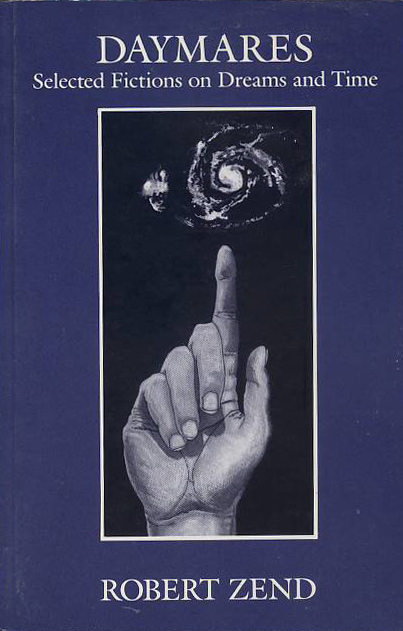
Daymares: Selected Fictions on Dreams and Time
Vancouver: Cacanadadada Press, 1991

          About a year ago, a frend who used to live next door to Robert Zend gave me a copy of Daymares. Already having a stack of unread books at my bedside, I put it on my shelf for another day. Recently, I came across his name and retrieved the book from the tail-end of my short story collection. Now I can hardly put it down.
          Zend’s stories continually involute expectations about identity, time, and the distinction between reality and illusion. Shape-shifting characters, dreams within dreams, anachronisms, and paradoxes keep the reader adrift in a fantastical realm whose often dark irrationality explores mysteries of humanity: uncharted cognitive depths, the burdens of history, and the continuities between self and other.
          Daymares is a genre-blending work containing mostly short stories but also poetry and concrete poetry (“typescapes”). Some of the stories offer twists on religious mythology, including “The End of the World,” a comical revision of the Apocalypse in which the narrator scoffs, “Mankind, shmankind!” and boffs his neighbour’s wife as the four horsemen gallop toward the annihilation of the earth into smithereens—sort of. Others, such as “A Dream About the Centre,” explore the vastness of human cognition in the blink of a waking dream. One of the most moving stories, “My Baby Brother,” confounds time and identity in exploring issues of Holocaust death, survival, and the continuity of life.
          This Hungarian-Canadian writer will appeal to anyone with a penchant for Jorge Luis Borges’ mind-bending labyrinths, paradoxes, and dreamscapes. But Zend is an original swimming in a similar stream of fantasy and dream, navigated with keen intellect and feeling for the human condition. Borges wrote to Zend: “You consider me one of your masters, yet you were my pupil even before reading my work.”
          After relishing Daymares, I eagerly sought other works by Zend and ordered From Zero to One, a collection of his poems. Click here for Glenn Gould’s tribute to Zend on the back jacket.
          Below I’m reproducing an excerpt from Zend’s introduction to the book as well as two poems and two typescapes.

from “Introduction to an unpublished manuscript entitled
Selected Dreams”


          Although the Sun declared it a false doctrine, we still secretly accept the creed of Darkness, which teaches us that the land of dreams is common for everybody: it is not three-billion individually enclosed lands, but one. It obeys not three-billion personal laws, but one. It is a common land where we all meet each other, and these meetings will be unremembered during the linear Sun-time, by the vertically erected individuals who intermingle on the curved, collective male-plane. We all believe—though we know it isn’t true—that the land into which we submerge (while our horizontal bodies rest, tossing and turning about) is real, as real, if not more, than that from which we sank down. Originally, we were all the sons and daughters of Darkness: that was our prenatal land, the Atlantis-womb before the ejaculating rays of the aroused Sun-lord fertilized it, generating us who grow and pop out into the light. We never lose our nostalgia for the cool, dank, soily shadow-shapes of the womb.
          This is the world of dreams from which, at the very beginning of our personal lives it was so hard to be torn away. This is where we spent most of our early time, sleeping. Gradually, as the duration of our sojourns in that world decreased, our time in the clear, collective, articulate world correspondingly increased. The sword of merciful death finally liberates us forever, from the task of wasting even short hours in this male-reality, so that we can return completely to virgin mother-existence. Death allows us back to the land of time-spacelessness; to the tiny centre point of our individual self which strangely coincides with the three-billion other human centre-points, with those of the dead ones, with those of our more ancient ancestors: swimming, crawling and flying creatures, rooting-stretching plants and perhaps even with the centre-points of other alien-living-units, of agitatedly swirling atoms and majestically rotating galaxies.
          The real difficulty, for both the individual and the race, is not to learn the language of Darkness, but rather to learn the language of the Sun. Only the minuscule peak of our iceberg-soul uses Sun-speech. Its bulky expanse hidden under the surface still speaks the ancient language of Darkness: we consist mainly of dreams and only negligibly of wakefulness. By collective agreement between the Sun-ruled ego-peaks, which engage themselves in labyrinthine sociopolitical mythologies, this original language is marked with the stamp of insanity. This “insanity” lurking in all of us, even at high-noon, never stops giving whispered suggestions to our seemingly sane, wakeful structures. That is why we periodically grow sick of them and, through bloody revolutions, try to change them back to the original Utopia which had existed in the Atlantean womb-past, and not, as is erroneously hypothesized, in the Sun-like, glowing erection-future. All these attempts are, of course, futile. It is impossible to convert rocks into clouds, father into mother, iron into fantasy. We don’t have to learn to speak the language of dreams because we never forget to speak it: we practise it a third of every day; we all come from it, persons as well as species. It is our real mother tongue: translations into it are impossible. Everything else: literature, communication, institutions, law, family, society, love, cities, technology, religion, art and science, is already a translation from it—and unsuccessful translations at that: like ruins disintegrating in an alien environment.
          You can dream of a lion which is as harmless and cute as an Easter Bunny, or of a motionless pillar, which is as menacing as a rapist. You can dream of lovemaking as unpleasant as slavery, or of bland, grey flower-pots as warm and sensuous as rosy-hued flesh. Translating them with Sun-lit words gives rise to impenetrable jungles of misunderstanding in which sameness means difference; nearness, distance; flux, solidity; consecutiveness, simultaneity and repetition, comparison. This language knows no word, its events do not provoke emotions, its objects do not lend themselves to symbolization. On the contrary, it informs us of the bankruptcy of words: its emotions provoke events and its abstract objects are expressions of solid symbols.
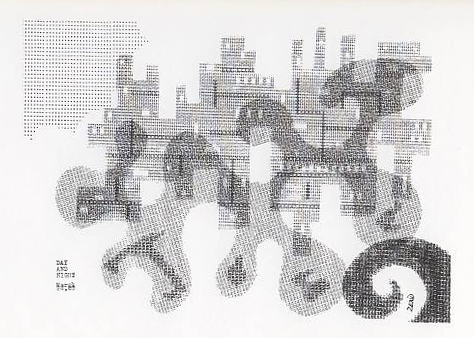
Day and Night (1983)


The Dream-Cycle

Nothing dreams Something
  but Something is mostly Void

    Void dreams Matter
      but Matter is mostly Vacuum

        Vacuum dreams a Universe
          but the Universe is mostly Ether

            Ether dreams Galaxies
              but a Galaxy is mostly Space

                Space dreams Solar Systems
                  but a Solar system is mostly Sky

                    Sky dreams Celestial Bodies
                        but a Celestial Body is mostly Hollow

                          Hollowness dreams Beings
                            but a Being is mostly Empty

                              Emptiness dreams Consciousness
                                but Consciousness is mostly Sleep

                                  Sleep dreams Wakefulness
                                    but Wakefulness is mostly Irrational

                                      Irrationality dreams Knowledge
                                        but Knowledge is mostly Chaos

                                          Chaos dreams Existence
                                            but Existence is mostly Nothing

Nothing dreams Everything
before it is ready to awake

1973

Awakening from Dreams (1983)


After I Die

After I die
Time will be Space
and I will move back and forth in it
    every step a generation
    and I will watch
    the child I was
    the Man I was—
        After I die
        “I” will be “he”

After I die
Now will be Then
and I will remember all who lived
    Napoleon and Socrates
    and Columbus and Leonardo
    and Moses and Gilgamesh
    and all the nameless ones
    will be like days in a long life—
        After I die
        “I” will be “they”

After I die
Here will be There
and I will expand or shrink at will
    the soul of atoms and their particles
    of suns and their planets
    of galaxies and their solar systems
    of universes and their galaxies
    will be my soul and they will rotate in me—
        After I die
        “I” will be “it”

After I die
If will be When
and I will fill all holes with existence
    making things that were not made
    living lives that were unlived
    growing histories that could have happened
    creating worlds that had been aborted
    realizing possibilities that never were—
        After I die
        “I” will be “god”

After I die
I will be nothing
and I am just dreaming about the impossible
projecting a tunnel under the prison wall
    but tomorrow: to go
    tomorrow: to talk
    tomorrow: to work
    tomorrow: to play
    tomorrow: to cope
    tomorrow: to survive—
        After I die “yes” will be “no”
        and everything will become so easy

Wednesday, September 20, 1973

Photo credit: Aniko Zend


Camille Martin