Tag Archives: poetry

Sampling Jay Millar’s Other Poems


Gibsons, BC: Nightwood Editions, 2010
Order from Nightwood Editions

          I could wax on about Jay Millar’s contributions to the Toronto poetry community and beyond as publisher of BookThug, co-founder of the Toronto New School of Writing, and poetry instructor (at TNSOW and George Brown College). And he probably wears more hats than I’m aware of. In short, a tireless and generous opener of doors for poetry to happen.
          But Millar is also (and to my mind, first and foremost) a wonderful poet, one of the few whose work I keep returning to for inspiration. I’m most familiar with the last four books of this already prolific poet: ESP: Accumulation Sonnets, False Maps for Other Creatures, The Small Blue, and Other Poems. And it’s from his latest that I want to offer a sample.
          Though I’m not really doing full-fledged reviews in my “Sampling” series, I’d like to mention just a couple of things that I admire about Other Poems. First is the subtle but pervasive theme of impermanence and mortality, which owes much to his understanding of natural cycles of creation and erosion, emergence and decline. To break the eligiac spell, Millar occasionally offers bouts of pure playfulness, as in “TRANSLATIONS FROM THE THE” (below).
          Also, although Millar’s lyric voice often flows in a conversational diction, he’s also an artist of the beautifully sculpted sentence, as in

How to desire that crackle trees half
empty of leaves crackle?

And:

Or could you possibly hear how
long the walk to chorus-less songs the lingual tics
are as likely as any to empty into.

No mere exercises in parsing (though that’s a pleasure in its own right), the complex and quirky syntax of these sentences draws us closer, in the act of unraveling them, to the heart of the matter. “Crackle” as both a noun and a verb draws attention to itself as the sound of autumn’s decay (as does “half / empty”), which makes the juxtaposition of “desire” with such decline even more jarring. And there’s something tautological about “the crackle that trees crackle.” The circular structure emphasizes decay as a natural and inevitable process in the cycle of life.
          And in the second sentence, “how / long the walk” meshes with the long and rather twisted syntax of the sentence, both of which speak to the mysterious and largely unknowable journey between thought and utterance (and poem).
          One more reason to get the book: Rob Lemon’s fantastical bestiary of images on the cover and throughout the book.
          Here’s a sampling of poems:

WOOD PAGES

I
How to desire that crackle trees half
empty of leaves crackle? A mind that
will run their minimalist instincts
through an environment only to
build nests into the whole of the sky. So
ghostly I recall some talk about
their presence, like names for mammals,
truncated communication that
listens carefully to the dispersed.
To listen to the wind is to see
a love, the feeling of settling love.

II
Autumn: some landscape the edges of the sky pulled
toward the earth for leaves to kick up the wind.

Can you sense the moment leaves halt for a fleeting
distraction of silence? Walk listens aloud

for the sound. What all the nameless creatures name. Some
relationship between two species in which one

obtains nutrients from the bodily function
of the other. Or could you possibly hear how

long the walk to chorus-less songs the lingual tics
are as likely as any to empty into.
 
 
BOX MAINTENANCE

after Robin Blaser’s “The Medium”

I wandered around in the woods
all day thinking of the ‘you’

in so many poems camaraderie invented
hung from the trees, their threads

any community that existed only in minds
anything I might address a poem to, but don’t

what’s out there and never will be
a space between the trees filled with insects or air
images for the future to unravel
or imagine they may have caught
a glimpse of simply
by reading the scripts

What points to itself inwardly,
and whispers. We want to participate,
speak for the dead, care for them,
care about them, tell them ‘we believe’—

the characters deep mirrors of broken text
lead you expertly suspended

I wandered around all day.
Whose woods is this? What lives here?
Will anyone record their thoughts?
Who will maintain the boxes?

Surely no one could invent themselves
without somewhere to store the keys.

I’ve never been handed the invitation.
I’ve slept, it’s true, but never dreamed here—
What would be the point?

This place is not sacred
enough to speak to anyone
as long as I’m thinking of you.
 
   
from “ENTROPIC: A NARRATIVE”

2
Driving the machinery deep into the landscape
Had been slotted into a very particular slot because it—
The whiteness—hurts my eyes most days.
Perhaps it was selfish, or a little unsettling,
How this particular light cast our shadows
Considering the weight of darkness
Was certainly quiet, how you say
The trying to figure out all the angles
That morning we gathered near the beach to ask
How the sun could bother to raise again, the impression
So hard against those who arrived.
Meanwhile, we are gathered here in a fashion
All the others wrote for us, and they keep on writing—
If anything it is a wondrous distraction.
I can only say this because
When the time came to interpret the script we saw
Water continue to erode the rock.
 
 
TRANSLATIONS FROM THE THE

Some modern song a trophy
Mock sprocket undergarment triad

Forces jibe, people wander,
The hotsprings bike an awful

To the point. Meanwhile, there’s
A decent ruckus with the flab.

Pot lid. Stereophonic drywall.
The basement denies the haircuts.

Five or six melons? I’ve rooms
Enough for mechanical tarts,

No vague limp television morph—
Titanic invasion again. Death toll

Blue shirt and trouser roll. Heard
The new bowl? It’s deep. Round

Here chirp clunk and garble.
Give it effort. Give it a home.


Camille Martin

Sonnet Workshop at TNSOW!

Less than two weeks before my five-week Sonnet Workshop begins! Here’s the info:

Sonnet Workshop (Mar 15 – Apr 12, 2011)
Instructor: Camille Martin

Duration: 5 weeks (Tuesdays), 15 March – 12 April 2011, 6:30 – 8:30pm

Capacity: 12 students

Combining a historical overview of the sonnet form (or as Anselm Hollo once called it, the sonnet state of mind) with creative writing assignments, this course offers students the opportunity to experience the sonnet as a traditional and experimental network of possibilities.

Through a series of Reading/Writing sessions focused around various “sonnet-inspired models,” participants will deepen their appreciation of the evolution of the sonnet across history as well as generate their own sonnets, investigating relationships between the rubrics of tradition and form and content and meaning, while continuing the momentum of the “little song’s” enduring popularity.

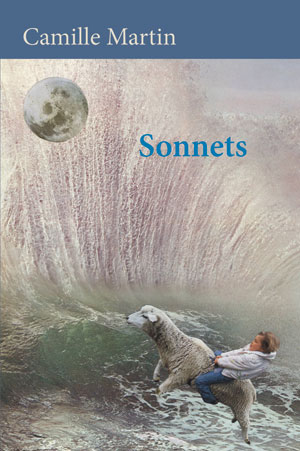
Required Texts: Sonnets by Camille Martin, as well as a selection of readings that will be provided.

Click here to register for the class at the TNSOW website.


Camille Martin

Maxine Gadd: Subway under Byzantium


Subway Under Byzantium: Poems, 1988-1996
Vancouver: New Star Books, 2008
order from SPD
New Star Books ordering page

it’s only Saddam is mad. oh, Max, they say, thinking yu know what they
mean this time          go meek as a lamb bred to roast on a sunday.          the
next thing yu know
they’ve got yr liver on a hook
flying in the breeze to snag
steel blue pterodactyls
      —from “Boatload to Atlantis”

          I met Maxine Gadd at my KSW reading in Vancouver last year. I didn’t know her poetry then, but nudged by Jordan Scott, I dove into her work and with a jolt of excitement recognized an edgy poetic voice that would be equally at home exploring the Gothic underbelly of the Deep South—Louisiana poet Jessica Freeman comes to mind as a counterpart, like Flannery O’Connor to Alice Munro.
          But regardless of that ring of kindred Southern irony in my ear as I read her poetry, I’d be a Gadd aficionado. Below are a few gems from Gadd’s 2008 collection, Subway Under Byzantium.

ferry weather feeling

ferry weather feeling
konked by a head-on collision
carroted into trans-substations
bad ice
agitated pre-sys-bitarian volcanic subtext

where do yu go to pay yr bills
little while flowers like flour over the wall
styrofoam lawnmowers

ok, we made a loop
now start hooking
 
 
for starchild

sticks and stones, bricks and bones; hated history
twittering a transcendent chant on the bridge
over the murky dawn
laying down a route that’s a rout
roar humbly on dear pack-lovers
tearing apart various entities
configurating rain fr ten a.m.

mud forever, fervent misery
knowing yr bred out diamond
suit ya fine
this little hole
        lined with
        reeds
 
 
Lac La Lack

is it a puddle yu jump in to splash the dry friends yu want as lovers
is it a dark pool into which houses dissolve in the infrared eyes of dogs and deer
is it a black lagoon with hieroglyphs spinning laughter
is it the blue green lantern of a pulp mill feeding the fish
about the blue about the green about to yellow about to redden the wail
the coyotes avoid,
that i wld avoid
if only the lonely
could park wild with a full deck of golden oldies
eh, yeah
fear of the old frontier, my deer
the fresh thing that’s happened to man and disappeared

its surely yr own deep liquid drained by the dry gulch of history
salt crusted around yr eyes but yr here at the lake, placed
to meet the tribes and sixty year old tourists not so different from yourself
as to clarify a Greek under the pines

a reputation away hang shiny cookies of thought
and just below the surface of emerald jelly
drowned theoreticians, smile up, fascinated still

sylph sylvie sits on rocks and combs her hair
a truckdriver buckles in the dark
grabs onto a green light hanging over the highway
and stops, leaving the truck on the centre line he jumps out
leaving the door open, goes to the lake
pours oil on troubled waters
relieves himself in it
calls it his queen
 
 
Subway Under Byzantium

IN AND OUT OF THE MOUTHS OF THE POOR, THE
        MARQUISE OF MAD MARCHE
demands good cookin, the bodies of the children and
“the poor just love it:go
wee wee wee wee wee weeeee
WE WE WE WE WE
            WE

we

(ah, oui)

love fingering our dream time, lifting it, high and dry
as the bird hung out on the wire, befallen
into the heat of our veins, in the subway under byzantium
teeming with Russian spies of love in each clean canadian house
hiding under the leopard skin tails of Great Aunt Ida
talking thru the night / talking to the night

here is an inheritance / snowballs light up the balls

still, they’re trying to do us in
they have fled the ditches with lilies that will eat us and all our crap
meld, marl us into mold, light and furry like
fairy hair and
merry
malty
we’ve already flown

Secret

we share this little secret
bergamot and eggs in the bottomless abyss
great to be so faithful

my lies open to the white
organized perpetuity
foolish gaze

truck stops on a giant spiderweb
the lazy warehouse
of the lost dog

yark my shoes, Jack
i’m as woozy as sedge
mind chimes to chizzy tiers

wild deer ness
once open for the armed
as i with spam

next spring yr tripudiating thru gnarled trees
the sweet breath of fungus
hauling yu down

yu break up
safe and sucked and hungry
and spent


Camille Martin

One for the Neglectorino Project*: Florine Stettheimer

* Click to see the Neglectornio Project
 
          An aside before the main attraction: I’ve been hard at work/play editing “Looms,” my poetry manuscript that I describe as a series of layered narratives. So with my energy going into this and other creative projects, I’m taking a break from writing reviews and close readings and for the time being I’ll just post poems from books that I’m reading, with book cover scans and where possible, links to sites where the books may be purchased.
         I might come back to these books or poems and write more about them at another time, but for now . . . pure poetry! I hope you enjoy my selections.
 

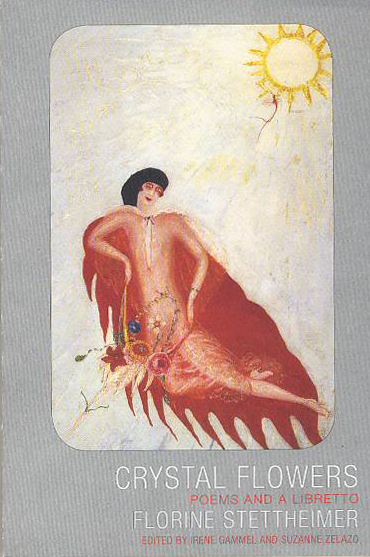
Crystal Flowers: Poems and a Libretto
Florine Stettheimer
Edited by Irene Gammel and Suzanne Zelazo
Toronto: BookThug, 2010
order from BookThug
order from SPD Books

         First, just out from BookThug, Crystal Flowers, a collection of short poems and a libretto resurrected from a relatively unknown American modernist poet and artist, Florine Stettheimer (1871 – 1944). Irene Gammel and Suzanne Zelazo compiled and edited this collection, which includes a generous and helpful introduction to her work.
         These deceptively simple poems—sometimes reminiscent of nursery rhymes—are often tinged with Stettheimer’s signature sardonic humour and her sense of the gendered complexities and imbalances of her time. There is something reminiscent also of Japanese poetry traditions in her ability to limn vivid images within succinct verses and to subvert the set-up emotional reaction with a hairpin turn.
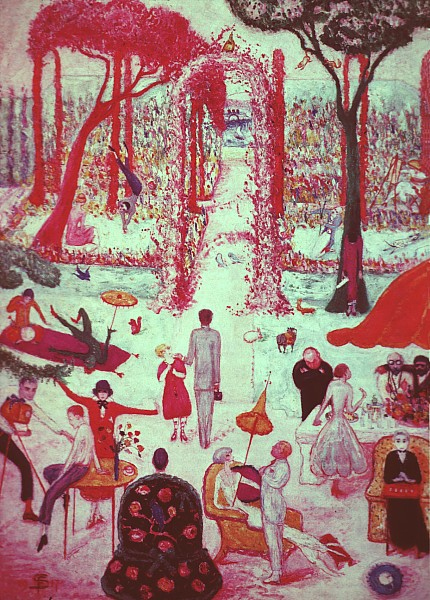
         I’m including a couple of her paintings following the poems.

Ephemère

I broke the glistening spider web
That held a lovely ephemère
I freed its delicate legs and wings
Of all the sticky untidy strings
It stayed with me a whole summer’s day
Then it simply flew away—
 
 
[Occasionally]

Occasionally
A human being
Saw my light
Rushed in
Got singed
Got scared
Rushed out
Called fire
Or it happened
That he tried
To subdue it
Or it happened
He tried to extinguish it
Never did a friend
Enjoy it
The way it was
So I learned to
Turn it low
Turn it out
When I meet a stranger—
Out of courtesy
I turn on a soft
Pink light
Which is found modest
Even charming
It is a protection
Against wear
And tears
And when
I am rid of
The Always-to-be-Stranger
I turn on my light
And become myself
 
 
[I found pink hearts]

I found pink hearts
soft to the touch
stuffed with fragrance
nestling among her underthings
I gently stole one
jammed it
full of pins
and hung it up
                    my Saint Sebastian.
 
 
Adventure in Larchmont

Scaredly cackling the stray white hen
Hopped up the steps of the kitchen stoop
Chased by a sleek green-eyed cat—
I saved the chicken from attack
Altho’ my taste was that of the cat.
 
 
The 13th of October

A black butterfly
with a long black shadow
was there
in my room
when I switched on the light
In the very middle
planted
on my coppercolored carpet . . .
It was motionless
it looked permanent
it thrilled me
with horror . . .
The grey walls
grew icy
the Japanese prints
did harakiri . . .
In my chill terror I make a vow:
I shall do my room
in white and gold
and paint gay flowers
on the walls
and honey bees
and white butterflies
and the song of birds
and the sun’s bright rays!

Florine Stettheimer, Family Portrait, II (1933)


Florine Stettheimer, Sunday Afternoon in the Country (1917)


Camille Martin

he-you-i: Who’s thinking, anyway?

Review of Every Day in the Morning (Slow) by Adam Seelig
Vancouver: New Star Books, 2010

          Adam Seelig’s Every Day in the Morning (Slow) is a savvy cross-genre poetic narrative that gets inside the head of Sam, a composer facing a crisis of creativity. Sam’s meandering morning thoughts reveal his frustration about his blocked creativity and his diminishing prospects for fame and money in an economy that he views as encouraging style, sentimentality, and the shallow repetition of the comfortable and familiar. These thoughts intertwine with Sam’s conflicted emotions about his mother, who died giving birth to him; his wealthy father, who has little understanding for Sam’s musical endeavours; and his wife, whose supportive words only send Sam into a spiral of guilt because of his lack of income.
          The book is a deceptively easy read: because of the liberal use of space on the page, it can be read in less than a couple of hours. But what makes it so extraordinary is Seelig’s seamless interweaving of the complex psychological, sexual, economic, and aesthetic themes within Sam’s reveries, the way that he guides the reader smoothly from one plane of thought to the next and demonstrates the interrelatedness of the themes flowing through Sam’s consciousness. For me the greatest pleasure is in re-reading the text, revisiting passages to experience at a slower pace the subtleties of their music. And there really is something musical—ironically enough, given Sam’s compositional block—in the thematic development and variations and in the rhythmic expressiveness aided by the use of space on the page, which reads something like a musical score: Sam’s elusive magnum opus, perhaps?
          Seelig’s striking use of space on the page places the text in a liminal genre between prose narrative and poem. The lineation and zigzagging left margin might seem daunting at first—quite a bit of eye hockey required—but an expressive rhythm emerges that, like a song by Janacek, aligns with speech patterns and with the emotional hesitations and associative streams of thought characteristic of the internal monologue. Here’s an excerpt from a page in which Sam contemplates the possible compromises a composer might make in an economy that rewards the commercialization of art:

The arrangement of the words emphasizes Sam’s bemoaning the correspondences between art, power, and money: like a capitalist bottom line, “sell” keeps hitting the left margin as a reminder of the hard economic realities of being an artist. Also, the repetition of words echoes the use of repetitive motifs and rhythms by composers of minimalist music, whom Sam views as a prime example of selling out in contemporary music. And the cheesy rhyming of “sham” and “ham” foreshadows his rant on the following page that “the cheesier the style the more it sells.”
          What might at first blush seem like an arbitrary scattering of words on the page is in reality a very smart use of space on the page—positions, margins, repetition—effectively scoring Sam’s thoughts. This use of space is a kind of stylistic signature of the book, but far from being what Sam sees as the vapid triumph of style, Seelig’s spacial manipulation meshes with and emphasizes the intricate interplay of ideas and emotions in Sam’s monologue. And the lineation produces a seamless quality, not only because of its cohesive effect on the whole, but also because the spatial patterns give the meandering thoughts the continuity that allows the reader to make connections among them, for example, between his troubled relationship with his wealthy father and his feelings of disgust toward the commercialization of art.
          But what is perhaps easier to take for granted in Every Day is the intricate and sophisticated shifting of perspective—thus the “he-you-i” in the title of this review. Although long passages of Sam’s internal monologue are written in the first person, the point of view shifts almost without the reader being aware of the change. The opening of the narrative shows just how Seelig glides from a third person narrator’s prologue:

*****
This is what happens in the morning of course many things happen to many people in the morning but this is what happens when Sam wakes up . . .
. . .
he puts on some shaving cream picks up his razor blade and starts shaving in the yellow light he’s flicked on a slightly yellow light that flickers at first above the mirror that reflects him
*****

to the second person:

*****
well what else can a mirror do but reflect and what else can you do in the mirror but face your face and reflect on how you used to believe you could write music to make a living simply make a living from writing your own God how naive you were to believe that back then . . .
. . .
while he does fine all the same because whatever Father wants Father gets with all the money he has for what for sitting for sitting on his rump all day as if his fat all shits bills all day long a trumpet call of bills from his ass as if from out of his fat ass pops one long trumpet that toots bills all day long just sitting since he sits on his ass all day
*****

and finally to the “i” of Sam’s internal monologue:

*****
like me i guess a little like me so what if i also sit when i work i really work i don’t just sit and get fat if anything i’m getting even thinner
*****

          The conversational “well” that opens the shift to the second person shows how subtly Seelig accomplishes the transition toward the internal monologue. Moreover, the “you,” which could be apprehended at first as an indefinite pronoun (a “you” out there, perhaps also the reader), presages Sam’s internal dialogue shaving before a mirror, addressing himself as “you” and responding as “i,” wondering whether he should latch onto a trademark, like the minimalists’ use of repetition, to become a famous composer. At the end of this passage, he agrees with his internal questioning voice, rejecting the prospect of becoming a “famous bore”:

*****
maybe one note is all it takes why not like Cage one note to be like John Cage or Riley repetitive like Terry Riley why is Terry Riley so repetitive a bore like Reich take a bore like Steve Reich is Philip Glass as repetitive you wonder as you shave in the mirror is one note all it takes for me to be the next Glass or Reich or Riley or Cage sure if what you want is to be a bore a famous bore mind you but a bore all the same why are they all the same and why is one more repetitive than the next is it to bore me to death
*****

          These subtle shifts in perspective enhance the seamless quality of the narrative, which is written so skilfully that a reader might marvel at the effect without at first being aware of how it was accomplished.
          Seelig’s shifting points of view remind me of Apollinaire’s “Zone,” a poem whose alternations among first, second, and third points of view have been associated with cubism. Some have interpreted these shifts as symptomatic of the modernist rupture of the self into expressions of self-alienation brought about by cultural forces of urbanization and technology. I’ve always felt that this argument is insufficient to explain the fracturing of the traditionally consistent point of view into modernist literature’s prismatic investigation of subjective experience. Call me an optimist, but I’m drawn more to Mary Ann Caws’ interpretation of the shifting points of view in “Zone”: “the pronominal zig-zags vibrate within the text, creating a warmth of contact between narrator and reader, drawn into the poem” (52).
          And to me, this is the effect of Seelig’s shifting points of view in Every Day, as the “he-you-i” flow at the opening demonstrates, for the reader is implicated in Sam’s dialogic “you.” Thus the boundaries between points of view are permeable, as are the resulting boundaries between narrator, character, and reader.
          In Every Day Seelig takes seamlessness, a quality associated with stream of consciousness writing, to another level through the musicality of the writing. And like hearing the music that Sam would probably like to compose, reading his thoughts is a hypnotic experience.

Work Cited
Caws, Mary Ann. “Strong-Line Poetry: Ashbery’s Dark Edging an the Lines of Self.” The Line in Postmodern Poetry. Eds. Robert Frank and Henry Sayre. Urbana: University of Illinois Press, 1988.


Camille Martin

The More The Merrier


Please tune in on Saturday, January 22 from 1 – 2 pm EST to CIUT 89.4 FM or listen live at http://cuit.fm

I’m excited to be reading on Donna G’s radio show, The More The Merrier, along with three other guest writers: Adam Seelig, Souvankham Thammavongsa, and Daniel Tysdal.

I’ll read from Sonnets and something from my new manuscript, Looms, maybe the one about mockingbirds announcing the arrival of hominids, or the one about the slug-fest inside Robin’s head, or the one with the “slicker lunacy” refrain . . .

Robert Zend: Dreams Report the Bankruptcy of Words


Robert Zend (1929-1985)
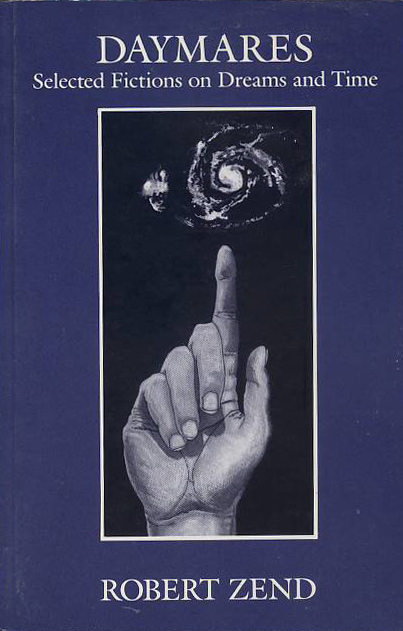
Daymares: Selected Fictions on Dreams and Time
Vancouver: Cacanadadada Press, 1991

          About a year ago, a frend who used to live next door to Robert Zend gave me a copy of Daymares. Already having a stack of unread books at my bedside, I put it on my shelf for another day. Recently, I came across his name and retrieved the book from the tail-end of my short story collection. Now I can hardly put it down.
          Zend’s stories continually involute expectations about identity, time, and the distinction between reality and illusion. Shape-shifting characters, dreams within dreams, anachronisms, and paradoxes keep the reader adrift in a fantastical realm whose often dark irrationality explores mysteries of humanity: uncharted cognitive depths, the burdens of history, and the continuities between self and other.
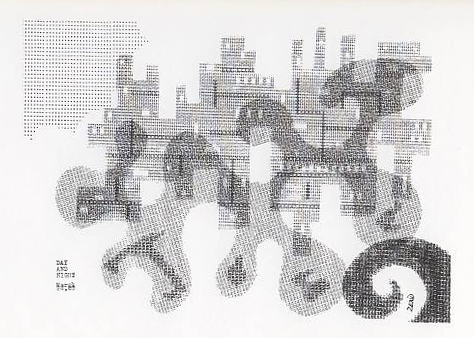
          Daymares is a genre-blending work containing mostly short stories but also poetry and concrete poetry (“typescapes”). Some of the stories offer twists on religious mythology, including “The End of the World,” a comical revision of the Apocalypse in which the narrator scoffs, “Mankind, shmankind!” and boffs his neighbour’s wife as the four horsemen gallop toward the annihilation of the earth into smithereens—sort of. Others, such as “A Dream About the Centre,” explore the vastness of human cognition in the blink of a waking dream. One of the most moving stories, “My Baby Brother,” confounds time and identity in exploring issues of Holocaust death, survival, and the continuity of life.
          This Hungarian-Canadian writer will appeal to anyone with a penchant for Jorge Luis Borges’ mind-bending labyrinths, paradoxes, and dreamscapes. But Zend is an original swimming in a similar stream of fantasy and dream, navigated with keen intellect and feeling for the human condition. Borges wrote to Zend: “You consider me one of your masters, yet you were my pupil even before reading my work.”
          After relishing Daymares, I eagerly sought other works by Zend and ordered From Zero to One, a collection of his poems. Click here for Glenn Gould’s tribute to Zend on the back jacket.
          Below I’m reproducing an excerpt from Zend’s introduction to the book as well as two poems and two typescapes.

from “Introduction to an unpublished manuscript entitled
Selected Dreams”


          Although the Sun declared it a false doctrine, we still secretly accept the creed of Darkness, which teaches us that the land of dreams is common for everybody: it is not three-billion individually enclosed lands, but one. It obeys not three-billion personal laws, but one. It is a common land where we all meet each other, and these meetings will be unremembered during the linear Sun-time, by the vertically erected individuals who intermingle on the curved, collective male-plane. We all believe—though we know it isn’t true—that the land into which we submerge (while our horizontal bodies rest, tossing and turning about) is real, as real, if not more, than that from which we sank down. Originally, we were all the sons and daughters of Darkness: that was our prenatal land, the Atlantis-womb before the ejaculating rays of the aroused Sun-lord fertilized it, generating us who grow and pop out into the light. We never lose our nostalgia for the cool, dank, soily shadow-shapes of the womb.
          This is the world of dreams from which, at the very beginning of our personal lives it was so hard to be torn away. This is where we spent most of our early time, sleeping. Gradually, as the duration of our sojourns in that world decreased, our time in the clear, collective, articulate world correspondingly increased. The sword of merciful death finally liberates us forever, from the task of wasting even short hours in this male-reality, so that we can return completely to virgin mother-existence. Death allows us back to the land of time-spacelessness; to the tiny centre point of our individual self which strangely coincides with the three-billion other human centre-points, with those of the dead ones, with those of our more ancient ancestors: swimming, crawling and flying creatures, rooting-stretching plants and perhaps even with the centre-points of other alien-living-units, of agitatedly swirling atoms and majestically rotating galaxies.
          The real difficulty, for both the individual and the race, is not to learn the language of Darkness, but rather to learn the language of the Sun. Only the minuscule peak of our iceberg-soul uses Sun-speech. Its bulky expanse hidden under the surface still speaks the ancient language of Darkness: we consist mainly of dreams and only negligibly of wakefulness. By collective agreement between the Sun-ruled ego-peaks, which engage themselves in labyrinthine sociopolitical mythologies, this original language is marked with the stamp of insanity. This “insanity” lurking in all of us, even at high-noon, never stops giving whispered suggestions to our seemingly sane, wakeful structures. That is why we periodically grow sick of them and, through bloody revolutions, try to change them back to the original Utopia which had existed in the Atlantean womb-past, and not, as is erroneously hypothesized, in the Sun-like, glowing erection-future. All these attempts are, of course, futile. It is impossible to convert rocks into clouds, father into mother, iron into fantasy. We don’t have to learn to speak the language of dreams because we never forget to speak it: we practise it a third of every day; we all come from it, persons as well as species. It is our real mother tongue: translations into it are impossible. Everything else: literature, communication, institutions, law, family, society, love, cities, technology, religion, art and science, is already a translation from it—and unsuccessful translations at that: like ruins disintegrating in an alien environment.
          You can dream of a lion which is as harmless and cute as an Easter Bunny, or of a motionless pillar, which is as menacing as a rapist. You can dream of lovemaking as unpleasant as slavery, or of bland, grey flower-pots as warm and sensuous as rosy-hued flesh. Translating them with Sun-lit words gives rise to impenetrable jungles of misunderstanding in which sameness means difference; nearness, distance; flux, solidity; consecutiveness, simultaneity and repetition, comparison. This language knows no word, its events do not provoke emotions, its objects do not lend themselves to symbolization. On the contrary, it informs us of the bankruptcy of words: its emotions provoke events and its abstract objects are expressions of solid symbols.

Day and Night (1983)


The Dream-Cycle

Nothing dreams Something
  but Something is mostly Void

    Void dreams Matter
      but Matter is mostly Vacuum

        Vacuum dreams a Universe
          but the Universe is mostly Ether

            Ether dreams Galaxies
              but a Galaxy is mostly Space

                Space dreams Solar Systems
                  but a Solar system is mostly Sky

                    Sky dreams Celestial Bodies
                        but a Celestial Body is mostly Hollow

                          Hollowness dreams Beings
                            but a Being is mostly Empty

                              Emptiness dreams Consciousness
                                but Consciousness is mostly Sleep

                                  Sleep dreams Wakefulness
                                    but Wakefulness is mostly Irrational

                                      Irrationality dreams Knowledge
                                        but Knowledge is mostly Chaos

                                          Chaos dreams Existence
                                            but Existence is mostly Nothing

Nothing dreams Everything
before it is ready to awake

1973

Awakening from Dreams (1983)


After I Die

After I die
Time will be Space
and I will move back and forth in it
    every step a generation
    and I will watch
    the child I was
    the Man I was—
        After I die
        “I” will be “he”

After I die
Now will be Then
and I will remember all who lived
    Napoleon and Socrates
    and Columbus and Leonardo
    and Moses and Gilgamesh
    and all the nameless ones
    will be like days in a long life—
        After I die
        “I” will be “they”

After I die
Here will be There
and I will expand or shrink at will
    the soul of atoms and their particles
    of suns and their planets
    of galaxies and their solar systems
    of universes and their galaxies
    will be my soul and they will rotate in me—
        After I die
        “I” will be “it”

After I die
If will be When
and I will fill all holes with existence
    making things that were not made
    living lives that were unlived
    growing histories that could have happened
    creating worlds that had been aborted
    realizing possibilities that never were—
        After I die
        “I” will be “god”

After I die
I will be nothing
and I am just dreaming about the impossible
projecting a tunnel under the prison wall
    but tomorrow: to go
    tomorrow: to talk
    tomorrow: to work
    tomorrow: to play
    tomorrow: to cope
    tomorrow: to survive—
        After I die “yes” will be “no”
        and everything will become so easy

Wednesday, September 20, 1973

Photo credit: Aniko Zend


Camille Martin

Recipes from the Red Planet: Meredith Quartermain’s Martian Feast

Recipes from the Red Planet by Meredith Quartermain
Susan Bee, illustrator
(Toronto: Book Thug, 2010)
order from Small Press Distribution
order from Book Thug

cover collage: Susan Bee


            Meredith Quartermain’s Recipes from the Red Planet pays homage in its title and inspiration to Jack Spicer’s notion of the poet as a conduit of language that seems to come from a source other than a consciously creating self, Martian signals being his memorable metaphor for this otherness of the poetic voice. But voice it is nonetheless, and whatever metaphor serves to describe the source of the poetic energy (Martians, radio signals, parasites, or invaders), the voices in Quartermain’s prose poems take center stage as they rant, apostrophize, soliloquize, surreal-ize, tell tall tales. Her stage is populated by a host of selves and others engaged in playful—often seriously playful—dialogue, and fittingly illustrated by six wonderfully quirky and surreal collages by Susan Bee.
            Book Thug appropriately placed this collection in its Department of Narrative Studies series: even when the speaking voices and time dimension of the stories seem most fractured, thing happen and voices talk about them. The narratives’ layered effect gives the illusion of alien languages and customs from different planets colliding to form new alien cultures that come into being in the act of reading. And the overlapping narratives create meaning that is in its own mysterious way decipherable yet also porous to allow variations of understanding and delight.
            Perhaps it’s apropos that poetry claiming, tongue in cheek, alien provenance doesn’t come across as traditional lyrical, meditative poetry. In Recipes from the Red Planet, there’s a wildness, often breathlessness, to the voices that broadcast dramatic and narrative speech celebrating the free, unfettered riffing of imagination.
            Unfettered isn’t synonymous, however, with disengaged. Although some poems in the collection revel in linguistic play for its own sake (not to say that such play isn’t politically engaged, at least not overtly), the playful stream of words more often than not swarms around and explores something of concern to her—a memory, a place, or social injustice, for example. Such concerns are what Spicer called the poet’s personal “furniture,” which the “Martians” work with, arrange, and invest with clues. For Spicer, the furniture—the poet’s language, memory, knowledge, idiosyncrasies as a human being—are not as relevant as his or her ability to clear the room of personal desire (“this is what I want the poem to say”) and allow the Martians to inhabit the furnished space and their voices to stream, as if through a neutral conduit, into the typing fingers.
            But the furniture is there nonetheless—Spicer never claimed that poetic dictation involved becoming a tabula rasa and letting go of one’s beliefs, but that in allowing an otherness to flow through, those beliefs might not come across the way one expected. If a poet wants to write about Vietnam, Spicer says, the Martians might end up talking about about ice-skating in Vermont (as Norman Mailer did when he exposed the horrors of the Vietnam War by telling the tale of an unsportsman-like bear hunt in Alaska).
            Quartermain’s perspectives on feminism, corporate misconduct, and the rescue of voices lost to the shadows of history come through clearly, and true to Spicer’s ideas about poetic dictation, these ideas are voiced by her “Martians” in wild tangents, unexpected flights, and strange juxtapositions. Personal opinion has not left the room, but a chorus of voices (and here the invasion metaphor seems apt) swarm into the room, rearranging the furniture as they please, creating surreal parables and buildings haunted with swirling voices. Agenda may seem secondary to the thrill of linguistic play, yet that ludic impulse is also intimately intertwined with the political. In the tradition of dystopian science fiction’s tactic of cognitive estrangement1, Quartermain’s Martians defamiliarize the inhumanity that is too often taken for granted, providing fresh perspectives on the troubled history of Earthlings.
            One poem that exemplifies such defamiliarization while also invoking Spicer’s Martian metaphor is the delightfully comical “A Disagreement over Lunch.” A woman asserts to a man over lunch that architecture is not only a human activity but a phenomenon of living beings—ants, for instance—that manipulate their environment under biological pressure: a decidedly anti-heroic point of view. But the man, firmly in the Ayn Rand camp, prefers to see the architecture of humans as heroically creative and uniquely above animal constructions.
            As they debate, however, a surreal drama unfolds: an eggplant-cum-football enters the room, hovers over a fruit bowl, lays eggs, and releases tiny creatures that roll their caravans and wagons over the peaches. The voice that narrates the surreal vision of the eggplant-blimp is ambiguous about the creatures and seems to debate itself: did the eggplant release ants or tiny humans? Thus the poem moves from the debate between the diners to a debate of the narrating voice at odds with itself, or at least unable to decide.
            This refusal of the narrating voice to take a position, to reason politically, and side with one or the other, is part of the subtle brilliance of Quartermain’s approach. The trope of the Martian’s bird’s-eye view allows the consideration of human behaviour from an alien perspective: a Martian anthropologist, presumably unfamiliar with the imposed hierarchy of life that humans often assume in their anthropocentric hubris, would likely have a broader perspective on the commonalities of living creatures. But the narrating voice, instead of simply siding with the woman (which is apparent, in any case), embraces the rhetoric of debate (ants? humans?) and ends on a note of undecidability, thus bringing ants and humans into the same realm, parading in lines and shaping their world.
            Like Spicer, Quartermain (or should I say, her Martians?) uses and rearranges the “furniture” of mythology, in her case to offer a feminist spin on patriarchal Greek myths. In “Sewing,” the aptly-named Mrs. Shears of Home-Ec is an unlikely but nonetheless quietly heroic feminist as she teaches her students to sew, all the while spinning yarns (so to speak) and debunking the partriarchal assumptions of ancient myths: it’s the women who kept home safe for the men, not the other way around; Andromeda was saved by a Minoan queen, not her future husband, Perseus. Thus Mrs. Shears teaches her students to stitch together their own stories without relying on prejudicial myths, and plants the idea that it is they who “piece reality together.”
            Quartermain’s collection revels in imaginative wordplay, and some poems, such as “Snow” just seem linguistically to shimmer for the pure joy of it:

“down steady down fall flake down by flake down round cloud-whirl tree by roof by frolicsome milk-wing flight-of-steps runaway runway quick lattice icicle faceted minikin clusters wittily mimical silica ventriloquy down by down by down doors porches by churches banks frosty postage to rustle and bluster downtown towers flour the tree-bark fringe the stones the hedges the wires the trellises tickle crystal thickety particle curriculum [. . .]”

I can add nothing that wouldn’t spoil the fun of the poem.
            And I could wax on about some of my favourites in Quartermain’s collection, such as “My City,” “Future Past,” “Fabulous Moderne,” “She would,” “The Plackener,” “Hotel Narrative.” But before I outstay the Martians’ welcome, I’ll end by briefly alluding to “The Sonic Boom” and returning to the idea, so important to Spicer’s poetics: sidestepping one’s own desires about the poem being written and allowing something else much stranger to speak through the poem and perhaps “say just exactly the opposite of what he wants himself, per se poet, to say” (Spicer 6). Quartermain’s “The Sonic Boom Catcher” hits the bull’s eye of the poet’s dilemma in implementing Spicer’s idea of writing as dictation. The paradox of the title beautifully sums up Spicer’s advice, quoted by Quartermain in her index: “You have to not really want not what you don’t want to say.” The trickiness of untangling that triple negative is like the trickiness of writing—you can’t fool the “Martians”; all you can do, says Spicer, is prepare the room and get rid of the personal.
            “The Sonic Boom Catcher” could also be read as a parable of the slipperiness of desire: once you have what you want, it ceases to be the object of desire, because the object of desire is desire itself. Readiness, patience, and a quieting of desire lure the Martians to the poet’s antennae.
            Recipes from the Red Planet is a paean to the imagination, sometimes madcap, sometimes pensive, but always generously liberating. Her description of the tree the speaker has given birth to in “Dear Mom,” is an apt mantra for the spirit of the book: “Merrythought. Willy nilly bodacious. Willy nilly lexiludic.” And imagination is just as often a celebration of its own play as an exploration of social and political engagement.
            It’s impossible to summarize the wealth of themes and the explosion of wordplay in this collection, and my review cannot do it justice. How to describe being a guest at Quartermain’s Martian banquet? You just have to be there.

collage: Susan Bee


1 See Darko Suvin’s work on science fiction.

Work Cited
Spicer, Jack. The House That Jack Built: The Collected Lectures of Jack Spicer. Ed. Peter Gizzi. Hanover, New Hampshire: University of New England, 1998.


Camille Martin

Saline: Kimberly Lyons’ Fleeting Continuum


(Click here to order from SPD.)

Please check out my review of Kimberly Lyons’ Saline in the new issue of Galatea Resurrects:

Kimberly Lyons’ Fleeting Continuum

The problem (and pleasure) of reviewing a book of poetry by Kimberly Lyons is that a review needs to generalize to an extent, yet my temptation is to pause at the details in the language, to become wrapped up in close readings of the images that flow in a continually morphing reverie . . . [click here to read the review]

Camille Martin

New upcoming events – poetry and collage

Just uploaded some new information into my Upcoming Events page:


COLLAGE EXHIBIT

Sunday, December 12 – Thursday, December 23, 2010
Toronto: Arta Gallery at The Distillery / 55 Mill Street
Three limited-edition collage prints on exhibit and available for purchase, such as this one:

The Birth of Newton


POETRY WORKSHOP

Five Tuesdays: March 15 – April 12, 2011, 6:30 – 8:30 pm
Toronto New School of Writing
click here for details & registration


POETRY READING

Wednesday, April 20, 2011
Toronto: The Pivot at The Press Club / 850 Dundas Street West


COLLAGE EXHIBIT

June 2011
Toronto Public Library, Woodside Square Branch
Twelve limited-edition collage prints on exhibit and available for purchase

Poetry’s 49th Parallel: Canadian/American Shibboleths

Is this a Canadian poet?

Is this Canadian poetry?

          I photo-shopped the above image of myself because I’ve never taken such a staged picture of myself. And I’ve never really experienced an identity crisis of nationality since immigrating from the United States to Canada. But I have been thinking about nationality lately. When I was living in the United States, I never described myself as an American poet. And these days, a full-fledged citizen of Canada and a resident for almost five years, I don’t generally refer to myself as a Canadian poet. I’ve long harboured a fantasy of belonging to a city-state, and when I was in the United States, I referred to myself as a New Orleans poet, just as now, in Canada, I call myself a Toronto poet.
          I’ve had a love-hate relationship with both the United States and Canada. Canada: health care system rocks, winter sucks. United States: Obama rocks (most of the time); Homeland Security, the Patriot Act, and Total Information Awareness (remember that short-lived megalomanic agency?) suck. In New Orleans, at the height of terrorist paranoia and duct tape frenzy, I was threatened with arrest for taking photographs, on public ground, of well-known monumental sculptures in front of a bank. That sucked.
          But my identity was never very dependent on nationality. Especially since Desert Storm, I haven’t self-identified as American, but I have always defined myself in part as Cajun. For me, the local or marginal identity, determined by patterns of settlement, wins out over the relatively artificial boundaries of nationhood. Even so, although I consider myself Cajun, not only by virtue of my father being Cajun but also because I was steeped in Cajun culture since birth, I was at the same time always looking over the shoulders of the culture, to an extent experiencing it vicariously. In Cajun country, I’m a Cajun and something of an alien. And now I live in Canada as a Canadian citizen.
          Canada’s identity has historically been shaped, in part, by its conscientious differentiation from the cultural behemoth south of the 49th parallel: to generalize, collectivism over individualism, peaceful resolution over escalation and violent enforcement, diplomacy and compromise over chauvinism and autocracy. However, even though I’m more sympathetic to such professed Canadian ideals, I don’t feel a strong desire to differentiate my poetry by nationality. In matters of culture (not so much pop culture, in which a certain amount of American hegemony is guaranteed by television, film, and commercial culture), I’m all for cross-pollination. I’ve been influenced by poets from the United States, Canada, the United Kingdom, Ireland, France, Japan, Hungary, Iran, Australia, Portugal, Ancient Greece, Finland . . . and the list goes on.
          Yet the reality is that Canadian government grants do not generally encourage reading venues to invite American poets (though this might be relaxing a little). Customs duties and taxes ensure that one is far less likely to find American poets on the shelves of Canadian bookstores. And vice versa, I hasten to add. Some American poets I knew were hard-pressed to name a single Canadian poet. I plead guilty to having been fairly ignorant, with some exceptions, of Canadian poetry before my move here. And I continue to bridge the knowledge and appreciation gap.
          Another reality is the anthology by nationhood. The anthology of Canadian poetry is a recurring staple in the poetry publishing world and a vexed one because of issues of inclusion and exclusion (a nature of the anthology beast) as these issues collide with issues of ethnicity and political borders. To see how complex the issue can become, read George Elliotte Clarke’s essay “Must All Blackness Be American?: Locating Canada in Borden’s ‘Tightrope Time,’ or Nationalizing Gilroy’s The Black Atlantic.”
          I’ve yet to see the hybrid American-Canadian anthology. Have I truly crossed the border poetically when I’m included in a Canadian anthology? I was recently featured in a Canadian online magazine, ditch, as a Canadian poet. There I was, in the inner circle along with the true-blooded Canadians, born under the loving gaze of Queen Elizabeth. Never having switched countries before, this was a new experience. I felt as though my mask of Canadian-ness might slip off at any moment and I would be revealed as a poser.
          So am I a Canadian poet? I remember the first grant that I got, two years after moving to Canada as a Permanent Resident—a Work-in-Progress grant from the Ontario Arts Council. A couple of my Canadian poet friends expressed surprise that I was officially qualified to apply for such a grant. Obviously, for granting purposes, I was as Canadian as the true children of the True North.
          What about my poetry – is there anything “Canadian” (however that might be defined) about it? A good deal of my poetry stems from my experience in the moment, wherever I happen to be: walking through downtown New Orleans, riding the Métro in Paris, or sitting in my Canadian apartment gazing at Canadian clouds drifting across the northern skies. As soon as I moved up here, my surroundings crept into my poems: ice and snow, especially, but also street scenes and people.
          As my new book, Sonnets, which was written entirely in Canada funded by a grant from the Ontario Arts Council, is collected in libraries in Canada and the United States, it’s interesting to note that Canadian libraries use the classification for a Canadian poet, and American libraries use the classification for an American poet. That’s fine by me—I’m happy to be claimed by both countries.
          And what do/should I call myself? Am I a hyphenated Canadian? I’ve read a bit about the dilemma of immigrants regarding whether or not to hyphenate the old and the new countries: Somali-Canadian, for example. And some bemoan perceived racial overtones in the tendency to hyphenating all but native-English-speaking immigrants of European descent. “British-Canadian” and “American-Canadian” are less frequently heard expressions than, say, Pakistani-Canadian. And “American expat” is heard more frequently than “Chinese expat.” I hyphenated myself once recently—American-Canadian—for a bio, just to try it on for size. It felt odd. First, to me the hyphenation implies that one is retaining a connection to the cultural heritage from the country of origin, which doesn’t ring true to me. Maybe Cajun-Canadian would be more accurate. Also, there’s a part of me—the part that made me want to move here—that wanted to be just “Canadian.”
          I don’t think that I can give a straight or easy answer to the question of whether or not am—or feel—Canadian. “Canadian” to an immigrant might not be a fact so much as an assumed identity. Facts: I was born in El Dorado, Arkansas; I’ve lived most of my life in Louisiana; I came to Canada as a Permanent Resident in October 2005; I’ve lived in Toronto for almost five years; I’m now a Canadian citizen as well as an American citizen; my ancestors were Acadians in present-day Nova Scotia, then Acadie (and, interesting sidenote, until a generation or so ago, there were still older Cajun folk in Louisiana who referred—not without a tinge of disdain—to “les Américains” and who retained a distant memory of the Mi’kmaqs).
          I’m ambivalent regarding a sense of national belonging as an American or a Canadian. No doubt part of that lack of nationalistic pride or fervour stems from my friendship with anarchists in New Orleans and France for many years and my interest in anarchist critique, historically, of the nation-state. I’ve never been the patriotic type.
          But I do identify ethnically as a Cajun. And since making my recent “pilgrimages” to Nova Scotia, the land of my French ancestors, I’ve come to feel a sense of closeness to the people living in the remaining Acadian towns and villages of southwestern Nova Scotia, such as West Pubnico and Church Point. Talking with the Acadian descendants in Nova Scotia, I sometimes had the eerie feeling that I had been teleported to rural south-central Louisiana. It wasn’t only the French names and language, it was the gregariousness, the unreserved joking, the welcoming of strangers, the nicknames, the proclivity for satirical mimicry and for storytelling, the close-knit community.
          I suppose I am something of a poser. I pose as a Canadian poet for grants because I can legitimately do so—I have for several years now qualified for grants issued by the governments of Canada, Ontario, and Toronto. And I’m extremely grateful for the privilege to live in a country where the government actually encourages the arts. When I first moved to Canada, I was fascinated by the new currency (loonies and toonies: cool) and by something in very small print on the twenty-dollar bill that still jolts me into an awareness of Canadian difference. I was accustomed to symbols of authority, monotheism, and divine providence on American paper currency. On the Canadian twenty-dollar bill, I saw images of sculptures by Bill Reid, a Canadian artist depicting aspects of the Haida culture of Canada’s northwest coast and, in tiny print, the words of French-Canadian poet Gabrielle Roy: “Could we ever know each other in the slightest without the arts?”


Some might shrug and say, “lip service”—especially considering recent budget cuts to the arts in Canada. Nonetheless, that statement as well as the generous granting system (generous especially when compared to comparable government funding in the United States) tends to create an atmosphere in which the arts are valued.
          So as far as the government is concerned, I’m Canadian. And I pose as a Canadian poet for anthologies with the rationale that most of the poetry that I’m writing is born in Canada (does that make my poetic progeny second-generation Canadian?).
          I also pose as an American poet because, after all, my poetic lineage is largely and undeniably American since I wasn’t exposed to much Canadian poetry when I started writing poetry in earnest. And besides, my American/Southern accent is hard to hide. Try as I might to switch to “zed” and to learn the subtleties of interjecting “eh” in conversation, I’m not sure I’ll ever pass the Canadian shibboleth.
          And aware as I am of subtle (and sometimes not-so-subtle) manifestations of anti-Americanism, I trust that most people involved in the arts are enlightened enough not to harbour irrational prejudices against those Americans who have decided, for whatever reason, to leave the United States and embrace Canada. Surely attitudes have changed since the time when a Czech-Canadian painter was denied a grant by the Canada Council of the Arts because, as he was told by the panel, his work wasn’t “Canadian” enough. Following that rejection, he didn’t change his style but if you look closely, he has subtly worked into some of his paintings a maple leaf, as if to say with wry humour, ok, now is my work Canadian enough? Nonetheless, a Canadian press not long ago turned down a manuscript of mine because it was deemed to be “too American.” Is there a lingering bias against Canadian poets born in the United States? Does this reflect cultural protectionism, and if so, is there any place for this in decisions about grants and publications?
          The 49th parallel isn’t meaningless—of course, Canadian poetry has its own heritage, lineages, traditions, schools, tendencies, and so on. I’ve noticed a more prevalent concern with political issues—ecology, feminism, poverty, diversity—in both mainstream and avant verse. And there is an ongoing fascination among many Canadian poets, especially of the experimental persuasion, with conceptual poetry: oulipian gestures seem to thrive here among certain poets and readers. Molly Peacock, in her forward to Open Field: 30 Contemporary Canadian Poets, notes another difference and gives the following advice for Americans reading that anthology:

“Don’t panic if each poem doesn’t start with a bang. While American poets train for the high-diving board, jackknifing into the deep end of the pool, Canadian poets presume that readers will let them wade out until their feet no longer touch bottom. So if you are used to the fast splash of the American poem, a Canadian poem may seem as interminable as a raga is to the listeners of a pop song. In other words, you may feel yourself wondering when these poets will get to their points. In fact, there will probably be several points; Canadian time is time unwinding, not time in a flash.” (xiv)

I could say something similar (though probably not as eloquently as Molly) about some American poetry. Nonetheless, broad strokes are useful for conceptualizing cultural difference. And Sina Queyras has some trenchant observations, in her introduction to that anthology, of some of the characteristics and tendencies in Canadian poetry, especially regarding attitudes toward nature. Such anthologies, designed to introduce Americans to Canadian work that deserves to be appreciated, are needed to bridge the gap of ignorance on the part of American readers. That kind of cultural exchange can only be a healthy thing.
          The cultural differences between Canada and the United States are also reflected in daily life, and I can’t write an essay about being an American poet in Canada without commenting on such differences that I immediately became aware of when I set foot in Toronto in February 2004 to get a feel for the city where I wanted to relocate. Observing the advertising in the streets and subways, I noticed that the atmosphere of crass commercialism and materialism to which I was accustomed was a little toned down, and public service billboards were more frequent. The lack of racial tension on the streets was a refreshing change from the charged and often angry atmosphere in New Orleans, a city that still carries the baggage of historical racism. The rude, sexist comments by men in urban American streets were simply non-existent here. Once, as I was emerging from a Toronto subway station, a young man called out to me, smiling, “Looking good tonight!” It was sweetly appreciative; I smiled back.
          And I felt relatively safe in Toronto. I remember walking after dark with another woman to a poetry reading soon after I moved here. She decided to take a short cut through a park. I was terrified. “Are you sure it’s safe?” I asked. She just laughed and kept walking. I followed, looking around warily. I don’t think she realized the extent to which people in New Orleans are regularly mugged and even killed in parks. Tourists wandering into New Orleans’ famous parks and cemeteries are easy targets. “Another tourist shot in Armstrong Park” became an unfortunate cliche. New Orleans remains the murder capital of the United States—an extreme example, perhaps, but all major American cities struggle with similar kinds of problems—poverty, crime, racism, poor education, extreme divisions of wealth and poverty, and the ill-effects of decades of unaffordable or unavailable health care and other social services. Canadian cities struggle with some of these issues as well, but generally speaking, the problems are not as extreme as in the United States.
          I’m thrilled to be living in Canada, and I have come to love Toronto. I live downtown, in the heart of Old Toronto, in a cooperative apartment complex. The building is owned by a non-profit corporation; thus there is no landlord charging exorbitant rent while neglecting repairs. When I first moved here, I felt like Mary Tyler Moore in Minneapolis, ecstatically tossing her hat into the air (if you’ll pardon the American pop culture reference). After experiencing the demoralization of life in New Orleans, pre- and post-Katrina, I was elated to live in a city and a country with a different social ethos.
          As happy as I am to be here, I suppose I will continue to side-step the issue of Canadian-ness by simply saying that I’m a Toronto poet or to be even more neutral that I’m a poet based in Toronto. But I will also say that living in Canada has been extraordinarily good for me, and I wish I’d moved here years ago. I love many aspects of this country like I never loved the United States. I’ve come to admire many Canadian poets whose work I was never exposed to before I moved here. I’m here to stay.
          Am I masking, through my ambivalence, a secret desire to be Canadian, cut and dried, strong and free? No doubt. Part of me likes the idea of being Canadian. But I also know that the issues of nationality, ethnicity, and identity are a lot more complicated, for those born in Canada as well.
          My eyes are blue-green. Some days I see them as blue, other days as green. I can talk about the genetics of the colour, the lineage of ancestors from whom I inherited either colour, the factors that influence the colour that I perceive on a given day (such as the clothes I’m wearing, or my lover describing them as blue). I can talk a lot about those things. But deciding which side of the colour fence I’m on is just not something I’m very passionate about.

1 http://www2.athabascau.ca/cll/writers/english/writers/geclarke/locating_canada.php


Camille Martin

debut-esque

Editors Amy King and Ana Bozicevic just debuted a terrific new online magazine, esque. A unique feature is the division into two parts: “oetry” (“the kitchen sink”) and “ifesto” (“everything but”). An excerpt from the former:

Cole Swensen, from “Stele”

. . . .

Click on the excerpt to read the rest of the poem as well as work by the other contributors.

Camille

“not all slopes are tragic . . .”


Anny Ballardini kindly posted a poem of mine from “Looms,” a work-in-progress, to update her Fieralingue / Poet’s Corner website:


from “Looms”

*

not all slopes
are tragic. . . .

Click on the poem to read the rest of it.


Camille Martin

Cynthia Sailers: from Lake Systems


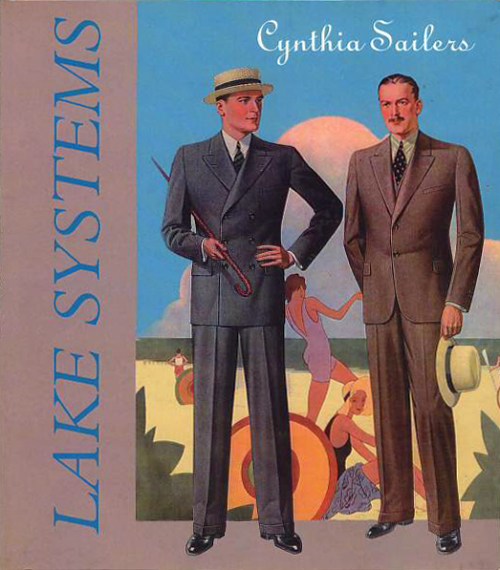
Cynthia Sailers, Lake Systems
(Oakland, Tougher Disguises Press, 2004)

Recently plucked a book more or less at random from my poetry bookcases and was delighted to rediscover one of my favourite book covers (and books): Cynthia Sailers’ Lake Systems. Those monumental men with knife pleats remind me of Anton Räderscheidt’s self-portrait—like Räderscheidt doing an ad for Coppertone.

It was a pleasure to re-read the poems in this collection, whose style swings from Ashberian lyrical to flarfish. I admire a book (and a poet) that doesn’t shirk from such swings, that doesn’t necessarily strive for cohesion or (shudder) authentic voice. Here are two:

from “10 Americans”

And yet we were the individuals who do not relate
to one another. When we find there’s a desire
to be crowded, to be all the numbers, or the observers
who would see in the faces that those faces were not
the answer. That those faces only pointed to
the amphitheatre of the mind in an hour of romantic
enthusiasm. If only we were immigrated, if only
we were knowledge, not like gardens, but underneath
it all, a shape of equal vividness, constrained by the one
thought we thought we wanted. A tracing of ourselves
against the beauty of lakes and grasses and colonial houses.
To be brushed along and kept close to the skin.
We were prepared to admit a solution for the lower forms
of life, for the seductive centuries and a break with
the past. And yet we were oscillating between the part
of ourselves that was set in motion and the part that lives
underground. I would sometimes get the feeling that
these parts were wanting to identify with the other, to find
another place to be free. A place with a view, a place
inside. To be freethinkers, to be identified with astrology.
If only their astrology was now moving them to new
places, moving them out of their feeling of oppression.

from “Lake Systems”:

The I(s) I Follow After

for Joan Retallack

I will not democracy churches conjecture
I pornography circa 1930 mockery
the bird I (pornography) usually suspect
dustbowl I situate o, love I imitate(or)
automatic I pepto-bismol I
juction boobs of new country I
laminate I New Jersey I, I
sensual topical bloom
I double-parked yoga live
grammatical attachment I office
I too numerous too non-union I life-
lessly convene I abstract mass
adulterous subject I promising water deficiency
I witness prison language I advances
western I p.s. represent misanthropic I
mid-century I nepotism I lost cause
I necessitate the point of impact I polygraph


Camille Martin

Poetic Polyphony in Scott Thurston’s Internal Rhyme

Shearsman Books, 2010


          In a previous post on musicality in poetry, I discussed the translation of simultaneity in music into a comparable literary expression. By simultaneity in music I mean polyphony, the vertical dimension of notes on the staff: the notes in a chord sound simultaneously as do the voices in a fugue. In literature, polyphony can be suggested by the simultaneity of thoughts, dialogue, or action by characters, as in the eight voices of the fugue in Joyce’s Ulysses.
          Scott Thurston’s Internal Rhyme beautifully translates the melodic and harmonic dimensions of music into poetry. The spatial division of each poem into quadrants allows both a horizontal (melodic) and a vertical (harmonic) reading of the lines. The vertical resonates with the horizontal, and the dialogue between melody and harmony opens up the semantic field. To use another musical analogy, what emerges from this dialogue is harmonic overtones, the acoustic phenomenon that enriches the experience of music.
          Because the most startling aspect of this collection is its formal innovation, I’d like to focus on possible strategies for the reader. Here’s an example from Internal Rhyme:

                    what I give myself to            haunted by surface
                    a polished shine                    or cloudy patina
                    it takes art to maintain         a perpetual crisis
                    taking everything                  you have

                    I want to give                        my heart out
                    to your ideal world                in its tension
                    I have to wait                        for the memory
                    for the poem                          to make it right

          At first blush, the possibilities presented by the quadrants seemed to me a kind of combinatorics, a conceptual experiment that reminded me a little of Raymond Queneau’s Cent mille milliards de poèmes, a series of ten sonnets whose interchangeable lines offer to the reader an almost inexhaustible series of permutations—to be mathematically precise, one hundred trillion sonnets can be generated from the conceptual machine of the ten original sonnets. Queneau’s Oulipian experiment stretches the limits of the readability of the set of ten sonnets in all of their permutations—an impossibly large number sonnets for the mortal reader to consume.
          In the case of Thurston’s quadrants, three obvious possibilities occurred to me: line-by-line (horizontally), left column-right column (vertically), and four vertical columns (left, right, left, right). But there was something disasatisfying about treating each of these readings equally, so I needed to find a more natural way to integrate the horizontal with the vertical. It occurred to me that treating the page as a musical score gave me a more rewarding entry into the intricacies suggested by the quadrants. In other words, I read the poem as horizontal (melodic) lines and allow my peripheral vision, so to speak, to note vertical (harmonic) configurations of three or four lines that enrich the reading, perhaps turning the poem on itself or opening up other semantic possibilities.
          First, my conscious mind gravitates toward a traditional line-by-line reading—partly from habit and partly because the syntactical flow of the poems in Internal Rhyme is most apparent that way. For example, in the above poem, although there’s no punctuation, my mind readily creates syntactical clusters and sentences from a horizontal reading.
          Note also the division into two equal parts that such a reading suggests: “what I give myself to” opens the first stanza, and “I want to give” opens the second. Metapoetically, the poem juxtaposes the poet’s experience and perception (what he gives himself to) with his translation of that experience into poetry (his desire to give himself over to the tension in the ideal world of the poem: the “perpetual crisis” that poetry sustains). The last two lines constitute the poem’s volta, in this case the condition upon which that translation into poetry is contingent: waiting for his memory of tension within his own experience.
          But the spatial division of the poem into quadrants compels me to notice the vertical possibilities as well. In the above poem, for example, a horizontal reading yields

              I have to wait / for the memory / for the poem / to make it right

whereas a vertical reading might yield

              I have to wait / for the poem / for the memory / to make it right

          Thus waiting for the memory of tension (in the previous reading) is aligned with waiting for the poem to emerge for the memory to “make it right.” The boundaries between experience, memory and poetic creation are thus nicely blurred into a riddle: is it unresolved memory that drives the poem into creation, or the poem’s creation that illuminates cognitive mysteries?
          Such an overlay of readings expands the poem exponentially as the mind picks up, consciously or subconsciously, variations in the configurations of lines. Reading the poems in this way allows me to blend the melodic and the harmonic dimensions to create a kind of polyphonic experience. To return to a musical analogy, the intricate texture of this overlay is like the harmonic overtones that enrich the experience of music.
          The analogies between music and poetry are ancient, and the innovative musicality of Internal Rhyme offers a richly legible and resonant kind of poetic polyphony.

* * *

From the Shearsman Books website:
Scott Thurston lectures at the University of Salford where he runs a Masters in Innovative and Experimental Creative Writing. He co-runs The Other Room reading series in Manchester, edits The Radiator, a little magazine of poetics, and co-edits The Journal of British and Irish Innovative Poetry with Robert Sheppard. He has published three collections with Shearsman.


Camille Martin

Looms in Talking Writing

Three poems from “Looms” (a work in progress) and a collage (Divers Remember the Naming of Gifts) recently appeared in Talking Writing: A Literary Magazine.


Camille Martin

Samuel Greenberg’s Braided Secrets

Self portrait, 1915


          Taking a cue from Charles Bernstein’s championing of the poetry of Samuel Greenberg (1893 – 1917), whose promise was cut short by tuberculosis at the age of twenty-three, I’ve been reading some of the poems readily available online through Michael Smith’s excellent website.
          Reception of Greenberg’s poems has been mixed. Allen Tate finds some of his work “turgid and bathetic,” although he also judges that “poetry of the twentieth century in the United States could not be complete without the publication of the poems of Samuel Greenberg.”
          Part of the difficulty of Greenberg’s work that gives rise to Tate’s claim of turgidity is its often vague or ambiguous syntax, its nonstandard punctuation, and its archaic poeticisms of diction and syntactical inversion. In a 1947 review, John Berryman judges that “Greenberg had with rare exceptions so little control over syntax (‘of grammatic assistance unguided’) that the best of them are inevitably those that . . . follow a catalogue development.” But while Berryman grants that the reader’s “allowances” in reading Greenberg’s can be “justifi[ed] in biography” (by which he means, I suppose, a less than ideal education), he also points out that time invested in the poems is often worthwhile, rewarding the reader with the realization that here is not vague inspiration (or, as James Laughlin, intending to be critical, put it, “unconscious dictation”) but instead craft and intention. Reading Berryman’s several astute interpretations of Greenberg’s poems, I gained an appreciation for Greenberg’s wielding of syntax.
          If Berryman’s attitude toward Greenberg’s syntactical acrobatics and ambiguities alternates between accepting them as limitations and elevating them to the level of deliberate craft, Bernstein’s assessment is less ambivalent: he appreciates them as characteristics of a “radically modernist dimension”: “His swerve from syntax as a principal of clausal subordination and hierarchy opens up the field of serial apostrophe that pushes to liberate itself from the confines of ‘literary diction.’”
          For me, both are true to a degree. Greenberg’s work does sometimes suffer from overwrought syntax and diction, but at the same time he is pushing the possibilities of language into a kind of musicality that cannot be expressed in a plainer style. The seemingly off-kilter clauses of his sentences, nudged out of the standard hierarchy, create a complex, braided language that withholds secrets. And the floating strands of that texture counter-intuitively creates more possibilities in which readers can interweave meaning.
         Below are three of his more interesting poems. In a subsequent post, I’ll discuss one of them in more detail and address the question, Is there sometimes an ironic stance at the heart of what Tate calls Greenberg’s bathos?

Immortality

But only to be memories of spiritual gate
Leting us feel the difference from the real
Are not limits the sooth to formulate
Theories thereof, simply our ruler to feel?
Basques of statuets of Eruptions long ago,
Of power in semetry, marvel of thought
The crafts attempt, showing rare aspiration
The museums of the ancient fine stones
For bowels and cups, found Historians
Sacred adorations, the numismatist hath shown
But only to be memories of spiritual gate
Leting us feel, the difference from the real
Are not limits, the sooth to formulate
Theories thereof, simply our ruler to feel?,

Night

Night! the lute as daylight But dim
A cloister strangly near a hill
Rang the evening chimes of prayor
The shadows of the miniature lamps
Shaped strange unseen, frightful creatures
Of horrid ghosts, vailed in pale caps
The solitude teeming in its hush
Let the unseen noises of insects clear
Buzz in their melancholy wiery hum
Dreams are short, But their Beauties are
Rare, night is long, causes thought
Its Freedom, of Fantasie to acquire
The grey demon clouds covered Heaven
Which hid the moon, but stars retreating fought

The Glass Bubles

The motion of gathering loops of Water
Must either Burst – or remain in a moment
The violet colours Through the glass
Throw up – little swellings that appear
And spatter – as soon as another strikes
And is Born – so pure are they of coloured
Hues that we feel the absent strength of
its power – when they Begin – they gather
Like sand on the Beach – each buble
Contains a complete eye of water.


Camille Martin

The Language of Desire to Speak: Joseph Massey’s Exit North


          Another just-received and welcome addition to Jay MillAr’s BookThug brood: Joseph Massey’s chapbook Exit North.
          In these poems, Massey depicts experience as a cross-hatch of perspective, sensory traces, and memory interlaced with symbols that continually learn and put to the test their nature-shaping patterns. If perception’s chaos is sorted out, linguistically occupied, cross-referenced with emotion and memory, it is also underlaid with emptiness: the page on which so much was believed to be written turns out to be blank.
          Experience lures language, which just as inevitably fades into silence just out of reach of the desire for the culmination of the senses in names, familiar and knowable. Attempts to understand, to order, to see yield “rhythms / looped through / the musicless field.” And this filtered experience of clamour full of trenchant detail leaves its traces as “an echo / gathering more / and more silence.”
          Massey’s poetic language enacts the rich mental process of knowing laced with the futility of perceiving the “sky clouded / by cloudlessness.” If, however, in the end we are left only with the desire to name, “to find / a word there,” that desire mitigates the abject state of being within impenetrable confusion: “the impulse [to speak] is enough.”
          A sampling to whet the appetite:

The Process

Cross-stitched
outside sounds
double the day’s

indoor confusion.
How to untwine
noise, to see.

There’s the bay,
highway slashed
beneath; water

a weaker shade
of gray than this
momentary sky’s

widening bruise.
The page turns
on the table, bare

despite all
I thought was
written there.

* * * *

Backdrop

From this hill’s vantage
all things become
whatever wind
makes them.

Electronic church bells
peal past overlapped
crow calls—

one left
circling,
recircling
a car lot.

* * * *

Bench

Cut grass, gasoline,
mound of rotted
weeds in a vacant lot

—the scent cast,
dense, with
each breeze—in

flustered shade.
What’s in a day’s
name: its slowly

summoned rhythms
looped through
the music-

less field—after-
noon’s clamor:
huddled

cars, deflated
bass lines
at a red light,

an argument
rattling the blue
aluminum trailer.

* * * *

Camille Martin
http://www.shearsman.com/pages/books/catalog/2010/martin.html

Reading the Minds of Events: Leslie Scalapino’s Plural Time

The following essay was published in a critical feature on Leslie Scalapino in HOW2 2.2 (Spring 2004).


Reading the Minds of Events:
Leslie Scalapino’s Plural Time

Camille Martin


In a stream of reassuring
argument the memory
forms a flight of steps
swinging out over the

Void …

—Norma Cole1

Narrative is neither an oppressor to be obliterated nor the validating force of all literary impulse.

—Carla Harryman2

          One of Leslie Scalapino’s primary concerns in her poetry is to question conventional ways of thinking about time in relation to event, experience, memory, and narrative. Her work relentlessly interrogates narrativistic categories and exposes essentialist ways of thinking about time and memory. Scalapino does not deny narrative’s causal and sequential linkage of events as a phenomenon in its own right. Instead, she uses narrative to question commonly accepted immanences within its framework.
          Unlike some work in the experimental literary realm with which she is associated, Scalapino’s poetry seems at first blush referentially and syntactically normative—or at least much of it is not so disjunctive that the reader cannot discern an underlying conventional sentence structure. People, events and objects often seem to be situated in a specific time and place, even though that place might not be described with many details. Indeed, the tone of her poetry can seem flat and stark, particularly to those unaccustomed to reading her work or unfamiliar with her philosophical project. The work seems to lack dimensions that might lend it the texture, feeling, or depth to which readers are accustomed in more conventionally descriptive or narrative writing. In her poetry, people sometimes seem faceless; activity takes place without psychologized or emotional drama; poetic sequences often omit a definite temporal or spatial orientation (instead, things seem to exist and occur in relation to all other things); and boundaries between self and other, public and private, past and present are everywhere transgressed. In addition, the iteration of actions or images in varying contexts gives the work a radically unfamiliar quality.
          It is just this feeling of an unfamiliar mental terrain that Scalapino constructs in order to demonstrate the illusions of hierarchy that conventional structuring of language can create and to show how this hierarchy influences the interpretation of one’s experience. For example, conventional narratives tend to place events along a temporal echelon of past, present, and future and to impose a structure of causality on events and phenomena. These temporal and causal conventions structure events and thought so that “activity and time per se” become “a condition of tradition.” Thus “both time and activity are a ‘lost mass’ at any time,” 3 and experience is drained of the kind of intelligibility that Scalapino associates with the non-hierarchical and simultaneous presentation of past, present, and future.
          In her writing, Scalapino attempts to imitate experience, as opposed to representing it according to a preestablished order, and to allow the multiple layers that create the memory of a single event to exist simultaneously without structuring them in an arrangement of prominence, causality, or in a psychologized drama. She reveals the simplest and most mundane of events to be instances of “social and interior constructions.” 4 She thereby demonstrates the radically impermanent nature of these events once they are no longer abstracted from present experience and attached to a constructed temporal order within a narrative or linked by allusion to other histories. She avoids the emblematic and descriptive framing of experience and resists the coalescing of experience into ordered wholes. Instead, her writing allows events (including memories themselves as events) to exist dependent upon one another, while avoiding the temptation to reify or essentialize experience. For when we attribute intrinsic existence to the phenomena of events, perceptions, or thoughts, it can seem deceptively natural to shape those phenomena into a conventional order whose relationship to the world seems transparent, inevitable, and even preordained. Scalapino chooses a more difficult kind of writing that critiques the construction of hierarchical dualities of inner and outer being, private and public experience, and the representation of events in time. She critiques the effects of such ordering by means of blurring conventional categories of existence and action in time and space.
          In the relentless thoroughness with which Scalapino attempts to dissolve putative boundaries separating dualistic realms, attribute a radical impermanence to all phenomena, and critique any last vestige of essence and immanence, her poetry resonates with certain strains of Eastern thought, and in particular with the thought of the ancient Buddhist philosopher and poet Nāgārjuna. Scalapino’s sympathetic reading of the philosophical verses of Nāgārjuna is evident not only in some of her essays but also in much of her poetry. My purpose in this essay is to show Scalapino’s treatment of the phenomena of time, memory, and event in her poetry by analyzing three works: a poem from the series “The Woman Who Could Read the Minds of Dogs,” a brief passage from New Time, and “bum series” from Way. I will also demonstrate the close affinity between the underlying philosophy of Scalapino’s poetry and Nāgārjuna’s philosophy of the Middle Way.
          Before elaborating on the influence of Eastern philosophy on Scalapino’s work, let us first read an early poem from the sequence “The Woman Who Could Read the Minds of Dogs.” Doing so will place in poetic context her concern with the relation between experience and the memory of past events, a theme that she continues to explore in subsequent books. A close reading of “on itself. His red hair was standing up) ‘I just began to weep’.” reveals how intertwined events and memories function within the poem to produce a feeling of temporal disorientation, and how the poem’s syntactical idiosyncrasies work in tandem with the content. 5 Here is the poem:


on itself. His red hair was standing up) “I just began to weep”.

Much later, after I had ceased to know the man who had once
described to me how , driving his new car with its top down
around and around the block (with his 1st wife in the car—
he said that he had been downtown with her drinking in a bar) ,
while he was looking for the entrance to the hotel parking lot ,
he had collided, or rather, had grazed the sides of 3 parked
cars ; as I said, it was much later when I was standing
on the jetty of a marina and watching a man standing up in
a motor boat, while he turned it around and around in circles.
“Well, (I remembered the man I had known saying about himself
—as I watched the man in the motor boat turning it slowly
on itself. His red hair was standing up) “I just began to weep”. 6


          Like many of the individual poems in “The Woman Who Could Read the Minds of Dogs,” “on itself” presents a narrative within a narrative. In the first of these, the speaker relates a story told to her by a friend in which he, driving with his first wife and circling around the block trying to find the entrance to a hotel parking lot, sideswipes three parked cars in the process. After this, he “just began to weep.” The speaker then relates a second incident, in which she sees a man in a motor boat going around in circles. In the second incident, her experience of seeing the circling boat reminds her of her friend’s story of circling in his car. The main common element in the two stories is the circular motion of the boat and car.
          Scalapino juxtaposes these two events and also conflates them through syntactical structures that disorient the reader’s sense of their discrete nature. In order to demonstrate how the syntax works to create a distinctive sensibility in regard to time, memory and experience, it may be helpful first to analyze the layers of time that overlap and spill into each other. There are five identifiable layers, in which (in chronological order):

1) a man and his first wife circle around a block in a car
2) the speaker hears the man tell of his experience in the car
3) the speaker sees a man circling in a boat
4) Scalapino writes the poem
5) the reader reads Scalapino’s poem

The list does not include events of remembrance, in which, for example, the man remembers his experience in the car, the speaker remembers the man telling of his experience in the car, and so forth. Such events of memory exist in potential infinitude.
          The poem opens with the third time frame in which the speaker, standing on the jetty of a marina, sees a man in a boat going in circles: “Much later, after I had ceased to know the man who had once / described to me how , driving his new car . . .” (emphasis added). The poem immediately switches to its two prior events: the man tells the speaker of circling in the car with his first wife, and prior to that, the event of circling around the block takes place. Midway through the poem, the speaker returns to the marina incident: “as I said, it was much later when I was standing / on the jetty of a marina . . .” In a parenthetical exegesis toward the end, Scalapino juxtaposes the three in simultaneity: “‘Well’, (I remembered the man I had known saying about himself /—as I watched the man in the motor boat turning it slowly / on itself. His red hair was standing up) ‘I just began to weep’.” By withholding syntactic closure and suspending the emotional gesture toward which the poem seems to be leading (“I just began to weep”), the whole poem seems like one long periodic sentence. The long subordinate and independent clauses, parenthetical interruptions, and grammatical solecisms are not resolved until the very end. However, unlike the formal result that might be expected of a sentence that is structured hierarchically, the effect of this periodic sentence that is more than the resolution of its parts is not order but temporal disorientation; one’s sense of time, place, and point of view is dislocated, suspended. The poem’s syntactical complexity and elliptical twists confound the events of narration and memory so that a sort of temporal reciprocity occurs among them: the playing field on which time, event, memory unfold is leveled. Furthermore, the superimposition of several narrative strands creates momentary confusion and produces a plurality of time frames. Thus the nature of historical events as discretely communicable phenomena is placed under question.
          If the dispersed sense of time and the syntactical ambiguities reticulate experience and memory rather than centralize it, they also move toward convergence, if not resolution. First, a simultaneity of events is suggested by the syntactical overlapping of the imagined time, the recalled time, and the current time. Second, there is a convergence of coinciding elements within the narratives; its topology resembles the converging of tributaries into one commingling and transformed river. Following the description of the man in the boat, the impetus of a linear narrative would logically be expected to continue in the context of the speaker and that man. The final gesture of weeping, although belonging semantically and originally to the man circling in his car, is attributable also to the speaker. If one disregards the parenthetical remark and the quotation marks in the last three lines, which refer to the context of the man in the car:


Well”, (I remembered the man I had known saying about himself
as I watched the man in the motor boat turning it slowly
on itself. His red hair was standing up) “I just began to weep
”. [Emphasis added.]


the syntactical inertia indeed impels us toward a weeping speaker, and by transference, to Scalapino and to the reader. The repetition of “standing” in reference to both the speaker and the man (“I was standing / on the jetty of a marina and watching a man standing up in / a motor boat . . . His red hair was standing up”) further implicates the speaker and the man in the boat in the same gesture, therefore facilitating the transference of “weeping” from the man to the speaker. Nevertheless, although weeping constitutes the emotional crux of the poem, the temporal disjunctures and clausal ambiguities result in the text’s resistance to the stabilization of the locus of the weeping and to the centrality of that emotional response.
          These simultaneous movements of divergence, reticulation and convergence generate much of the tension and instability of the poem. They also suggest metaphorically the schism between event and narrative; the associative infinity that, through the fractured (and fracturing) self, destabilizes the discrete historical event we know through conventional wisdom; and the coincidence (as in the simultaneity of “weeping”) of recreated events through that association.
          Scalapino is concerned to demonstrate a rupture between phenomena and our perception and memory of them, and ruptures between successive remembrances of a particular past event: “Perception itself is phenomena,” 7 and Scalapino is careful to distinguish between an event and the perceptual interpretation of that event. She is also concerned to demonstrate the same principle regarding writing as phenomenon. A consideration of the implied time frame of the writer further demonstrates this phenomenon of contradictory motions. First, the writing of narrative inherently exhibits the rupture between the writing and the event narrated: “The camera lens of writing is the split between oneself and reality. Which one sees first—view of dying and life—is inside, looking out into untroubled ‘experience.’” 8 Writing creates both a distancing from and a transformation of experience, in which the writer makes visible what was concealed. Scalapino’s writing of history involves the interplay among moments remote in time, as well as between those moments and the associations spawned by them in the speaker’s mind (and by extension, the reader’s mind). Such interplay, in a potentially infinite network recreating the past, is made accessible and public. The mind as creator of events and the writer as recorder of a thus pluralized history constitute the true narrative, for “No events occur. Because these are in the past. They don’t exist.” 9
          Lastly, there is the time frame of the poem’s reader, who also participates in and reconstructs the events of the narrative. In a phrase that echoes reader response theories, Scalapino writes, “Reading as imposing syntax, is creating reality as imposition on a formation of one’s thoughts and actions,” and again, “reading impos[es] a reality on us.” 10 For Scalapino, the reader recreates recorded events as they collide with his or her own remembered narratives, transforming them in the process into narrative phenomena in their own right.
          The actual and mnemonic events in “on itself” do not seem to lead to climax and closure as is often the case in conventional narrative, but rather these events suggest an infinite network of possible junctures and intersections of narratives. The coincidence of narratives suggests a circuity in events that “come up as the same sound pattern.” 11Scalapino’s poem reveals and expands meaning through the network of juxtaposed narratives. And through correspondences in thematic material, she explores the interplay of experience, memory, and written history. Scalapino would claim that events do not exist—other than as they are recreated and associated in the mind.
          She also addresses the inevitable lament that if events do not exist, then humans are forever alienated from any meaningful experience of reality. This would be the case, however, only in a philosophy founded on the possibility of epistemological certitude. Scalapino recovers experience by positing observation or “attention of itself as an activity,” 12 which is different from approaching experience with a drive for accurate or certain knowledge, and viewing the result of experience as a body of perceptional and mnemonic data that one possesses as a storehouse of one’s own experience. Instead, one attends to the process of observation, which is an event of attention, or as Scalapino has it, “watching as being itself action.” 13
          In her more recent writings, Scalapino acknowledges that she has been greatly influenced by traditions of eastern philosophy, and in particular by the writings of the early Indian Buddhist philosopher and poet Nāgārjuna, who lived approximately during the second century C.E. Nāgārjuna founded the Mādhyamika (Middle Path) schools of Mahāyāna Buddhism. His longest and most significant text is the Mūlamadhyamakakārikā (translated by Jay L. Garfield as The Fundamental Verses of the Middle Way). 14 The influence of Nāgārjuna’s systematic revelation of the emptiness of all conceptual, nominal, and conventional categories is evident in Scalapino’s thinking about the dispelling of conceptual illusions. 15 Given the influence of Nāgārjuna’s philosophy on Scalapino’s work, it will be useful to present a summary of some principal doctrines in his unrelenting critique of ontological and epistemological categories. 16
          In the Mūlamadhyamakakārikā, Nāgārjuna speaks of two realities or categories of truth. Conventional or nominal truth refers to the human conceptual framework. This is the quotidian reality that is shaped by social consent, the reality of common sense observation whose categories and referents seem accurate enough to our human judgment. We accept this everyday truth in order to get on in the world without spending an undue amount of time making simple decisions. Conventional existence, in this philosophy, is dependent upon the referential nature of language. However, Nāgārjuna argues that this conventional and nominal reality, while extremely useful, and while existing on a practical level, does not correspond to an independent reality. 17 Ultimate truth, on the other hand, is reality free of subjectivity, free of the linguistic constructions through which we interpret our perceptions of objects and events. It is independent of the perceptual and conceptual reality that always mediates human knowledge of the world. It denotes “the way things turn out to be when we subject them to analysis with the intention of discovering the nature they have from their own side, as opposed to the characteristics we impute to them.” 18 This truth can never be known from its side, but only through our perceptions of it. By means of an exhaustive and rigorous analysis, Nāgārjuna attempts to dispel every shred of illusion regarding the inherent existence of any category of reality, including emptiness itself. Emptiness cannot be upheld as a reality that is less empty than human categories, an essential void that stands beyond the pale of conventional reality. It is, like all other categories, itself empty, part of the nature of conventional reality. And it is the emptiness of emptiness that for Nāgārjuna is the link that keeps the two mutually contradictory realms in relation to one another, and that in fact explains their paradoxical unity. He demonstrates that the two realities are in a subtle, paradoxical and dependent relationship to one another.
          Nāgārjuna suggests that “what counts as real depends precisely on our conventions,” 19 yet he goes to great pains to demonstrate the emptiness of those conventions. And even emptiness has no inherent or independent existence, but is itself empty. To see an object as empty (of inherent or essential existence) is to see it as dependently arisen and as conventional reality. Any object “depends upon the existence of empty phenomena,” therefore “emptiness itself is empty.” 20 And for Nāgārjuna, the doctrine of the emptiness of emptiness is inextricably interwoven with the doctrine of the deep identity between the two truths of conventional reality and ultimate reality. Our interpretations of the world are ultimately empty of essence, and yet because emptiness is itself also a dependently arising phenomenon, it is also empty.
          Nāgārjuna’s Buddhism is not nihilistic in its denunciation of inherent existence. He does not intend to imply that reality is nothing at all, an absolute void without matter or shape. Instead, “the actuality of the entire phenomenal world, persons and all, is recovered within that emptiness.” 21 When he speaks of the lack of existence, he speaks of what we might call “essence” or “inherent existence,” that is, an existence with properties apart from human attribution of a bounded entity with properties, as if there were a direct correspondence between language and the object it describes. Morality and salvation are just as crucial to Nāgārjuna’s philosophy as his emphasis on pervasive emptiness. For Nāgārjuna, the recovery of the former is, paradoxically, dependent upon a full understanding of the latter. His critique of inherent existence insistently breaks down all conventional and nominal categories, which impose hierarchies and attributes that humans often come to believe as fixed and stable. His philosophy is one of radical impermanence and emptiness, yet it is also profoundly concerned with morality.
          Thus Nāgārjuna’s philosophy is not dualistic, nor is it nihilistic. The doctrine of emptiness is closely interwoven with the doctrine of the identity of the two truths or realities, and within this doctrine is recovered a strongly soteriological and moral ground. For, Nāgārjuna’s logic goes, with an essential or inherent nature, how could one hope to effect the change necessary to become enlightened?
          The brief explanation above offers an overview of some important points within Nāgārjuna’s complex and subtle argumentation in the twenty-seven verses of the Mūlamadhyamakakārikā. For my purposes, one of the most important features of his philosophy of the middle way is the holding of two contradictory truths at one time (their radical difference), and the simultaneous erasing of the boundaries between them (their deep identity). Nāgārjuna does not set “ultimate reality” on a pedestal as the more important of the two realities, but instead seems to keep the two in perpetual tension, mutually informing one another in a relationship of balanced dependence and dialogue.
          Scalapino’s reading of Nāgārjuna profoundly influenced her thought and work, which engages in a critique of essentialized thinking about phenomena, and invites the reader to consider the ultimate emptiness of our constructions and interpretations and to realize that “all phenomena and perception are groundless.” 22 The poetry that she values

articulates a critique of ‘one’s assumptions’ (one’s observation, or of perception itself as cultural) by perceiving or rendering perception as being without basis. At the same time, this examination of subjectivity in fact can work as a critique and revelation of our culture.
          In other words, by undercutting the observer, one has a perspective of place that is both spatially ‘interior’ and ‘outside’—a relativity. 23

“The observer” to be undercut is the idea of the individual’s unique perspective on reality and his or her unawareness of that perspective as socially and individually constructed—in other words, its status as a category that, in Nāgārjuna’s sense, is empty of inherent or transcendental quality. “The deconstruction of our view of reality is oneself in one time not maintaining either one’s own subjective view or the social or phenomenological interpretation of occurrences. Nor is this ‘not holding a view.’” 24 Instead, one must maintain a “perspective of place” that is simultaneously interior and exterior, aware of the mediation of one’s perception yet also attempting “to find out what’s there, as occurrence.” 25 Perception may indeed be empty, “without basis”; however, its critique is paradoxically arrived at through the very nominal categories called empty. And thus this very practical vehicle of the critique is not devalued in relation to ultimate reality.
          In Scalapino’s view, neither the phenomenon itself nor its apprehension by the mind has inherent existence. 26 She attempts to demonstrate this in her writing through her treatment of narrative, which dismantles sequential events by showing that narrative as well as one’s sense of the discrete division of time into past, present, and future has no basis outside our conceptual framework. 27 On the other hand, her work does not try to demonstrate the inferiority of narrative. To the contrary, she paradoxically investigates narrative through narrative and imagines a presentation of phenomena unfolding in time that is radically different from the conventionally linear ordering of events that are held together by the glue of causality and intentionality. Thus she criticizes “[t]he contemporary poetic-polemics association of ‘narrative’ as being only convention—‘experience’ thus denigrated, not regarded as exploratory,” for this position “in fact does not allow scrutiny of one’s own polemic.” 28 If avant-garde poets see their task as being only the dismantling and denigration of conventional constructs of time and narrative sequence, then they deny from the outset the very thing that is crucial to a dialectical development of their critique. What is needed is a dialogue between the natural and human impulses to link events in a narrative sequence and the recognition of the emptiness of that linkage from the standpoint of extrasubjective reality—Nāgārjuna’s ultimate reality. And that critique, according to Scalapino, must also include self-scrutiny.
          An examination of passages from two of her works demonstrates her “middle way” of conceptualizing events occurring in time and the process of remembering and recording them. New Time, a recent book-length work by Scalapino, effectively demonstrates some of the notions that have been a constant concern in her poetry and poetics. 29 In this work, she also makes expressively clear the political implications of one’s attitude toward such categories as history and narrative. New Time is a long meditation on how time might be thought if one were to dispense with many of the hierarchies that one takes for granted in the experience of actions and thoughts and in the writing of these events. If one is to dispel one’s illusions of the inherent existence of memories and their correspondence to actual events in a continually receding present moment, then one must realize the extent to which language shapes one’s interpretations of perceptions. 30
          For Scalapino, writing itself is an event that is as remote from a past event as one’s memory of it. According to her, writing about an event does not have a causal relationship to the event itself, which also has no inherent existence since it is in the past. Writing about an event (like thinking about an event) is an event itself, a new time in its own right, a present experience that attempts to recall a nonexistent event yet is tinged with all other events perceived since the experience of the event that prompted the writing: “Remembering everything, all layers at the same time, writing is the mind’s operations per se and imitation of it at the same time.” 31 Herein lie two meanings of “new time”: it is at once a new way of conceptualizing time as well as a guide for a more zen-like experiencing of the “new time” of the present moment.
          In her discussion of her play The Present, Scalapino describes this phenomenon of writing as a means of revealing the mind in the act of structuring reality yet also as a means of creating its own reality. In the play, the characters speak their actions as well as enact them. These verbalized and acted movements are followed later by “sequences of observation or discursive commentary,” which are “spoken and also shown as handwritten phrases on slides.” The separation of the passages of action and those of conceptualization causes these obverse phenomena “to collapse becoming one—always being separate. It is ‘as if’ we’re seeing and reading mind structuring.” The events are simultaneously related (they “becom[e] one”) and individuated (“always being separate”). 32 The boundaries between event, conceptualization, and writing (narrative) are collapsed at the same time that each of these phenomena is held to be a discrete event in its own right. Conceptualizing events by verbalizing or writing them tends to cause one to blur the boundaries between narrative and event, as if one is reliving a phenomenon that somehow still exists through the recreation of it. The artifice of narrative obscures the speaking and writing of an event as events themselves: “Writing not having any relation to event/being it—by being exactly its activity. It’s the ‘same thing’ as life (syntactically)—it is life. It has to be or it’s nothing.” Writing is both an imitation of the motion of the mind (and indeed, of perception itself) constructing and categorizing and associating events, and an event, a motion, an activity, in its own right. Scalapino’s writing

inverts the insight that social constructions are always necessarily mediated through language . . ., suggesting instead that these vehicles of mediation are themselves the central constituents of experience—hence the text becomes the act. Scalapino asks that the reader acknowledge that the text doesn’t simply represent reality for us (albeit in an ideologically governed way) but produces a reality on its own terms. (emphasis in original) 33

Scalapino writes the mental terrain as experience and reveals the process by which we construct that terrain. This process renders us more consciously aware of the rupture between an event and its interpretation or imitation in writing, as well as of the phenomenon of writing as life.
          New Time, like many of Scalapino’s previous works, is in the form of a series of short blocks of text. Each block in the series consists of one or more paragraphs. Here is the first block:

          there’s still on the rim of night (having been in it) which is (in night) there as his horizontal lying rest in snow—breathing in breath ‘at’ the light day

          overwhelming the mark being ‘by’ his ‘action’—there—only. one’s—only breathing in breath—not night or day.

          past cold, the man kneeling in snow—outside, one—which is horizontal waiting—in ‘falling snow’ overwhelming of the mark, the other being in it—only. as being the only overwhelming of rim.

          that he’s—‘running’—by being forward ‘lying’ which is waiting (outside): ‘by’—on the ground in rim of snow dropping on sky and floor only. 34

In this brief and rather disorienting episode are encapsulated some of the thematic materials that undergo many permutations during the course of the sequence, giving the impression of an infinity of possible recontextualizations. The whole does not have a conventional climactic narrative shape, but instead proceeds incrementally and elaborationally. Its line of development is not a trajectory moving toward a goal but an investigation in a psychologically flattened field in which neither the outside¬ realm of discursive, socially sanctioned language nor the interior language of individual subjectivity are allowed to settle into anything resembling a conventional descriptive or historical account. Instead, interior and exterior states of being are allowed to become blurred, to commingle and to critique one another so that the language of neither individual psychology nor the larger political and social realm can be reified or seen as having an essential or separate existence. Nor can the recounting of events be construed as uncomplicated history. Instead, the writing posits itself as phenomenon and tends to resist at every successive reading any stable interpretation. Its structure and syntactical displacements complicate dualities of time, perception, and history, and destabilize hierarchical formation.
          The setting, point of view, and action in time can only be described in plural and provisional terms. The time of day shifts so that the passage, taken as a whole, does not clearly seem to take place at either night or day, dawn or dusk. Or rather, it is all of these and thus also none of them. It is a place and time “on the rim”; the time is “not night or day” but instead a state between darkness and light, night and day, action and rest, subjective and objective, inside and outside. This middle ground state is reminiscent of Nāgārjuna’s formulation of the middle way in the Mādhyamika school of Buddhism. It is a state on the cusp that is empty of determinable coherence, yet that is continually “overflowing the mark,” its significance overdetermined at every turn as various themes and events are repeatedly recontextualized and perceived in different time frames. This state recalls Scalapino’s description of “a relativity” in which both inside and outside, past and present, can occur simultaneously. Scalapino acknowledges the hierarchy imposed by interpretation and conceptual categorization and posits a new time that exists not as a reflection of the past or a reference to the future: “[New Time] is ‘about’ time in that a new time occurs outside as being the present moment ‘then,’ which is separate from either the text or the interaction between the people (and separate from the interaction between one’s reading and one’s present mind) but arising ‘between’ these.” 35 In this rather difficult passage, Scalapino theorizes an in-between state of apprehending the new time. This temporality is not equivalent to any of the discrete time frames associated with an event, the recording of the event as written text, the performance of the event for an audience, or the reading about the event by an individual. It is not the occurrence of any of these phenomena alone as somehow representing any other occurrence, yet it is also all of them. It is a temporality outside them (not restricted to a point of view) and also between them. It is a temporality not separate from the event.
          In the text, dawn and dusk are interchangeable; their relatedness consists in the fact of their having both once been in the present, and their recurrence as a phenomenon of the writer’s and reader’s experience of the text, occurring with no basis for intrinsic reference: “Dawn is at the same time as dusk ‘as’ present time. Syntax ‘there’ (of the text) is relational as if a ‘time’ of . . . muscular physical motion. . . . It is a ‘time’ not as speech or sound per se—but as the reader’s experience of simultaneous relating and dis-connection only. There is ‘to be’ no basis.” 36 Scalapino posits timeframes (dawn and dusk) as syntactical constructions and shows their relation to the actual “muscular” events of physical movements as one of dissociation. Yet they are also related in the mind in the experience of the reader. The experiences of “relating and dis-connection” are, paradoxically, simultaneous, with no hierarchical positioning between them.
          Scalapino posits a radical critique of rationality at its earliest, most elemental inception—the moment of perception and the incipient work of the brain to interpret perceived phenomena, including that of reading a text. Indeed, “Perception itself is phenomena,” just as the perceived event is a phenomenon:

My focus is on non-hierarchical structure in writing. For example, the implications of time as activity—the future being in the past and present, these times separate and going on simultaneously, equally active . . . suggest a non-hierarchical structure in which all times exist at once. And occur as activity without excluding each other. 37
. . . . .
          (My) intention—in poetry—is to get complete observing at the same instant (space) as it being the action.
          There’s no relation between events and events. Any. They are separate. Events that occur—(regardless of their interpretation—). (But also that they are at once only their interpretation and only their occurrence.) 38

The repetition of the word “only” in the opening of New Time suggests just this separation of events through the emptiness of their causality. In other words, events are separate because no matter what spin we put on the causal relationship between them, they are, according to Nāgārjuna’s category of “ultimate truth,” free of subjectivity, perspective, linguistic construction, interpretations, and intentions. But as Scalapino hastens to add, since the reality of our interpretations and nominal attributions are not to be denied or negated, and since we have only perception and thought with which to judge existence, events are simultaneously our interpretation of them. Scalapino’s is not a nihilistic universe but instead one in which perception has been radically de-hierarchicalized and critiqued in order to realize its merely apparent essential correspondence with exterior reality:

A phenomenon hasn’t inherent existence—as it is not based on a single moment of a mind, nor on successive moments of a mind, as such moments arise dependently (don’t exist inherently, not being that phenomenon itself—though appearing to be). In other words, the apprehension or the ‘moment’ of the mind appears to be the phenomenon itself, which the mind itself is seeing. Neither exists inherently. 39

The “onlyness” of events, which I take Scalapino to mean the emptiness of causality between events, is similar to Nāgārjuna’s (and more generally, the Buddhist) doctrine of “dependent co-origination.” Nāgārjuna rigorously deconstructs the notion of any phenomena’s inherent or independent existence. Our perceptions may convincingly persuade us of their identity with their object, of their direct and correspondence with an independent reality. However,

An existent entity (mental episode)
Has no object.
Since a mental episode is without an object,
How could there be any percept-condition? 40

Our perception posits no direct correspondence to phenomena; instead, our perceptions give the illusion that what we see gives us knowledge about the actual object, knowledge that corresponds directly to that object. What we perceive is, in effect, the mind seeing its interpretation of what is out there. According to this view, our experience is dependent upon interpretations of perceptions, which are dependent upon the structure and functions of our body, including its production of language, and its interactions with other bodies and phenomena. 41 Nothing within or without human existence has permanent, inherent, essential, or independent qualities. The aim of a conceptualization of perception based on dependent co-origination is to yield a view of reality freed of the illusions of a model of direct correspondence and simultaneously to posit the ultimate emptiness of such dualisms as inner and outer, public and private, subject and object. For each term of a duality is contained within the other, indeed in a sense is the other and is dependent upon the other, without, however, necessitating a causal link between them in which the one somehow inherently brings about or influences the other. Scalapino suggests the emptiness of this causal link above when she states that “[t]here’s no relation between events and events.” As we have seen, Nāgārjuna posits a deep identity between the doctrines of conventional and ultimate reality, opposed doctrines that at first introduction to his philosophy might seem like a definitively dualistic formulation.
          For Scalapino, writing that attempts to capture one’s memory of experiences in descriptive detail or narrative and causal links can perpetuate illusions about the ways that we actually perceive, encode, and recall phenomena. Her project is instead the persistent disillusionment of notions regarding any notion of permanent or essential nature of experience, memory, and perspective. Our interpretation of phenomena depends upon our perception and memory, and Scalapino goes to these roots of cognition to investigate how we formulate and come to believe in mnemonic illusions. Her process demonstrates the constructed, impermanent, and creative nature of memory. To alter Heraclitus’ maxim slightly, she demonstrates that one is never able to step into the same mnemonic river twice. This phenomenon is what Scalapino refers to when she says that

A segment in the poem is the actual act or event itself—occurring long after it occurred; or acts put into it which occurred more recently. They somehow come up as the same sound pattern.
The self is unraveled as an example in investigating particular historical events, which are potentially infinite. 42

The text itself is an event that reenacts the prior event it records, and intersects or collides with other “acts which occurred more recently.” Indeed, events related by the speaker become interrelated moments that exist in potential infinitude in the mind. Such recreated and recreating events are exposed through the unraveling of the self in the writing of these moments.
          Thus Scalapino does not negate the convention of narrative, which would lead to a dualistic position not admitting dialogue between conventional or nominal reality and an imagined reality empty of the subjective creation of categories and temporalities. Instead, her work engages both realities in a dialogue that acknowledges narrative convention and its illusions. Her work leads the reader to become hyper-aware of the artificiality of the tenses and causalities that one constructs in narrating events and of the illusory nature of the project of reproducing events linguistically, so that one feels that the words somehow intrinsically correspond with or attach to a phenomenon. To recall an event is, according to Scalapino, its own event. This notion is a truism within cognitive science. As neuroscientist Richard Cytowic states,

memory . . . is a creative process during which the state of the brain’s electrical fields change. The sensory cortices generate a distinct pattern for each act of recognition and recall, with no two ever exactly the same. They are close enough to cause the illusion that we understand and have seen the event before, although this is never quite true. Each time we recall something it comes tainted with the circumstances of the recall. When it is recalled again, it carries with it a new kind of baggage, and so on. So each act of recognition and recall is a fresh, creative process and not merely a retrieval of some fixed item from storage. 43

Even though humans often have the illusion of thinking of memory as a simple process of retrieval of stored information, and that each time a memory is recalled it is a faithful repetition of the first time it was recalled, this is not the case. As far as memory is concerned, there is no such thing as repetition. And this phenomenon of the fundamental non-identity of events and memory goes to the heart of Scalapino’s revision of notions of narrativity.
          Considering her emphasis on the radical impermanence as well as the emptiness of essence at the heart of any narrative endeavor, it is fitting that her work never arrives at a stasis but instead constantly produces a paradoxical relationship between its narrativistic and anti-narrativistic impulses, that is, between passages that describe phenomena and those elements that disrupt such description. Scalapino is not engaged in a denial of story. Indeed, within her works she tells many stories. Rather, she is concerned in her work to level the field that includes an actual event and the narrative that describes it so that they occupy more or less equal regions on a plane, so to speak. Each is a phenomenon in its own right, and each has properties of impermanence and the lack of an essence that can be fixed temporally or semantically. And neither is subordinate to the other: narrative is not subordinate to the event that it attempts to mimetically reproduce, and the event is not subordinate to a notion of a lasting monument of its description. Instead, Scalapino shows the two terms to be mutually dependent: they are in constant dialogue with one another, interrogating one another’s position so that neither is seen as predominant or superior to the other.
          One point that is crucial to the consideration of Scalapino’s project of questioning our conceptual habits of structuring time is that cognitive science prioritizes motion before time. No matter how we express ideas of time, they are always dependent upon the particular kind of metaphor used, and it is misleading and fallacious to reify what were conceptual metaphors in the first place. In her works, Scalapino often isolates motion and merges time frames, as if time were not an outwardly reified entity passing along a linear continuum (a metaphorical conceptualization), but something created and recreated inwardly, in a blooming, buzzing confusion of present, past, and future.
          Scalapino’s poetics attempts to reverse the impulse to reify and to give priority to ordered and hierarchicalized time (tradition) and to make motion and the experience of time subservient to tradition. Such a cultural imperative tends to impoverish experience, which in a conservative worldview must be understood as a condition of the conceptualization of motion and events. Relinquished in Scalapino’s view is the articulation of public and private spheres, so that the possibility for action and present experience to be recovered outside conventional conceptualization remains alive:

Activity is the only community. The conservative gesture, always a constant (any ordering, institutional and societal) is to view both activity and time per se as a condition of tradition. As such, both time and activity are a “lost mass” at any time. “For just as modern man has been deprived of his biography, his experience has likewise been expropriated.”

The recovery of experience allows community interactions to take place in a greatly enriched field of possibility, without the necessity to integrate dualities, but also with an understanding that the drive to order and prioritize them is not a determinant of an order of truth that exists outside us.
          In “bum series,” a section within her book-length poem Way, Scalapino explicitly shows the interdependent relationships among entities. Moreover, she confounds perspectives and time-frames so that if a reader is expecting a psychologized narrative describing how the “bums” came to live—and die—on the street or how the “I” enters the causal sequence of events, such expectations are everywhere deflected. Events and relations, not time, are primary. The insistent dashes in the poem string together interruptive clauses, constantly reminding the reader of the relationships among entities in the poem, as in the first four stanzas:

the men—when I’d
been out in the cold weather—were
found lying on the street, having
died—from the weather; though
usually being there when it’s warmer

the men
on the street who’d
died—in the weather—who’re bums
observing it, that instance
of where they are—not my
seeing that

cranes are on the
skyline—which are accustomed
to lift the containers to or from
the freighters—as the new
wave attire of the man

though not muscular
—but young—with
the new wave dyed blonde hair—seeming to
wait at the bus stop, but
always outside of the hair salon

Scalapino fashions a temporal poetics in which time does not consist of a series of discrete beings or things occurring in a sequence of measured moments and happenings among which can be traced a narrative held together by the glue of causality. Objects, persons, and events do not possess discrete or inherent existence; instead, they always arise in a relationship of dependence, or rather interdependence. They are recorded in a web of motions and events that we only seem to perceive as the phenomenon itself. Not only are boundaries between subjectivities and tenses blurred, but also the more conventional narrative and descriptive ordering is actively destructured and flattened. This ordering occurs as a series of related or dependent phenomena.
          For example, although the title focuses attention on the morally charged primary event of the series, the death of the bums, the bums and their deaths are brought into relation with several other events, consciousnesses, and entities, including cranes, freighters, a man in new wave attire who works in a garage, the “dumb” speaker, oil rigs, and the “present president.” The event that was invisible to the community—the death of the bums—is brought into ordinary, matter-of-fact relation to surrounding people, events, and things and to the sphere of political and economic power. The very invisibility of the event is a barometer of the community’s malaise: its snobbery, uncaring attitude, and ignorance. The poem enacts the relations among the various persons and entities yet resists their dramatization, which would assign a causal relationship and hierarchical ordering to events. Self-sufficiency seems absent in the series. Instead, all movements, events, and entities exist and function in relation to others. The writing enacts the relation between the “public figure” and “the freighter,” “[the relation] of the man with the dyed / blonde hair and / new wave attire—and / the freighter,” “[the relation] of our present / president . . . to the freighter,” the relation of the “social struggle” of the bums “to the freighter,” the relation of “the person of / new wave attire . . . to / the freighter,” and so forth. The writing also demonstrates that the relationship of self to self is a complicated one, conditioned by the interpretations of others and one’s interpretation of one’s own identities: “[T]he man in the new / wave attire” exists not inherently or independently but “as the relation / of him / being another person,” and “as / the freighter” and also as “his and its relation.”
          However, some entities and events seem to be in an inverse or negative relation to others, notably the “present president” in relation to the bums and their social struggle. To the president, the bums are “abroad,” not in his own country and therefore in a vacant locus, always elsewhere and never included. Or rather they are included (living within the city limits, haunting its streets, and in the potential care of the state and community) as an exclusion (relegated to exist and perish outside that care). In a protectionist state, they exist outside the rope that separates those who belong from those who do not merit the paternalistic beneficence of the state. Thus the president is in an inverse relation to the bums “when there’s a social struggle in their whole setting, which is abroad.” But the bums themselves seem unaware of the social struggle, involved instead in the struggle for existence and survival on the streets. Not to “have desire—of the present” is to remain “dumb,” ignorant of social struggle and social interrelatedness.
          Although the speaker confesses her ignorance, she also has the possibility not to remain as “unrepaired” as the car, not to remain in a senseless time, unable to experience the presence or to sense—in the sense of both understanding and perceiving—the interrelatedness and dependent nature of existence. She “almost froze” at the same time as the bums, “and realized I / could die from it.” Then she both doesn’t care and also realizes that it’s not possible for her not to care, since she and the bums cannot have inherent existence atomistically separated from each other. “[W]hen that’s senseless,” when not caring makes no ethical sense, her ignorance has been repaired, as the car may be repaired. However, the car has not been repaired at the time that the bums die from the cold. Thus, as if in sympathetic vibration with a broken-down car in the same setting, the bums are, even in their death, experiencing “grinding and / movement in relation to it.” The ending brings home the critical issues at stake for Scalapino in a dark and starkly comical moment.
          Scalapino doesn’t so much shock us into the recognition of the bums’ relation to the various parts and to the whole of the community as make us feel discomfort at the metaphysical rug of time and description and their hierarchical accoutrements being pulled from under us. And it is in this zone of unease, in which we no longer have the comfort of temporal and causal handles, of hermeneutical certainty, or of the truth-correspondence of perception and cognition to an extrasubjective reality, that we find ourselves adrift in the free-floating strangeness of a world of phenomena and events in dependent relation. Discrete things and happenings do not ineluctably and irretrievably recede into a past that we continually try to recapture through historical representation of a selective narrative with causal links. Instead, Scalapino uses writing to invite critique of the experientially alienated self, the self incapable of experiencing movement and event, bound instead to a dualistic, atomistic, and mechanistic conception of existence. In “bum series” she presents the possibility of a “dumb” existence lost to the universe of becoming, prioritizing lost time and reifying time and its passage.
          She also, however, presents the possibility of disabused existence in which the present event is given priority and in which inner and outer clocks only seem to correspond to reality. The speaker has awareness and the possibility for self-critique that the other “snobs” do not seem to have. In the writing, then, is the possibility of greater self-awareness and the realization of Nāgārjuna’s dependent co-origination of the phenomenal world. This view of reality is opposed to what cognitive scientists call the illusion of the “homunculus,” which is to say the discrete, disembodied, rational mind that is independent of other homunculi and that believes in the capacity to capture the past with a truth that somehow corresponds with external reality.
          Scalapino’s project of paying close attention to one’s perception of ongoing motions and events in an attempt to recover experience not yet steered into temporal categories and trajectories is closely related to the project of recovering experience in a reality that is constantly being shaped (often without one’s consciousness of it) into categories of intersubjective relations and private and public realms of experience. Her poetry aims to open the field of possibility for experience, both individual and social.


Notes


1Norma Cole, Desire and Its Double (Saratoga, Calif.: Instress, 1998), n.p.

2Harryman, “Toy Boats,” in Animal Instincts, 109.

3Leslie Scalapino, The Public World / Syntactically Impermanence (Hanover, N.Y.: Wesleyan University Press, 1999), 3.

4Leslie Scalapino, R-hu (Berkeley: Atelos, 2000), 83.

5Ibid., 33.

6Leslie Scalapino, “The Woman Who Could Read the Minds of Dogs,” in Considering How Exaggerated Music Is (San Francisco: North Point Press, 1982), 31-50, originally published as The Woman Who Could Read the Minds of Dogs (n.p.: Sand Dollar, 1976).

7Scalapino, The Public World / Syntactically Impermanence, 53.

8Leslie Scalapino, How Phenomena Appear to Unfold (Elmwood, Conn.: Potes and Poets Press, 1989), 22.

9Ibid., 21.

10Ibid., 30.

11Ibid., 21.

12Scalapino, The Public World / Syntactically Impermanence, 13.

13Ibid., 13.

14Jay L. Garfield, “Introduction to the Commentary,” in The Fundamental Wisdom of the Middle Way: Nagarjuna’s Mulamadhyamakakarika, by Nagarjuna (New York: Oxford University Press, 1995), 87.

15Scalapino’s discussion of her affinity for Nagarjuna’s work is contained in her essay “The Recovery of the Public World,” in The Public World / Syntactically Impermanence (Hanover, N.H.: Wesleyan University Press, 1999), 53-62.

16In my discussion of Nagarjuna, I am indebted to Garfield’s clear analyses of the often puzzling and obscure verses of the Mulamadhyamakakarika . See his introduction and commentary in The Fundamental Wisdom of the Middle Way: Nagarjuna’s Mulamadhyamakakarika, 87-359.

17Garfield, “Introduction,” 88-89.

18Ibid., 298.

19Ibid., 89.

20Ibid., 316.

21Ibid., 94-95.

22Scalapino, The Public World / Syntactically Impermanence, 55.

23Ibid., 55.

24Ibid., 54.

25Ibid.

26Ibid., 53.

27Ibid., 55.

28Ibid., 20.

29Leslie Scalapino, New Time (Hanover, N.H.: Wesleyan University Press, 1999).

30For example, in the preceding sentence, my description of the past as “receding” uses a common metaphor in which the future is in front of oneself, the present is where one is located, and the past is behind oneself. This metaphorical structure for temporality is common among cultures worldwide, but is not the only way of conceptualizing time. As Lakoff and Johnson point out in Philosophy in the Flesh, in the language of Aymara, spoken by a Chilean people of the Andes, the past is in front of oneself and the future is behind oneself. Lakoff and Johnson claim that an analysis of metaphors for time is important to philosophy because it is easy to be led astray by such metaphors. The force of linguistic habit leads us to take these metaphors as literal fact instead of as a useful conceptual apparatus. For example, if one thinks of an event as taking place within a duration of time, then one may be led to believe that the event and the duration are separate phenomena, and therefore that time has “a metaphysical existence independent of events.” See Lakoff and Johnson, Philosophy in the Flesh, 156-57. The entire chapters on “Time” (137-69) and “Events and Causes” (170-234) are helpful to understand how cognitive categories shape ways of thinking about time, events, and causality.

31Scalapino, The Public World / Syntactically Impermanence, 4.

32Ibid., 12.

33Nicky Marsh, “‘Notes on My Writing’: Poetics as Exegesis,” Postmodern Culture 8, no. 3. Retrieved September 9, 2002, from the World Wide Web: http://muse.jhu.edu/journals/postmodern_culture/v008/8.3r_marsh.htmlMarsh, 2, paragraph 4.

34Scalapino, New Time, 1.

35Scalapino, The Public World / Syntactically Impermanence, 35.

36Ibid., 36.

37Ibid., 3.

38Ibid., 16.

39Ibid., 53.

40Nagarjuna, The Fundamental Wisdom of the Middle Way: Nagarjuna’s Mulamadhyamakakarika (New York: Oxford University Press, 1995), 4.

41See Garfield, commentary to “Examination of Conditions,” The Fundamental Wisdom of the Middle Way, 117-18: “If we consider a particular moment of perception, the object of that perceptual episode no longer exists. This is so simply because of the mundane fact that the chain of events responsible for the arising of perceptual consciousness takes time. So the tree of which I am perceptually aware now is a tree that existed about one hundred milliseconds ago; not one that exists now. The light took some time to reach my eye; the nerve impulses from the eye to the brain took some time; visual processing took still more time. So if the story about how the tree is the percept-object condition of my perception according to which the tree exists simultaneously with the perception and exerts a causal power on my eye or visual consciousness were accepted, perception would be impossible.”

42Scalapino, How Phenomena Appear to Unfold, 21.

43Cytowic, The Man Who Tasted Shapes, 192-93.

44Scalapino, The Public World / Syntactically Impermanence, 3. Scalapino is quoting Giorgio Agamben, Infancy and History: The Destruction of Experience, translated by Liz Heron (London: Verso, 1993), 13.

45Leslie Scalapino, “the bum series,” in Way (San Francisco: North Point Press, 1988), 49-61.


Camille Martin
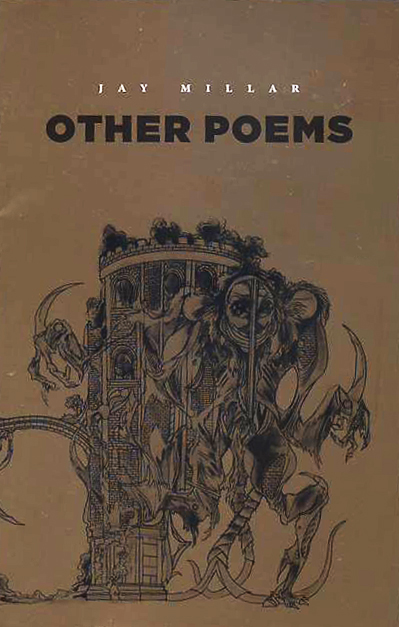
The Fledgling Book Flies the Nest

          This post is more meditative and personal than most of my literary musings, but I’ve been thinking about various reactions to some of the poems in Sonnets.
          As I was putting together the final manuscript of Sonnets, naturally I made certain decisions about which to include and which to put on the back burner, perhaps for future revisions. As well, in the final, published, version, there are some sonnets that I feel closer to than others.
          But once my book goes out into the world, I have no control over which poems, to quote Dickinson, make readers feel physically as if the top of their head is coming off, and which, not so much.
          For example, one friend named a sonnet that he particularly enjoyed. It was one that in the editing stage I had seriously considered tossing. This has happened often enough to bring home the point that after a work is released into the world, the author becomes largely irrelevant, unless biographical information contributes to the meaning of a poem (my Katrina poems, for example)—and even then. Unmoored from the intentions and contextual significance in the mind of the poet, readers become, to use Barthes’ term, writerly. I might not share a certain predilection for or interpretation of a poem, but who am I to say? And it’s a pleasure for me to know how others are reading my work.
          At a reading, I sometimes find myself about to start talking about what the poem means to me and then catch myself, so as not to impose a set of significations to the poem.
          And in the editing stage, when I had trusted friends help me to edit the manuscript, one editor felt that a certain sonnet should be dropped, while another felt it absolutely must be included. I hated to be the one to break the tie, but more often than not, iI decided to include it, since at least one seasoned poet felt strongly about it, and I didn’t want to deny the little sonnet its chance to shine, even if only for a minority of readers.
          It can be illuminating and broadening to read other’s interpretations of particular poems. Not long ago, Bill Knott wrote a sensitive and insightful analysis of one of the sonnets, “comatose in paradise,” in which he gave it a depth of meaning and pointed out interconnected ideas that I hadn’t noticed before. As much pleasure and satisfaction as I derive from writing, it’s at least as gratifying to hear others’ take on the poetry. Perhaps it’s true that poets are the worst interpreters of their own poetry.
          I’m wondering what others think when they hear such unexpected feedback from others.

Camille Martin
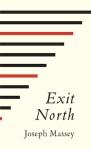
http://www.shearsman.com/pages/books/catalog/2010/martin.html