Tag Archives: Camille Martin

Zydeco Gallery One


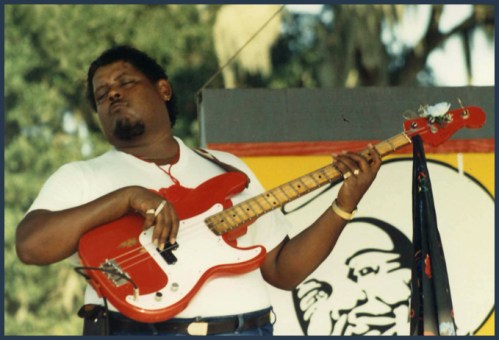
In August of 1989 and 1990, I attended the Zydeco Festival in Plaisance, Louisiana, a small community just west of the town of Opelousas. The festival’s one stage was set up in the middle of a field. Just beyond the stage was an enormous old live oak tree, where dancers and musicians could take a rest and escape the strong August sun of the Louisiana sub-tropics. The festival was small, relative to productions such as the Festival Acadien in Lafayette, or the Jazz Festival in New Orleans. And that was part of its appeal for me. You didn’t have to sit way up in North Dakota to find a spot to lay your towel on the ground and hear your favourite band. In front of stage was a dancing area, and you could get right up to the edge of the stage and see the band closeup without jostling through hoards of people. The atmosphere was relaxed, and anyone could dance with anyone, no introduction needed—you just went up to someone, held out your hand, and said, Let’s go!

The following four photographs are the first in a series; I’ll post the other installments in separate posts. I took the pictures in late afternoon, when the sun cast a golden light and the atmosphere took on the clarity of a lucid dream. It was a weekend of pure joy. And I haven’t even started on the food.

I’ve given the name of the one musician in this grouping that I recall. If anyone reading this recognizes anyone else, please let me know in the comments box. Merci!


(Photo: Camille Martin)

(Photo: Camille Martin)


(Photo: Camille Martin)

(Photo: Camille Martin)


(Photo: Camille Martin)

(Photo: Camille Martin)


(Photo: Camille Martin)

(Photo: Camille Martin)

Terrance Simien


The following short introduction to the history of zydeco comes from from the official Zydeco Festival website:


History

In the days of old, the Creole Community would gather at harvest time and work together to complete their tasks. When a family would have a bouchere` (butchering of a hog), everyone in the community would come over and share in the work and cooking of fresh meat.

When the work was finished, the people would celebrate and entertain themselves with a “La La” ( Creole French for house dance.) Instruments used to create “La La” music were the scrubboard (frottoir), spoons, fiddle, triangles (ti-fers), and an accordion.

When times got tough for a family, they would throw a “La La”, a Saturday night dance in the living room. Emptying the room of all furniture, they would charge ten or fifteen cents admission and sell gumbo, homemade beer and lemonade. Even churches would give benefit “La La” to support different functions of the church.

By most of the music being sung in Creole French, “La La” music was only thought of as being for rural and “old folks. One noted musician, the late great “King of Zydeco”, Clifton Chenier, is credited with naming the music ZYDECO “les haricots” (snapbeans).

In 1981 fearful that Creole and Zydeco music was dying out, “The Treasures of Opelousas” a group of concerned citizens under the guidance and sponsorship of Southern Development Foundation, organized the Southwest Louisiana Zydeco Music Festival.

The first Zydeco Festival in 1982 was started on a farmer’s field in the Plaisance community on the outskirts of Opelousas, with four hundred of our neighbors attending.

These traditions of yesteryear may be only a memory for some, but it is the testimony that the Zydeco Music Festival serves. A testimony to those who came before….to the ancestors who toiled in the fields under the hot sun to take care of their families….to those who shared with one another during good and bad times…especially to the ancestors who celebrated, laughed, and loved despite the hardships they encountered.

The Zydeco Music Festival is their offspring – a living reminder for us never to forget where we come from, to always appreciate and respect our past, and most of all to continue our legacy in keeping the rich culture alive.
Southern Development Foundation has kept the Original Southwest Louisiana Zydeco Music Festival alive and developed it into what is now known as the world’s largest Zydeco (“LA LA”) Music Festival.


Camille Martin
http://www.camillemartin.ca

sixpence


(Photo: Camille Martin)

(Photo: Camille Martin)


sixpence to feed the flocks
sixpence to drown the rocks
sixpence to crack the eaves
sixpence to climb the stairs
until they end
sixpence to fell the leaves
sixpence to weave a blanket
without a thread
sixpence to dry the wells
sixpence to burn the hearts
in their lairs
sixpence to rock the bells
and hear them knell
until they stop


first published in Hamilton Stone Review


Camille Martin

unarmed to the hilt


The latest in unarmed gear, featuring one of my collages on the cover:
unarmed #60

unarmed #60

unarmed is a gem of a zine with loyal fans in Minneapolis/St. Paul and beyond. It follows in the venerable footsteps of independent poetry zines of the 60s, often just mimeographed and stapled, such as Ted Berrigan’s C Magazine, Ed Sanders’ Fuck You: A Magazine of the Arts, Anne Waldman and Waldman and Lewis Warsh’s Angel Hair Magazine, and a host of others since that explosion of small presses.

How many old school print poetry zines are still out there that haven’t converted to pixels? More than you might think, but not as many as before the advent of the internet.

unarmed makes reading poetry at the bus stop sexy.


Samples from unarmed:

Joel Dailey unarmed

Joel Dailey


Sheila Murphy

Sheila Murphy


Camille Martin
http://www.camillemartin.ca

Experiment #61

(Photo: Camille Martin)

(Photo: Camille Martin)


a
tugboat
horn
lows
over
the
Mississippi

*

in
Paris,
a
cat
prowls
on
a
balcony,
seeking
an
open
window


Camille Martin
http://www.camillemartin.ca

a pinch of salt

(Photo: Camille Martin)

(Photo: Camille Martin)


                  dark corner, bare bulb, square
                  one thought. hearth with care-
                  ful ashes. rocker, unoccupied.
                  embroidered shrine: marriage’s framed
                  zygotes. cow-eyed portraits.
                  all-season ancestors,
                  carpet. everlast bricks
                  irrelevant. modern kitchen defunct.
                  growl morphs into rattle. a thimble
                  of ouch matches brown
                  accessories. whatever works.
                  a little string, a little dust.
                  take a pinch of salt
                  and measure it.


                  Camille Martin
                  http://www.camillemartin.ca

Continents of Foam: Elisée Reclus’ Analogous Phenomena


Photo: Camille Martin

Photo: Camille Martin


    One of my favourite retreats on the ship was the far end of the stern behind the chains of the rudder. Leaning over the side, I gazed at the wake for hours on end. The waves came one after the other to lure my vision into their spirals, and to look away required a strong effort. The curls, the circular ripples, the bedlam, the eddying wavelets, the dances of the foamy trails, the struggles between the waves that reunited behind the keel, clutching and writhing, the formation of swift funnels trailing clusters of transparent bubbles in their vortex—all these little dramas of drop and foam held my attention with an irresistible fascination. Beyond the swift and twisting line of the wake, large surfaces of foam passed by, thrown aside to the right and left by the prow of the ship. Islands, archipelagos, and continents coalesced, broke apart, diminished, dissolved and vanished.
    In reality, there is not a great difference, geologically speaking, between these continents of foam and the continents of land that we inhabit. Small or large, all phenomena are analogous: our continents also will dissolve and reform elsewhere, like clusters of white bubbles carried along by the wake of the vessel.

—Elisée Reclus


Map of Mississippi River Delta, from Reclus' Voyage to New Orleans

Map of Mississippi River Delta, from Reclus' Voyage to New Orleans


The above passage is from Voyage to New Orleans by French anarchist and geographer Elisée Reclus (1830-1905). In 1851, Reclus was exiled from France because of his protest of Louis Napoléon Bonaparte’s coup d’état. He traveled to Louisiana and in 1855 published an account of his voyage through the Caribbean and up the Mississippi delta, and his stay of several years in the city of New Orleans. His essay is a remarkable account, not only of geographical observations, but also of life in antebellum New Orleans from the perspective of an anarchist thinker. He astutely observed the political and religious corruption in the city and writes a moving condemnation of slavery after witnessing a slave auction.

I was drawn to this three-part gem because of the rich, poetic language of the young Reclus and because of his many astute observations about the natural world and human behaviour. In the summer of 1997, I translated it into English, and after polishing it with John P. Clark, we published it in 1999 as Voyage to New Orleans: Anarchist Impressions of the Old South.

Selections from this translation were recently reprinted in Harald Bauder and Salvatore Engel-Di Mauro’s Critical Geographies: A Collection of Readings (Kelowna, Canada: Praxis (e)Press, 2008).

Here’s the link to (e)Press’ reprint:

http://www.praxis-epress.org/CGR/9-Reclus.pdf


Camille Martin
http://www.camillemartin.ca

The Prince of Orange

(Photo: Camille Martin)

(Photo: Camille Martin)


                Now. Tell me how much I am to respect
                the Prince of Orange. In that fine-spun prose
                that fine-spun rosy prose.

                How sheen it is! (Talk of dopey Raggedy Ann
                hanging from a peg is talk
                stained purple from sour grapes.

                So they say.) What a fine ring
                (or is it twang?) the word “frivolous”
                possesseth. Yea.

                About dead Arthur. Who knows but I
                that he loved licorice and
                marshmallows?

                Not you swell fellows and girls no no
                Nor you swell girls and fellows.


                Gilbert Sorrentino, The Orangery, p. 57


                Camille Martin
                http://www.camillemartin.ca

Gail Tarantino: Learning to Use a Spoon by Reading Braille


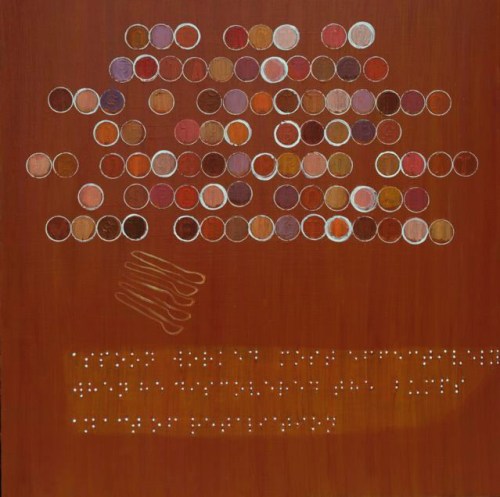
    I was excited today to discover the visual art of Gail Tarantino through three works in the December 2008 issue of Cricket Online Review. Her bio tells of her “not-so-secret desire to be literary” in her work, and her weaving of “compressed narratives and distilled description” with the “rhythmic and musical aspects of language.” Like artists such as Ann Hamilton, there is a conceptual sophistication in the way that Tarantino uses language in her work. Interestingly, both have used Braille. For the 1989 Venice Biennale, Hamilton rendered Charles Reznikoff’s Testimony: the United States (1885-1915) into Braille in an installation entitled Myein. On a much smaller scale, Tarantino’s One Act in Cricket features a sentence in Braille:

Gail Tarantino, <em>One Act</em>

Gail Tarantino, One Act

    In order to understand the interplay among the images in the three horizontal fields, it is necessary to decipher the Braille, something that I at first resisted. But my curiosity prevailed and I arranged the work on my screen next to a Braille alphabet and proceeded to decipher the sentence, letter by letter, yielding the following:

        a spoon worked most effectively
        when he discovered the bumps
        an act of retaliation

    As I progressed, the act of decoding it became easier, due to my increasing familiarity with the configuration of dots and the fact that after a few letters, guesswork came into play. A long word beginning with “effe . . .” can be guessed pretty accurately. But the slowness of my reading made me aware of how much take reading for granted, in a similar way that I take eating with a spoon for granted. Mulling over each letter in Braille slowed down the process. My brain, racing ahead of my slogging pace, was thinking of various possibilities, leading me to make incorrect assumptions a couple of times. I was taking too long to think about the text, so my mind was impatiently filling in the gaps in an effort to understand.
    After deciphering the words, I realized that my effort was roughly analogous to a child learning to eat with a spoon: both are, as the title suggests, “one act.” This analogy is supported by the echoing of the shape of the Braille’s background colour, which is reminiscent of a spoon.
    Tarantino compels viewers who do not know Braille to experience the unfamiliarity of the text and the opacity of its meaning until we decipher it, letter by letter. And in the act of doing so, we become conscious of the configurations of dots in each letter, recalling our original experience learning to read as a child, tracing the shape of each letter, as well as discovering the shape and usefulness of a spoon. Our reward is discovering something about writing as medium for communication, its thingy existence, as opposed to it being a system endowed with inherent meaning.
    Significantly, the understanding of the Braille sentence is crucial to speculating on the meaning of the middle and top portions of the work. The middle portion consists of a series of spoons, one rather flat, like a knife, and the others in the familiar rounded concave shape.
    The top half of One Act consists of scores of what look like little bowls. Some are missing, so that the pattern echoes the Braille in the bottom half. They are also different colours, resembling perhaps little pots of paint or perhaps bowls of soup, or food in the concave part of the spoon, the reward of the savvy child.
    The question arises as to why Tarantino would describe the act of learning as on of retaliation, assuming that I am understanding the Braille sentence correctly. Retaliation requires first an act to retaliate against, so it seems plausible to assume that “he’ is retaliating against the opaque meaning of the spoon’s shape prior to his figuring it out, an opaqueness that strikes him as an act of hostility, which he counters by learning the usefulness of the spoon’s “bump.”
    Carrying over the ideas in the message to the analogy of learning to read, the Braille sentence might suggest the concept of violence in the act of understanding. This idea is expressed in a set of conceptual metaphors in English, such as “to attack (or tackle, or surmount) the problem,” “to struggle with the meaning of something,” and “to fight ignorance.” These all suggest that understanding is a process of overcoming that which we don’t at first apprehend: the child “overcomes” the spoon’s unintelligibility; the uninitiated tackle the illegibility of Braille. And that violence is a retaliation against the violence of opacity, of being faced with something that is (at first) illegible.
    Derrida’s theories on the violence of writing come to mind here, of writing regulating meaning, inscription as prohibition, law, circumscription. Before we deciphered the Braille, its meaning was opaque to us; it shunned our desire to understand it. Thus it might appear that Tarantino is turning the tables on the idea of violence inherent in writing, for the text (or the spoon) do their violence by remaining unintelligible, and the reader retaliates by learning and understanding. The violence of the reader is not the same as the violence of writing, for in Tarantino’s work, the reader’s violence is against illegibility. And meaning, interpretation, writing, and learning are not inherently acts of violence.
    I may be overreaching in my musings here, and I certainly don’t mean to suggest that this is the only way of approaching this work. As One Act implies, there can be many different rewards to learning how to use a spoon, as the many bowls of soup in different colours attests, and by extension many different ways to understand a text.
    In any case, I sense an acute intelligence at work in Tarantino’s work. It grapples with (to continue the conceptual metaphor) questions of representation, writing, legibility, and meaning in a condensed yet open-ended work. Did I mention that it’s also beautiful?
    I highly recommend her website, where many of her works can be found:

http://gailtarantino.com/

Works consulted:

Derrida, Jacques. “The Violence of the Page.” Of Grammatology. Tr. Gayatri Chakravorty Spivak. Baltimore: The Johns Hopkins UP, 1976.

Marsh, Jack E. “Of Violence: The Force and Significance of Violence in the Early Derrida.” Philosophy and Social Criticism. 35.3 (2009): 269-286.


Camille Martin
http://www.camillemartin.ca

how beautiful is the universe


ravenous bird resizedbird


how beautiful is the universe
when something digestible meets
with an eager digestion
how sweet the embrace
when atom rushes to the arms
of waiting atom
and they dance together
skimming with fairy feet
along a tide of gastric juices


Don Marquis, Archy and Mehitabel


Camille Martin

When Houses Were Alive

(Photo: Camille Martin)

(Photo: Camille Martin)


When Houses Were Alive

    One night a house suddenly rose up from the ground and went flying through the air. It was dark, & it is said that a swishing, rushing noise was heard as it flew through the air. The house had not yet reached the end of its road when the people inside begged it to stop. So the house stopped.
    They had no blubber when they stopped. So they took soft, freshly drifted snow & put it in their lamps & it burned.
    They had come down at a village. A man came to their house & said:
    Look, they are burning snow in their lamps. Snow can burn.
    But the moment these words were uttered, they lamp went out.


Inugpasugjuk. “Eskimo Prose Poems.” Technicians of the Sacred. Ed. Jerome Rothenberg. Garden City, NY: Anchor Books, 1969.


Camille Martin
http://www.camillemartin.ca

the air blanked out. it had been seen on its mind.

BEAN (photo: Camille Martin)

BEAN (photo: Camille Martin)


Alberta Turner: What do you mean, mean?

Alberta Turner (1919-2003)

Alberta Turner (1919-2003)

In 2006, C. A. Conrad launched the Neglectorino Project, inviting people to bring to light their favourite poets relegated to obscurity instead of basking in the posterity they deserved. Luckily, the list is still up and running, and it’s open for anyone to name their own favourites in the comments
boxes . . .

http://neglectorino.blogspot.com/

. . . which I just did: Alberta Turner. Her most recent publication, I believe, is a new and selected collection, Beginning with And (Bottom Dog Press, 1994). It’s available from Small Press Distribution.
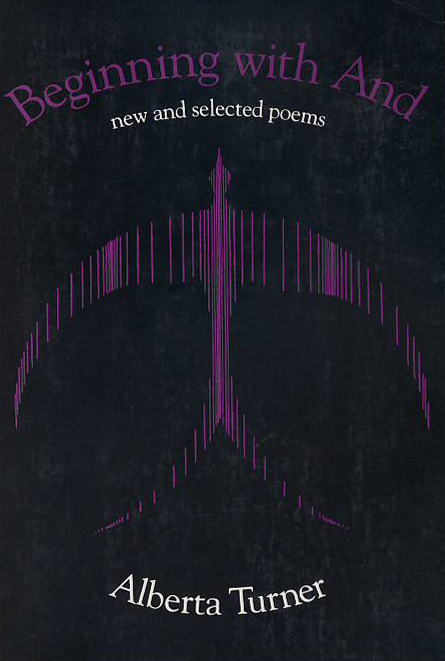
Bottom Dog Press, 1994

Bottom Dog Press, 1994

Perhaps she’s less neglected a poet than I am assuming. Out of curiosity I searched the Poetics archives and found narry a mention of her (except for one post by me a couple of years ago). On that listserv, her death in 2003 didn’t register a tremor on the Richter scale. I also checked some long-standing and prominent poetry blogs of Poetics List members, and again, no mention. So I don’t think that she is particularly well known among the more experimentally inclined.

Thematically, she is a poet of the quotidian: she observes the minute moments of ordinary life and turns them inside-out to bring to light the contents of their pockets. She also knocks the icon of the domestic goddess off her pedestal.

In a sonnet entitled “Accounting,” a woman putters around the house, cooking in the kitchen, getting dressed, and tying her shoelaces that have come undone. All the while, she obsessively counts things in the kitchen and then her own multiple selves that seem to be reflected in a domestic hall of mirrors:

Accounting

Twenty of them. Count
five with heads
eight with holes
seven of some soft stuff—

You put boots on the cat,
a diamond bracelet on the crow.
Look at yourself grinning out of the spider web,
stuffing your twins into a pouch.

Two of you have identical spoons,
four go to the same shelf for salt,
three return to the fifth stone from the door
to tie your shoes.

A dried bee crunches underfoot.
Two of you will crunch bees.

Lid and Spoon (1977)

Her sardonic response to the tiresome, petty activities of daily life is evident in her reference to food she is preparing (“seven of some soft stuff”) and her self-mockery dressing before a cracked mirror (“stuffing your twins into a pouch”). She also inserts an element of absurdity and self-deprecation in her dressing, which is described in the language of the folk tale: “You put boots on the cat” (perhaps a reference to puss-in-boots, a children’s tale) and “a diamond bracelet on the crow” (“old crow” being derogatory slang for an unattractive woman).

Her counting exercise magnifies her sense of ennui performing repetitive mundane actions—holding a spoon, reaching for salt on a shelf, getting dressed before a cracked mirror, and hearing the crunch of stepping on dried insects. And her reference to herself in the second person reveals her alienation from herself. It is as though she were outside her body observing with subtle and good-humoured mockery her multiplied selves do chores.

Turner experienced the women’s movement of the 60s during her 40s; thus she spent the first twenty years of her adulthood in an overtly sexist society in which women were still by and large expected to function in traditional domestic roles. Turner, with sly humour, makes fun of her role, which she obviously doesn’t relish, of perfoming household duties.

Turner is not only a poet of domestic dissent. Her work, while largely accessible, is edgy and often disjunctive, qualities that threw off some critics, such as Margaret Gibson, who reviewed Lids and Spoons in the Library Journal in 1977. Gibson disparages Turner’s “astigmatic” vision in her “surreal collages” and “oracular riddles.” On the other hand, she praises Turner’s poems that form “organic wholes anchored in a world we can recognize for ourselves.” Critics who were accustomed to more accessible poetry were puzzled by her work’s experimental qualities such as odd juxtapositions, fragmentary phrases, and, as in the following poem, the unsettling use of nouns for verbs:

Mean, MEAN

Little eggs—blue, specked.
Laid, they grape;
feathered, they bead;
beaded, they
bird
very small birds
blur or brown, bellied
in white
What they mean is small:
beak-bite, spur prick,
brittle
spike.

*

I heard you,
MEAN!

Because hinge? Because tile’s hollow—
and straws and legs?
Because feet have the soles of feet?

Pockets for tails. A tail graft in
Capetown has held three weeks.

*

The soft part of conchs,
the stuff between shells.
I have bells of pods, necklaces of
teeth, but my tools
are spoon—somewhere a
pulp needs me—a drying juice,
an unhoused snail.

Learning to Count (1974)

The title, with its imperative to produce a more transparent meaning, could be a response to her critics who would tame the syntax and bridge the gaps. The first section begins quietly with a line designed, perhaps, to appeal to her critics. It is an image fairly bursting with preciosity: “Little eggs—blue, specked.” Then Turner slyly subverts the syntactical normalcy by splashing the parts of speech wherever she likes with quick, sure strokes: “Laid, they grape; / feathered, they bead; / beaded they bird.” Next follow three lines describing the “very small birds” in a tone similar to the first line.

She seems to turn to her critics to tell them what the poem means in case they missed it: “small.” The final three lines contain only six words, but they are so thick with alliteration, assonance, and near-rhymes that their meaning fades into the background and their sounds take precedence:

beak-bite, spur prick,
brittle
spike.

In their dense musicality, these short, energetic lines are reminiscent of troubadour poet Arnaut Daniel, particularly his chanson “L’aur amara,” which is also about birds, a favourite subject of Daniel:

L’aur amara
fa’ls bruels brancutz
clarzir,
que’l dous’espeis’ab fuelhs,
e’ls letz
becx
dels auzels ramencx
te babs e mutz,
pars
e non pars,
. . .

Even if you haven’t learned Medieval Occitan (and who has the time for it these days?), you can tell the extreme care with which Daniel selected each word to achieve a complex sonic weaving. *

In Turner’s three lines,

beak-bite, spur prick,
brittle
spike.

the “beak,” “spur,” and “spike” are tiny in relation to a bird’s body. But smallness is also expressed through the sounds of the words, which have a short, pecking quality to my ears, signifying the tiny motions of the bird’s beak, just as the sounds of Daniel’s lines might suggest the chirping of birds.

In the second section, Turner again seems to turn to her critics who would have her write more “meaningful” poetry, this time with extreme annoyance: “I heard you, / MEAN!” She then asks why she should mean, but her very questions belie her tendency to disjunction rather than “organic wholes”:

Because hinge? Because tile’s hollow—
and straws and legs?
Because feet have the soles of feet?

The last two lines are delightfully indecipherable. At this point, she is off the beaten track of clear meaning, talking in dry reportage style about “pockets,” “tails,” and a “tail graft in / Capetown.”

Turner has it her way in the third section, and this time, no critics are invited. The musicality of Turner’s range of tones and timbres is again reminiscent of Daniel:

The soft part of conchs,
the stuff between shells.
I have bells of pods, necklaces of
teeth, but my tools
are spoon—somewhere a
pulp needs me—a drying juice,
an unhoused snail.

In spite of its disjunctiveness (spoons and mollusks), the poem’s images echo impressionistically—although perhaps not in Gibson’s desired “organic unity.”

I’ll post one other poem by Alberta Turner, without comment:

HOOD BUTTON SHELL FUR

Gravity and wind so bells
feet in pairs ring pant legs
sausage curls clang hoods
domes hunch on traffic lights that lift
and swing

also cold its squirrel tail its nose drop
and cannon mouths their coin
*
One slave
to fasten the clasp of her cross
one
to slice her butter onto her toast

And she is fatherless
fed the bully to the meanest hog
sewed his buttons on a girl’s coat
*
Assume
that custard is smooth
that blue is sad and kind

Assume a god
ladle of fish
ladle of glue

And why not perch the snail shell on the log
as if the snail were still climbing out?
*
Three beans in a row red beans
three snows with no salt between
Ladder perhaps?

“Stop” And I would
But without wheels? Without road?
Stop an axe drop a hand

And fur is as angry as I can today

Lid and Spoon (1977)

* Ezra Pound, an admirer and translator of Daniel’s chansons, renders these lines as follows:

The bitter air
Strips panoply
From trees
Where softer winds set leaves,
And glad
Beaks
Now in breaks are coy,
Scarce peep the wee
Mates
And un-mates

Camille Martin
http://www.camillemartin.ca

Do the Play Thing: Signs of Rita

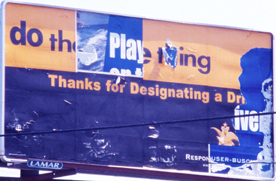
In September 2005, I found myself unexpectedly living in Lafayette, Louisiana, where my parents live, about 130 miles west of New Orleans— enough distance to escape the wrath of Hurricane Katrina. But after Katrina came Rita, as if the Gulf coast hadn’t suffered enough. Lafayette didn’t receive the brunt of the hurricane’s force, but it did experience high winds.

One hot afternoon driving in heavy traffic, inching along Kaliste Saloom Road, I took these pictures of billboards whose layers had been peeled away by the gusts of Rita. The power of hurricanes evokes in my mind images of uprooted trees and roof shingles blown off houses—and worse. It seemed odd to see this more subtle manifestation of their power.

signs of rita (1)

signs of rita (2)

signs of rita (3)

Camille Martin
http://www.camillemartin.ca

Extreme Inefficiency of the Rube Goldberg Machine: Peter Fischli and David Weiss’s The Way Things Go

Complexities

everything’s more or less
rube goldberg

—Larry Eigner

The video above is only a short clip from a 1987 thirty-minute film of a Rube Goldberg machine that Peter Fischli and David Weiss constructed from ordinary objects such as tires, candles, fuses, tape, bottles, boards, rags, and chemicals—stuff that one might find lying around in a garage or basement workshop.

I thought it would be interesting to compare their machine with those entered in Rube Goldberg machine contests, such as the Japanese television show Pythagora Switch or the student competition at Purdue University, first held in 1947 and now in its twenty-second consecutive year (Townsend). The comparison might lead to some revelations about The Way Things Go by showing what it is not.

The element of competition, of course, creates an aura of sensationalism as the camera follows one event to the next. The souped-up hype of the Japanese announcer tries to increase suspense about whether the machine will move like clockwork until the final goal of the exercise in inefficiency is accomplished (cracking an egg into a dish, for example), or whether the machine will grind to a halt due to a broken link.

By contrast, The Way Things Go is not particularly suspenseful: early on in the film one can guess that this will be a documentation of a fully functioning machine. This lack of emphasis on suspense allows the viewer to concentrate on the metaphysics of causality and not on the relatively mundane thrill of nervous anticipation similiar to the car chase in an action/adventure film: will the chain of events set in motion by the car chase enable the hero to save the world and rescue the woman?

Also, Fischli and Weiss’s machine runs rather slowly in comparison to the relatively hyperactive machines in the competitions, which must hold the attention of a live audience:

The slower speed of The Way Things Go is partly a result of the larger scale of the machine, which the two men built in a warehouse. There is an expansiveness about the documented events that enables the viewer more time to meditate on the implications of such extreme inefficiency.

For me, the most compelling difference that sets Fischli and Weiss’s machine apart from the contest machines lies in its relatively nonrepresentational quality. In the case of the Purdue competition, points are awarded for the machine’s theme, for example, Jurassic Park, or this one based on the board game Clue:

(Townsend)

(Townsend)

But The Way Things Go is qualitatively very different from these examples. The causal connections are ingenious—that goes with the territory of constructing an imaginative machine of extreme inefficiency. Sometimes they are humorous, sometimes beautiful (the flaming cloth torch spiraling down a little pole like a blazing volleyball is particularly compelling aesthetically). Yet they never slide into preciosity with overt references to symbols (such as an arrow shooting a heart) or a doll-house-like miniature reality (such as a ski lift). The events in the causal chain remain fairly abstract. In the machine, things often do what they are intended to do in the real world (tires roll, catapults hurl objects, a torch sets a pile of straw ablaze), but these agents of change are less likely to remind the viewer of the experience of actual causal sequences beyond a single link in the sequence: the elements in the chain are fairly unrelated representationally.

This abstract quality of the machine allows the focus to remain on the idea of one thing causing another to do something—the “way things go.” This focus facilitates a wider field of possible associations as one wonders, What triggers catastrophes in the world? A war is started over a casual insult blown out of proportion, setting off a chain of events ending in mass slaughter. Chaos theory’s “butterfly effect” asks the question, poetically expressed in the title of a talk by Edward Lorenz, whether “the flap of a butterfly’s wings in Brazil [can] set off a tornado in Texas.”
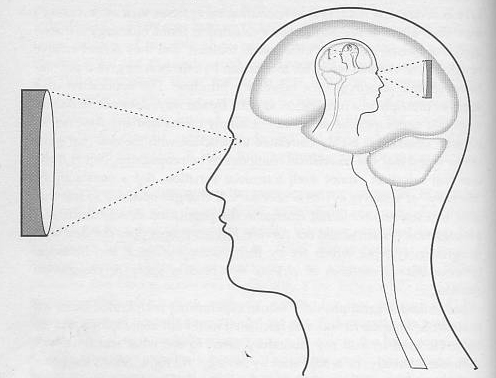
And there are countless other small “catastrophes” in the world that go on without our being aware of their processual underpinnings. For example, the sequence of events that results in a person seeing something is incredibly complicated. In The Amazing Brain, Robert Ornstein and Richard F. Thompson present a simplified illustrated tour of the process of vision, demonstrating the complex sequence of events that must happen in order for David to recognize his mother, who has come to visit him on his marble plinth:

How Vision Works 1

In a more than twenty-page guided tour that is reminiscent of a Rube Goldberg machine, the authors show the step-by-step process of sight, from an image entering the pupil to the inversion of the image by the lens, the projection of the image onto the retina, and the transmission of that information via the optic nerve to the visual cortex, where a complex system of layers and columns and neurons analyzes the information. After further complex processing in the brain, David recognizes his mother and smiles:

MAMA!

MAMA!

The authors point out that their “greatly simplified tour of an incredibly complex chain of events has taken as least several thousand times longer to read than the fraction of a second in which the actual event occurred” (129). Indeed, if humans had to be conscious of every decision that their bodies made, they would soon perish. Seeing a rhino about to charge  doesn’t suddenly turn a person into a philosopher but a runner. Through evolution, adaptive changes are selected that allow many functions and processes to take place routinely and unconsciously. Similarly, Fischli and Weiss’s machine suggests the complex network of events that lie beneath the surface of what we perceive to be a single, simple event.

And the events in their film also suggest the moment at which an object being changed reaches the point of no return: the “straw that broke the camel’s back” phenomenon. Within Fishli and Weiss’s delicately precise sequence, the point at which cause becomes effect can be identified or at least imagined. For example, sparks from fireworks shoot into the air, but only one spark is needed to travel far enough set afire the pool of gasoline a few feet away. Water pouring into a jar gradually fills it up, and the added weight of the jar causes the lever upon which it rests to move down. We can imagine that only a drop is needed to make the difference between stasis and motion. I’m reminded of the field of catastrophe theory, which studies small changes in a dynamic system resulting in large consequences.

The insights and pleasures of The Way Things Go are at once aesthetic, scientific, and metaphysical. The rough ordinariness of the objects draws our attention to the mundane phenomenon of causality that we take for granted on so many levels of our lives. There is a hypnotic beauty in the slow unfolding of events. And the abstract little machines within the larger machine facilitate meditation on the very nature of causality. I’m reminded of Galileo’s early experiments on gravity, such as the Inclined Plane Ball:

Galileo - Inclined Plane Ball

I imagine that a physicist would have many more layers of understanding of The Way Things Go.

Buddhist philosophy as well as science has a history of focused meditation on the nature of cause and effect. Nagarjuna, for example, a third century precursor of late twentieth-century deconstructionist philosophy, posits that causality is an illusion, since there is no essential quality of cause or effect residing in any particular agent of change.

And that brings me to the larger theme of the film: change, ephemerality. The chain moves from one event to the next in a seemingly endless series that explores the nature of change and, by extension, mortality. In a Rube Goldberg machine, as in a dominoes chain reaction, there is no going back. And the way things go is inexorably forward (to use a conceptual metaphor of time moving ahead of us). And since the links in the chain are displaced or destroyed in their implementation, the machine can be recreated only by constructing the machine afresh. The film evokes the trajectory and cycle of life, full of inefficiencies and absurdities, and shot through with the certainty of change.

Works Cited

Eigner, Larry. “Complexities (October 9 91).” readiness / enough / depends / on. Los Angeles: Green Integer, 2000. n.p.

Ornstein, Robert, and Richard F. Thompson. Illus. David Macaulay. The Amazing Brain. Boston: Houghton Mifflin, 1984.

Townsend, Allie. “Rube Goldberg Machines Go Green at Indiana-Based Contest.” Popular Mechanics. March 31, 2009. http://www.popularmechanics.com/science/research/4311263.html

Camille Martin
http://www.camillemartin.ca

Empty Lawns and Battered Days: Rupert Loydell’s “Slow-Motion”

Rupert Loydell

Rupert Loydell


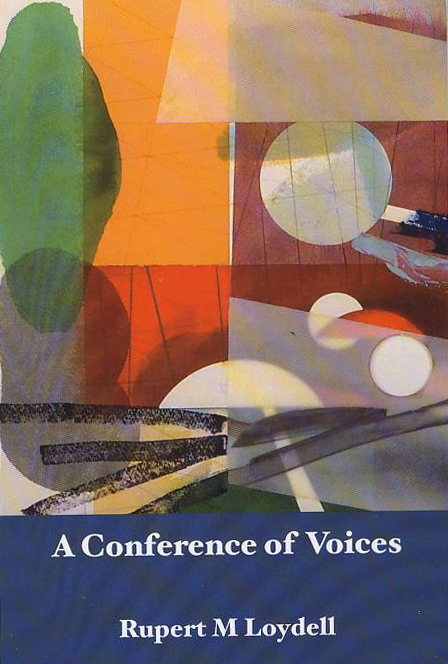
On first reading the poetry of Rupert Loydell, a fairly recent discovery for me, I felt an immediate poetic kinship. And now I feel an indebtedness as well, since his work continues to inspire me in my own poetry. Here is a poem from A Conference of Voices that I feel particularly drawn to:

Slow-Motion

Our baby swings slow-motion against the sky
chuckling as she comes towards us,
before reversing away still laughing.

I waited for a friend in the dark by the cathedral.
Life revolves around it, but no-one needs it any more;
we take for granted that meaning exists.

The sun swings slow-motion across the sky.
I push our baby, asleep in her buggy,
around the streets. Time passes so slow.

I have never known these suburbs so well:
the empty lawns, blank windows, tidied streets.
The days pile up, battered at both ends.

Doubt swings slow-motion across my life,
questioning how I spend my time,
muttering persistently about love.

With apologies to Loydell in case I miss the mark, I’d like to offer the following appreciation of his poem in an old-fashioned close reading.

Despite the cheerful opening image of a laughing baby on a swing, a sadness permeates Loydell’s poem due in part to the emphasis on the passage of time, exemplified by the motif of the slow-motion arc. The melancholic mood is also expressed in other motifs: the missed connections, the alienation of the speaker from his own existence, and the feelings of futility in the passage of time.

Failed or absent connections are the norm in the poem. The baby swings joyfully, but if hands connect with his body to push him, they are not evident. The speaker awaits a friend but doesn’t say whether or not the friend ever arrives. A feeling of oppressive ennui haunts the speaker’s stroll with the sleeping baby in the buggy. Instead of feeling comforted by his familiarity with the neighbourhood, he instead observes the clean orderliness of the suburban landscape with its “empty lawns,” “blank windows,” and absence of people.

Because of the speaker’s keen awareness of the present moment, time seems to pass slowly: the swinging arc of the baby and of the sun are depicted as is they were slow-motion film clips.  Despite the unhurried pace of life, the days inexorably “pile up,” and the speaker feels less than satisfied with the meaning of his life, the days being “battered” both in the past and in the anticipated future. He knows that meaning exists, even though religion no longer provides the framework, but that meaning is subordinated to his feelings of separateness from others and anxiety about the trajectory of his life.

The personified doubt of the last stanza swings across the sky marking the passage of time and “muttering persistently about love.” Doubt appears as the mouthpiece of time, which accumulates the days in a futile pile.

In the second stanza, doubt’s skeptical turn of mind questions the necessity of God to give meaning to existence: “no-one needs [the cathedral] anymore.” Doubt might also cause us to take an ironic stance toward anything that smacks of certainty or sincerity. But here, doubt, instead of urging a cynical attitude towards love, instead seems to encourage a questioning of the things that humans do that lead to the absence of feelings of connectedness, of expressions of love. Doubt doesn’t loudly trumpet an imperative to connect, to bridge the gulf separating self from other and self from self. Instead, it “mutter[s] persistantly” like the speaker’s cranky conscience urging him to re-examine his life and to embrace human connection.

Loydell’s table-turning gesture to have doubt, not a more positive agent, muttering about love as though it were the underlying drone in the noise of life, is an apt stroke. Instead of encouraging us simply to fill the gaps in our lives with love, doubt urges us to question what it is that created the gaps in the first place.

Shearsman Books, 2004

Shearsman Books, 2004

Link to Loydell’s online magazine:
Stride Magazine

Camille Martin
http://www.camillemartin.ca

Serendipity and the Felon: Jiri Kolar, Emmet Gowin, and the Cognitive Iceberg

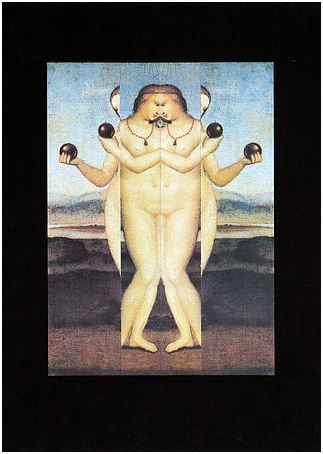
A few days ago, I was searching for images by one of my favourite collage artists, Jiří Kolář, whose last name, pronounced in his native Czech, sounds like “collage” (no doubt an example of true serendipity). I found two images from his series “Three Graces.”

Kolar 1

Kolar 2

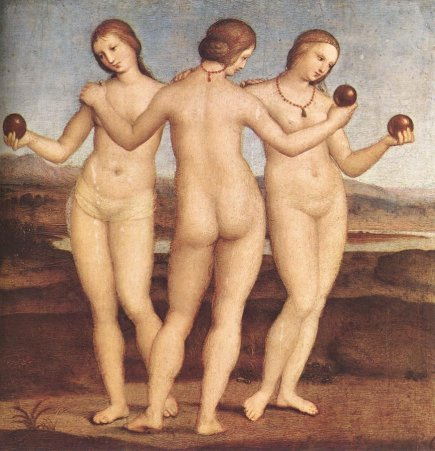
I have admired these since I was first exposed to the work of Kolář at an exhibition at the Albright-Knox Gallery in Buffalo. He uses as source material Raphael’s painting of the Three Graces holding the apples of the Hesperides, which are supposed to grant immortality.

Raphael, Three Graces

The depiction of the three Graces of ancient mythology traditionally shows two facing the viewer and the third in front of them, with her back to the viewer. Kolář seems to be playing with that traditional positioning, manipulating the bodies of the Graces using symmetry and mirror imaging so that the three seem to be merging into two in the first collage, and into one in the second collage.

Around the same time that I was studying these collages, I began thinking of Southern photographers, like Clarence Laughlin, Bellocq, and Emmet Gowin. A search for images by Gowin led quickly to a photograph very familiar to me, Nancy, Danville, Virginia, 1969, featuring a double-jointed girl who intertwines her arms in front of her and delicately holds an egg in each hand.

Gowin

Here’s where the question of serendipity started to surface. I found correspondences between Kolář’s Three Graces panels and Gowin’s Nancy to be striking: both have an otherworldly, delicate quality, and both depict females with oddly manipulated or twisted arms, holding round objects in their hands. I couldn’t help but wonder whether the association was entirely serendipitous or whether my mind had been leading me to Gowin’s photograph by a process of nonconscious association.

It’s possible that the association was fortuitous, but I don’t think that the idea of an associative process unbeknownst to consciousness is too far-fetched to be plausible. I can demonstrate stranger and more involved associative pathways in which my nonconscious mind seems to be feeding me hints, like a criminal toying with a detective, until the detective experiences the eureka moment and the elusive felon once again slips away.

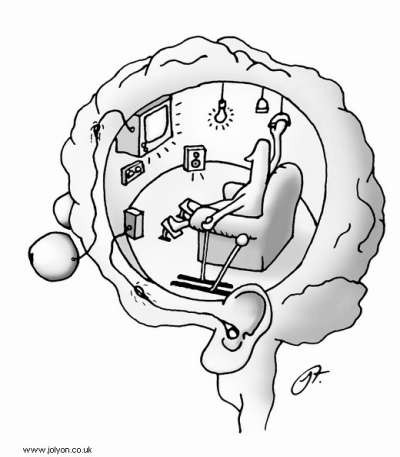
But how can we really know whether a particular association, like my pairing of Three Graces with Nancy, occurred by chance? Neuroscientist Michael Gazzaniga notes that the brain is like an iceberg: upwards of 90% of cognitive functions are not available to conscious awareness. This unavailability of much cognition to consciousness can make it seem as though there were another thinking entity (or perhaps multiple entities) within us, one that knows far more than our imaginary little conscious homunculus knows, and knows it before the homunculus gets clued in. Here’s an outdated depiction of how the mind works, with all processes coming together in a central location to be understood by a central processor (shown here as the homunculus):

homunculus

Of course, there isn’t anything like a little person inside our heads, or anything like a control centre in the brain, a central processing unit where perception and thought come together and the will of the cognitive CEO gets executed. This dualistic fallacy is known as the endless regression of homunculi:

"The endless regression of homunculi. The idea of instruction or information processing requires someone, or something, to read it. But a similar entity is then required to read the resulting messages, and so on, endlessly." Gerald M. Edelman, <em>Bright Air, Brilliant Fire: On the Matter of the Mind</em>, p. 80

"The endless regression of homunculi. The idea of instruction or information processing requires someone, or something, to read it. But a similar entity is then required to read the resulting messages, and so on, endlessly." Gerald M. Edelman, Bright Air, Brilliant Fire: On the Matter of the Mind, p. 80

After we have traced back our mental associations, the realization that something had been brewing in the deeps all along and that, as Antonio Damasio claims, “we are always hopelessly late for consciousness,” is unsettling. But I wouldn’t trade the dialogue with my teasing “felon” for a homunculus, or for serendipity, for that matter. In Kolář’s two collages, merging and symmetry have the effect, not of producing unity, but of accentuating disintegration. In the first collage, disembodied limbs and faces emerge out of nowhere, and in the second collage, the seemingly unified body is in reality disconnected from her head and feet.

Similarly, we can never merge our cognitive Graces or know them completely. That proposition once again buys into the idea of the mind as having a converging point of information, whereas scientists have discounted hierarchical and linear systems in favour of a multiplex system of connections that are “parallel, recursive, feedforward, and feedback” (Richard Cytowic, The Man Who Tasted Shapes, 156).

The idiom “my mind is playing tricks on me” aptly expresses the idea of a divided mind. Kolář’ plays tricks on our eyes with the mirrored image of the Graces merging towards a centre that can never unify them but only further discombobulate them.

I haven’t found a third panel in Kolář”s Three Graces series, but one can imagine that further unification of the image along the mirror’s edge would cause the Graces to vanish into thin air.

Unity is dysfunction, disappearance, stasis. A monotheistic brain cannot create a world.

Discombobulation is function, fertility.

And however mysterious and unavailable to consciousness are the tricks the Graces play on themselves, these tricks enable the mental associations from which we create our worlds. Like the girl holding the eggs in her twisted arms, they affirm creation and bring new realms into being.

Camille Martin
http://www.camillemartin.ca

Laura Jensen: Degrees of Separation from Bad Boats

Mental associations are one of the big cognitive mysteries. Neurons connect in our brains almost effortlessly, without our being fully aware of the process. This morning a series of five associations led me from thoughts of Clarence Laughlin, the New Orleans surreal photographer who specialized in ghostly veiled women, masks, cemeteries, and antebellum ruins, to the title poem of Laura Jensen’s Bad Boats. How, exactly, does that happen?

And how’s that for burying the lead? Jensen’s poem hasn’t lost any of its appeal since I first read it about fifteen years ago.

“Bad Boats”

They are like women because they sway.
They are like men because they swagger.
They are like lions because they are king here.
They walk on the sea. The drifting
logs are good: they are taking their punishment.
But the bad boats are ready to be bad,
to overturn in water, to demolish the swagger
and the sway. They are bad boats
because they cannot wind their own rope
or guide themselves neatly close to the wharf.
In their egomania they are glad
for the burden of the storm the men are shirking
when they go for their coffee and yawn.
They are bad boats and they hate their anchors.

Laura Jensen, Bad Boats
The Ecco Press, 1977

Visit Laura Jensen’s blog:
http://spicedrawermouse.blogspot.com/

Laura Jensen

bad-boats-web

Camille Martin
http://www.camillemartin.ca

Camille Martin’s Upcoming Events


Some upcoming events featuring my poetry and art:


Square Foot Show (Toronto)
Three of my collage prints will be exhibited.
100A Ossington Avenue, Toronto
(a few blocks north of AWOL Gallery)
Show dates: Saturday, August 15, – September 6, 2009
Artists Reception: Saturday, August 15, 2009, 7 pm
Gallery Hours: Th – Sa 12-6 pm / Su 1-5 pm

Rainbow Market Square Gallery (Toronto)
Sublime Scraps: The Collage Prints of Camille Martin
Ten of my collage prints will be exhibited.
80 Front Street East between Church and Jarvis
April 1 – April 30, 2010

Publication of Sonnets by Shearsman Books
Late 2009 or early 2010. Stay tuned for book launch information and tour dates. Sonnets will be distributed in Canada, the UK, and the US.

Shearsman Books Reading Series
UK Sonnets launch: early May 2010 (Click here)
Swedenborg Hall, Swedenborg House
20/21 Bloomsbury Way, London, England

Camille Martin
http://www.camillemartin.ca

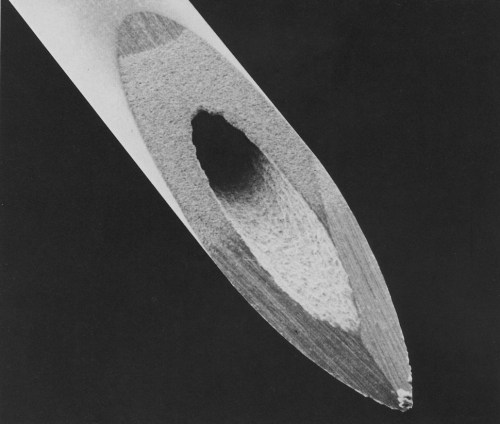
If the needle is a poem, then what is the fang? 

needle

snake fang

Images: Small Worlds Close Up by Lisa Grillone and Joseph Gennaro.

Camille Martin
http://www.camillemartin.ca

body, a mind stitching shorn shadows

public shadows

courts shadows

(Photos: Camille Martin)


Camille Martin
http://www.camillemartin.ca