Category Archives: poetry

C. L. Bledsoe’s mindful review of Sonnets

         There’s a terrific review of Sonnets (Shearsman Books, 2010) by C. L. Bledsoe at Murder Your Darlings. I say “terrific” not only because it’s a positive review (music to any poet’s ears) but also because the reviewer quotes from and discusses several poems in the book. It’s a mindful review, and it’s evident he didn’t just skim the book but read slowly and attentively.
         Bledsoe’s general appraisal of Sonnets:

“Martin’s poems are complex and elegant. She reveals a vital, passionate intellect in these poems that move fast as river water after a spring thaw. I can’t wait to read her next collection.”

Click the image below to read his thought-provoking review:

Sonnets can be ordered on the publisher’s page, which offers links to multiple distributors.


Camille Martin

Enter at Goodreads for free copy of Looms

As the official publication date of Looms nears, I registered the book for the Goodreads giveaway. It’s free to enter, and at the end date I’ll mail copies to the winners (selected by Goodreads using some algorithm that’s beyond my poetry-addled brain to fathom) . . .

Click the image below to enter at Goodreads:


Cheers!


Camille Martin

Looms now available: check for pre-order discounts

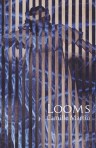
Looms, my fourth book of poetry, is now available for pre-order from your favourite bookstore and online sources.

At the bottom of the Shearsman Books page is a convenient clickable list so you can choose your preferred source and compare prices—you may wish to check for pre-order discounts (The Book Depository has one, last time I checked).

Looms is my second title published by Shearsman Books, and I couldn’t be happier with the way it came out. The cover features one of my collages, Blind Man’s Bluff, and the publisher, Tony Frazer, did a beautiful job (as usual) designing and producing the book.

Publisher’s description of Looms:
The title of Looms signifies the weaving tool as well as the shadowing appearance of something. These “woven tales” were inspired by Barbara Guest’s statement that a tale “doesn’t tell the truth about itself; it tells us what it dreams about.” The strands of their surreal allegories converse, one idea giving rise to another, and the paths of their dialogue become the fabric of the narrative. In a second meaning, something that looms remains in a state of imminent arrival. Such are these tales, like parables with infinitely deferred lessons.


Camille Martin

“Earth beckons rain and grape . . .”

A poem of mine is featured in Truck:

Thanks to rob mclennan, who is in the driver’s seat of Truck for the month of August.


Camille Martin

filling Station: The Crow Issue

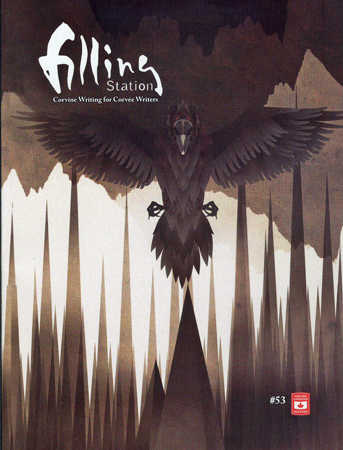
Three of my poems were recently published in filling Station: Corvine Writing for Corvée Writers (#53).

Thanks to Caitlynn Cummings, the new Managing Editor of filling Station.

The issue features a murder of corvine poets: Mat Laporte, Eric Schmaltz, Darius Kinney, Kris Demeanor, Kim Kautsky, Kevin Stebner, Anahita Jamali Rad, David Goldstein, Christin Miscione, Jason Sunder, Dylan King, Daniel Roche, Justin Foster, Allie Jaynes, Rosemary Griebel, Ursula Jordaan, and Kris Demeanor.

Not to mention an unkindness of raven art, fiction, and nonfiction (including a review of Jenny Sampirisi’s Croak).


Camille Martin

13 Poetry Books on Neptune

Stuart Ross asked me to list the 13 poetry books I’d want to keep me company if I were stranded on Neptune (he promised to provide breathing apparatus and a sandwich). It wasn’t easy to pare it down to 13, but here it is . . .

Click to see the list . . .


Camille Martin

Robert Zend’s “Typescapes”: Concrete poetry from a Renaissance man of Canadian letters


detail from Robert Zend’s typescape Peapoteacock

          A few months ago, I wrote a brief essay about Daymares, Robert Zend’s collection of stories, poems, and concrete poetry, one of his few books still in print. Zend (1929-1985) was a Hungarian-Canadian writer who immigrated to Canada in 1956, the year of the Hungarian Uprising. He settled in Toronto and worked for many years for the CBC. He was one of the most versatile Canadian writers, producing poetry, concrete poetry, novels, short fiction, essays, and plays. He was also a composer, a filmmaker, and a creator of mertz-like sculptures made of found objects.
          While researching the Toronto Reference Library’s holdings of Zend’s works, I came across a thirty-year old treasure in the Special Art Room Stacks: Arbormundi (Tree of the World), a portfolio of seventeen of Zend’s concrete poems created on a typewriter, for which he coined the word “typescapes.” Although Zend didn’t invent typewriter art, he did seem to have created it without knowledge of any forebears in that genre. Below is the cover page. Following this brief essay are five more samples of typescapes from Arbormundi.

          Zend’s typescapes are remarkable for their meticulous execution, which often involves superimposed shapes and figures. At the areas of intersection of these shapes, the effect is far from being muddied or heavy. Instead, they retain the delicacy that is characteristic of the whole.
          Part of the beauty of these concrete poems is the ethereal effect produced by the transparency of the overlaid shapes. The result of this diaphonous quality is that it is difficult to determine which object is in front or behind the other: The objects seem to blend into one another, a visual legerdemain made possible by the open spaces of the typed letters and symbols: a superimposed “x” and “p” gives little hint as to which was typed over the other. Therefore the realm in which the ghostly forms interact spatially and symbolically is flattened into a plane of shared patterns and meanings. Zend’s often punning titles also reflect this idea of blending, as for example in “Peapoteacock,” where he brings “teapot” and “peacock” into verbal and visual contiguity so that one is contained within the other.
          Another aspect of the beautiful intricacy of the overlaid objects is that the areas of intersection naturally produce darker areas, which form shapes of their own consisting of outlines of both objects (as overlapping circles in a Venn diagram produce a shaded area formed with arcs from both circles). The interplay of the shapes of each object with the shapes produced by their overlay creates an impression of both dialogue and unity between the objects.
          The miracle of these concrete poems is that from what must have been a slow and painstaking process of planning and execution using paper inserted into a clunky machine come visions of airy lightness and delicate movement.
         All of these effects harmonize with Zend’s recurrent themes of commonality and universality: the Other within the I, and the endless cycle of creation and destruction. They seem to be part of Zend’s spiritual expression of the continuities of life and death; as Zend puts it in Daymares, from the “prenatal . . . to the land of time-spacelessness; to the tiny centre point of our individual self which strangely coincides with the three-billion other human centre-points, with those of the dead ones, with those of our more ancient ancestors: swimming, crawling and flying creatures, rooting-stretching plants and perhaps even with the centre-points of other alien-living-units, of agitatedly swirling atoms and majestically rotating galaxies.”
          Below are five typescapes from Arbormundi, which was published by blewointment press in 1982. A note to the portfolio states that “Zend creates them with a manual typewriter; no electronics, computers or glue involved.”
          Following this sampling is a typescape by Zend based on a portrait of him by Hungarian artist Istvan Vigh.


Vivarbor (May 16, 1978)


Detail of Vivarbor


Orientopolis (Eastern city) (June 1, 1978)


Uriburus (April 13, 1978)


Rhumballion (May 14, 1978)


Peapoteacock (May 16, 1978)


Zendscape by Robert Zend, based on a portrait by Istvan Vigh


Camille Martin

Photos! Camille Martin and Mark Goldstein at the Myopic in Chicago

Borghes imagined paradise to be a kind of library. It can also be a dream of a bookstore with a poetry reading series, such as Myopic Books in Chicago. It’s hard to imagine a more heavenly venue. Below is a slideshow of photos from my reading there on April 21 with Mark Goldstein. Big thank-yous to Larry Sawyer, host extraordinaire of the Myopic Poetry Series.

This slideshow requires JavaScript.


Camille Martin

“Their species is finally getting somewhere . . .”: Angel House Press (National Poetry Month)

Another poem from my forthcoming Looms (Shearsman Books) has been selected for a National Poetry Month series:

click to link to the poem at Angel House Press

Thanks to Amanda Earl, poet and publisher of Angel House Press!


Camille Martin

The Toronto Quarterly: “perfidy shows up with its pleasant molecules”

A poem from my upcoming collection, Looms, kicks off The Toronto Quarterly’s National Poetry Month parade. Thanks to Darryl Salach!

Click to see TTQ.


Camille Martin

Arc Poetry Magazine: “In the badlands of the vernacular . . .”

The latest issue of Arc Poetry Magazine (67, Winter 2012) includes “In the badlands of the vernacular,” a poem from my upcoming collection, Looms.
          What I want to offer in this post is a short selection of lines from other poets represented in the magazine, lines composed of language that crackles with static electricity and nudges improbable likelihoods awake. I could have included many more but here’s just a sample . . .


Adam Sol, “Note Found in a Copy of Midsummer Night’s Dream
. . . .
Through the windows of the library
          the leaves shiver to the tune
of Max Bruch’s Scottish Fantasy.
          It all tastes of the jammy fingers
that last handled these headphones.


Elizabeth Bachinsky, “I Want to Have a Chuck and Di Party Like My Parents Did in the Yukon in the 80s”
–for Jamella Hagen
But where will I get the helicopter?
Who will make my dress
out of garbage bags? And where
will I find the good-sized rock
for our game of rockball?
How will we climb to the ridge
of the glacier? Who will dig
the trench to the fuel pump? And where
will we get the kleig lights?
. . . .


Andrew Faulkner, “Tumour”
. . . .
Indifferent continent where metaphors go:

zebra mussel, surgeon’s golf ball,
a connect-the-dots dot with the image

filled in. Death on a rusty tricycle.
. . . .


Adrienne Gruber, “Reasons To Choose the Leafy Sea Dragon as Your Lover”
          Narrated by Jim Carrey           you were featured in a slow motion 3D IMAX. Relative of the sea horse; same delicate trumpet nose, same philosophy of child rearing. Found in shallow pools, spindly body hovering over brown kelp beds.
. . . .


rob mclennan, “grief notes: glass,”
. . . .
          we sit

& echo out less
serious remarks; a language

made of snarks & sneers
                    ;what matters?
                    what’s the (even) point?

sky turns black; the dishes
come to forefront,

broke,


Matt Schumacher, “The Sea Spider Suppositions”
. . . .
Suppose the sea spider in its mind
always climbs a sleek ladder
whether in the Antarctic or Mediterranean
and peers out of its eye turret
as if it were a walking underwater castle.
. . . .


Camille Martin

And/Or: Word – Image – Provocation

After all these years, my heart still skips a beat when I get a poetry magazine in the mail, and I’m usually ripping into the envelope and flipping through the pages even before I’ve walked back down the hall to my apartment.
         A few days ago I received my contributor’s copy of And/Or, Volume 2 of the perfect-bound indie journal dedicated to experimental writing and graphic art. I have to admire a magazine that embraces the word “experimental” in its description—I’ve never had a problem with that word, not least because it shares a Latin root with “peril.” And what’s not to love about perilous poetry?
         I hope there will be many more issues of And/Or—it’s beautifully produced and edited and it has a focused mission. Its 144 pages feature poetry, prose, and visual art, plus work in the aptly-named category “and/or”: hybrids that don’t neatly fit the usual slots. Contributors come from places as diverse as Sugar Tit, South Carolina (yes, the author may be punking us, but such a hamlet actually exists), and a more believable “old house in Kolkata, India.”
         I read magazines for some of the same reasons I read anthologies—I’m likely to encounter the work of people I know and admire, but there’s also the excitement of discovering voices previously unknown to me. My copy of And/Or is already marked up with checks next to the names of writers whose books I’d like to follow up with in the future. And—not incidentally—creating a palimpsest of the page with your own pencil is one of the joys of print journals.
         A poetic salute (however you want to envision that) to Editor-in-Chief Damian Ward Hey, Managing Editor Mike Russo, and the other editors. The admirably indecisive And/Or can be ordered here.
         Below are a couple of samples that snagged my attention. I deliberately chose younger writers whose work I’d never read. First, an excerpt from Kelley Irmen’s short prose sequence, “This Is Not Voyeurism.” The whole sequence is worth the price of admission.
         Second, a work by Joshua Ware classified in that undefinable “and/or” rubric. A short poem is followed by absurdly pedantic exegesis and nested footnotes. It’s tongue-in-cheek tone and process reminds me a little of Gass’s Willie Master’s Lonesome Wife, or Nabokov’s Pale Fire, in miniature.
         Lastly, a painting by the inimitable Bunny Mazhari, who was kind enough to send me a jpeg of the work to share on Rogue Embryo.
          Oodles more great stuff have found a home in this issue, including poetry by Dawn Pendergast, Christophe Casamassima, and Donna Kuhn; and art by Danielle Tunstall. And much more.


Kelley Irmen, from “This Is Not Voyeurism”

          His boots are unlaced and he says, “You have to write this in fragments. Fuck a beginning. There’s no beginning. Fuck their middle—because there’s no middle, we’re in the middle; you can’t catch it while it’s happening. And fuck, fuck the ending because there won’t be an ending either. These are scenes. We come here to eat, to bullshit with you and a few other people. These are scenes. And you writing about Eddie and how he shot the moon out of the sky at five in the morning—that’s a scene that won’t mean shit to anyone but the person who saw it fall out of the sky, you know what I mean?”


Joshua Ware, “cities, / thought becomes”

Noetic cities
empty into assembly
line after
noons.

Swirl
sing sounds
index im
possibility.

A
symmetrical
words fade in
two hysterics

____________

The above poem attempts to undermine rational thought through a series of clever interactions between form and content. Such tactics are problematic, in that “cleverness is becoming stupidity,” and moreover, “clever people have always made it easy for barbarians, because they are so stupid*.”

Given this fact of cleverness, it may be of more interest to discuss an aesthetic concern unrelated to the above poem**. The EXPLANATORY NOTE for “Moonrise Paints a Lady’s Portrait” states that “poetry is the act of metamorphosing disparate images.” While certainly correct, this is but one aspect of poetry***. Poetry can also be thought of as sensation, or that which has “one fact turned toward the subject, and one fact turned toward the object. Or rather, it has no face at all, it is both things indissolubly . . . at one and the same time I becomes sensation and something happens through sensation, one through the other, one in the other (Deleuze, Francis Bacon 25).” Sensation, in other words, is the process of becoming faceless****; to this extent, sensation is not the subject nor the object, but the movement that takes place between the subject and the object: a transitive state: a verb that creates ephemeral and conditional nouns as effects of its action in highly specific contexts. Poetry, stated differently, is the movement of the subject (i.e. the poets as writers or readers) through and within the object (i.e. the text, whether materially, linguistically, or conceptually) that perpetually alters them both. As such, one may claim that “sensation is realized in the material,” while the material, concomitantly, “passes into sensation (Deleuze and Gauttari, What is Philosophy? 193).” If and when the movement ceases, both the subject and the object territorialize into rigid loci of the State; there is no longer poetry, but something else (e.g. stagnated nouns, information, communication, order words, commodities, exchangeable goods, etc.).

“While the poets agree that there is a certain amount of cleverness in the above poem, they do not necessarily agree with the EXPLANATORY NOTE’s assessment of cleverness, nor do they believe that it is the poem’s overriding concern.

**The poets do not believe that the aforementioned “aesthetic concern” is unrelated to the above poem. In fact, they are of the impression that it is very much related.

***Poetry, indeed, should be considered a multiplicity if one has any chance of understanding it, or better stated, moving comfortably through and within it.

****Foucault once wrote: “I am . . . not the only one who writes to have no face (Archaeology of Knowledge,19).”


Bunny Mazhari, Francis Bacon


Camille Martin

The Self vs. Apollo the Dork: Ish Klein’s “WE WILL FREE EACH OTHER”

Klein’s complete poem is in the previous post and following the essay below.
         Two things about Ish Klein’s poetry have consistently grabbed the attention of reviewers: the voice, which is conversational yet poetically sophisticated; and her use of exclamation points both in the title of her first book (Union!) and sprinkled throughout her poems as the emotion associated with the “bang” arises and overflows.
          Klein’s poems exude personality, and that inimitable voice of hers makes them fun to read. It’s what Frank O’Hara might have sounded like if he had texted his poems.
          And just for fun, here’s a comparison of two passages showing the exclamatory trademark of each poet:

                    O’Hara, from “Autobiographia Literaria” (3):

                    And here I am, the
                    center of all beauty!
                    writing these poems!
                    Imagine!

                    Klein, from “WE WILL FREE EACH OTHER” (6):

                    I hissed

                    and he hissed back.
                    It was so ugly!
                    I cried and he cried
                    and I thought pathetic!

          In her essay “Frank O’Hara: Nothing Personal,” Elaine Equi writes of O’Hara’s “giddy” and “orgasmic” use of the exclamation point. She also notes that such instances can be read as “a curious mix of the heartfelt and the insincere. . . . His poems ask to be read as genuine, even as they retreat into irony.” And in Klein as in O’Hara, what saves all those exclamation points from being irredeemably hokey (or a little “too happy,” as Jerome Sala puts it [qtd. in Equi]) is that they serve a richer purpose beyond simple wonder or crankiness.
          In the following, I talk about Klein’s famous exclamation points, but first I want to zoom out and consider broader themes in one of her poems (“WE WILL FREE EACH OTHER”), within which enthusiasm and its signature punctuation mark are players on a dialectical stage.
          I wasn’t expecting to find the Genesis myths of creation and Eden lurking in Klein’s child-like speaker, but in fact they form the backdrop for her struggles with a conflicted self. First, Klein opens the poem with a hint of the biblical story of creation: an image of stars and the idea of things coming into being, expressed with a sense of awe and excitement:

                    [. . .] the stars,
                    they were wondering, “When is X coming out?”
                    Considering the material, X will be something!”

Also, the speaker sometimes uses biblical diction, reinforcing the allusions to biblical mythology:

                    As a stone on the base of [the mountain] did I make me.

Moreover, echoing the story of the Fall, the speaker takes the form of a “serpent.” After the “dorky actor” (more about him in a moment) insists on imposing form on the speaker, she “hiss[es]” at him in annoyance, whereupon he hisses back. Lastly, at the poem’s end, the actor and the speaker simultaneously lament that they “sold [their] birthright for food” to satisfy hunger—another reference to the Fall.
          A major theme in the creation myth of Genesis is the division of the previously amorphous universe into hierarchical dualities as God differentiates light from dark, land from sea, human from animal, male from female. In Klein’s poem, the theme of division plays out on several levels, including, at the opening, a Dionysian/Apollonian dichotomy between the enthusiasm of the exclamation point and the “dork” of an “actor” who arrives to contain the Dionysian excess and impose order.
          First, let’s consider the exclamation point, for Klein the punctuation mark of the Dionysian: “A glamorous anus . . . mark[s] the sentiment” of the sign, which also connotes excess (waste, appropriate to the anus) and superfluity:

                    Always it was exclaimed.
                    It was exclaimed!!!

Those who have taught Freshman Comp (or who have ever been young, for that matter) will recognize the novice writer’s tendency to signal such emotional excess, regardless of the rhetorical situation. Students are taught to curb this tendency in formal writing and save it for texting friends. But in the above passage from Klein’s poem, free reign is given to the diction of overflowing and youthful excitement, also emphasized by the repetition of the sentence “It was exclaimed.”
          These two lines not only heighten the theme of Dionysian excess; they also enact a little self-reflexive moment: “It was exclaimed!!!” with its excess of exclamation points enacts the enthusiasm it announces. That reflexivity is a harbinger for the larger theme that emerges in the interaction between the speaker and her alter-ego, the “dorky actor.”
          And it is this actor who emerges to spoil the Bacchanalian fun, demanding form and accuracy and coming after the speaker with “calipers.” This Apollonian presence gradually merges with the speaker through his mimicry of her: he is characterized as an “actor” who merely “pretends.” Yet this actor also remains at a critical distance of the self, which is characteristic of Nietzsche’s exploration of the Apollonian overseer of the self:

                    . . . the measured restraint, the freedom
                    from the wilder emotions, that calm of
                    the sculptor god [whose] eye must be
                    “sunlike” . . . (35)

          At the opening of the poem is an echo of the Apollonian “sunlike” eye and of the eye of God. Both Apollo and the God of Genesis impose order on formlessness, but Klein satirically figures the eye of Apollo/God as “larval”:

                    Yes, yes larval,
                    larvalous was eye–the stars,
                    they were wondering, “When is X coming out?
                    Considering the material, X will be something!”

“Larvalous was eye” echoes Psalms 118:23:

                    This is the LORD’S doing; it is
                    marvellous in our eyes.

as well as numerous biblical passages referring to the eye(s) of God. And there is a hint of the “eye/I” play on words as well—for the poet-speaker is also a maker and a shaper. But here the eye of the divider (whether of God, Apollo, or the self) is a mere larva, all potential rather than action. Klein, in one concise image cutting the divine Apollonian down to a potential insect, hints at the larger battle that develops between ecstatic enthusiasm and formal restraint.
          I have been pointing out Klein’s talent at foreshadowing themes, such as that of reflexivity in the sentence with three exclamation points, and of the dethroning of the Apollonian in the “larvalous eye.” The poem is rich in such moments, and I want to examine one more such instance. In the very image of the exclamation point (“line dividing over a little black hole”), the dividing line foreshadows the arrival of the Apollonian impulse of the actor, and seems to contain within one little symbol the dichotomy worked through later in the poem: the division between chaos and order, between Rimbaud’s “je” and “autre.”
          The remainder of the poem develops the struggle between the self and its Other, the enthusiastic “I” fighting against the dorky “me,” all calipers and control and “seeing-me-capacity,” and trying to outsmart and evade her shape-shifting pursuer.
          The poem’s playfully Romantic enthusiasm (its Wordsworthian “spontaneous overflowing of powerful feelings”) comes across more like a spoof, a cartoonish mimicry of Romanticism. In this cartoon, the caliper-wielding hunter pursues the hunted speaker, but every time the latter turns around, she seems to be looking into a mirror. The two forces within the split self may be endlessly duking it out, but there’s also an underlying identity between them, an identity that becomes ever more apparent at the end. The actor

                    mouth[s] my every mood. Instantly I say,
                    “Don’t believe him–he isn’t it.
                    He isn’t something; he’s pretending.”

                    Which is what he’s saying.
                    Then he says (and this comes from my mouth, too),
                    “Sold for food.
                    I sold my birthright for food.

                    I was hungry.
                    I WAS HUNGRY!”

                    But I am not hungry.

                    But I said it anyway.

          In this retelling of the myth of the Fall at the end of the poem, there’s a movement like a pendulum coming to rest at the mid-point of its arc. Throughout the poem, the self and the “dorky actor” have been reacting to each other. In the end their identities become one, like Rimbaud’s “Je est un autre.” They dissolve into one another and what’s left is indecision, a self conflicted: Hungry or not hungry? To say it or not to say it?
          The self-conscious self is a paradox. On the one hand, the self is in a sense discrete: an undifferentiated “aspic, unset,” or an Icaraus-like being, “the sun touching only me.” It is simultaneously the “pretender” who, having located his “seeing-me-capacity,” comes after the speaker with evaluating “calipers” and points at her.
          Klein’s self is never resolved but remains a seething contradiction, saying that hunger made it eat the apple of knowledge, yet simultaneously denying its hunger. The self and its “dorky” other may be mouthing each other’s words in an ongoing chain reaction of mirror neurons, yet it’s still a story of “he said/she said.” Knowledge may be power, but it’s also problematic. It’s like a detective story in which two criminals point the finger at each other, and as long as they continue to do so in the absence of evidence, the case will remain open.
          And what of the title? Have the self and the dork freed each other? I think the poem itself is proof that they have.

Here’s the complete poem:

WE WILL FREE EACH OTHER

Yes, yes larval.
Larvalous was eye—the stars,
they were wondering, “When is X coming out?
Considering the material, X will be something!”

Always it was exclaimed.
It was exclaimed!!!
The expectation and their faces like the mark:
a line dividing over a little black hole.

A glamorous anus was the mark of the sentiment.
And then, and then came the actor.
The dork who wanted form. And he figured
where the seeing-me-capacity was and he watched me be.

This guy had been practicing accuracy
and still he came upon me with calipers.
Calipers! Still he pointed towards me
until I hissed

and he hissed back.
It was so ugly!
I cried and he cried
and I thought pathetic!

So I rolled up and grumbled.
I put a mountain in my mind.
I broke from it—a boulder me
and I hurled down a slope—the hardest part of the mountain.

As a stone on the base of it did i make me
and then I said slowly,
“Mountain. Go. Away. Leave. Me. In. Space.
The. Actor. Can. Look. At. A. Rock.”

When I looked out the actor was a rock,
a rock who may have been there before me.
I should not have been so astounded.
So much the fool was I being.

I was, I was, I was
just short of being nothing
and the actor was more on top of it than me.
This actor—watch out!

If you see the actor, evaporate—
find a place—be there instead,

I returned to the serpent form. I said,
“Stop looking at me while I’m working on stuff!”
And I know you know this. I know you know
he’s saying when I say this at the same time

the same exact time. And maybe even—
No. That’s just me but some would say
he’s saying it first. Some would say,
I said it first.

“STOP LOOKING AT ME
WHILE I’M WORKING!”

What do you want then?
What do you want?
So weakened was I then being, indeed, NOW recounting
recounting turns me into an aspic, unset—

a drooling reverberating—just recounting,
and I have been recounting for hours,
every day in some point, in stone time,
although I am not now a stone girl.

In-between-worlds / during / visiting
under the heat lamp sun, the earth—
our incubator. Within this context
of incompletion, I am coming to power in space.

So it’s electric flying too
over grey and glinting paths,
the sun touching only me like so
because it’s my feeling

and wild-eyed I find myself aloft
and taken away: hurray, hurray
I say, “We’re here!”
and the ground comes up

and the actor is on the pavement splayed,
mouthing my every mood. Instantly I say,
“Don’t believe him—he isn’t it.
He isn’t something; he’s pretending.”

Which is what he’s saying.
Then he says (and this comes from my mouth, too),
“Sold for food.
I sold my birthright for food.

I was hungry.
I WAS HUNGRY!”

But I am not hungry.

But I said it anyway.


Works Cited

Equi, Elaine. “Frank O’Hara: Nothing Personal.” Conjunctions 29 (1997): n.pag. Web. 14 Mar. 2012.

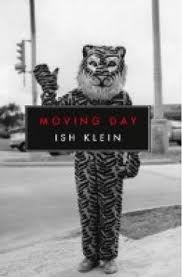
Klein, Ish. Moving Day. Ann Arbor: Canarium Books, 2011.

Nietzsche, Friedrich. “The Birth of Tragedy.” Basic Writings of Nietzsche. Tr. and Ed. Walter Kaufmann. (New York: Modern Library, 2000). 1-144.

O’Hara, Frank. The Selected Poems of Frank O’Hara. New York: Vintaqge Books, 1974.


Camille Martin

Ish Klein’s “We Will Free Each Other”

Before my recent reading for Big Night in Buffalo, I went on a book-buying spree at Talking Leaves. I was the proverbial kid in a candy store. Michael Kelleher, who accompanied me, and Jonathan Welch, the bookstore’s owner, both recommended Ish Klein’s Moving Day (Canarium Books, 2011). After thumbing through the book a little, I instinctively knew that the two had advised me well; I was happy to be introduced to the work of this poet.
         I’d like to offer one of her poems from that collection below. I was interested in the struggle within the poem between the speaker and the “dorky actor” who keeps pursuing her and interrupting her fun, observing her yet also sharing her identity.
         This and many other poems in Moving Day are amenable to close reading, and anyone who follows this blog knows that I love nothing better than to slow down my reading and savour the richness that a poem can yield, in both its fractured surface and its play of ideas.
         In my next post, I’ll take a closer look at the struggle between the self and the dork. Here’s the poem:

WE WILL FREE EACH OTHER

Yes, yes larval.
Larvalous was eye—the stars,
they were wondering, “When is X coming out?
Considering the material, X will be something!”

Always it was exclaimed.
It was exclaimed!!!
The expectation and their faces like the mark:
a line dividing over a little black hole.

A glamorous anus was the mark of the sentiment.
And then, and then came the actor.
The dork who wanted form. And he figured
where the seeing-me-capacity was and he watched me be.

This guy had been practicing accuracy
and still he came upon me with calipers.
Calipers! Still he pointed towards me
until I hissed

and he hissed back.
It was so ugly!
I cried and he cried
and I thought pathetic!

So I rolled up and grumbled.
I put a mountain in my mind.
I broke from it—a boulder me
and I hurled down a slope—the hardest part of the mountain.

As a stone on the base of it did i make me
and then I said slowly,
“Mountain. Go. Away. Leave. Me. In. Space.
The. Actor. Can. Look. At. A. Rock.”

When I looked out the actor was a rock,
a rock who may have been there before me.
I should not have been so astounded.
So much the fool was I being.

I was, I was, I was
just short of being nothing
and the actor was more on top of it than me.
This actor—watch out!

If you see the actor, evaporate—
find a place—be there instead,

I returned to the serpent form. I said,
“Stop looking at me while I’m working on stuff!”
And I know you know this. I know you know
he’s saying when I say this at the same time

the same exact time. And maybe even—
No. That’s just me but some would say
he’s saying it first. Some would say,
I said it first.

“STOP LOOKING AT ME
WHILE I’M WORKING!”

What do you want then?
What do you want?
So weakened was I then being, indeed, NOW recounting
recounting turns me into an aspic, unset—

a drooling reverberating—just recounting,
and I have been recounting for hours,
every day in some point, in stone time,
although I am not now a stone girl.

In-between-worlds / during / visiting
under the heat lamp sun, the earth—
our incubator. Within this context
of incompletion, I am coming to power in space.

So it’s electric flying too
over grey and glinting paths,
the sun touching only me like so
because it’s my feeling

and wild-eyed I find myself aloft
and taken away: hurray, hurray
I say, “We’re here!”
and the ground comes up

and the actor is on the pavement splayed,
mouthing my every mood. Instantly I say,
“Don’t believe him—he isn’t it.
He isn’t something; he’s pretending.”

Which is what he’s saying.
Then he says (and this comes from my mouth, too),
“Sold for food.
I sold my birthright for food.

I was hungry.
I WAS HUNGRY!”

But I am not hungry.

But I said it anyway.


Camille Martin

“Chafing at the Margins”: An Interview with Joel Dailey


[“I’ve reveled in obscurity my whole writing life, and publishing with presses that were close to the ground, or even underground, well, they were a fit for my work, which is chafing at the margins . . . “]

Poet and publisher Joel Dailey is the author of Lower 48 (1999) and My Psychic Dogs My Life (2008), both from Lavender Ink. Since the mid-70s, he has published numerous chapbooks with small presses, including Surprised by French Fries (Ugly Duckling Presse, 2011), How to Wallpaper Like a Pro (Unarmed, 2007), Biopic (Igneus Press, 1999), Audience, Ambience, Ambulance (Blank Gun Press, 1999), and Mars, 1953 (Rumba Press, 1979). His magazine publications are too many to mention, but let’s just say they include Rolling Stone, Exquisite Corpse, Fuck, and New American Writing.
         For many years Dailey has been an influential and generous presence in the New Orleans poetry community and far beyond. Through his long-running and iconoclastic magazine,
Fell Swoop: The All Bohemian Revue*, he has published countless poets as well as many single-author issues by the likes of Ted Berrigan, Aram Saroyan Keith Abbott, Bill Berkson, and Richard Martin.
         As for Dailey’s own poetry, Hank Lazer praises
Lower 48 as “an energetic, humorous, edgy successor to Allen Ginsberg’s “America” in which “Dailey wanders this world of manipulative consumerism resisting its hold with his blazing stun-guns of outrage, paranoia, passion, and comedy, leaving a laminated America del Norte in his wake.”
         And in
My Psychic Dogs My Life, Kevin Killian “feel[s] the New Orleans gris-gris emanating from this book like candyfloss” and “the magic of a true trickster substituting words and ideas like dice in a shell game, conjuring spells on the unprepared.”
         Samples of Dailey’s gris-gris can be found here, here, and here.
         The following interview was conducted in one fell swoop, so to speak, on February 26, 2012.

* Subscription to the print-only Fell Swoop is $15 (USD) for three issues per year:
     
Fell Swoop / PO Box 740158 / New Orleans, LA / 70174 / USA

Camille Martin: Thanks, Joel, for sitting down with me in our respective cities of New Orleans and Toronto for this interview.

Some of your earliest poetry publications were in Rolling Stone, which you later collected into a chapbook, Not on the Cover. Before I knew that about you, I didn’t realize Rolling Stone was a haven for poetry. What was it like publishing there? Please tell me they paid you in concert tickets and coke bashes.

[“The Rolling Stone poems had to be brief, quick and clever….writing for this market was actually good exercise for me at that time.”]

Joel Dailey: Back in 1978 I was living in West Los Angeles working at a “literary” bookstore in Santa Monica called Intellectuals and Liars. At that time Rolling Stone was a newsprint weekly, publishing short poems between and among record reviews in the back pages of each issue. I don’t recall how or who but someone tipped me off that Charles Perry did the poetry editing out of the San Francisco office. So I sent off a batch of short poems and he took a couple. I later found out that Perry would have the accepted poems typeset and thumbtacked them all to a bulletin board. When an issue was nearly ready to go to print, he’d look for spaces in the record review section, and the poems which fit the openings were published. RS paid a modest sum upon publication, but I was convinced that hundreds of thousands of readers were having their lives changed by my little ditties hopping out of my typewriter. The RS poems had to be brief, quick and clever….writing for this market was actually good exercise for me at that time, as a writer I mean. How to say something deliberate and humorous, perhaps, was a challenge, and many of the ideas came right out of my journals from that time. To this day, my crisp journal entries, my habitual (yet another bad habit?) collecting of language sticks and stems, often leads to poems—or they become integral parts of poems. I still have the ten or so back issues of RS in which my poems can be found. The chapbook you mention is long out of print………..

CM: But thankfully not your long-overdue first book of poetry, Lower 48 (1999), nor My Psychic Dogs My Life (2008).

You’ve also published a plethora of chapbooks since 1975. The fifteen chaps of yours that grace the shelves of my left field poetry collection are gems of pop-culture mashup, cynical (and sometimes not-so-cynical) advice to the lovelorn, and other timeless matters. The earliest that I have is Positions, published by Morgan Press in 1976—a beauty of a little book.

Morgan Press and the others that have published your chapbooks read like a who’s who of renegade small presses from the 70s to the present: to name only a handful, Pentagram, Shockbox, Rumba Train, Blank Gun, Semiquasi, Lavender Ink, and of course your own self-styled “All Bohemian Revue,” the justly infamous Fell Swoop.

There’s a whiff of samizdat—or at least underground basement operation—about the small press culture and especially these chaps. Please describe your affinity for chapbooks, which you’ve made into a kind of art form in your oeuvre, and your experience publishing them with the small presses that you’ve worked with over the years.

[“I got a small printing press one Christmas and began printing The Garfield Gazette . . . I’d leave copies on the neighbors’ front porches.”]

JD: You’re probably the one person besides me who thinks Lower 48 was overdue…..When I was growing up the kinds of jobs I imagined one day having all had to do with communication: I wanted to be a radio announcer, a journalist, a teacher. I got a small printing press one Christmas and began printing The Garfield Gazette, a three or four page newspaper. My mom still has a few issues salted away. I’d leave copies on the neighbors’ front porches. So this yearning to communicate was strong within me. I got onto poetry via Rod McKuen during my adolescent years and began writing. When the quality improved years later, 1975 saw my first chapbook, Exploring Another Leg, issued from Pentagram. Some of those deep-image poems appeared in magazines, but I had the feeling that them appearing separately diminished their impact. I needed to group them, the best of them, and fashion a chapbook—which I did, and the ms. hit Mike Tarachow at the right moment; he was very excited and had to publish it. Bless him.

Jack Spicer of course had the great idea that individual poems were better in a field of work; his notion of writing books (or chapbooks) instead of single poems was a valuable insight and very different from the workshop idea of penning the immortal poem, the one that will get you into The Greatest Hits of Am Po…..I’ve reveled in obscurity my whole writing life, and publishing with presses that were close to the ground, or even underground, well, they were a fit for my work, which is chafing at the margins, and now satirically attacks mainstream media, Am “culture” (when I hear the word ‘culture,’ I reach for the remote), and Am Poetry itself….I’m comfortable standing at the edge of the crowd rather than being engulfed in the thick of it.

CM: I hope someday we’ll be treated to the greatest hits from The Garfield Gazette!

I know that the work of Ted Berrigan was important to you early on. What was it about Berrigan’s work that affected you? What other poets were early influences? If you were to write your bildungsroman, would you describe any poetic epiphanies?

[“We met Ted and Alice at the train station with a cold Pepsi (we had read The Sonnets, noting Ted’s favorite liquid) and he began talking and chain smoking….”]

JD: Don’t hold your breath for seeing issues of The Garfield Gazette! I spent my junior year abroad at the University of Nottingham. At the time I was writing but I thought I was going to become an English professor with a Phd in Literature and the Nottingham year was, I thought, a necessary stepping stone in my envisioned academic career—but I was wrong about that….I met Philip Jenkins, a fellow student, a Welshman, at school there and he was heavily into the New York School and got me reading those poets, as well as the Black Mountain gang. Then we learned Ted Berrigan and the pregnant Alice Notley were at Essex for the year where Ted was teaching. Jenks took over the fledgling Literary Society and used its budgeted funds to bring this barbarian Ted Berrigan to read and give a lecture. We met Ted and Alice at the train station with a cold Pepsi (we had read The Sonnets, noting Ted’s favorite liquid) and he began talking and chain smoking….What he had to say in his non-stop fashion was beyond interesting. I had stopped attending classes at the university; I was disenchanted with the academick path I once sought and didn’t know what to do next…..Ted came on like gangbusters. His American accent, his bearing, his sureness in the idea that serving Poetry and living Poetry was not only the right choice, but the only choice—that devotion—all of that impressed me and guided me. Plus, at his reading he read great stuff; his works were terrific! Meeting him there on foreign soil changed my life for the better. I’ve never doubted that. Ted’s works have a lot to teach writers, and I’m delighted to see his Collected Poems and now his Selected Poems published so that a new generation has access to his work.

CM: Surprised by French Fries (haven’t we all been?) is a terrific chapbook hot off the Ugly Duckling Presse. The poems are by turns irreverent (“no ideas but in socks”), enlightened (“The earflaps are detachable so shutup.org”), and disturbed (“The previous owner may be previously disturbed”). Do you think of your poetry as holding up a mirror to media-saturated baby boomers and Gen-X? If we recognize ourselves in that mirror, should we be afraid? Very afraid?

Or do you think of it as helping us to chuckle through the sobbing?

Both? Neither?

[“How to be boring in a new way is not my goal. The language has to be up to something….”]

JD: I think we should all be terrified every second. Hiding under the bed as a matter of course can become a way of life, an indoor sport. Humor has always been an effective instrument and the definition of satire is humor with a point or at the point of a sword. I like to think that a reader of my work is immediately thrown off-balance by the poem not reading like his or her concept of what a poem is, or what it can do. For me, poetry has got to be entertaining and I set that standard for my own little creations, my windup monsters unleashed on unsuspecting readers of any generation. Milton Berle, that great standup slam poet, once said, “Laughter is an instant vacation…” I agree with him. Another great poet of our time whose works I treasure and admire, Anselm Hollo, once told me that for him if Language Poets didn’t have a sense of humor on display in their works it was a problem because then all you have is this dry, unending language flow. How to be boring in a new way is not my goal. The language has to be up to something…. I often surprise myself with the zingers that line up in my works….they are often pulled from my journal in which I record all manner of language bits, from magazine covers, tv news broadcasts, things I hear people say, to offbeat or common phrases I discover in student papers. The language surrounding us and creating our agreed-upon “reality” is rich, and out of that language pipe, I fashion poems. Ideally, the poems create an experience themselves instead of narrating past experiences—reading the poem is itself a fresh experience……

CM: Your poetry has been unflagging in its satirical edginess—to pick up on Berle, it has been an uninterrupted vacation. Has your writing changed from the time you started publishing around the mid-70s leading up to your most recent book, My Psychic Dog My Life, published by Lavender Ink, and beyond? Have you become more inclined, like a good Strangelove subject, to stop worrying and love the detritus of mass-pop-culture (please don’t reach for the remote just yet)? Or less?

[“. . . beneath this entertainment surface, there’s a critical, satirical message that happens without my completely controlling and engineering it . . .”]

JD: Recently a girlfriend of mine from the 70s when I was starting out with writing, recently she contacted me after no contact for 30+ years to say I ruined her life and she was dispatching a team of professional assassins to “take me out…” (just kidding). Actually, she was cleaning out her attic and stumbled upon a box of my letters, poems I’d written, etc. She was going to throw it all away but then thought better, found and emailed me, and sent this box, a literal and figurative blast from the past.. In exchange I sent her some recent books. She was astonished by how the 2011 scribblings were so different from the 1975 works—but she said many of the same elements were visible in the later works that she knew from the early, young man poems. Yes, a line of development (and hopefully, improvement) is clear as it is in many poets’ work if you get to see all of it. My poems from the 70s were more serious, but then I was also writing comical prose poems, and the Rolling Stone poems were lighter in tone. The surface of my writing now is fast in pace, humorous often by way of juxtaposition, but beneath this entertainment surface, there’s a critical, satirical message that happens without my completely controlling and engineering it. The message shows up, and I hope it’s heard or understood, understand?

CM: And the message is all the more effective, I think, because, as you say, you don’t completely control and engineer it, which is as good a segue as any to my next question.

Something you told me years ago about writing and editing has stayed with me, a twist on Kerouac: “First thought, best thought—unless it’s not.” I like the way this alerts us not to take the dictums of the legendaries too categorically. With all the manifestos and -isms stirring up the history of poetry, is there a danger in taking poetic camps and icons too seriously?

[“My entire life I’ve yearned, especially at night, to one day become an ism and finally amount to something….”]

JD: Wait a sec, Camille—this question’s a lob, a telegraphed fastball right down the middle of the dinner plate…..I adore the movements and the isms….My entire life I’ve yearned, especially at night, to one day become an ism and finally amount to something….I liked Actualism, actually, a movement out of Iowa City (of all places!) in the 70s—which was a tongue-in-cheek goof, sort of, on isms and movements. The interested reader can find an informative essay on Actualism by Dave Morice on Andrei Codrescu’s website. Who’s to say the Surrealists weren’t kidding? Marcel DuChamp was—or wasn’t he? Writers of the NY School never really fancied themselves a school at all, but it’s facile to refer to them in that way. Same with The Language School or Black Mountain (which really was a school, sort of, with a campus and a towering giant named Charles Olson) These are individual writers whose work deserves individual attention (in varying degrees)….I believe there’s a real danger in taking everything too seriously—and for a poet, taking him/herself too seriously? That is a disaster, as it shows up in self-inflated, self-important, self-serving (that’s a good dose of self, no?) poetry which isn’t worth reading….I’m a cardcarrying member of the infamous Post Contemporary School—wanna see my badge?

CM: That’s tempting, Joel, let’s talk.

You have now published more than a hundred issues of the intrepid Fell Swoop, which takes its cue from the great mimeographed zines of the 60s such as Ed Sanders’ Fuck You: A Magazine of the Arts. That makes it one of the longest-running small press magazines on earth. Ever. And it’s the only one I know that, like a box of Cracker Jacks on crack, includes the occasional plastic utensil to surprise and delight the unsuspecting subscriber.


the “None of the Talent, Half the Brain” issue

What’s the history of the Swoop? If there’s a secret to its longevity, does it come in a convenient, easy-to-swallow capsule? And do we dare to hope that it will never, ever, bow out gracefully?

[“Our stated mission is to destroy American Literature . . .”]

JD: It’s really a newsletter for the Insane or the Inane; it’s a bad habit and I’ll probably go blind from keeping at it….I’ve vowed to quit producing the Swoop dozens of times, but always returned to do another issue. I enjoy making the issues and sending them out….I guess when I stop enjoying the process, I’ll quit it. Our stated mission is to destroy American Literature, with a spotlight on Am Po, but truly Am Po is proving adept at destroying itself; it’s fraught with self involved careerists who are churning out Real Drivel (as opposed to Unreal Drivel, which might be more interesting)—and getting rewarded for it, as they slime trail along their “career paths” to Hooterville….

[“. . . the magazine was born the summer Ted Berrigan died, in the early 80s. My reaction to his death was to create something.”]

History? The right Reverend Richard Martin has been a contributor to every general issue; he is also our Resident Historian, a non-paying and rather cramped position….the magazine was born the summer Ted Berrigan died, in the early 80s. My reaction to his death was to create something, and so the Swooper was birthed and has continued these many years, publishing hundreds of engaging and worthwhile writers—including you, Camille…..

CM: It has been a privilege to contribute to the Swoop’s worthy cause of general mayhem.

Speaking of mayhem of a different sort, you and your family were greatly affected by Hurricane Katrina. Your home was flooded and you were displaced for months. I’ll never forget when you Fed-Exed your house key to me from your Pennsylvania home-away-from-home, so that I could sneak back into New Orleans, still under mandatory evacuation, and check up on your two cats.

In post-apocalyptic New Orleans, there was a point when Fell Swoop aficionados wondered whether the magazine would survive the disruption and continue to inject us with an antidote of impertinent chutzpah on a semi-regular basis. Après le deluge, what has given you the grit to forge ahead with your magazine, your poetry, and life in general?

A related question: In My Psychic Dogs My Life, there’s a section written under the sign of Katrina, “My Evacuation.” Whereas some poetry inspired by that muse-bitch takes a more lyrical, somber approach, in your work there seems to be a continuum in your absurdist take on the horrors-that-be—no doubt reflecting the nonstop flow of sense-defying news, pre- and post-K, in the (un)real world from which you draw your poetic raw materials. Was it difficult writing after Katrina, or was it—so to speak—cathartic?

[“It was a lot of work mixed with truckloads of Uncertainty, but, hell, the terms of existence bleed Uncertainty—”]

JD: Katrina spawned a lot of things: reconstruction, displacement, suicides, divorces, widespread fraud—and I have to tell you, HK “inspired” a lot of terrible poetry. Of course HK affected me personally, as you point out, but in terms of my writing, it added a layer, another post-apocalyptic level. We literally started over here and did without numerous comforts people take for granted. There was no mail delivery in Orleans Parish for weeks, so the Swoop rented a po box in nearby Metairie in order to receive and send dispatches; we published an issue with Joe Brainard’s adapted and adopted beloved comic character Nancy on the cover screaming “Help!” We’re the better for having experienced HK I think; the city is stronger and making a comeback. It was a lot of work mixed with truckloads of Uncertainty, but, hell, the terms of existence bleed Uncertainty—we foolishly convince ourselves that we’re secure. Olson’s warning comes to mind, “Beware of Permanence!” Part of returning to the ‘normalcy’ of my life after HK was getting back to writing; the hurricane changed many things but not my continued and continuous absurdist view of the world and peddling it through new poems.


the historic Nancy issue

CM: Are there any top-secret projects in the wings that you’d like to spill to WikiLeaks?

[“We just released The Human Bond by Clark Coolidge, a single author issue. This is Clark’s recent James Bond sonnets—not to be missed.”]

JD: I wish I had a top secret or a top hat project to give you and your readers a scoop, but o and alas. We just released The Human Bond by Clark Coolidge, a single author issue. This is Clark’s recent James Bond sonnets—not to be missed. He is a very interesting writer whose work I obviously value, a writer who’s sort of flying beneath the radar, but his work pushes limits and buttons and it does and has been doing so since the 60s. Another recent single author number is The ABC Of Duck, by a creature named Duck Martian, an alphabetical work; this feathered fowl definitely knows his ABC’s. So interesting material is still being created, and Fell Swoop is proud to offer these works to an adoring public……

CM: Rightly so.

I’ve known you for a long time, Joel, yet the marrow of your being remains a mystery to me. My Psychic Dogs My Life opens with a devastating autobiographical exposé:

A little about my life
Remove shrinkwrap.

Please help your fans understand: who’s the real Joel Dailey? Who or what will we encounter under the layers of shrinkwrap?

[“We’re all walking (or crawling) contradictions…..”]

JD: You make me chuckle, Camille….What’s inside your shrinkwrap? I looked up the meaning of my first name once; Joel was defined as “lover of literature,” and that’s true, I am. I often teach British Lit. Survey; the Romantic Age is my favorite period. I love Shakespeare’s tragedies. My two daughters grew up hearing, “How sharper than a serpent’s tooth it is to have a thankless child!” I can leer like Lear. My tastes in fiction tend to be conventional (Jane Austen is the berries, as Al Capone might have said) rather than experimental or just plain old mental. We’re all walking (or crawling) contradictions…..It’s like my Uncle Walt was fond of observing, “Do I contradict myself? Very well then, I contradict myself. I am large. I contain multitudes….” In point of measurable fact, I’m an extra-large——

CM: Thank you for sharing, Joel.

For our readers: Below is a bonus package of Dailey chapbooks. Click on any one to get the gallery view.


Camille Martin

Poems from “Blueshift Road” in Seventeen Seconds

I’m tickled to have six poems from my manuscript Blueshift Road in the latest issue of 17 Seconds: A Journal of Poetry and Poetics, edited by Ottawa poet and publisher rob mclennan:

“Snipe Hunt”
“Frittering Buttress”
“Twin Cicadas”
“Marble Petals”
“Sleeves Hold Up the Coat”
“The Sea Hag’s Last Stand”

Also in the issue are works critical and poetic by Gary Barwin, Marcus McCann, Pattie McCarthy, rob mclennan, Sean Moreland, and Monty Reid.

Kitschy-coo!


Camille Martin

Shearsman Books to publish Looms

Shearsman Books rocks my world — again! Like my previous collection (Sonnets), Looms will appear from Shearsman, a UK literary press that publishes about sixty new titles per year.

Poets who have published with Shearsman include Mark Scroggins, Maxine Chernoff, Tony Lopez, anne blonstein, Carrie Etter, Joseph Massey, Lisa Samuels, Eileen Tabios, Tom Clark, Anne Gorrick, Michael Heller, and Scott Thurston, to name only a few.

Among Canadian poets, Erin Mouré has published three books of translations of the poetry of Chus Pato for Shearsman.

I’m in fierce company.

Unless predictions of Doomsday 2012 come true, Looms will loom on the horizon in fall 2012.


Camille Martin

How will you re-invent the sonnet?

One week left to enroll in my Sonnet Workshop at the Toronto New School of Writing. Click here to view course details on the TNSoW website.

And don’t worry, if you don’t want to write traditional sonnets, we’ll also

conceptualize
fantasize
destabilize
plagiarize
sexualize (un-bowdlerize)
Hooverize
Berriganize
zero-ize
parodize
phoneticize
blasonize (& anti-blasonize)
weave
cleave
deceive
pre-conceive
mis-conceive
beat
cheat
retreat (don’t tase me, Bard!)
boff
doff
scoff
dash off
fend off
bugger off
mace
erase
debase
disgrace
replace
deep space
upper case (or any case)

. . . and if you like, embrace

the sonnet (or what’s left of it)

Duration: 21 February – 27 March 2012 (6 Tuesdays) 6-8 PM
Location: Of Swallows, 283 College Street, Upper Floor Seminar Room

Click here for more information about the course and instructor bio at the TNSoW website.


Camille Martin

“Toronto poets Camille Martin and Mark Goldstein bring lyricism to BIG NIGHT”
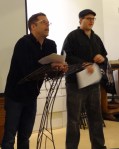
Photos! Buffalo’s Big Night featuring Camille Martin and Mark Goldstein
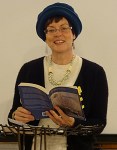

Buffalo is a happening poetry mecca—here are some photos from my January 28 reading with Mark Goldstein, also featuring films by Carl Lee and gourmet eats by Geoffrey Gatza. As if that weren’t enough, we were also treated to a mock Republican poet debate by Michael Kelleher and Aaron Lowinger (co-curators of Big Night).
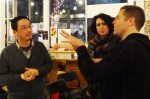
Alas, I didn’t get photos of half the people I would have liked to—I wanted to enjoy their company as well—but here are a few that I was able to snap at the event. Enjoy!

(Click on a photo to get the gallery view.)


Camille Martin