My “world premiere” of Looms will be in Cobourg, Ontario, about an hour’s train ride east of Toronto.
Poet James Pickersgill put together some thought-provoking interview questions in advance of the reading. Below is a sample, and the complete interview can be found here.
Q – Camille, it is not at all true that poetry is your single creative outlet. You are known as a collage artist, too. You are an editor yourself … and a translator. Your own work has been translated into other languages as well. You have been a university teacher. You’ve organized poetry reading series. You’ve had radio shows and you blog actively on the internet. When listed like that, these activities might sound like an array of separate pigeon-holes but I suspect that there is a lot of cross-pollination, so to speak. What is the nature of this creativity as you experience it: one spark that finds many openings to jump into flame, or, can it be distinct and separate creative impetuses?
Camille Martin – I love the idea of cross-pollination. In fact, I think my primary creative impulse is to bring together: to merge or to juxtapose. It’s the basic impetus for the metaphor: to bring unlike things into dialogue. And for me, that goes for disciplines as well. I was reading and seeking out poetry on my own from an early age, though I didn’t begin writing it in earnest until my late 30s. But my first creative expression was musical – I was trained as a classical pianist since I was six years old, and I went on to get a graduate degree in piano performance. I was also intensely interested in visual art. I’ve always felt a desire to bring the arts together. So now, in the autumn of my life, I have the pleasure of doing all three: making collages, writing poetry, and setting my poetry to music. I think these disciplines are sparking conversations among each another.
Borghes imagined paradise to be a kind of library. It can also be a dream of a bookstore with a poetry reading series, such as Myopic Books in Chicago. It’s hard to imagine a more heavenly venue. Below is a slideshow of photos from my reading there on April 21 with Mark Goldstein. Big thank-yous to Larry Sawyer, host extraordinaire of the Myopic Poetry Series.
Buffalo is a happening poetry mecca—here are some photos from my January 28 reading with Mark Goldstein, also featuring films by Carl Lee and gourmet eats by Geoffrey Gatza. As if that weren’t enough, we were also treated to a mock Republican poet debate by Michael Kelleher and Aaron Lowinger (co-curators of Big Night).
Alas, I didn’t get photos of half the people I would have liked to—I wanted to enjoy their company as well—but here are a few that I was able to snap at the event. Enjoy!
(Click on a photo to get the gallery view.)
Big Night poster
Geoffrey Gatza’s signature sweet cornbread for Big Night
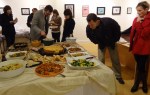
pre-reading chow-down
Michael Kelleher and Aaron Lowinger’s mock Republican poet debate
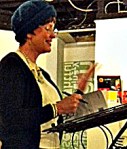
Camille Martin reading for Big Night (photo credit: Michael Kelleher)
(photo credit: Michael Kelleher)
(photo credit: Karen Goldstein)
Mark Goldstein reading for Big Night
Mark Goldstein
Barbara Cole and Geoffrey Gatza
enjoying Geoffrey Gatza’s gourmet groaning board
Dorothea Braemer and Mark Goldstein
Jonathan Welch (of Talking Leaves Books fame)
Carl Lee, Barbara Cole, & Michael Kelleher
Geoffrey Gatza & Todd Mattina
Dorothea Braemer & Michael Kelleher
Mark Goldstein
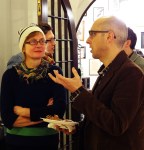
Camille Martin and Michael Kelleher (photo credit: Lori Desormeaux)
Fellow Toronto poet Mark Goldstein and I are delighted to be kicking off Big Night Buffalo’s 2012 reading season at the beautiful Western New York Book Arts Center.
My last tour-by-train this fall will be to Bridge Street Books in Washington, DC, and Segue Reading Series in New York.
This is the longest tour (by far) as I’m choosing to travel by train. Getting to DC will take a total of sixteen hours (interrupted by a rest-layover in New York). Even given the slower pace (and in reality, partly because of it), I’m finding that I much prefer to travel by train rather than plane.
For one thing, I’ll have uninterrupted time to work on a couple of writing projects—an interview as well as an essay on the literariness of train travel, which I began to explore in a previous post on Fernando Pessoa.
I’ll also continue readings that I started during my earlier trips, one of which is Bayamus & Cardinal Polatuo, two novels by Polish-British writer Stephen Themerson (with an introduction by Keith Waldrop). Come to think of it, maybe I should bring along some Kurt Schwitters, too, as a companion to this book, since Themerson and his wife, Franciszka, published his work in London.
Another is Blaise Cendras, especially “La prose du Transsibérien et de la Petite Jehanne de France.” I can’t seem to locate my translation by Ron Padgett, but I have an en face by Dos Passos that seems quite good.
The journey begins tomorrow morning at the entrance to the VIA Rail Station in Toronto, which is guarded by a mobile scare-owl. The pigeons nesting there are too smart to be tricked by the paper raptor twisting in the wind.
Here’s the information on my upcoming readings n DC and NY:
MEL NICHOLS, AMY WRIGHT,
AND CAMILLE MARTIN
7:30 PM Thursday, October 27 Bridge Street Books
(5 blocks from Foggy Bottom Metro, next to Four Seasons in Georgetown at the end of M Street)
Washington, DC
Hosted by Rod Smith
RAE ARMANTROUT AND CAMILLE MARTIN
4:00 – 6:00 PM, Saturday, Octoer 29 Segue Series at the Bowery Poetry Club
308 Bowery (just north of Houston)
NYC
$6 admission goes to support the readers
Hosted by Trisha Low and Kaegan Sparks
Rae Armantrout’s most recent poetry collections are Money Shot (Weslyan, 2011) and Versed (Wesleyan, 2009), which received the Pulitzer Prize. Armantrout is Professor of Poetry and Poetics at the University of California, San Diego.
Camille Martin is the author of Sonnets (Shearsman, 2010) and Codes of Public Sleep (BookThug, 2007). Recent projects include “Looms,” a collection of layered narratives, and “The Evangeline Papers,” a poetic sequence based on her Acadian/Cajun heritage and archaeological digs at an 18th century village in Nova Scotia.
Mel Nichols is the author of Catalytic Exteriorization Phenomenon (National Poetry Series finalist, Edge 2009), Bicycle Day (Slack Buddha 2008), and Day Poems (Edge 2005). She teaches at George Mason University and curates the Ruthless Grip Poetry Series in Washington, DC.
Amy Wright is the Nonfiction Editor of Zone 3 Press and Zone 3 journal, as well as the author of two chapbooks, Farm (Finishing Line Press: 2010) and There Are No New Ways To Kill A Man (Apostrophe Books: 2009). Her prose and poetry appears in Western Humanities Review, Bellingham Review, American Letters & Commentary, Quarterly West, and The Southern Poetry Anthology, Volume III: Southern Appalachia.
Ongoing fantasy: to book poetry readings with perfect timing for the peak ripening of fall colours. I hit the gold, orange, and red jackpot in Ottawa and Kingston during my recent readings for the AB Series (hosted by Max Middle) and the Thrive Series (hosted by Erin Foley). The views from the train were gorgeous, and the lush backdrop of colours made walking around town with friends before and after the reading that much more enjoyable.
Photos from the readings in Ottawa and Kingston:
Photo credit: Max Middle
AB Series, showing my new Above/Ground chapbook, If Leaf, Then Arpeggio, with colliding galaxies on the cover
Photo credit: Pearl Pirie
AB Series
Photo credit: Erin Foley
Thrive Series reading from Sonnets (dig the moose-muse!)
Thanks to Dale Smith for organizing and hosting this reading for Susan Briante and me at Ryerson University. The event served as the launch for the new issue of White Wall Review. There was a wonderful turnout. Congratulations to the winners of the Chang School creative writing contests!
I’m packing for the second leg of my six-city train tour. This Saturday, I’m reading for the AB Series in Ottawa, and Monday, for the Thrive Series in Kingston.
“Martin’s quick-paced tempo led the audience through a whirlwind of intimate and surreal thought that was entirely engaging.”
— Amanda Roth, Grey Borders Reading Series
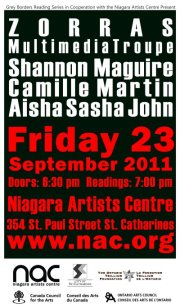
The September 23 Grey Borders Reading began on a surreal note as the poets were ushered onto the stage by Shelby, a young woman playing bagpipes. She happened to be at the Niagara Artists Centre before the reading, preparing for the next day’s annual parade through downtown St. Catharines to celebrate grapes and wine, without which the history of surrealism just wouldn’t have been the same.
And the surreality of the evening, fueled by wine and spiraling into the weirdness that poetry fiends crave, intensified with the poets’ readings: Shannon Maguire, Aisha Sasha John, Zorras, and yours untruly.
Afterward, we spilled into the night and settled in a pub lined with giant vats of pumpkin beer, spinning ever more exquisite corpses.
Thanks to Shelby, Eric Schmaltz (curator), the Niagara Artists Centre, and also to Amanda Roth for her photos and report on the evening.
Camille Martin
My travel companion for my train trip to St. Catharines to read at the Grey Borders Series was, it turns out, allergic to travel. Looking out of train windows gave him an overwhelming feeling of ennui, though he expressed his neurasthenic tedium with poetic melancholy. He was Fernando Pessoa (or rather, one of his many heteronyms, Bernardo Soares) in the form of The Book of Disquiet, a series of short, introspective prose pieces. I had thumbed through it at Nicholas Hoare Books, and Pessoa’s sensibility in these fleeting but often brilliant meditations reminded me of Emil Cioran’s existential darkness in A Short History of Decay. Even though travel, which I love, was anathema to Pessoa’s Soares, I decided the book would be ideal train reading: something I could dip into, put down, ruminate on, and pick up again. Flashes of philosophical introspection and train travel were made for each other.
There’s a visceral poetry to the experience of riding a train, which Blaise Cendrars understood so beautifully in his long poem “Prose of the Trans-Siberian and of Little Jehanne of France.” And my journey with The Book of Disquiet was the richer that Pessoa’s poetic prose harmonized with the rhythmic sways and bumps of the train:
The idea of travelling nauseates me.
I’ve already seen what I’ve never seen.
I’ve already seen what I have yet to see.
. . .
Landscapes are repetitions. On a simple train ride
I uselessly and restlessly waver between my inattention
to the landscape and my inattention to the book
that would amuse me if I were someone else. Life
makes me feel a vague nausea, and any kind of
movement aggravates it.
Only landscapes that don’t exist and books I’ll
never read aren’t tedious. Life, for me, is a
drowsiness that never reaches the brain. This
I keep free, so that I can be sad there.
I also brought along my new video camera, which became an extension of my fascination with the constantly-shifting scenery from train windows. There’s something infinitely expansive about the poetic, otherworldly, and metaphorical possibilities of the view from a train window. Visually, views within and outside trains are multi-layered. The view outside is a palimpsest of successive layers moving at different speeds depending on their distance: the blur of rails and gravel, the telephone poles flowing by and their wires complexly crisscrossing against the sky, the foreground (slagheaps, warehouses, rows of trucks or crops, houses, other trains), and the horizon (greenery, water). Then there’s the window itself, which might be streaked with rain but which always reflects a ghostly veneer of the interior scene: the ceiling lights, the young woman reading a book opposite me, the frames of windows on the other side of the train.
And there’s a difference between watching the scenery rush toward you and watching it get sucked away from you, and that difference translates into contrasting psychological states, at least for me. Since our cognitive metaphors shape our experience of time (the future approaches us and the past recedes into the distance), the head-on perspective creates the optimism of moving into the future and the other, the melancholy of watching the present frittering away from you and your ability to change it.
I think what I love so much about train travel is its artifice, its literary qualities. And it’s the metaphorical and philosophical dimensions of travel where Pessoa and I find common ground. A passage I found myself returning to during my trip:
Eternal tourists of ourselves, there is no
landscape but what we are. We possess nothing,
for we don’t even possess ourselves. We have
nothing because we are nothing. What hand
will I reach out, and to what universe? The
universe isn’t mine: it’s me.
Like Borges and his insistent refrain that “There is no whole self,” Pessoa set about dissolving the notion of a unitary Cartesian identity. And like the ephemeral scenery from a train, the self relentlessly renews itself and enters the present with continually shifting points of reference.
The video below is a short film I made from scenes between Toronto and St. Catharines. As I edited the film I found that I was creating a somewhat artificial narrative of the trip: the departure, the stops along the way, the rain followed by blue skies. The film doesn’t have an arrival; it ends with a long view of puffy clouds. And the final scene reminds me of a passage in The Book of Disquiet describing Soares’ business trip:
The train slows down, we’re at Cais do Sodré.
I’ve arrived at Lisbon, but not at a conclusion.
Slow Remains is a short film using videos from my recent train travel to St. Catharines to read at the Grey Borders Series. The music is China Gates by John Adams, performed by Nicolas Hodges.
I’ll be reading with Shannon Maguire, Aisha Sasha John, and Zorras Multimedia Troupe—a treat to be reading with these terrific poets! And many thanks to Eric Schmaltz and the Niagara Artist Centre for making this event happen.
Then on to Toronto, Ottawa, Kingston, Washington DC, and New York.
I’ll read never-before-aired poems from my new manuscript “Looms.” Copies of my recently-published Sonnets (Shearsman Books, 2010) will be available for purchase.
A big thanks to hosts Liz Howard and Shannon Maguire!
Time: Tuesday, June 7, 6:30 pm—9:30 pm
Location: The Ossington (61 Ossington Avenue, Toronto)
Beatriz Hausner’s (Toronto, ON) poetry is rooted in the legacy of international surrealism, especially its Spanish American expression. Hausner’s extensive work as a translator has focused on the writers of that literature, including Rosamel del Valle, Enrique Molina, Olga Orozco, César Moro, the poets of Mandrágora, among many others. Hausner’s work has been anthologized and published in journals both in Canada and internationally, in French, Spanish and Portuguese translation. Recent publications of her poetry include: The Wardrobe Mistress (2003), Towards the Ideal Man Poems (2003), The Stitched Heart (2004), The Archival Stone (2005) and Sew Him Up (2010). Hausner is one of the publishers of Quattro Books (www.quattrobooks.ca). She works as a public librarian in Toronto.
Camille Martin, a Toronto poet, is the author of three books of poetry: Sonnets, Codes of Public Sleep, and Sesame Kiosk. Her work has been widely and internationally published in journals and translated into Spanish and German. Her current works in progress are “Looms,” a collection of layered narratives, and “The Evangeline Papers,” a poetic sequence based on her Cajun/Acadian heritage.
Claire Lacey blogs as poetactics. Claire studied English language and literature at Glendon College then headed west to cause a ruckus as a patagrad at the University of Calgary, where she writes poetry about linguistics and birds and bridges. Claire spent the last year working as writer-in-residence at a Calgary high school to convince students that poetry isn’t boring. Claire is poetry editor of Dandelion magazine.
I’ve been Influencied! Last Wednesday, Sonnets was the focus of Margaret Christakos’ Influency class at the University of Toronto’s School of Continuing Education. After Margaret’s warm-up introduction, students read reflections on the book and rob mclennan gave a talk about it (which can be read here). I read from the book (and from my manuscript “Looms”) and then there was a general discussion.
What a brilliant idea, this class! In a few weeks, I’ll be on the other side of the magnifying glass as I give a talk on Kaie Kellough’s Maple Leaf Rag. I’m especially looking forward to hearing Kaie again. I read with him in Montreal a couple of years ago—he’s a mind-blowing performer!
I’m excited that Margaret Christakos has invited me to participate in Influency 10: A Toronto Poetry Salon, a lecture-reading series at the University of Toronto School of Continuing Education.
April 13 rob mcclennan speaking on Camille Martin’s Sonnets
April 20 Daniel Scott Tysdal speaking on Larissa Lai’s Automaton Biographies
April 27 Larissa Lai speaking on Mark Truscott’s Nature
May 4 Mark Truscott on Daniel Scott Tysdal’s The Mourner’s Book of Albums
May 11 Camille Martin speaking on Kaie Kellough’s Maple Leaf Rag
May 18 Kaie Kellough speaking on rob mcclennan’s Wild Horses
May 25
A combined evening at a venue not on U of T campus, also open to public (for a door fee).
Rachel Zolf on Erin Moure’s Pillage Laud AND Erin Moure on Rachel Zolf’s Neighbour Procedure
No class June 1
June 8 Final potluck and Student Intertexts on Influency 9 authors and books (important! please attend!)
Classes are facilitated by Margaret Christakos.
Influency 10: A Toronto Poetry Salon
April 6- June 8 2011 (no class June 1)
Wednesday evenings, 7-9:30 pm (we begin promptly at 7:05 and make every effort to end by 9:30; some classes may extend to 10pm).
For readers and writers alike. A powerful way to reconnect with poetry, to build bridges into the contemporary poetry scene, and to deepen critical engagement with poetry. Many writers and literature buffs attend this course; the class is equally welcoming to people with a beginner’s level of experience with reading poetry. Adults from 18-1000 years welcome. Approximately half the registrants in any given session have taken previous sessions of the class; and each session we welcome newcomers. The course may count towards a certificate in creative writing, or be taken for pleasure. Registrants compose readerly critical responses to books weekly, and write a final “Intertext” reflecting on two or more of the books studied, for presentation. Registrants also take turns in small groups introducing guests and bringing along snacks and non-alcoholic beverages to produce a congenial social environment for each evening.
Influency: A Toronto Poetry Salon has run twice annually from Fall 2006. In each session, 8 accomplished poets working in distinctive styles will appear as both guest readers and peer critics in this unique lecture-reading series hosted by Margaret Christakos. Each poet’s critique of a colleague’s work will be followed with a reading by the poet under discussion. A group discussion led by Christakos will follow. Students will accumulate critical vocabulary to discuss more fluently the divergences of approach, motive, process and product typical of Toronto’s multitraditional literary culture. The 8-book package under discussion will be available in class for $130. Register a week prior to course beginning if possible to facilitate smooth running of a complex course! Note this spring’s session is 9 in-class meetings, with an extended evening on May 25 at an off-campus location.
The course has also spawned a fledgling online magazine called http://www.influencysalon.ca; please visit to see some of the essays and responses presented at some of our earlier classes.
Location: Rm 108, St George Campus Health Sciences Building, University of Toronto (one block west of University, south side of College St. Queen’s Park subway station at College and University)
Course number 1777 – 010
Register at http://www.learn.utoronto.ca
University of Toronto School of Continuing Studies Creative Writing program. No prerequisite.
Course $249 plus $130 book fee (8 poetry books). Fee is paid at first class by personal cheque or cash.
Please tune in on Saturday, January 22 from 1 – 2 pm EST to CIUT 89.4 FM or listen live at http://cuit.fm
I’m excited to be reading on Donna G’s radio show, The More The Merrier, along with three other guest writers: Adam Seelig, Souvankham Thammavongsa, and Daniel Tysdal.
I’ll read from Sonnets and something from my new manuscript, Looms, maybe the one about mockingbirds announcing the arrival of hominids, or the one about the slug-fest inside Robin’s head, or the one with the “slicker lunacy” refrain . . .
Just uploaded some new information into my Upcoming Events page:
COLLAGE EXHIBIT
Sunday, December 12 – Thursday, December 23, 2010
Toronto: Arta Gallery at The Distillery / 55 Mill Street
Three limited-edition collage prints on exhibit and available for purchase, such as this one:

















 Rogue Embryo