Fellow Toronto poet Mark Goldstein and I are delighted to be kicking off Big Night Buffalo’s 2012 reading season at the beautiful Western New York Book Arts Center.
The monostich could inspire a question for poetic Trivial Pursuit: What form (other than prose poetry and vispo) has no line breaks?
The monostich has none because it consists of a single line. In the essay collection A Broken Thing: Poets on the Line, Kimiko Hahn explores this Lilliputian form, both in its literal manifestation—a poem written and intended as a monostich—and as a “found monostich,” the idea of reading a poem with an appreciation for an individual line as “a startling fragment that [has] its own integrity.”
For the latter, Hahn gives examples of such lines to be savoured for their poetic cadence from Denise Levertov’s “A Common Ground”:
grown in grit or fine
[. . .]
new green, of coppery
[. . .]
crumpled wax paper, cartons
[. . .]
curved, green-centered, falling
A single line within Levertov’s poem becomes an imagined monostich, suspended in its own time and space.
Hahn points out that whereas imagery appeals to the visual imagination, cadence involves the ear attuned to the pitch and rhythm of a group of words, and she recounts that in her evolution as a poet she gradually became aware of the qualities of poetic cadence while considering such found monostiches within longer poems.
Barbara Guest comes to mind as another poet who often sculpts her lines with a stand-alone quality, such as the following from Quilts:
where footsteps tremble on quicksand squiggly
[. . .]
third time white like autumn squash
[. . .]
minnows on muslin
One of my works-in-progress contains a section of short poems, “R is the Artichoke of Rose.” I skimmed through it looking for monostiches, certain that there’d be a handful, but was surprised to find only one. The majority are between two and six lines. I’d forgotten that most of the ultra-short poems that were originally written as one line have since been revised into lineated poems.
Why have I avoided the monostich, even in the case of a “flash poem” consisting of two words? I think it is because my ear—and mind—have become attuned to the argument of the sonnet. Although many of the poems in my Sonnets are far from traditional, I can see that the idea of the argument or even simply the development of an idea attracted me to that ancient form. The “if” and “then” structure had its appeal, and if the argument of a sonnet turned out to be illogical or open-ended, then that could become part of the movement of thought, the disruption of the proposition-conclusion folded into the scheme, observing itself in the act of giving the mental slip.
My lone monostich in “R is the Artichoke of Rose” is a parody of a famous line by Emily Dickinson:
I heard a Leafblower—when I died—
If the monostich has an argument, it’s necessarily more subtle, even if it’s on the scale of subject-predicate, clause-clause, or a pithy dialogue with a predecessor.
Below are some more true monostiches, memorable not only because their brevity makes them so easy to remember. Here’s one from Craig Dworkin’s aptly-named Motes:
WILTED TULIPS
split little puppet pulpits tilted spilling dew
The delicate tongue-twister of staccato plosives creates a striking image developing the title: the poetic miniature satisfies both ear and eye.
In John Ashbery’s “37 Haiku,” each unfurls on a single line, and again, these monostiches turn on striking images, as in these two:
Night occurs dimmer each time with the pieces
of light smaller and squarer
A blue anchor grains of grit in a tall sky sewing
In the second monostich, the final word, “sewing,” subtly echoes Lautréamont’s famous description of beauty as “the chance encounter of a sewing machine and an umbrella on a dissection table.” That statement, which became a sort of anthem for surrealists, speaks of the mysterious charm that ensues from the dialogue among disparate images. Perhaps the chance encounter involves some stitching together of such images, and Ashbery’s allusion nicely suggests the marriage of anchor and sandy grit in the sky, which might be reflected in “tall” or oceanic water.
Many of Ron Padgett’s monostiches in “To Francis Sauf Que” exemplify his signature humour. I almost bypassed the one below, but it grew on me. (I’m finding that the effectiveness of some of the more successful monostiches increases exponentially with the thoughts they generate.)
Now I love you again because of these roosters.
Padgett’s fragment appears to be lifted from a narrative; the absence of context gives the line a twist of absurdity. But it also seems to offer a goofy explanation for the mysterious force that compels one person to be attracted to another, in this case perhaps in an on-again-off-again relationship: I’m not sure exactly why I love you again (the speaker seems to say), but these roosters are as good a reason as any. The line has the qualities of both a dramatic assertion and an aphorism.
I don’t think the poem would work as well as a couplet:
Now I love you again
because of these roosters.
The separation of the abstraction (love) from the image (roosters) drains the poem of its humour. It’s funny and poignant precisely because of its seamless, matter-of-fact, droll delivery. The line break is overkill.
Almost none of the more impressive one-liners survives exclusively on abstraction. In the example by Padgett, “love” is paired with a vivid image, “roosters,” which also serves as a kind of punch line to the enigma of love.
A few years ago, issues of Peter O’Toole: A Magazine of One-Line Poems began to surface in Toronto, published by Stuart Ross. It’s the only magazine I know of that specialized in the monostich. Here’s one by Clarice Eckford that nicely captures a particular type of tedium:
WAITING FOR THE BUS
knee-deep in cement
And Dani Couture’s ear- and eye-fest:
Freezer unfrozen, slabs relax in the november electric heat.
And Stuart Ross’s deadpan deflation of vainglory, perhaps describing the imagined triumph of a poet arriving in town for a reading versus the mundane reality:
AND THEY SHALL GREET US WITH ROSES
The cheeseburger broke out of the plastic bag.
Steve Venright’s contributions hinge on spoonerisms:
With his long reach he pulled out the wrong leech.
And Joel Dailey offers a sardonic take on adjusting to the end times:
CELL PHONE BITCH SLAP
The end of the world may require some lifestyle changes
Lastly, one of my own from the magazine:
dead saints dream of the enshrined relics of their flight
At least some of the monostiches above that have titles could arguably be called distiches. But such an argument might be putting too fine a point on the matter. Why shouldn’t monostiches be entitled to titles?
Anyway, it’s New Year’s Eve and I’m not in the mood to split hairs. So here’s a parting monostich for everyone who’s read to the end:
Sheila E. Murphy is not only one of the most prolific contemporary poets; she’s also one of the most generous collaborators with other poets. Sometimes, collaborating poets engage in a clearly-delineated dialogue and indicate who wrote what, as in Leslie Scalapino and Lyn Hejinian’s Sight. But Murphy’s collaborations with poets such as Douglas Barbour, Charles Alexander, mIEKAL aND, and Peter Ganick tend more or less seamlessly to synthesize their respective contributions so that the textual offspring, so to speak, blends genetic material from both.
This is the case with Beyond the Bother of Sunlight, Murphy’s most recent collaborative effort, in which she pairs up with Lewis LaCook, who publishes much of his work on his blog, Xanax Pop. Beyond the Bother of Sunlight consists of fifty-two untitled poems, suggesting perhaps one poem for every week of a year, as well as a series exploring related themes. Though their collaborative process is not described, knowing LaCook’s proclivity for digital manipulation of text, it’s possible that this played a part in the compositional method. But whether or not this is the case, there is ample evidence of a very human, joyous, and intelligent shaping of the material. And the result is, to my mind, a smooth blending of their poetics and a serendipitous duet. To borrow their own words, the poetry creates “accidents of startled symmetry,” “birthing fluid children.”
It’s not surprising that both Murphy and LaCook have musical backgrounds, because reading the poetry is like listening to music whose complexity becomes more apparent as the piece progresses: gradually the listener becomes aware of themes and motifs, and during the course of the composition part of the pleasure is in the recognition of patterns and the recontextualization and development of those melodic fragments.
The word that comes to mind to describe this intensely musical poetry is relational: Murphy and LaCook bring words from particular realms of signification in relation to one another so that their meaning shifts as, for example, when a words from the semantic fields of spirituality and sexuality are juxtaposed. A bit later, a word with sexual connotations might be set next to a mathematical term. Thus words such as “wafer” and “bless,” “tryst” and “moan,” and “fraction” and “equation” surface in varying contexts throughout the book, suggesting a kind of musical grammar in which words recur within different syntactical and semantic frameworks. Very early into the poems I began to perceive and enjoy the deft interweaving of themes that give the poetry an inner coherence but that also allows it generous room to breathe semantically due to the contextual shifts.
In the following four passages, taken from different sections of the book, note the recurrent themes of consciousness, sexuality, spirituality, mathematics, language, time, and light/colour:
1) What if sleep were as translucent as desire?
Desire breaks out of its equation
As mathematics clarify, language amples
2)
The frozen integers lacking this much space
Become a world thus far undocumented
3)
The more I simmer, the more you pave
The more you reverence, the more I stave off
Glyphs tearing into torpor
4)
Only a certain paradise knows
How to pause a shape of color in your sleep
These and other themes are subtly intertwined throughout the book, giving the poetry (to use an analogy other than music) the texture of an intricate fabric woven with colourful threads that create recognizable but shifting patterns. There are sonic patterns, too, as in the assonance created by “lacing gaps” and, later in the same poem, its anagrammatic echo, “lapse of grace.”
The semantic field of Beyond the Bother of Sunlight is constrained by the vocabulary derived from particular realms of experience and knowledge yet also expansive due to a kind of lexical synesthesia that blends terms from these realms and enriches their experience. The result is poetry in which “language amples” into “a world thus far undocumented.”
This is a book to which I’ll return to savour its mysteries. To appreciate more fully the beauty of Murphy and LaCook’s collaboration, you should read more than just a couple of poems to experience the sympathetic vibrations of the motifs that surface throughout the book. Nonetheless I’d like to offer two in their entirety, which I hope will entice you to to read more:
4/
Pacing bequeaths to water
What water and the sky do best:
Replenish.
Smile extinguishes all traces of significance.
We motor our way home, inventing machines to carry or to carry us.
Punctuation creeps into our codes, lacing gaps
Into our bodies, bracing pauses
Through which topographies of lingo
Merge, filling the map
That way I’ve got everything flattened
And before me, ready to be folded
Along all the wrong spines,
Awaiting translation in the temporal plain.
But there’s nothing so-so about you.
Only every once in a while in the crackling
That swept over my brain text like viral winds
Swallowing scorched information affords
Fabulous blossoms, So beautiful, so suspiciously pure, you
Doubt your touch of it.
Purity eventually is traced
To touch. Suspicion twines around
Topographies that embrace
The merging of sweet spines.
A singular fulfillment rescinds the stencil
That reduces bliss to genuflection. Are we there yet?
A physicality endears itself to lapse of grace
Whose map occurs to us. In time,
A blossom purrs with listening. We hear in our flesh the tension of it,
The awful urging pulsing breaks.
5/
It was eventually found that the paint
Would pane around the letters in ghost
Plains, and this complicated into
A false sense of depth.
When walking on
The surface her feet sometimes
Slipped through
It was all she could do to keep herself
Balanced, his
Inattention was her fated goal.
It had been a long time since he looked you in the eye.
We’re a conquered people, servants
In our own land. Tranquillizers, accidents
It is forbidden for anyone to open that book
Until physicality becomes religious combustion
I see it as hopeless to try to reason with you
Just in case the flowers didn’t work
He burrowed into the fields of narrativity
Slipping through the confluence of probable branches
Until he walked on translucent panes, interlocking,
Layered. Tranquilizers conquer you. Lovely tranquilizers,
Accidents. It is forbidden for anyone to open that book.
Tranquil is a word. Speech.
Ventilation coughs up
Translucence and transmission.
Changes lock open
The book of wheels, the book of patter, the book
Of a religion
Killing beams no episode at all.
All out of kilter then, the plot’s made simple
And advisement borrows shrapnel of nativity.
Bloom time once crescent shaped is domed
Its wheatened blue comes close to venture
Spawn.
On Writing, with Camille Martin
“Camille Martin talks to Open Book about her work as a visual artist, the development of her writing, her upcoming poetry collection, Looms, and more.” Click here to go to the interview.
My last tour-by-train this fall will be to Bridge Street Books in Washington, DC, and Segue Reading Series in New York.
This is the longest tour (by far) as I’m choosing to travel by train. Getting to DC will take a total of sixteen hours (interrupted by a rest-layover in New York). Even given the slower pace (and in reality, partly because of it), I’m finding that I much prefer to travel by train rather than plane.
For one thing, I’ll have uninterrupted time to work on a couple of writing projects—an interview as well as an essay on the literariness of train travel, which I began to explore in a previous post on Fernando Pessoa.
I’ll also continue readings that I started during my earlier trips, one of which is Bayamus & Cardinal Polatuo, two novels by Polish-British writer Stephen Themerson (with an introduction by Keith Waldrop). Come to think of it, maybe I should bring along some Kurt Schwitters, too, as a companion to this book, since Themerson and his wife, Franciszka, published his work in London.
Another is Blaise Cendras, especially “La prose du Transsibérien et de la Petite Jehanne de France.” I can’t seem to locate my translation by Ron Padgett, but I have an en face by Dos Passos that seems quite good.
The journey begins tomorrow morning at the entrance to the VIA Rail Station in Toronto, which is guarded by a mobile scare-owl. The pigeons nesting there are too smart to be tricked by the paper raptor twisting in the wind.
Here’s the information on my upcoming readings n DC and NY:
MEL NICHOLS, AMY WRIGHT,
AND CAMILLE MARTIN
7:30 PM Thursday, October 27 Bridge Street Books
(5 blocks from Foggy Bottom Metro, next to Four Seasons in Georgetown at the end of M Street)
Washington, DC
Hosted by Rod Smith
RAE ARMANTROUT AND CAMILLE MARTIN
4:00 – 6:00 PM, Saturday, Octoer 29 Segue Series at the Bowery Poetry Club
308 Bowery (just north of Houston)
NYC
$6 admission goes to support the readers
Hosted by Trisha Low and Kaegan Sparks
Rae Armantrout’s most recent poetry collections are Money Shot (Weslyan, 2011) and Versed (Wesleyan, 2009), which received the Pulitzer Prize. Armantrout is Professor of Poetry and Poetics at the University of California, San Diego.
Camille Martin is the author of Sonnets (Shearsman, 2010) and Codes of Public Sleep (BookThug, 2007). Recent projects include “Looms,” a collection of layered narratives, and “The Evangeline Papers,” a poetic sequence based on her Acadian/Cajun heritage and archaeological digs at an 18th century village in Nova Scotia.
Mel Nichols is the author of Catalytic Exteriorization Phenomenon (National Poetry Series finalist, Edge 2009), Bicycle Day (Slack Buddha 2008), and Day Poems (Edge 2005). She teaches at George Mason University and curates the Ruthless Grip Poetry Series in Washington, DC.
Amy Wright is the Nonfiction Editor of Zone 3 Press and Zone 3 journal, as well as the author of two chapbooks, Farm (Finishing Line Press: 2010) and There Are No New Ways To Kill A Man (Apostrophe Books: 2009). Her prose and poetry appears in Western Humanities Review, Bellingham Review, American Letters & Commentary, Quarterly West, and The Southern Poetry Anthology, Volume III: Southern Appalachia.
Ongoing fantasy: to book poetry readings with perfect timing for the peak ripening of fall colours. I hit the gold, orange, and red jackpot in Ottawa and Kingston during my recent readings for the AB Series (hosted by Max Middle) and the Thrive Series (hosted by Erin Foley). The views from the train were gorgeous, and the lush backdrop of colours made walking around town with friends before and after the reading that much more enjoyable.
Photos from the readings in Ottawa and Kingston:
Photo credit: Max Middle
AB Series, showing my new Above/Ground chapbook, If Leaf, Then Arpeggio, with colliding galaxies on the cover
Photo credit: Pearl Pirie
AB Series
Photo credit: Erin Foley
Thrive Series reading from Sonnets (dig the moose-muse!)
Thanks to Dale Smith for organizing and hosting this reading for Susan Briante and me at Ryerson University. The event served as the launch for the new issue of White Wall Review. There was a wonderful turnout. Congratulations to the winners of the Chang School creative writing contests!
I’m packing for the second leg of my six-city train tour. This Saturday, I’m reading for the AB Series in Ottawa, and Monday, for the Thrive Series in Kingston.
In good weather, Jiri and I love to take the ferry to the Toronto Islands, not only for the pleasure of bicycling along the wide, car-free trails, but for the ferry ride itself.
On the ceiling of the lower deck stretch long rows of orange life jackets. Walking along the length of the boat, I filmed a long shot of them, which I later inverted and overlaid with water imagery.
At first, the the thought of such a juxtaposition creating the illusion of underwater life jackets seemed obvious or literal, but as I began putting the images together, the resulting little film felt to me like a meditation on impermanence, a theme that I also explore in some of my poetry.
The strange thing, though, is that such meditations on the deathless rhythms of change, far from being depressing, give me a kind of — at first, I wrote “pleasure,” but it’s more like an aura of peace. Thich Nhat Hanh expresses the feeling beautifully in this epigrammatic passage:
We should not complain about impermanence,
because without impermanence, nothing is possible.
The soundtrack is from William Duckworth’s The Time Curve Preludes performed by Neely Bruce, piano.
Camille Martin
“Martin’s quick-paced tempo led the audience through a whirlwind of intimate and surreal thought that was entirely engaging.”
— Amanda Roth, Grey Borders Reading Series
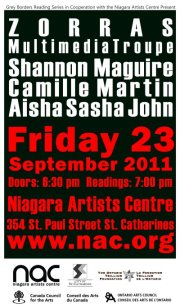
The September 23 Grey Borders Reading began on a surreal note as the poets were ushered onto the stage by Shelby, a young woman playing bagpipes. She happened to be at the Niagara Artists Centre before the reading, preparing for the next day’s annual parade through downtown St. Catharines to celebrate grapes and wine, without which the history of surrealism just wouldn’t have been the same.
And the surreality of the evening, fueled by wine and spiraling into the weirdness that poetry fiends crave, intensified with the poets’ readings: Shannon Maguire, Aisha Sasha John, Zorras, and yours untruly.
Afterward, we spilled into the night and settled in a pub lined with giant vats of pumpkin beer, spinning ever more exquisite corpses.
Thanks to Shelby, Eric Schmaltz (curator), the Niagara Artists Centre, and also to Amanda Roth for her photos and report on the evening.
Camille Martin
My travel companion for my train trip to St. Catharines to read at the Grey Borders Series was, it turns out, allergic to travel. Looking out of train windows gave him an overwhelming feeling of ennui, though he expressed his neurasthenic tedium with poetic melancholy. He was Fernando Pessoa (or rather, one of his many heteronyms, Bernardo Soares) in the form of The Book of Disquiet, a series of short, introspective prose pieces. I had thumbed through it at Nicholas Hoare Books, and Pessoa’s sensibility in these fleeting but often brilliant meditations reminded me of Emil Cioran’s existential darkness in A Short History of Decay. Even though travel, which I love, was anathema to Pessoa’s Soares, I decided the book would be ideal train reading: something I could dip into, put down, ruminate on, and pick up again. Flashes of philosophical introspection and train travel were made for each other.
There’s a visceral poetry to the experience of riding a train, which Blaise Cendrars understood so beautifully in his long poem “Prose of the Trans-Siberian and of Little Jehanne of France.” And my journey with The Book of Disquiet was the richer that Pessoa’s poetic prose harmonized with the rhythmic sways and bumps of the train:
The idea of travelling nauseates me.
I’ve already seen what I’ve never seen.
I’ve already seen what I have yet to see.
. . .
Landscapes are repetitions. On a simple train ride
I uselessly and restlessly waver between my inattention
to the landscape and my inattention to the book
that would amuse me if I were someone else. Life
makes me feel a vague nausea, and any kind of
movement aggravates it.
Only landscapes that don’t exist and books I’ll
never read aren’t tedious. Life, for me, is a
drowsiness that never reaches the brain. This
I keep free, so that I can be sad there.
I also brought along my new video camera, which became an extension of my fascination with the constantly-shifting scenery from train windows. There’s something infinitely expansive about the poetic, otherworldly, and metaphorical possibilities of the view from a train window. Visually, views within and outside trains are multi-layered. The view outside is a palimpsest of successive layers moving at different speeds depending on their distance: the blur of rails and gravel, the telephone poles flowing by and their wires complexly crisscrossing against the sky, the foreground (slagheaps, warehouses, rows of trucks or crops, houses, other trains), and the horizon (greenery, water). Then there’s the window itself, which might be streaked with rain but which always reflects a ghostly veneer of the interior scene: the ceiling lights, the young woman reading a book opposite me, the frames of windows on the other side of the train.
And there’s a difference between watching the scenery rush toward you and watching it get sucked away from you, and that difference translates into contrasting psychological states, at least for me. Since our cognitive metaphors shape our experience of time (the future approaches us and the past recedes into the distance), the head-on perspective creates the optimism of moving into the future and the other, the melancholy of watching the present frittering away from you and your ability to change it.
I think what I love so much about train travel is its artifice, its literary qualities. And it’s the metaphorical and philosophical dimensions of travel where Pessoa and I find common ground. A passage I found myself returning to during my trip:
Eternal tourists of ourselves, there is no
landscape but what we are. We possess nothing,
for we don’t even possess ourselves. We have
nothing because we are nothing. What hand
will I reach out, and to what universe? The
universe isn’t mine: it’s me.
Like Borges and his insistent refrain that “There is no whole self,” Pessoa set about dissolving the notion of a unitary Cartesian identity. And like the ephemeral scenery from a train, the self relentlessly renews itself and enters the present with continually shifting points of reference.
The video below is a short film I made from scenes between Toronto and St. Catharines. As I edited the film I found that I was creating a somewhat artificial narrative of the trip: the departure, the stops along the way, the rain followed by blue skies. The film doesn’t have an arrival; it ends with a long view of puffy clouds. And the final scene reminds me of a passage in The Book of Disquiet describing Soares’ business trip:
The train slows down, we’re at Cais do Sodré.
I’ve arrived at Lisbon, but not at a conclusion.
Slow Remains is a short film using videos from my recent train travel to St. Catharines to read at the Grey Borders Series. The music is China Gates by John Adams, performed by Nicolas Hodges.
Paul Vermeersch recently asked me to participate in his ongoing “They Will Take My Island” poetic project, in which he asks poets to respond to the eponymous 1944 painting by Arshile Gorky. I enthusiastically accepted the challenge, and immediately the question of the identity of “them” and “me” arose.
In an age in which questions of political and economic power seem more urgent than ever, probably the meaning that will most readily surface in people’s minds is of a powerful “they” taking something away from “me,” perhaps the sovereign island of individuality, the ability to determine the course of one’s life, free of coercion from the nefarious powers-that-be. In any case, that was the meaning that first came to my mind. And several of the poems powerfully develop that political facet of the title.
But what is fascinating about all of the poetic responses to Paul’s prompt is the sheer variety of approaches to those open-ended pronouns, as well as to the syntax of the sentence itself. As I sketched, drafted, and edited the poem, I developed the title to reflect my own philosophical, aesthetic, and cognitive concerns. And writing it was satisfying in unexpected ways.
So thank you, Paul, for the invitation to participate in a project that has brought me much pleasure, in both the writing of my poem and the enjoyment of reading the other poets’ responses to the title.
I’ll be reading with Shannon Maguire, Aisha Sasha John, and Zorras Multimedia Troupe—a treat to be reading with these terrific poets! And many thanks to Eric Schmaltz and the Niagara Artist Centre for making this event happen.
Then on to Toronto, Ottawa, Kingston, Washington DC, and New York.
Be sure to check out the YouTube link at the end of this review for a spell-binding performance by Kaie Kellough!
Winnipeg: Arbeiter Ring, 2010
Signifying the Tradition:
Kaie Kellough’s Maple Leaf Rag
by Camille Martin
Kaie Kellough’s Maple Leaf Rag is an exemplary Influency text—a model of intertextuality that weaves together history, genres, disciplines, and processes. Its historical themes include the history of the African Diaspora, the Middle Passage, slavery, the Jim Crow era of segregation and discrimination, and the lingering racism experienced by people of colour. It’s also in dialogue with musical and oral traditions: jazz, blues, reggae, bebop, and dub poetry. In its blending of the oral and written, it pays tribute to the strength of both. And it engages issues of social justice, infusing its rhymes, rhythms and wordplay with the caveat to remain vigilant about racial prejudice. Maple Leaf Rag pays homage to black culture and also engages in a lively dialogue with traditions. And this doubleness is important to the heritage in which the text swims. On the one hand, its identity is linked with the history and experiences in black culture. On the other hand, it also uses processes within that tradition to “play the dozens” with its own heritage, to riff, pun, encode, and ironize its text, so that the book is a continually shape-shifting, meaning-splitting exploration of moments leading to its own creation.
This tradition of intertextuality in black literary history is explored in a landmark book of criticism, Henry Louis Gates’s The Signifying Monkey: A Theory of African-American Literary Criticism. In African, Caribbean, and African-American mythology, the trickster figures of Esu and of the Signifying Monkey represent messenger types (like the Greek god Hermes) who convey and interpret messages between the gods and humans (5, 6, 8). Some of the qualities of Esu include “satire, parody, irony, magic, indeterminacy, open-endedness, ambiguity, sexuality, chance, uncertainty.”(6). Above all, this mythical figure represents “figurative language and its interpretation” (6).
Gates summarizes the ways in which these tricksters inform the entire lineage of black culture, from pre-slavery Africa to the present. First, he describes a double-voiced discourse, a tension between oral traditions and the written page that manifests as “finding a voice in writing” (21).
A second type of doubleness in the black vernacular tradition arising from the trickster figures of Esu and the Monkey “undercuts . . . the literal” and “privilege[s] the figurative and the ambiguous.” Think of this doubleness as the very figure of a metaphor, a dance between the literal and the figurative.
A third rhetorical strategy that arises from the trickster myths is the “indeterminacy of interpretation” (22). For Gates, this means that “[t]he text . . . is not fixed in any determinate sense; in one sense, it consists of the dynamic and indeterminate relationship between truth on the one hand and understanding on the other”(25). In “the highly structured rhetoric of the Signifying Monkey” in “Afro-American vernacular discourse,” “a chain of signifiers [is] open to (mis)understanding. The open-endedness of figurative language, rather than its single-minded closure, is inscribed in the myths of the Signifying Monkey” (42). Signifying “is a rhetorical practice that is not engaged in the game of information-giving”; instead, it “wreaks havoc upon the signifier” and thus “meaning is deferred” (52, 53). There is a “repeated stress on the sheer materiality, and the willful play, of the signifier itself” (59). Signifying doesn’t so much preach but instead sends its message indirectly, through verbal play and wit.
In short, the Signifying Monkey is “he who dwells at the margin of discourse, ever punning, ever troping, ever embodying the ambiguities of language” (52).
Gates also emphasizes an important rhetorical strategy in black literary tradition, related to the trickster trope of interpretation and revision: intertextuality or pastiche. He quotes Kimberly W. Benston’s definition of “genealogical revisionism”:
All Afro-American literature may be seen as one vast
genealogical poem that attempts to restore continuity
to the ruptures or discontinuities imposed
by the history of the black presence in America. (123)
As Gates puts it, “pastiche” is literary history naming itself. . . . Writers Signify upon each other’s texts by rewriting the received textual tradition”(124). Referring to the texts of others can serve the purpose of homage, with no criticism implied, or critical, implying some kind of revision or critique of the text: repetition and revision (79).
I’d like to explore Kellough’s Maple Leaf Rag through the lens of the signifying tradition in oral and written black culture. Kellough’s introduction, entitled “readeradar,” alerts us to the disrupting and deferring of meaning through puns and double-talk as well as through the sound or oral element of the poetry:
sound guides each poem, often to a place where words
are splintered, meanderings belaboured, & meanings
are blurred. sometimes sense is suspended, sent up,
upended while sound is riffed on, the way a jazz
singer swerves from word to scat. some of these poems
are kin to the blues while others are jazz offspring.
I have tried to make the words scat, sing, swing. to this
end i’ve spaced them out on the page in dense prose
blocks, loose spiralling helices, narrow
descending lyrics, hand-drawn diagrams, &
so forth. (13)
The vernacular tradition on which Kellough draws also embraces music, which like a scat singer splays and reorders syllables that come in and out of meaning, always repeating, giving the sense of continuity, and revising, giving a sense of transformation, of never staying in one place. To the element of sound he adds the musical scoring of words on the page, in an imitation of the syncopations of jazz.
In “readeradar,” Kellough also points to the project of intertextuality in his poems:
these poems contain numerous references to
black canadian, caribbean, and african american
culture: from hair styles to slave cemeteries,
athletics to immigration, musicians to
rainbow coalitions. (13)
Thus in Kellough’s introduction are strong clues that he is drawing on the traditions that Gates analyzes in The Signifying Monkey. In the first of the three main characteristics of the signifying tradition, Gates demonstrates in much written black literature the meeting of—and tension between—oral and written traditions. Likewise, Kellough’s poems in this collection explore the conjunction of sound and writing; of, on the one hand, dub poetry and musical practice, and on the other, their arrangement on the page as if in a musical score. Two obvious examples of this conjunction occur in the real score notated on pp. 73-74, as well as in “word sound system #2” (32), which explores various permutations of “word” and “sound,” and invites the reader to imagine how it might sound if performed. The mind’s ear is a powerful compulsion in many of these poems.
And in the strongly rhythmic “block rock” (53-55), the percussive repetitions and revisions of “BOOM BOOM BAP” alternate with lines that bring together the rhythmic bouncing of basketballs on asphalt, “life’s hard knock,” babies being rocked to sleep, “junkies,” the rhythms of life on the street, jazz, “funk talk,” and most ominously, the “morse code” of “gunshots.” In the onomatopoeic and ever-shifting “BOOM BOOM BAP” lines is a sense of the materiality of the words: they are nonsense words imitating the basketball’s bouncing. But these word-sounds also create a nether-space of pure rhythm overlain with meaning, as the words shift to “BOON,” “DOOM,” BOOM,” and “CLAP,” which parallel the shifting significations of the joyous as well as dangerous rhythms of life.
In a similar way, “échos / montréal nord, 11 août, 2008” (33) with its strong visual and aural components, reflects on violence begetting violence, which echoes and reveberates like the sound of a revolver shooting. The idea of echoing gunshots is achieved by the anaphoric repetition of “BLAMM” in large, bold font that diminishes like a receding echo with each line. The main subject of the poem is the Montreal police shooting, without provocation, of unarmed citizens. The date in the subtitle refers to a night of rioting in North Montreal to protest the allegedly unprovoked police shooting of Fredy Villanueva (the “unarmed brown boy,” an eighteen-year-old Latino man), which echoes in turn the police shooting of Anthony Griffin, a nineteen-year-old man who allegedly was also unjustly shot and killed by Montreal police. Marcellus Wallace, the fictional drug kingpin in the film Pulp Fiction is apparently mentioned as a symbol of violence begetting violence, this time in the world of organized crime and drug trafficking.
The violence that reverberates through the poem seems to be the result of the riot: “the eye socket ruptured by a rock,” the “molotov,” the storefront (“vitrine”) smashed by a bat, the “bricks . . . batter[ing]” an “ambulance.” It also echoes the “slug” of rum the police captain downs and the “shutter” of the “reporter’s camera” as well as his “deadline” for getting in the story. In the last line, “BLAMM” has become “BALMM.” The morning is personified as begging for an end to the violence, replacing it with the soothing balm of its soft light.
“quittin’ rhyme / blues-bop for Kim” (22) sets to paper the fast pace and short, crisp, rhyming lines of bebop music. The tight and intricately interwoven rhymes of the short and long “i” sounds and word repetitions create a bebop effect. The poem is also rich in assonance, rhymes, half-rhymes, and alliteration, accentuating its musicality.
The poem is in three sections, each introduced by the same tercet:
if you quit me
on the quick
split me in a lick
This tercet introduces patterns that are repeated and varied throughout: the “if” subordinate clause, which introduces a cause-and-future-effect pattern: “if you quit me . . . my heels’ll kick me.”
The fast-paced repetition of “you” and “me” give the poem a sense of urgency as well as humour. “Quick” means both suddenly and “alive”; the latter meaning contrasts with the various plays on death, such as the speaker’s heart stopping, digging a pit or ending up in a ditch, his kissing a chill glass lip, diving into die, wilting, and being blasted by ice.
The rhythm of the poem slows down in two places: the “tlick / tlock. tlick / tlock / ’ll seize / stop” of the speaker’s heart. The tripping meter of the opening tercet is slowed down to the spondaic rhythms of his beating heart.
It also slows down in the last line, whose rhythm is so different from the trippingly light rhythms of most of the poem, it arrests the reading and draws attention to the startling image of a “flower blasted by ice.”
The poem’s insistent short i’s suddenly become long i’s in the third section: “dive . . . die . . . jive . . . spite . . . like . . . vice,” then briefly return to a couple of short i’s (will . . . wilt) and then the final long i of “ice” delivers the sucker punch.
The poem’s theme is as old as poetry itself: the spurned lover. But in the poem, the lover’s misery becomes an festival of rhythms and rhymes that belies the bitter occasion of the poem’s creation. We should also be so fortunate with such sublimation of pain.
As a dub poet himself, Kellough dips into the dub tradition in “boyhood dub / self portrait” (25). The poem creates strong rhythms emphasized by the short lines. The poem’s musicality is brought out by rhymes, half-rhymes, and assonance playing and echoing off one another, as well as interwoven word plays, puns that expand the meaning and enlarge the semantic possibilities of the text.
“boyhood dub” (25, 26) is a paean to reggae music—especially the experience of becoming lost in its “riddims.” The speaker of the poem is in Montreal during the winter, listening to a record of Bob Marley accompanied by the I-Threes. He’s grooving to the music and creates a kind of fantasy of being in Jamaica listening to a live performance. His imaginary world is strong and detailed: he imagines the parts of the drum set (tom, steel, hi-hat) and the organ and the skank of the guitar (strumming on the off-beats). But Anansie, the Spider (a West African and Caribbean trickster figure) spins a thread and climbs down the wooden “trunk” of the electronic speaker, bringing the fantasy back to reality: the “sham isle” has feather dusters for flocks of tropical birds, a wooden woofer instead of a tree trunk, a light bulb and electric fan instead of a tropical sun and breeze.
However much the “cynic winter” murders his fantasy, memory once again draws him into the music, gives him a sense of connectedness to the history of the African diaspora and slavery (“toiling,” “coffled”).
The last words of the poem (“real me”) can be read in several ways: 1) as an imperative to make the world of reggae real, to bring it to life instead of “failing to wail” in a “vapid living room,” 2) “reel” as in to reel with dizzyiness or joy, 3) to “reel” in a fish, as the music is reeling him in (with Anansi’s silk line?), and 4) “reel” as in spin (the record, the fan). If the music isn’t the real thing (he’s listening to a record in cold Montreal, in a rather sterile environment, it nonetheless makes him feel more real, give him a sense of self, of identity, and connects him with the stream of Black heritage.
My last example of Kellough’s use of music forms and oral tradition on the printed page is the poem written in a traditional twelve-bar blues form, “simon the cyrene’s harlem dream” (37). Here’s the first stanza, each line constituting two of the twelve bars:
When I get to heaven
Ima ditty on in
When I get to heaven
Ima bop on in.
st. peter best
park my wings.
The blues form creates a strong auditory effect as the reader imagines hearing the words sung to the traditional blues harmony.
Of course, in all of these poems exemplifying Kellough’s written expression of oral and musical traditions, we can also see ways in which the strong element of sound, playing with word sounds and shifting their meanings, as in “blam” to “balm,” and “boom” to “boon” to “doom,” splays the meaning, splitting the words and re-splicing them in new contexts to create a slippery progression of meanings that reverberate, recalling Gates’ description of the repetition and revision of signifying texts.
I’d like to return briefly to “simon the cyrene’s harlem dream” as a poem that exemplifies the idea of intertextuality, which is integral to the signifying tradition. The historical Simon the Cyrene was from a Jewish community in present-day Libya; according to some Gospels, he was compelled by Romans to carry the cross for Jesus on his way to the crucifixion. Because he lived in northern Africa, Simon has become known as the first African saintly Christian. In passion plays, his character is often played by black actors (such as Paul Robeson and Sidney Poitier). “simon the cyrene’s harlem dream” imaginatively blends the identity of Simon the Cyrene and a Harlem blues singer invoking a heaven for himself after a life of suffering under racial discrimination. In this poem Simon fantasizes going to heaven as a passage into a music club, where St. Peter will park his wings and Paul as “maître-d” will give him the best seat next to the stage. “Jesus in an apron” will serve him “rum ’n rocks.” The angels will be “sepia-fine,” “brown as praise.” Famous entertainers from Harlem Renaissance days will perform for him: Josephine Baker, James P. Johnson, and Willie the Lion, and Fats Waller. In other words, in heaven, he will be given the best seat in the house, whereas in life because of his race he was denied entry into some Harlem clubs, such as the Cotton Club, despite the fact that most of the entertainers were black.
There’s another tradition that Kellough riffs on in this poem. Depicting biblical characters as black has a tradition dating back to the first converted slaves in the sixteenth century and reaching a zenith during the 1920s and 1930s, especially during the Harlem Renaissance (Pinder 223). Countee Cullen’s conflation of Christ with the lynched black man in his long poem “The Black Christ” (1929) is one of the most famous examples.
As Kellough dips into the long and rich history of black culture in Africa, the Caribbean, North America, and Europe, he recovers voices and details that might otherwise be forgotten. For example, “pardner hand savings plan” describes the experience of African and Caribbean blacks recruited to help rebuild British cities damaged by German blitz attacks during World War II. This immigration began with the arrival of about 500 Jamaicans on the Windrush in 1948, who sought greater economic opportunities and were attracted by the low boat fare. Pioneers in the racial diversification of Great Britain following World War II and dissolution of the British Empire, these immigrants were often given jobs of hard labour, and they faced racism and discrimination (Facing History). To cope with their adversity in their new home country, many of them formed benevolent societies to benefit, in turn, each member of the society, with a lump sum gathered from the tithing of all.
In the poem, the labour is described as de facto indentured servitude, a postcolonial extension of imperialist use and abuse of black labour. Uprooted and degraded in the country where they wished to improve their lot, these immigrants often felt themselves to be in a cultural limbo, wanted for their labour but shunned by racist attitudes. As if to emphasize their conflicted and transcultural identity, Kellogh, in a twist on Dickens’ A Christmas Carol, describes these labourers as the “ghosts / of empires past,” and in an ironic echo of the social strata of India, once part of the British Empire, as the “untouchable caste.”
Similarly, “the executioner” (63) recalls the story of Bernard Hopkins, African-American champion boxer. Written in the first person, the prose poem is a boasting, rollicking autobiographical rant that ends with a mythical ascension to the sun to become “the pure light beamed into your living room” as “you, dark doubter and cynic, flick on your television, receive my violent illumination.” The bright light of the television screen is likened to the “leather-melting ring-lights” and to the sun to which he ascends like an Icarus whose wings are immune to melting.
“jelly roll in canaan land” (19) recounts the story of the early New Orleans jazz musician’s stay in Vancouver, an interesting note in the history of jazz.
And lastly, “the didnt dues / for nobody” (44) also riffs on moments or aspects of African-American culture and history. Using the repetition of “I didnt,” the speaker ironically denies playing a part in or emulating any of them, from bebop to the rainbow coalition to the crip walk to jheri curls.
The last words, “national dearth” sounds like “national debt”; “debt” combined with the “dues” of the title turn the “didn’t’s” of the poem into an ironic statement of apathy, whereas vigilance against racism should foster a sense of indebtedness toward those who have contributed to Black culture or paid their dues in creating awareness about racism. The action of the 1968 athletes with fists raised in a Black Power salute becomes here a metaphor for thrusting the fists through the national dearth or debt, suggesting either a lack of awareness of racism or an indifference to the need for vigilance against its roots.
The poems in Maple Leaf Rag participate in the long and venerable tradition of genealogical revisionism; the words and meanings of its poems, disrupted by rhythmic splitting and splicing, multiplied by its polyphonies, both rupture and heal. These are poems of defiance and anger against racism, past and present. They are poems of vigilance, rattling the cage of complacency. They are poems of joy and playfulness reveling in expressions of black culture. And they are poems recovering pieces and voices of history in danger of being forgotten by a generation who sometimes feel themselves to be untouched by the historical baggage of discrimination and xenophobia, despite the official Canadian mantra of multiculturalism.
Works Cited
Cullen, Countee. The Black Christ and Other Poems. New York: Harper, 1929.
Gates, Henry Louis, Jr. The Signifying Monkey: A Theory of African-American Literary Criticism. New York: Oxford UP, 1988. Identity and Belonging in a Changing Great Britain. London: Facing History and Ourselves Foundation, 2009.
Pinder, Kymberly N. “‘Our Father, God; our Brother, Christ; or are We Bastard Kin?’: Images of Christ in African American Painting.” African American Review 31.2 (1997): 223-33.
“I transgressed the imagined
and resisted the ordered metaphors
of threat.”
– from Decompositions
For most of his life, Ken Belford has lived in the rural and wilderness areas of the Nass Valley in northern British Columbia. In his latest book of poetry, Decompositions, his meditations on humans and nature have entered a new breadth of poetic maturity and ecological wisdom that comes from years of sustaining himself from the land and being attentive to the “intelligence of nature” (Belford).
His poetry is down-to-earth, conversational. But Belford’s self-description as an autodidact—poetically or otherwise—should not be construed as a marker of unsophistication. Here is an ecologically-minded poet whose complex thought arises not only from scientific knowledge of ecosystems, geology, microbiology, and genetics, but also—and more importantly—from a lifetime of observing and meditating on the intricate connections between land and its inhabitants. And in Decompositions, Belford voices his seasoned understanding of the natural world and the human pressures that transform it. It’s poetry that has been decades in the ripening: rooted in long experience, enlightened by keen awareness, and expressed with an original and quietly compelling poetic sensibility.
I’m fascinated by the uniqueness of Belford’s poetic voice in comparison to that of many contemporary nature poets. And I think it’s important to understand what sets his work apart because of a set of expectations that readers (including myself) may bring to nature poetry and its more current rubric, eco-poetry. So first: what his approach to nature poetry is not.
Nature poetry can dazzle with lavish description and linguistic pyrotechnics, but in contrast to poets who offer the reader an epiphany of place recognition, Belford asks,
Who
says good writing conveys
a strong sense of place?
Belford is wary of the type of “possessive poem” that attempts to capture its object through descriptive details:
The aggressive impulses of
the lyric load the details
of the story with what seems
to be a post-dating hangover.
Tongue in cheek, Belford suggests that, perhaps counter-intuitively, a poetics of descriptive infatuation might have a numbing effect as one becomes inebriated with the language that tries more to “capture” the lover than to explore and cultivate a mutual partnership.
Also, some nature poets are inclined to forewarn and prescribe, but for Belford,
The apparent attempts at
moral instruction from poets
who do not own their own
lives makes me think that about
is control, which is why I’m
not convenient, and more
temporary, why I long to be
idle and purposely dormant,
and accelerate from
those empty places country
does not allow escape from.
Inconvenient indeed, if what a reader seeks is use-value to adorn an ideological or political banner. Belford’s poetry resists the easy sound byte and knee-jerk emotions about nature that may find themselves subservient to causes.
And nature poetry can lament lost Arcadias. But Belford renounces idyllic worlds that never existed anyway:
It’s best to blink and learn to forget
if it’s arcadia or aecidia, best to be
happy, and forget the topological terms
of day, the derivatives of night, and
let the pre-existing ideal slip your mind
and be bygone, and accommodate
the misfit. Images are nomadic.
In short, Belford isn’t so much interested in generating a sense of wonder about nature, in offering artificially-imaged nature as “a lifestyle Photoshop retouches,” or in engendering a feeling of melancholy or moral outrage about ecological disruption. This is not eco-poetry with an agenda. Belford’s more concerned with exploring with open mind the entanglements of nature (wild or channelled) and human perception, language (including poetic language) and social interactions. And in these explorations, “misfits” are not anomalies, and images—being the product of brains whose plasticity mirrors nature’s own continual shiftings—are not stable.
“Inter-connectedness” has become an ecological cliché, a vague truism for the web of dependence linking natural phenomena. As Belford questions his relation to his natural surroundings, he avoids such easy sentiments (which might arise from an “about” branch of nature poetry) by meditating on processes of evolution and genetics:
[T]he type of contact I lived was not
a food, or family, or animal contact route,
but evolved from a common ancestor.
His relation to nature doesn’t so much resemble the unthinking and likely accidental “contact route” followed by the spread of pathogens. It’s more like a feeling of relatedness to other beings through the genetic links of common ancestry. He describes his genes as having descended from
an old sequence recopied upstream
in a new strand that follows flooding
and I’m good at attaching to surfaces.
His arrival from distant ancestors is a traversal of nature in time that recognizes his (literal) inter-relatedness with all beings by virtue of his descent downstream, “follow[ing] flooding,” from common ancestors. Although this kind of genetic transmission is “vertical” in the biological sense of descent from parent to offspring, Belford emphasizes the horizontal links with other beings, forged by common ancestry. He views distant cousins on the tree of life as important a part of his family as great grandparents.
He also portrays his existence in the world in horizontal terms: he “attach[es] to surfaces” and
integrat[es] in through recombinations
as a naked piece of DNA in the environment,
not passed vertically
from generation to generation,
but by means of the conjugation of plasmids
into the occupation of the new.
The metaphors of horizontal and vertical genetics offer a distinction that is important to Belford’s outlook. Vertical genetic transfer represents the line of ancestry from which each living being has descended. An emphasis on the vertical thus prioritizes one’s own familial lineage, as opposed to recognizing one’s relatedness to species that branched off from our own line. The image of verticality makes it easier to conceptualize homo sapiens as having a unique and special rank at the pinnacle of the evolutionary tree.
By contrast, Belford likens his being within nature to horizontal genetic transfer (as in the conjugation of plasmids), which involves the passing of genetic material from one cell to another. The receiving cell is not considered to be the offspring of the donating cell though this type of transfer can be a mechanism of evolution.
Thus Belford envisions neither himself as a child of nature nor nature as his Garden of Eden. Instead, he sees himself and his natural environment as interacting systems of lateral exchange and mutation. And this view allows him to recognize that the human mind is only one instance of intelligence in nature, which has endowed other beings with their own native intellect in negotiating their worlds:
A wolf decided to
walk with me. They keep lists.
C is for company. You go up and
north at the same time. Everything
that lives acts in a particular way
and has a reason to live.
As a dweller in the wilderness who has seen the encroachment of loggers and farmers, Belford writes in many poems in Decompositions about the disruption of ecosystems and the ensuing ill effects on nature and humans, especially the poor: deforestation, the decline of diversity, the invasion of non-native species, and the spread of pathogens (“the fevers that go with harm” and that disproportionately affect the poor). The latter is both a literal problem and an analogy for economic forces that pave the way for the dissemination of disease and, ironically, enough, for the
good roads [that] bring
health care in because the
villages are going to need it.
In the midst of the disturbed soil and leaching toxins that degrade wilderness and disrupt ecosystems, Belford reflects on the ecological philosophy that he embraces, for he’s
sympathetic to trans-species, overgrown
gardens, and fragmentation and loss, and
of the conflicts and pathways toward coexistence.
I almost glossed over the word “trans-species” but learned that the term refers to an environmental outlook developed by Gay Bradshaw that
re-embeds humans within the larger matrix
of the animal kingdom by erasing the “and”
between humans and animals that has been
used to demarcate and reinforce the false
notion that humans are substantively
different cognitively and emotionally from
other species. (qtd. in Marino)
In Belford’s reference to trans-species, I’m again reminded of his emphasis on the horizontal exchange of genetic material. Vertical descent can suggest differentiation among species, notwithstanding the common ancestors that unite humans to every other living being. But horizontal cellular exchange implies, in the here and now, a non-hierarchical stance in relation to other beings and, indeed, the topology and matter of the land.
Belford’s turning away from the vertical “sequence of ancestors” is also consonant with his more general “shifting trust of order’s / single-file chain of incidents”: He’s no writer of “orderly passages” but of thoughts that “deviat[e] from the expected.”
I admire and respect Belford’s Decompositions because of its groundedness in science and long experience. And these tell him that inherent in biological and geological processes are constant shifts among order, chaos, growth, and decay:
The body
is weather, the mind is a wetland,
instincts come and go, responses
evolve, and signals mix.
And it also reminds him that like his poems, to which he attributes “high mutation rates,” his own life is part of nature’s ongoing process:
I’m forever in potential,
always wandering around, getting to
the top, and rolling down the other side.
I’ll give Belford a long last word by quoting a poem, one of my favourites, from Decompositions:
I bit into a persimmon and the weather
on the other side of town seemed murky
and sour, not because it was still and
without explanation, but a skip. It’s
just what happens. After all, nothing
is restricted to straight lines, and
the reflective surface of the page is
sometimes cool and cold, or warm and hot.
And there, by the edge of a weary pond,
smelled the ba and bit and breath of life,
for the earth does breathe, and flicked
a match and smoked in the breathing place
where phenomena are not perception,
but drag one weary foot after another.
And in the fetid air, inhaled and exhaled,
and stayed a while, for something like
a happy hour in the brush, for a puff
of air and a puff of smoke and a rest
in the steam and stench of suggestion.
Works Cited
Belford, Ken. “de comp.” Message to the author. 10 July 2011. E-mail.
In other news, I recently completed a new collection of poems, “Looms.” I used the Toronto New School of Writing‘s Manuscript Midwives program and went through intensive and gratifying editing sessions with poet Phil Hall, who has an uncanny ability to figure out what you want to do and help you do it better. I’m excited about this new manuscript, which is getting encouraging feedback from poet friends who’ve read the manuscript and heard my readings from it, most recently at AvantGarden.
And onward to a new poetry manuscript with the working title “Cambrian Blues.”














 Rogue Embryo