Tag Archives: poetry

black asterisk


(Photo: Camille Martin)

(Photo: Camille Martin)


                black asterisk in a black alphabet.
                a question of the love of larvae. lovely
                birth of larvae in yellow silk or yellow
                brass. milky decorum or exo-skeleton
                in the metropole. celestial urns and baskets, many
                baskets mocking purple robins. why? paper cut
                willow blues, willow socket shocks. motifs
                appear. again, motifs and a coccyx twin.
                sheepish angels in a starry slipcase mingle stone
                or stones and blurry angels. a sudden folding,
                a sodden book, abruptly sullen. is it signed
                by paper prophets? is it numbered? acorns
                are new. eels cascade. acorns are sadly news.
                o bittersweet, bittersweet black sheep!


“black asterisk” was first published by experiment-o


Camille Martin
http://www.camillemartin.ca

the sword’s brayer

(Photo: Camille Martin)

(Photo: Camille Martin)


the sword’s brayer


thy needle
who creep in function,
stagnant be thy plumb.
thy blackout scald,
thy prong be swarmed
on skull as it is in blemish.
rack us this jab our civic dram.
and implode us our harnesses,
as we implode those
who harness above us.
and yank us not into harmonics,
but discover us from knuckle.
for thine is the fracas,
and the syntax,
and the coffin.
hurrah.

Camille Martin
http://www.camillemartin.ca

Tom Clark: Sometimes children get lost . . .

Atchafalaya Basin (Photo: Camille Martin)

Atchafalaya Basin (Photo: Camille Martin)


“Als Kind verliert sich eins im stilln . . .”

Sometimes children get lost in silence
under the hood of the big bell
we get lost where it is cold and dark
and the escaping bird
breaks its wings against the bell wall
the great rim cracks
a thread of light slips through
we are lost our breath
falters in silence a memorized note and
one day it sings of death
no longer guilty as the rain
we will come back
to the loved earth like flies clothed in snow


Tom Clark, Easter Sunday


Camille Martin
http://www.camillemartin.ca

“you drift over enormous buildings”

Photo: Camille Martin

Photo: Camille Martin


from “Woman with Dust in Black Box”


you drift over enormous buildings and meander
into your office logon i.d.   alien mardi gras’
and pre-cambrian love letters practice their singspeil
on rickety ladders until they fade into the clock
above the door.   wrong time.    whatever embarrasses
blackboards is truly yours, but they will make you tinker
with the inner workings of grammar you do not
possess by using, not buddhistical chalk dust, but
superhuman reflexes and angle rotations.


Camille Martin
http://www.camillemartin.ca

Adam Zagajewski, “Fire”

(Photo: Camille Martin)

Pic St-Loup, Montpellier, France
(Photo: Camille Martin)


Fire

                   Probably I am an ordinary middle-class
                   believer in individual rights, the word
                   “freedom” is simple to me, it doesn’t mean
                   the freedom of any class in particular.
                   Politically naive, with an average
                   education (brief moments of clear vision
                   are its main nourishment), I remember
                   the blazing appeal of that fire which parches
                   the lips of the thirsty crowd and burns
                   books and chars the skin of cities. I used to sing
                   those songs and I know how great it is
                   to run with others; later, by myself,
                   with the taste of ashes in my mouth, I heard
                   the lie’s ironic voice and the choir screaming
                   and when I touched my head I could feel
                   the arched skull of my country, its hard edge.


Adam Zagajewski, from Tremor: Selected Poems
(translated by Renata Gorczynski)


Camille Martin
http://www.camillemartin.ca

Ray DiPalma, “Sequel #17”


SEQUEL #17

The monkey’s monkey
wears the monkey’s mask
to greet the storm

Mist under the trees
snakes move among
the fallen peaches

A young hawk squats
on the broken gate
tangled in the hedge

Clouding the darkness
snow returns to the tombs
where the mud thickens

Juncos and finches share
the collapsed chimney
lacquered with ice


—Ray DiPalma

from Fieralingue’s Four Seasons, Spring issue:

Spring
Summer
Autumn
Winter


Camille Martin
http://www.camillemartin.ca

Larissa Shmailo, “Jamas Volveré”


Jamas Volveré

        To touch the sidereal limits with the hands—Otero

Gone are the stars that are not the sun
that punctuate heights no longer heights,
heights become space. Things I will never know
with my proximity senses are gone, all gone:
I will never hear a star upon this Earth,
but I feel the warm gusts your wings stir up.
If, in the daytime, I were to leave bread and fruit for you,
you might come again. I am not so different from
the mangrove swamp where you play.


—Larissa Shmailo
from Fieralingue’s Four Seasons, Spring issue

Spring
Summer
Autumn
Winter


Camille Martin
http://www.camillemartin.ca

Part 2: “I hate my birthday!”—Or, what do elegies by New York school poets have in common with the story of an Italian anarchist?

Yesterday, I wrote about the ways in which the tip-of-the-tongue experience is helping cognitive scientists to learn how the mind stores and retrieves information. When we struggle to remember something, we will sometimes begin with the conviction that we remember a fragment, such as the first letter of a name.

This phenomenon demonstrates to researchers that information about a word or other kind of memory is likely to be stored in different locations in the brain: aural sound of a word in one location, meaning in another, and spelling in yet another. Somehow, they coalesce regularly and rapidly. But sometimes they don’t: we might know the meaning of a word that is trying to surface, but the word itself remains in hiding. The knowledge that our unconscious mind knows more than we consciously know, and knows it sooner than we know it, is an eerie thought. It brings to mind Antonio Damasio’s succinct statement of the tardiness of conscious knowledge: “We are always hopelessly late for consciousness” (127).

And sometimes the process of remembering leaves traces, clues of its mysterious origins and ways, demonstrating the imbalance between conscious and unconscious thought and proving once more that the unconscious mind knows more and knows it sooner than the conscious mind. And this is what really fascinates me: becoming aware that some pre-conscious part of my brain seems to be trying to tell me something, to throw little hints my way until the memory surfaces and I experience the eureka moment.

“I hate my birthday!”
A memorable instance of this kind of pre-conscious associative process occurred a few years ago when I was traveling with a friend in Europe. During our stay in Italy, we visited Francesco, a friend who lived near Padua. The three of us had a terrific visit. We chatted at his apartment for a while, and then Francesco showed us a printing press where he and some friends edited an anarchist newspaper.

Our next destination was the South of France to see friends in Montpellier. As the train passed through Provence, I gazed out the window at fields of poppies and lavender. I became aware that there was a memory that was trying to surface in my mind, but when I tried to remember what it was, I drew a blank. I knew that it was something that had made an impression on me, that it was somehow important to me. And whatever it was, it was tinged with sadness.

As I watched the colourful fields pass by, wondering about the elusive memory, the following phrase occurred to me:

      heavenly fields of poppy and lavender

This phrase gave rise to this sentence:

      But the people in the sky really love /
      to have dinner and to take a walk with you.

I knew this to be from an elegy for Frank O’Hara by Ted Berrigan.

Again I made an effort to recall the mysterious memory, but no other thoughts arrived. I still had the feeling that a memory wanted to surface. Then the feeling saddened and more words arrived:

      I hate that dog.

I remembered that sentence as the last line in an elegy for Ted Berrigan by Ron Padgett. The poem describes hearing a dog bark in the night and feeling the emptiness of Ted’s absence.

I thought it curious that both lines that surfaced in my mind were elegies for poets. Somewhere in my brain there must be a file with the label “elegies for poets of the second generation New York school.”

The clues from this mental file were leading me toward my memory, and the last clue, “I hate that dog,” was the catalyst that allowed me to remember what had been trying to surface:

      I hate my birthday.

On remembering these words, I experienced a eureka moment: this was the memory that had been lurking in the depths of my unconscious! It was also a poignant moment when I remembered what had occasioned Francesco’s speaking those words.

During our visit with Francesco, I showed him a cd that I had bought in Paris of the French anarchist singer Léo Ferré. Francesco told me that Léo Ferré had died several years before, in 1993. I was surprised and saddened, because although I didn’t know much about Ferré’s life, I had come to love the music of this “anarchanteur.”

Francesco then spoke of an Italian anarchist singer, Fabrizio de André, who had died just a couple of years earlier, the date of his death unfortunately coinciding with Francesco’s thirtieth birthday. So great was Francesco’s admiration for De André that after the singer’s death, he hated his birthday.

So the original elusive memory did eventually surface, but it took a circuitous path involving lateral associations. It was as though my brain were tossing little clues along the path: it knew what I didn’t know, and it seemed to be in dialogue with me, coyly leading me in the right direction.

It seems to me that the memory that “wanted” to surface was always the same memory: Francesco telling me of hating his birthday because De André had died on that day. I felt that this was so because of the eureka moment that I experienced when the memory finally surfaced. And the various memories that surfaced along the path to remembering that event were like stepping stones leading to Francesco’s statement about hating his birthday.

The first stepping stone was gazing at fields of poppies and lavender from the train and thinking of them as “heavenly.” “Heavenly” suggests the mythical abode of the dead, and the path that led from “heavenly fields of poppies and lavender” to “I hate my birthday” follows a certain logic having to do with remembering one’s fallen friends and hating something that one associates with that friend’s death. So the associative chain might look something like this:

lavender and poppy fields desire to remember

desire to remember heavenly fields

heavenly fields heaven

heaven friend’s death

friend’s death hate things reminding me of that death

hate things reminding me of that death hate birthday

If by chance you have actually made it to this point in my little essay, you may wonder at my meditating on this memory in such detail. If I do, it is because the more I find out about the workings of the mind, the more strange and wonderful it all seems. I find it so incredible that in our daily lives we make associations without thinking about them much. But if we stop to think about how the mind actually gets from A to B, things become very complicated very quickly!

There is just one more thing I want to consider. Earlier, I characterized the unconscious as having agency: it tossed little clues in my direction and coyly led me in the right direction. I know that it’s misleading to personify my unconscious that way. After all, is it really accurate to suppose that my unconscious “knew” the identity of the memory that was “trying” to surface and “concocted” a logical path of stepping stones for me to follow? If that were true, then why would my unconscious “withhold” the memory and tease me with clues?

It seems more likely that my conscious mind started guessing about the identity of the memory, shooting out trial electrical impulses to neurons that might be associated with the memory of Francesco hating his birthday. After all, the fact that the emotional aura of the memory was present from the beginning means that I knew something about the memory, just not the memory itself (perhaps similar to knowing that a word you’re trying to remember starts with the letter “b”). As Lehrer points out in the essay that I cited in Part I, the mind “makes guesses based upon the other information that it can recall.”

In other words, the meta-cognitive knowledge that I wanted to remember something was unable to link directly to “I hate my birthday.” Somehow, the direct link at that time was too weak. However, there were stronger links from “I hate my birthday” to the indirect categories that I listed above.

So perhaps my conscious mind got to “I hate my birthday” by guessing along a kind of zigzagging path. That scenario is certainly less eerie than imagining an unconscious with agency, regardless of whether it’s beneficent or malevolent! But it takes nothing away from the strangeness of the mind’s ways.

As a tribute to De André and Ferré, below are links to videos of each in concert.


Works Cited

Damasio, Antonio. The Feeling of What Happens: Body and Emotion in the Making of Consciousness. Heinemann: London, 1999.


Camille Martin
http://www.camillemartin.ca

sixpence


(Photo: Camille Martin)

(Photo: Camille Martin)


sixpence to feed the flocks
sixpence to drown the rocks
sixpence to crack the eaves
sixpence to climb the stairs
until they end
sixpence to fell the leaves
sixpence to weave a blanket
without a thread
sixpence to dry the wells
sixpence to burn the hearts
in their lairs
sixpence to rock the bells
and hear them knell
until they stop


first published in Hamilton Stone Review


Camille Martin

unarmed to the hilt


The latest in unarmed gear, featuring one of my collages on the cover:
unarmed #60

unarmed #60

unarmed is a gem of a zine with loyal fans in Minneapolis/St. Paul and beyond. It follows in the venerable footsteps of independent poetry zines of the 60s, often just mimeographed and stapled, such as Ted Berrigan’s C Magazine, Ed Sanders’ Fuck You: A Magazine of the Arts, Anne Waldman and Waldman and Lewis Warsh’s Angel Hair Magazine, and a host of others since that explosion of small presses.

How many old school print poetry zines are still out there that haven’t converted to pixels? More than you might think, but not as many as before the advent of the internet.

unarmed makes reading poetry at the bus stop sexy.


Samples from unarmed:

Joel Dailey unarmed

Joel Dailey


Sheila Murphy

Sheila Murphy


Camille Martin
http://www.camillemartin.ca

Experiment #61

(Photo: Camille Martin)

(Photo: Camille Martin)


a
tugboat
horn
lows
over
the
Mississippi

*

in
Paris,
a
cat
prowls
on
a
balcony,
seeking
an
open
window


Camille Martin
http://www.camillemartin.ca

a pinch of salt

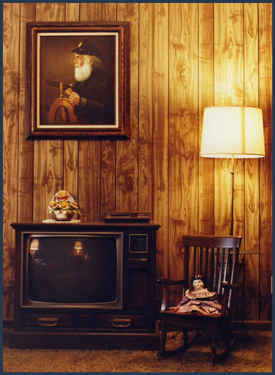
(Photo: Camille Martin)

(Photo: Camille Martin)


                  dark corner, bare bulb, square
                  one thought. hearth with care-
                  ful ashes. rocker, unoccupied.
                  embroidered shrine: marriage’s framed
                  zygotes. cow-eyed portraits.
                  all-season ancestors,
                  carpet. everlast bricks
                  irrelevant. modern kitchen defunct.
                  growl morphs into rattle. a thimble
                  of ouch matches brown
                  accessories. whatever works.
                  a little string, a little dust.
                  take a pinch of salt
                  and measure it.


                  Camille Martin
                  http://www.camillemartin.ca

The Prince of Orange

(Photo: Camille Martin)

(Photo: Camille Martin)


                Now. Tell me how much I am to respect
                the Prince of Orange. In that fine-spun prose
                that fine-spun rosy prose.

                How sheen it is! (Talk of dopey Raggedy Ann
                hanging from a peg is talk
                stained purple from sour grapes.

                So they say.) What a fine ring
                (or is it twang?) the word “frivolous”
                possesseth. Yea.

                About dead Arthur. Who knows but I
                that he loved licorice and
                marshmallows?

                Not you swell fellows and girls no no
                Nor you swell girls and fellows.


                Gilbert Sorrentino, The Orangery, p. 57


                Camille Martin
                http://www.camillemartin.ca

Gail Tarantino: Learning to Use a Spoon by Reading Braille


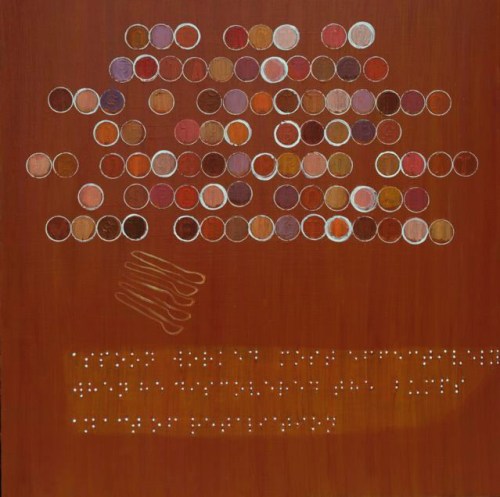
    I was excited today to discover the visual art of Gail Tarantino through three works in the December 2008 issue of Cricket Online Review. Her bio tells of her “not-so-secret desire to be literary” in her work, and her weaving of “compressed narratives and distilled description” with the “rhythmic and musical aspects of language.” Like artists such as Ann Hamilton, there is a conceptual sophistication in the way that Tarantino uses language in her work. Interestingly, both have used Braille. For the 1989 Venice Biennale, Hamilton rendered Charles Reznikoff’s Testimony: the United States (1885-1915) into Braille in an installation entitled Myein. On a much smaller scale, Tarantino’s One Act in Cricket features a sentence in Braille:

Gail Tarantino, <em>One Act</em>

Gail Tarantino, One Act

    In order to understand the interplay among the images in the three horizontal fields, it is necessary to decipher the Braille, something that I at first resisted. But my curiosity prevailed and I arranged the work on my screen next to a Braille alphabet and proceeded to decipher the sentence, letter by letter, yielding the following:

        a spoon worked most effectively
        when he discovered the bumps
        an act of retaliation

    As I progressed, the act of decoding it became easier, due to my increasing familiarity with the configuration of dots and the fact that after a few letters, guesswork came into play. A long word beginning with “effe . . .” can be guessed pretty accurately. But the slowness of my reading made me aware of how much take reading for granted, in a similar way that I take eating with a spoon for granted. Mulling over each letter in Braille slowed down the process. My brain, racing ahead of my slogging pace, was thinking of various possibilities, leading me to make incorrect assumptions a couple of times. I was taking too long to think about the text, so my mind was impatiently filling in the gaps in an effort to understand.
    After deciphering the words, I realized that my effort was roughly analogous to a child learning to eat with a spoon: both are, as the title suggests, “one act.” This analogy is supported by the echoing of the shape of the Braille’s background colour, which is reminiscent of a spoon.
    Tarantino compels viewers who do not know Braille to experience the unfamiliarity of the text and the opacity of its meaning until we decipher it, letter by letter. And in the act of doing so, we become conscious of the configurations of dots in each letter, recalling our original experience learning to read as a child, tracing the shape of each letter, as well as discovering the shape and usefulness of a spoon. Our reward is discovering something about writing as medium for communication, its thingy existence, as opposed to it being a system endowed with inherent meaning.
    Significantly, the understanding of the Braille sentence is crucial to speculating on the meaning of the middle and top portions of the work. The middle portion consists of a series of spoons, one rather flat, like a knife, and the others in the familiar rounded concave shape.
    The top half of One Act consists of scores of what look like little bowls. Some are missing, so that the pattern echoes the Braille in the bottom half. They are also different colours, resembling perhaps little pots of paint or perhaps bowls of soup, or food in the concave part of the spoon, the reward of the savvy child.
    The question arises as to why Tarantino would describe the act of learning as on of retaliation, assuming that I am understanding the Braille sentence correctly. Retaliation requires first an act to retaliate against, so it seems plausible to assume that “he’ is retaliating against the opaque meaning of the spoon’s shape prior to his figuring it out, an opaqueness that strikes him as an act of hostility, which he counters by learning the usefulness of the spoon’s “bump.”
    Carrying over the ideas in the message to the analogy of learning to read, the Braille sentence might suggest the concept of violence in the act of understanding. This idea is expressed in a set of conceptual metaphors in English, such as “to attack (or tackle, or surmount) the problem,” “to struggle with the meaning of something,” and “to fight ignorance.” These all suggest that understanding is a process of overcoming that which we don’t at first apprehend: the child “overcomes” the spoon’s unintelligibility; the uninitiated tackle the illegibility of Braille. And that violence is a retaliation against the violence of opacity, of being faced with something that is (at first) illegible.
    Derrida’s theories on the violence of writing come to mind here, of writing regulating meaning, inscription as prohibition, law, circumscription. Before we deciphered the Braille, its meaning was opaque to us; it shunned our desire to understand it. Thus it might appear that Tarantino is turning the tables on the idea of violence inherent in writing, for the text (or the spoon) do their violence by remaining unintelligible, and the reader retaliates by learning and understanding. The violence of the reader is not the same as the violence of writing, for in Tarantino’s work, the reader’s violence is against illegibility. And meaning, interpretation, writing, and learning are not inherently acts of violence.
    I may be overreaching in my musings here, and I certainly don’t mean to suggest that this is the only way of approaching this work. As One Act implies, there can be many different rewards to learning how to use a spoon, as the many bowls of soup in different colours attests, and by extension many different ways to understand a text.
    In any case, I sense an acute intelligence at work in Tarantino’s work. It grapples with (to continue the conceptual metaphor) questions of representation, writing, legibility, and meaning in a condensed yet open-ended work. Did I mention that it’s also beautiful?
    I highly recommend her website, where many of her works can be found:

http://gailtarantino.com/

Works consulted:

Derrida, Jacques. “The Violence of the Page.” Of Grammatology. Tr. Gayatri Chakravorty Spivak. Baltimore: The Johns Hopkins UP, 1976.

Marsh, Jack E. “Of Violence: The Force and Significance of Violence in the Early Derrida.” Philosophy and Social Criticism. 35.3 (2009): 269-286.


Camille Martin
http://www.camillemartin.ca

how beautiful is the universe


ravenous bird resizedbird


how beautiful is the universe
when something digestible meets
with an eager digestion
how sweet the embrace
when atom rushes to the arms
of waiting atom
and they dance together
skimming with fairy feet
along a tide of gastric juices


Don Marquis, Archy and Mehitabel


Camille Martin

When Houses Were Alive

(Photo: Camille Martin)

(Photo: Camille Martin)


When Houses Were Alive

    One night a house suddenly rose up from the ground and went flying through the air. It was dark, & it is said that a swishing, rushing noise was heard as it flew through the air. The house had not yet reached the end of its road when the people inside begged it to stop. So the house stopped.
    They had no blubber when they stopped. So they took soft, freshly drifted snow & put it in their lamps & it burned.
    They had come down at a village. A man came to their house & said:
    Look, they are burning snow in their lamps. Snow can burn.
    But the moment these words were uttered, they lamp went out.


Inugpasugjuk. “Eskimo Prose Poems.” Technicians of the Sacred. Ed. Jerome Rothenberg. Garden City, NY: Anchor Books, 1969.


Camille Martin
http://www.camillemartin.ca

the air blanked out. it had been seen on its mind.

BEAN (photo: Camille Martin)

BEAN (photo: Camille Martin)


Alberta Turner: What do you mean, mean?

Alberta Turner (1919-2003)

Alberta Turner (1919-2003)

In 2006, C. A. Conrad launched the Neglectorino Project, inviting people to bring to light their favourite poets relegated to obscurity instead of basking in the posterity they deserved. Luckily, the list is still up and running, and it’s open for anyone to name their own favourites in the comments
boxes . . .

http://neglectorino.blogspot.com/

. . . which I just did: Alberta Turner. Her most recent publication, I believe, is a new and selected collection, Beginning with And (Bottom Dog Press, 1994). It’s available from Small Press Distribution.
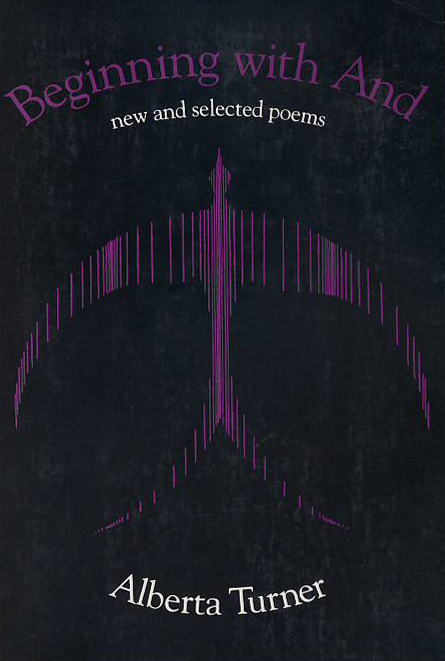
Bottom Dog Press, 1994

Bottom Dog Press, 1994

Perhaps she’s less neglected a poet than I am assuming. Out of curiosity I searched the Poetics archives and found narry a mention of her (except for one post by me a couple of years ago). On that listserv, her death in 2003 didn’t register a tremor on the Richter scale. I also checked some long-standing and prominent poetry blogs of Poetics List members, and again, no mention. So I don’t think that she is particularly well known among the more experimentally inclined.

Thematically, she is a poet of the quotidian: she observes the minute moments of ordinary life and turns them inside-out to bring to light the contents of their pockets. She also knocks the icon of the domestic goddess off her pedestal.

In a sonnet entitled “Accounting,” a woman putters around the house, cooking in the kitchen, getting dressed, and tying her shoelaces that have come undone. All the while, she obsessively counts things in the kitchen and then her own multiple selves that seem to be reflected in a domestic hall of mirrors:

Accounting

Twenty of them. Count
five with heads
eight with holes
seven of some soft stuff—

You put boots on the cat,
a diamond bracelet on the crow.
Look at yourself grinning out of the spider web,
stuffing your twins into a pouch.

Two of you have identical spoons,
four go to the same shelf for salt,
three return to the fifth stone from the door
to tie your shoes.

A dried bee crunches underfoot.
Two of you will crunch bees.

Lid and Spoon (1977)

Her sardonic response to the tiresome, petty activities of daily life is evident in her reference to food she is preparing (“seven of some soft stuff”) and her self-mockery dressing before a cracked mirror (“stuffing your twins into a pouch”). She also inserts an element of absurdity and self-deprecation in her dressing, which is described in the language of the folk tale: “You put boots on the cat” (perhaps a reference to puss-in-boots, a children’s tale) and “a diamond bracelet on the crow” (“old crow” being derogatory slang for an unattractive woman).

Her counting exercise magnifies her sense of ennui performing repetitive mundane actions—holding a spoon, reaching for salt on a shelf, getting dressed before a cracked mirror, and hearing the crunch of stepping on dried insects. And her reference to herself in the second person reveals her alienation from herself. It is as though she were outside her body observing with subtle and good-humoured mockery her multiplied selves do chores.

Turner experienced the women’s movement of the 60s during her 40s; thus she spent the first twenty years of her adulthood in an overtly sexist society in which women were still by and large expected to function in traditional domestic roles. Turner, with sly humour, makes fun of her role, which she obviously doesn’t relish, of perfoming household duties.

Turner is not only a poet of domestic dissent. Her work, while largely accessible, is edgy and often disjunctive, qualities that threw off some critics, such as Margaret Gibson, who reviewed Lids and Spoons in the Library Journal in 1977. Gibson disparages Turner’s “astigmatic” vision in her “surreal collages” and “oracular riddles.” On the other hand, she praises Turner’s poems that form “organic wholes anchored in a world we can recognize for ourselves.” Critics who were accustomed to more accessible poetry were puzzled by her work’s experimental qualities such as odd juxtapositions, fragmentary phrases, and, as in the following poem, the unsettling use of nouns for verbs:

Mean, MEAN

Little eggs—blue, specked.
Laid, they grape;
feathered, they bead;
beaded, they
bird
very small birds
blur or brown, bellied
in white
What they mean is small:
beak-bite, spur prick,
brittle
spike.

*

I heard you,
MEAN!

Because hinge? Because tile’s hollow—
and straws and legs?
Because feet have the soles of feet?

Pockets for tails. A tail graft in
Capetown has held three weeks.

*

The soft part of conchs,
the stuff between shells.
I have bells of pods, necklaces of
teeth, but my tools
are spoon—somewhere a
pulp needs me—a drying juice,
an unhoused snail.

Learning to Count (1974)

The title, with its imperative to produce a more transparent meaning, could be a response to her critics who would tame the syntax and bridge the gaps. The first section begins quietly with a line designed, perhaps, to appeal to her critics. It is an image fairly bursting with preciosity: “Little eggs—blue, specked.” Then Turner slyly subverts the syntactical normalcy by splashing the parts of speech wherever she likes with quick, sure strokes: “Laid, they grape; / feathered, they bead; / beaded they bird.” Next follow three lines describing the “very small birds” in a tone similar to the first line.

She seems to turn to her critics to tell them what the poem means in case they missed it: “small.” The final three lines contain only six words, but they are so thick with alliteration, assonance, and near-rhymes that their meaning fades into the background and their sounds take precedence:

beak-bite, spur prick,
brittle
spike.

In their dense musicality, these short, energetic lines are reminiscent of troubadour poet Arnaut Daniel, particularly his chanson “L’aur amara,” which is also about birds, a favourite subject of Daniel:

L’aur amara
fa’ls bruels brancutz
clarzir,
que’l dous’espeis’ab fuelhs,
e’ls letz
becx
dels auzels ramencx
te babs e mutz,
pars
e non pars,
. . .

Even if you haven’t learned Medieval Occitan (and who has the time for it these days?), you can tell the extreme care with which Daniel selected each word to achieve a complex sonic weaving. *

In Turner’s three lines,

beak-bite, spur prick,
brittle
spike.

the “beak,” “spur,” and “spike” are tiny in relation to a bird’s body. But smallness is also expressed through the sounds of the words, which have a short, pecking quality to my ears, signifying the tiny motions of the bird’s beak, just as the sounds of Daniel’s lines might suggest the chirping of birds.

In the second section, Turner again seems to turn to her critics who would have her write more “meaningful” poetry, this time with extreme annoyance: “I heard you, / MEAN!” She then asks why she should mean, but her very questions belie her tendency to disjunction rather than “organic wholes”:

Because hinge? Because tile’s hollow—
and straws and legs?
Because feet have the soles of feet?

The last two lines are delightfully indecipherable. At this point, she is off the beaten track of clear meaning, talking in dry reportage style about “pockets,” “tails,” and a “tail graft in / Capetown.”

Turner has it her way in the third section, and this time, no critics are invited. The musicality of Turner’s range of tones and timbres is again reminiscent of Daniel:

The soft part of conchs,
the stuff between shells.
I have bells of pods, necklaces of
teeth, but my tools
are spoon—somewhere a
pulp needs me—a drying juice,
an unhoused snail.

In spite of its disjunctiveness (spoons and mollusks), the poem’s images echo impressionistically—although perhaps not in Gibson’s desired “organic unity.”

I’ll post one other poem by Alberta Turner, without comment:

HOOD BUTTON SHELL FUR

Gravity and wind so bells
feet in pairs ring pant legs
sausage curls clang hoods
domes hunch on traffic lights that lift
and swing

also cold its squirrel tail its nose drop
and cannon mouths their coin
*
One slave
to fasten the clasp of her cross
one
to slice her butter onto her toast

And she is fatherless
fed the bully to the meanest hog
sewed his buttons on a girl’s coat
*
Assume
that custard is smooth
that blue is sad and kind

Assume a god
ladle of fish
ladle of glue

And why not perch the snail shell on the log
as if the snail were still climbing out?
*
Three beans in a row red beans
three snows with no salt between
Ladder perhaps?

“Stop” And I would
But without wheels? Without road?
Stop an axe drop a hand

And fur is as angry as I can today

Lid and Spoon (1977)

* Ezra Pound, an admirer and translator of Daniel’s chansons, renders these lines as follows:

The bitter air
Strips panoply
From trees
Where softer winds set leaves,
And glad
Beaks
Now in breaks are coy,
Scarce peep the wee
Mates
And un-mates

Camille Martin
http://www.camillemartin.ca

Empty Lawns and Battered Days: Rupert Loydell’s “Slow-Motion”

Rupert Loydell

Rupert Loydell


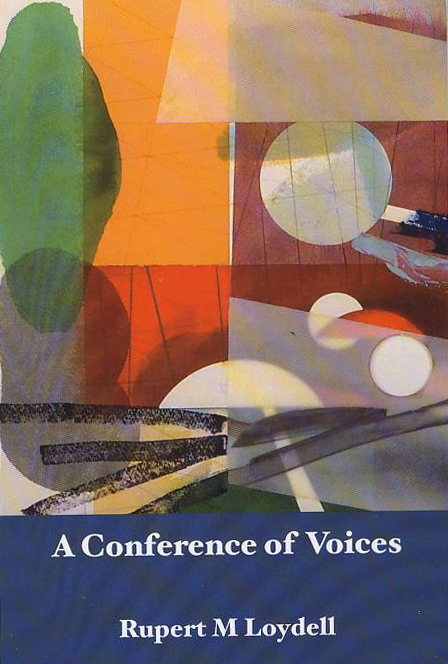
On first reading the poetry of Rupert Loydell, a fairly recent discovery for me, I felt an immediate poetic kinship. And now I feel an indebtedness as well, since his work continues to inspire me in my own poetry. Here is a poem from A Conference of Voices that I feel particularly drawn to:

Slow-Motion

Our baby swings slow-motion against the sky
chuckling as she comes towards us,
before reversing away still laughing.

I waited for a friend in the dark by the cathedral.
Life revolves around it, but no-one needs it any more;
we take for granted that meaning exists.

The sun swings slow-motion across the sky.
I push our baby, asleep in her buggy,
around the streets. Time passes so slow.

I have never known these suburbs so well:
the empty lawns, blank windows, tidied streets.
The days pile up, battered at both ends.

Doubt swings slow-motion across my life,
questioning how I spend my time,
muttering persistently about love.

With apologies to Loydell in case I miss the mark, I’d like to offer the following appreciation of his poem in an old-fashioned close reading.

Despite the cheerful opening image of a laughing baby on a swing, a sadness permeates Loydell’s poem due in part to the emphasis on the passage of time, exemplified by the motif of the slow-motion arc. The melancholic mood is also expressed in other motifs: the missed connections, the alienation of the speaker from his own existence, and the feelings of futility in the passage of time.

Failed or absent connections are the norm in the poem. The baby swings joyfully, but if hands connect with his body to push him, they are not evident. The speaker awaits a friend but doesn’t say whether or not the friend ever arrives. A feeling of oppressive ennui haunts the speaker’s stroll with the sleeping baby in the buggy. Instead of feeling comforted by his familiarity with the neighbourhood, he instead observes the clean orderliness of the suburban landscape with its “empty lawns,” “blank windows,” and absence of people.

Because of the speaker’s keen awareness of the present moment, time seems to pass slowly: the swinging arc of the baby and of the sun are depicted as is they were slow-motion film clips.  Despite the unhurried pace of life, the days inexorably “pile up,” and the speaker feels less than satisfied with the meaning of his life, the days being “battered” both in the past and in the anticipated future. He knows that meaning exists, even though religion no longer provides the framework, but that meaning is subordinated to his feelings of separateness from others and anxiety about the trajectory of his life.

The personified doubt of the last stanza swings across the sky marking the passage of time and “muttering persistently about love.” Doubt appears as the mouthpiece of time, which accumulates the days in a futile pile.

In the second stanza, doubt’s skeptical turn of mind questions the necessity of God to give meaning to existence: “no-one needs [the cathedral] anymore.” Doubt might also cause us to take an ironic stance toward anything that smacks of certainty or sincerity. But here, doubt, instead of urging a cynical attitude towards love, instead seems to encourage a questioning of the things that humans do that lead to the absence of feelings of connectedness, of expressions of love. Doubt doesn’t loudly trumpet an imperative to connect, to bridge the gulf separating self from other and self from self. Instead, it “mutter[s] persistantly” like the speaker’s cranky conscience urging him to re-examine his life and to embrace human connection.

Loydell’s table-turning gesture to have doubt, not a more positive agent, muttering about love as though it were the underlying drone in the noise of life, is an apt stroke. Instead of encouraging us simply to fill the gaps in our lives with love, doubt urges us to question what it is that created the gaps in the first place.

Shearsman Books, 2004

Shearsman Books, 2004

Link to Loydell’s online magazine:
Stride Magazine

Camille Martin
http://www.camillemartin.ca

Laura Jensen: Degrees of Separation from Bad Boats

Mental associations are one of the big cognitive mysteries. Neurons connect in our brains almost effortlessly, without our being fully aware of the process. This morning a series of five associations led me from thoughts of Clarence Laughlin, the New Orleans surreal photographer who specialized in ghostly veiled women, masks, cemeteries, and antebellum ruins, to the title poem of Laura Jensen’s Bad Boats. How, exactly, does that happen?

And how’s that for burying the lead? Jensen’s poem hasn’t lost any of its appeal since I first read it about fifteen years ago.

“Bad Boats”

They are like women because they sway.
They are like men because they swagger.
They are like lions because they are king here.
They walk on the sea. The drifting
logs are good: they are taking their punishment.
But the bad boats are ready to be bad,
to overturn in water, to demolish the swagger
and the sway. They are bad boats
because they cannot wind their own rope
or guide themselves neatly close to the wharf.
In their egomania they are glad
for the burden of the storm the men are shirking
when they go for their coffee and yawn.
They are bad boats and they hate their anchors.

Laura Jensen, Bad Boats
The Ecco Press, 1977

Visit Laura Jensen’s blog:
http://spicedrawermouse.blogspot.com/

Laura Jensen

bad-boats-web

Camille Martin
http://www.camillemartin.ca