Tag Archives: poems

The return of the rogue . . .

More posts arriving soon, including samples from poetry books that have taken off the top of my head lately.

Meanwhile, please have a look at my newly spruced-up website—it’s leaner and cleaner and easier to navigate:

http://www.camillemartin.ca

Enjoy the perusing. Comments welcome!

In other news, I recently completed a new collection of poems, “Looms.” I used the Toronto New School of Writing‘s Manuscript Midwives program and went through intensive and gratifying editing sessions with poet Phil Hall, who has an uncanny ability to figure out what you want to do and help you do it better. I’m excited about this new manuscript, which is getting encouraging feedback from poet friends who’ve read the manuscript and heard my readings from it, most recently at AvantGarden.

And onward to a new poetry manuscript with the working title “Cambrian Blues.”

Cheers!


Camille Martin

Camille Martin, Beatriz Hausner, and Claire Lacey at AvantGarden (Toronto)

Please join Beatriz Hausner, Claire Lacey, and me next Tuesday, June 7, for our AvantGarden reading at The Ossington (Toronto).

I’ll read never-before-aired poems from my new manuscript “Looms.” Copies of my recently-published Sonnets (Shearsman Books, 2010) will be available for purchase.

A big thanks to hosts Liz Howard and Shannon Maguire!

Time: Tuesday, June 7, 6:30 pm—9:30 pm
Location: The Ossington (61 Ossington Avenue, Toronto)

Beatriz Hausner’s (Toronto, ON) poetry is rooted in the legacy of international surrealism, especially its Spanish American expression. Hausner’s extensive work as a translator has focused on the writers of that literature, including Rosamel del Valle, Enrique Molina, Olga Orozco, César Moro, the poets of Mandrágora, among many others. Hausner’s work has been anthologized and published in journals both in Canada and internationally, in French, Spanish and Portuguese translation. Recent publications of her poetry include: The Wardrobe Mistress (2003), Towards the Ideal Man Poems (2003), The Stitched Heart (2004), The Archival Stone (2005) and Sew Him Up (2010). Hausner is one of the publishers of Quattro Books (www.quattrobooks.ca). She works as a public librarian in Toronto.

Camille Martin, a Toronto poet, is the author of three books of poetry: Sonnets, Codes of Public Sleep, and Sesame Kiosk. Her work has been widely and internationally published in journals and translated into Spanish and German. Her current works in progress are “Looms,” a collection of layered narratives, and “The Evangeline Papers,” a poetic sequence based on her Cajun/Acadian heritage.

Claire Lacey blogs as poetactics. Claire studied English language and literature at Glendon College then headed west to cause a ruckus as a patagrad at the University of Calgary, where she writes poetry about linguistics and birds and bridges. Claire spent the last year working as writer-in-residence at a Calgary high school to convince students that poetry isn’t boring. Claire is poetry editor of Dandelion magazine.


Camille Martin

Sampling Jay Millar’s Other Poems


Gibsons, BC: Nightwood Editions, 2010
Order from Nightwood Editions

          I could wax on about Jay Millar’s contributions to the Toronto poetry community and beyond as publisher of BookThug, co-founder of the Toronto New School of Writing, and poetry instructor (at TNSOW and George Brown College). And he probably wears more hats than I’m aware of. In short, a tireless and generous opener of doors for poetry to happen.
          But Millar is also (and to my mind, first and foremost) a wonderful poet, one of the few whose work I keep returning to for inspiration. I’m most familiar with the last four books of this already prolific poet: ESP: Accumulation Sonnets, False Maps for Other Creatures, The Small Blue, and Other Poems. And it’s from his latest that I want to offer a sample.
          Though I’m not really doing full-fledged reviews in my “Sampling” series, I’d like to mention just a couple of things that I admire about Other Poems. First is the subtle but pervasive theme of impermanence and mortality, which owes much to his understanding of natural cycles of creation and erosion, emergence and decline. To break the eligiac spell, Millar occasionally offers bouts of pure playfulness, as in “TRANSLATIONS FROM THE THE” (below).
          Also, although Millar’s lyric voice often flows in a conversational diction, he’s also an artist of the beautifully sculpted sentence, as in

How to desire that crackle trees half
empty of leaves crackle?

And:

Or could you possibly hear how
long the walk to chorus-less songs the lingual tics
are as likely as any to empty into.

No mere exercises in parsing (though that’s a pleasure in its own right), the complex and quirky syntax of these sentences draws us closer, in the act of unraveling them, to the heart of the matter. “Crackle” as both a noun and a verb draws attention to itself as the sound of autumn’s decay (as does “half / empty”), which makes the juxtaposition of “desire” with such decline even more jarring. And there’s something tautological about “the crackle that trees crackle.” The circular structure emphasizes decay as a natural and inevitable process in the cycle of life.
          And in the second sentence, “how / long the walk” meshes with the long and rather twisted syntax of the sentence, both of which speak to the mysterious and largely unknowable journey between thought and utterance (and poem).
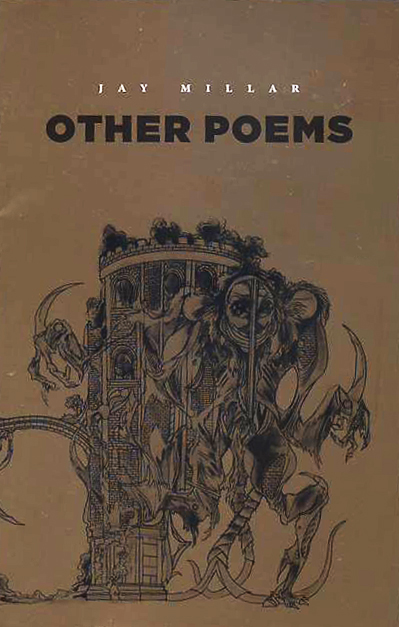
          One more reason to get the book: Rob Lemon’s fantastical bestiary of images on the cover and throughout the book.
          Here’s a sampling of poems:

WOOD PAGES

I
How to desire that crackle trees half
empty of leaves crackle? A mind that
will run their minimalist instincts
through an environment only to
build nests into the whole of the sky. So
ghostly I recall some talk about
their presence, like names for mammals,
truncated communication that
listens carefully to the dispersed.
To listen to the wind is to see
a love, the feeling of settling love.

II
Autumn: some landscape the edges of the sky pulled
toward the earth for leaves to kick up the wind.

Can you sense the moment leaves halt for a fleeting
distraction of silence? Walk listens aloud

for the sound. What all the nameless creatures name. Some
relationship between two species in which one

obtains nutrients from the bodily function
of the other. Or could you possibly hear how

long the walk to chorus-less songs the lingual tics
are as likely as any to empty into.
 
 
BOX MAINTENANCE

after Robin Blaser’s “The Medium”

I wandered around in the woods
all day thinking of the ‘you’

in so many poems camaraderie invented
hung from the trees, their threads

any community that existed only in minds
anything I might address a poem to, but don’t

what’s out there and never will be
a space between the trees filled with insects or air
images for the future to unravel
or imagine they may have caught
a glimpse of simply
by reading the scripts

What points to itself inwardly,
and whispers. We want to participate,
speak for the dead, care for them,
care about them, tell them ‘we believe’—

the characters deep mirrors of broken text
lead you expertly suspended

I wandered around all day.
Whose woods is this? What lives here?
Will anyone record their thoughts?
Who will maintain the boxes?

Surely no one could invent themselves
without somewhere to store the keys.

I’ve never been handed the invitation.
I’ve slept, it’s true, but never dreamed here—
What would be the point?

This place is not sacred
enough to speak to anyone
as long as I’m thinking of you.
 
   
from “ENTROPIC: A NARRATIVE”

2
Driving the machinery deep into the landscape
Had been slotted into a very particular slot because it—
The whiteness—hurts my eyes most days.
Perhaps it was selfish, or a little unsettling,
How this particular light cast our shadows
Considering the weight of darkness
Was certainly quiet, how you say
The trying to figure out all the angles
That morning we gathered near the beach to ask
How the sun could bother to raise again, the impression
So hard against those who arrived.
Meanwhile, we are gathered here in a fashion
All the others wrote for us, and they keep on writing—
If anything it is a wondrous distraction.
I can only say this because
When the time came to interpret the script we saw
Water continue to erode the rock.
 
 
TRANSLATIONS FROM THE THE

Some modern song a trophy
Mock sprocket undergarment triad

Forces jibe, people wander,
The hotsprings bike an awful

To the point. Meanwhile, there’s
A decent ruckus with the flab.

Pot lid. Stereophonic drywall.
The basement denies the haircuts.

Five or six melons? I’ve rooms
Enough for mechanical tarts,

No vague limp television morph—
Titanic invasion again. Death toll

Blue shirt and trouser roll. Heard
The new bowl? It’s deep. Round

Here chirp clunk and garble.
Give it effort. Give it a home.


Camille Martin

Poetic Polyphony in Scott Thurston’s Internal Rhyme

Shearsman Books, 2010


          In a previous post on musicality in poetry, I discussed the translation of simultaneity in music into a comparable literary expression. By simultaneity in music I mean polyphony, the vertical dimension of notes on the staff: the notes in a chord sound simultaneously as do the voices in a fugue. In literature, polyphony can be suggested by the simultaneity of thoughts, dialogue, or action by characters, as in the eight voices of the fugue in Joyce’s Ulysses.
          Scott Thurston’s Internal Rhyme beautifully translates the melodic and harmonic dimensions of music into poetry. The spatial division of each poem into quadrants allows both a horizontal (melodic) and a vertical (harmonic) reading of the lines. The vertical resonates with the horizontal, and the dialogue between melody and harmony opens up the semantic field. To use another musical analogy, what emerges from this dialogue is harmonic overtones, the acoustic phenomenon that enriches the experience of music.
          Because the most startling aspect of this collection is its formal innovation, I’d like to focus on possible strategies for the reader. Here’s an example from Internal Rhyme:

                    what I give myself to            haunted by surface
                    a polished shine                    or cloudy patina
                    it takes art to maintain         a perpetual crisis
                    taking everything                  you have

                    I want to give                        my heart out
                    to your ideal world                in its tension
                    I have to wait                        for the memory
                    for the poem                          to make it right

          At first blush, the possibilities presented by the quadrants seemed to me a kind of combinatorics, a conceptual experiment that reminded me a little of Raymond Queneau’s Cent mille milliards de poèmes, a series of ten sonnets whose interchangeable lines offer to the reader an almost inexhaustible series of permutations—to be mathematically precise, one hundred trillion sonnets can be generated from the conceptual machine of the ten original sonnets. Queneau’s Oulipian experiment stretches the limits of the readability of the set of ten sonnets in all of their permutations—an impossibly large number sonnets for the mortal reader to consume.
          In the case of Thurston’s quadrants, three obvious possibilities occurred to me: line-by-line (horizontally), left column-right column (vertically), and four vertical columns (left, right, left, right). But there was something disasatisfying about treating each of these readings equally, so I needed to find a more natural way to integrate the horizontal with the vertical. It occurred to me that treating the page as a musical score gave me a more rewarding entry into the intricacies suggested by the quadrants. In other words, I read the poem as horizontal (melodic) lines and allow my peripheral vision, so to speak, to note vertical (harmonic) configurations of three or four lines that enrich the reading, perhaps turning the poem on itself or opening up other semantic possibilities.
          First, my conscious mind gravitates toward a traditional line-by-line reading—partly from habit and partly because the syntactical flow of the poems in Internal Rhyme is most apparent that way. For example, in the above poem, although there’s no punctuation, my mind readily creates syntactical clusters and sentences from a horizontal reading.
          Note also the division into two equal parts that such a reading suggests: “what I give myself to” opens the first stanza, and “I want to give” opens the second. Metapoetically, the poem juxtaposes the poet’s experience and perception (what he gives himself to) with his translation of that experience into poetry (his desire to give himself over to the tension in the ideal world of the poem: the “perpetual crisis” that poetry sustains). The last two lines constitute the poem’s volta, in this case the condition upon which that translation into poetry is contingent: waiting for his memory of tension within his own experience.
          But the spatial division of the poem into quadrants compels me to notice the vertical possibilities as well. In the above poem, for example, a horizontal reading yields

              I have to wait / for the memory / for the poem / to make it right

whereas a vertical reading might yield

              I have to wait / for the poem / for the memory / to make it right

          Thus waiting for the memory of tension (in the previous reading) is aligned with waiting for the poem to emerge for the memory to “make it right.” The boundaries between experience, memory and poetic creation are thus nicely blurred into a riddle: is it unresolved memory that drives the poem into creation, or the poem’s creation that illuminates cognitive mysteries?
          Such an overlay of readings expands the poem exponentially as the mind picks up, consciously or subconsciously, variations in the configurations of lines. Reading the poems in this way allows me to blend the melodic and the harmonic dimensions to create a kind of polyphonic experience. To return to a musical analogy, the intricate texture of this overlay is like the harmonic overtones that enrich the experience of music.
          The analogies between music and poetry are ancient, and the innovative musicality of Internal Rhyme offers a richly legible and resonant kind of poetic polyphony.

* * *

From the Shearsman Books website:
Scott Thurston lectures at the University of Salford where he runs a Masters in Innovative and Experimental Creative Writing. He co-runs The Other Room reading series in Manchester, edits The Radiator, a little magazine of poetics, and co-edits The Journal of British and Irish Innovative Poetry with Robert Sheppard. He has published three collections with Shearsman.


Camille Martin

Looms in Talking Writing

Three poems from “Looms” (a work in progress) and a collage (Divers Remember the Naming of Gifts) recently appeared in Talking Writing: A Literary Magazine.


Camille Martin

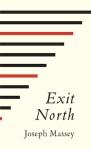
The Language of Desire to Speak: Joseph Massey’s Exit North


          Another just-received and welcome addition to Jay MillAr’s BookThug brood: Joseph Massey’s chapbook Exit North.
          In these poems, Massey depicts experience as a cross-hatch of perspective, sensory traces, and memory interlaced with symbols that continually learn and put to the test their nature-shaping patterns. If perception’s chaos is sorted out, linguistically occupied, cross-referenced with emotion and memory, it is also underlaid with emptiness: the page on which so much was believed to be written turns out to be blank.
          Experience lures language, which just as inevitably fades into silence just out of reach of the desire for the culmination of the senses in names, familiar and knowable. Attempts to understand, to order, to see yield “rhythms / looped through / the musicless field.” And this filtered experience of clamour full of trenchant detail leaves its traces as “an echo / gathering more / and more silence.”
          Massey’s poetic language enacts the rich mental process of knowing laced with the futility of perceiving the “sky clouded / by cloudlessness.” If, however, in the end we are left only with the desire to name, “to find / a word there,” that desire mitigates the abject state of being within impenetrable confusion: “the impulse [to speak] is enough.”
          A sampling to whet the appetite:

The Process

Cross-stitched
outside sounds
double the day’s

indoor confusion.
How to untwine
noise, to see.

There’s the bay,
highway slashed
beneath; water

a weaker shade
of gray than this
momentary sky’s

widening bruise.
The page turns
on the table, bare

despite all
I thought was
written there.

* * * *

Backdrop

From this hill’s vantage
all things become
whatever wind
makes them.

Electronic church bells
peal past overlapped
crow calls—

one left
circling,
recircling
a car lot.

* * * *

Bench

Cut grass, gasoline,
mound of rotted
weeds in a vacant lot

—the scent cast,
dense, with
each breeze—in

flustered shade.
What’s in a day’s
name: its slowly

summoned rhythms
looped through
the music-

less field—after-
noon’s clamor:
huddled

cars, deflated
bass lines
at a red light,

an argument
rattling the blue
aluminum trailer.

* * * *

Camille Martin
http://www.shearsman.com/pages/books/catalog/2010/martin.html