Sometimes children get lost in silence
under the hood of the big bell
we get lost where it is cold and dark
and the escaping bird
breaks its wings against the bell wall
the great rim cracks
a thread of light slips through
we are lost our breath
falters in silence a memorized note and
one day it sings of death
no longer guilty as the rain
we will come back
to the loved earth like flies clothed in snow
you drift over enormous buildings and meander
into your office logon i.d. alien mardi gras’
and pre-cambrian love letters practice their singspeil
on rickety ladders until they fade into the clock
above the door. wrong time. whatever embarrasses
blackboards is truly yours, but they will make you tinker
with the inner workings of grammar you do not
possess by using, not buddhistical chalk dust, but
superhuman reflexes and angle rotations.
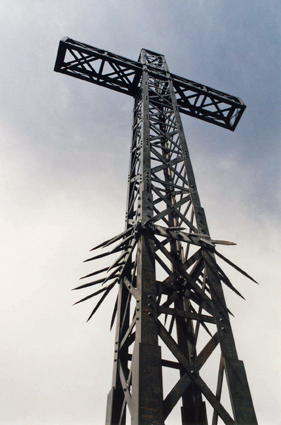
Pic St-Loup, Montpellier, France (Photo: Camille Martin)
Fire
Probably I am an ordinary middle-class
believer in individual rights, the word
“freedom” is simple to me, it doesn’t mean
the freedom of any class in particular.
Politically naive, with an average
education (brief moments of clear vision
are its main nourishment), I remember
the blazing appeal of that fire which parches
the lips of the thirsty crowd and burns
books and chars the skin of cities. I used to sing
those songs and I know how great it is
to run with others; later, by myself,
with the taste of ashes in my mouth, I heard
the lie’s ironic voice and the choir screaming
and when I touched my head I could feel
the arched skull of my country, its hard edge.
Adam Zagajewski, from Tremor: Selected Poems
(translated by Renata Gorczynski)
Gone are the stars that are not the sun
that punctuate heights no longer heights,
heights become space. Things I will never know
with my proximity senses are gone, all gone:
I will never hear a star upon this Earth,
but I feel the warm gusts your wings stir up.
If, in the daytime, I were to leave bread and fruit for you,
you might come again. I am not so different from
the mangrove swamp where you play.
—Larissa Shmailo
from Fieralingue’s Four Seasons, Spring issue
This phenomenon demonstrates to researchers that information about a word or other kind of memory is likely to be stored in different locations in the brain: aural sound of a word in one location, meaning in another, and spelling in yet another. Somehow, they coalesce regularly and rapidly. But sometimes they don’t: we might know the meaning of a word that is trying to surface, but the word itself remains in hiding. The knowledge that our unconscious mind knows more than we consciously know, and knows it sooner than we know it, is an eerie thought. It brings to mind Antonio Damasio’s succinct statement of the tardiness of conscious knowledge: “We are always hopelessly late for consciousness” (127).
And sometimes the process of remembering leaves traces, clues of its mysterious origins and ways, demonstrating the imbalance between conscious and unconscious thought and proving once more that the unconscious mind knows more and knows it sooner than the conscious mind. And this is what really fascinates me: becoming aware that some pre-conscious part of my brain seems to be trying to tell me something, to throw little hints my way until the memory surfaces and I experience the eureka moment.
“I hate my birthday!”
A memorable instance of this kind of pre-conscious associative process occurred a few years ago when I was traveling with a friend in Europe. During our stay in Italy, we visited Francesco, a friend who lived near Padua. The three of us had a terrific visit. We chatted at his apartment for a while, and then Francesco showed us a printing press where he and some friends edited an anarchist newspaper.
Our next destination was the South of France to see friends in Montpellier. As the train passed through Provence, I gazed out the window at fields of poppies and lavender. I became aware that there was a memory that was trying to surface in my mind, but when I tried to remember what it was, I drew a blank. I knew that it was something that had made an impression on me, that it was somehow important to me. And whatever it was, it was tinged with sadness.
As I watched the colourful fields pass by, wondering about the elusive memory, the following phrase occurred to me:
heavenly fields of poppy and lavender
This phrase gave rise to this sentence:
But the people in the sky really love /
to have dinner and to take a walk with you.
I knew this to be from an elegy for Frank O’Hara by Ted Berrigan.
Again I made an effort to recall the mysterious memory, but no other thoughts arrived. I still had the feeling that a memory wanted to surface. Then the feeling saddened and more words arrived:
I hate that dog.
I remembered that sentence as the last line in an elegy for Ted Berrigan by Ron Padgett. The poem describes hearing a dog bark in the night and feeling the emptiness of Ted’s absence.
I thought it curious that both lines that surfaced in my mind were elegies for poets. Somewhere in my brain there must be a file with the label “elegies for poets of the second generation New York school.”
The clues from this mental file were leading me toward my memory, and the last clue, “I hate that dog,” was the catalyst that allowed me to remember what had been trying to surface:
I hate my birthday.
On remembering these words, I experienced a eureka moment: this was the memory that had been lurking in the depths of my unconscious! It was also a poignant moment when I remembered what had occasioned Francesco’s speaking those words.
During our visit with Francesco, I showed him a cd that I had bought in Paris of the French anarchist singer Léo Ferré. Francesco told me that Léo Ferré had died several years before, in 1993. I was surprised and saddened, because although I didn’t know much about Ferré’s life, I had come to love the music of this “anarchanteur.”
Francesco then spoke of an Italian anarchist singer, Fabrizio de André, who had died just a couple of years earlier, the date of his death unfortunately coinciding with Francesco’s thirtieth birthday. So great was Francesco’s admiration for De André that after the singer’s death, he hated his birthday.
So the original elusive memory did eventually surface, but it took a circuitous path involving lateral associations. It was as though my brain were tossing little clues along the path: it knew what I didn’t know, and it seemed to be in dialogue with me, coyly leading me in the right direction.
It seems to me that the memory that “wanted” to surface was always the same memory: Francesco telling me of hating his birthday because De André had died on that day. I felt that this was so because of the eureka moment that I experienced when the memory finally surfaced. And the various memories that surfaced along the path to remembering that event were like stepping stones leading to Francesco’s statement about hating his birthday.
The first stepping stone was gazing at fields of poppies and lavender from the train and thinking of them as “heavenly.” “Heavenly” suggests the mythical abode of the dead, and the path that led from “heavenly fields of poppies and lavender” to “I hate my birthday” follows a certain logic having to do with remembering one’s fallen friends and hating something that one associates with that friend’s death. So the associative chain might look something like this:
lavender and poppy fields → desire to remember
desire to remember → heavenly fields
heavenly fields → heaven
heaven → friend’s death
friend’s death → hate things reminding me of that death
hate things reminding me of that death → hate birthday
If by chance you have actually made it to this point in my little essay, you may wonder at my meditating on this memory in such detail. If I do, it is because the more I find out about the workings of the mind, the more strange and wonderful it all seems. I find it so incredible that in our daily lives we make associations without thinking about them much. But if we stop to think about how the mind actually gets from A to B, things become very complicated very quickly!
There is just one more thing I want to consider. Earlier, I characterized the unconscious as having agency: it tossed little clues in my direction and coyly led me in the right direction. I know that it’s misleading to personify my unconscious that way. After all, is it really accurate to suppose that my unconscious “knew” the identity of the memory that was “trying” to surface and “concocted” a logical path of stepping stones for me to follow? If that were true, then why would my unconscious “withhold” the memory and tease me with clues?
It seems more likely that my conscious mind started guessing about the identity of the memory, shooting out trial electrical impulses to neurons that might be associated with the memory of Francesco hating his birthday. After all, the fact that the emotional aura of the memory was present from the beginning means that I knew something about the memory, just not the memory itself (perhaps similar to knowing that a word you’re trying to remember starts with the letter “b”). As Lehrer points out in the essay that I cited in Part I, the mind “makes guesses based upon the other information that it can recall.”
In other words, the meta-cognitive knowledge that I wanted to remember something was unable to link directly to “I hate my birthday.” Somehow, the direct link at that time was too weak. However, there were stronger links from “I hate my birthday” to the indirect categories that I listed above.
So perhaps my conscious mind got to “I hate my birthday” by guessing along a kind of zigzagging path. That scenario is certainly less eerie than imagining an unconscious with agency, regardless of whether it’s beneficent or malevolent! But it takes nothing away from the strangeness of the mind’s ways.
As a tribute to De André and Ferré, below are links to videos of each in concert.
Works Cited
Damasio, Antonio. The Feeling of What Happens: Body and Emotion in the Making of Consciousness. Heinemann: London, 1999.
Copernicus, Darwin, Freud:
hacking away at the pedestal
(with a pit stop at Total Information Awareness)
Freud traces the history of scientific revolutions as one of successive blows to “the naïve self-love of men.” In one blow, Copernicus disabused humanity of its belief in the centrality of the earth in the grand cosmic scheme. In a second blow, Darwin knocked humanity from the pedestal of its belief in the divine creation of humans as privileged beings who rank far above animals and plants.
But Freud reserves the coup de grace dealt to “human megalomania” for “the psychological research of the present time which seeks to prove to the ego that it is not even master in its own house, but must content itself with scanty information of what is going on unconsciously in its mind.”
Freud’s reference to the “megalomanic” view of human consciousness brings to my mind that most sinister creation of the post-9/11 Bush administration: the Total Information Awareness Program (TIA), brainchild of John Poindexter and Brian Hicks, devoted to ferreting out information on the identity, location, and plans of terrorists. There is an aura of unreality to the hubris of their creepy fantasy of omniscience, which would be appropriate to the surveillance ministry of a totalitarian regime in a science fiction dystopia—say, 1984. “Total information awareness” also seems to me an apt, if hyperbolic, way to describe the folk-psychological tendency to attribute to consciousness greater powers of awareness, concentration, objectivity, and memory than are warranted by this relatively focused and limited aspect of cognition.
In a more historical vein, Enlightenment thinkers extolled human consciousness as a supremely rational “master in its own house.” The belief in the power and scope of consciousness must have erected an enormous pedestal for it—a butte might better describe it—because after decades of hacking away at it, scientists are still discovering ways in which our over-inflated assessment of consciousness is based on illusions. It’s humbling to read about the experiments that demonstrate the conscious mind’s limitations: working memory is more limited, awareness of perception is more selective, memory is more fallible and susceptible to distortion, and sensory perception is a more creative process than previously thought. These illusions remind me of the sobering truism that consciousness is only the tip of the iceberg of cognition.
And that iceberg beneath the surface, with its vast storehouse of information and its inner workings, remains for the most part tantalizingly out of reach. The experience of hypnogogic dreams sometimes gives me the feeling that I’m dipping into a part of its vastness and getting a glimpse of its machinations. But mostly I’m unaware of the means by which I’m constantly being fed bits and pieces from my unconscious mind by countless little creatures of the deeps.
The tip-of-the-tongue syndrome
A mental phenomenon that we all know as the “tip-of-the-tongue” feeling can give us insight into the mysterious relationship between the unconscious and conscious mind. In a typical tip-of-the-tongue moment, we are unable to retrieve information that we are sure that we could remember if only we had access to it. But the link seems to be faulty, and we struggle. Perhaps we remember that the word we’re trying to remember begins with a “b,” and we might try different syllables beginning with that letter to see if we can trigger our memory. This kind of experience reveals to researchers some fundamental lessons about the way the brain is organized:
One of the key lessons of tip-of-the-tongue research
is that the human brain is a cluttered place. Our
knowledge is filed away in a somewhat slapdash
fashion, so that names are stored separately from
faces and the sound of a word and the meaning of a
word are kept in distinct locations. Sometimes when
we forget something, the memory is not so much
lost as misplaced.
The messy reality of the mind contradicts the
conventional metaphor of memory, which assumes
that the brain is like a vast and well-organized file
cabinet. According to this theory, we’re able to
locate the necessary memory because it has been
sorted according to some logical system. But this
metaphor is misleading. The brain isn’t an immaculate
file cabinet – it’s more like an untidy desk covered
with piles of paper. (Lehrer)
If my memory is anything like my own office desk, I’m in deep trouble. But conducting experiments into the tip-of-the-tongue phenomenon can give us a glimpse into the way in which memory is actually stored—not neatly categorized but fragmented and scattered. In fact,
the brain doesn’t have firsthand access to its own
memories. Instead, it makes guesses based upon
the other information that it can recall. For instance,
if we can remember the first letter of someone’s
name, then the conscious brain assumes that we
must also know his or her name, even if we can’t
recall it right away. This helps explain why people
are much more likely to experience a tip-of-the-
tongue state when they can recall more information
about the word or name they can’t actually
remember. (Lehrer)
In the study that Lehrer refers to, conducted by Lise Abrams, a person trying to recall the word “bandanna” can be successfully prompted with a word like “banish” because the latter word “activate[s] the same network of brain cells devoted to the sound” of the former. According to Abrams, tip-of-the-tongue experiences occur because the semantic connection is strong, but the phonological connection (the sound of the word) is weak. We have the feeling that we know what the word means, but we cannot speak the word.
And here’s where things get even more interesting: successful prompts need not be so direct. For example,
Abrams has shown that showing people a picture
of a motorcycle can help them remember the word
“biopsy.” Because the idea of a motorcycle is
connected in the brain to the word “bike,”
which shares a first syllable with “biopsy,” the
seemingly irrelevant cue becomes an effective hint.
Even when the subjects, asked to name the object in the picture, said “motorcycle” instead of “bike,” the tip-of-the-tongue problem of remembering “biopsy” was more frequently resolved than when a picture of, say, a helicopter was shown. So apparently, the proximity of “motorcycle” and “bike” in the brain can trigger the associative chain from “bike” to “biopsy,” even though one would be hard pressed to come up with an obvious associative link between “motorcycle” and “biopsy.”
Lyn Hejinian’s “incompletely reciprocal” lexicon
This kind of information flow reminds me of Lyn Hejinian’s remarks in “The Rejection of Closure” about lexical disjunction:
Even words in storage, in the dictionary, seem
frenetic with activity, as each individual entry
attracts to itself other words as definition, example,
and amplification. Thus, to open the dictionary at
random, mastoid attracts nipplelike, temporal, bone,
ear, and behind. Turning to temporal we find that
the definition includes time, space, life, world,
transitory, and near the temples, but, significantly,
not mastoid. There is no entry for nipplelike, but
the definition for nipple brings over protuberance,
breast, udder, the female, milk, discharge,
mouthpiece, and nursing bottle, and not mastoid,
nor temporal, nor time, bone, ear, space, or world.
It is relevant that the exchanges are incompletely
reciprocal.
Although the analogy between Hejinian’s lexical disjunction and memory’s associative process isn’t precise, the idea in common is the sidereal associations that produce a circuitous path: the two degrees of separation between “mastoid” and “transitory,” and between “motorcycle and “biopsy,” result in two words with wildly different meanings but nontheless with a filament of associations connecting them. And it is possible for a chain of very selective indirect associations to lead us to the word that was on the tip of our tongue.
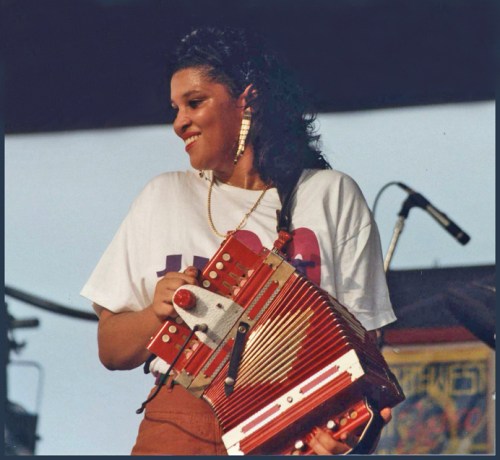
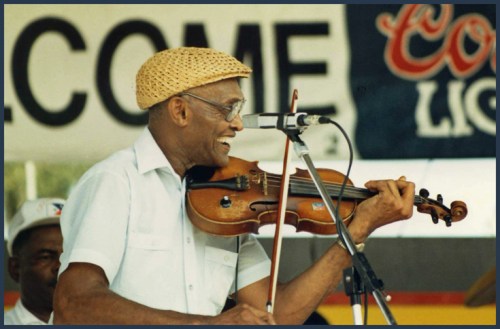
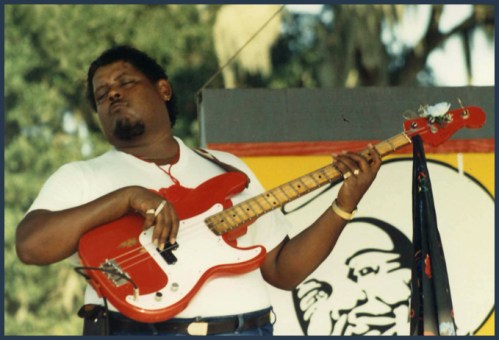
In August of 1989 and 1990, I attended the Zydeco Festival in Plaisance, Louisiana, a small community just west of the town of Opelousas. The festival’s one stage was set up in the middle of a field. Just beyond the stage was an enormous old live oak tree, where dancers and musicians could take a rest and escape the strong August sun of the Louisiana sub-tropics. The festival was small, relative to productions such as the Festival Acadien in Lafayette, or the Jazz Festival in New Orleans. And that was part of its appeal for me. You didn’t have to sit way up in North Dakota to find a spot to lay your towel on the ground and hear your favourite band. In front of stage was a dancing area, and you could get right up to the edge of the stage and see the band closeup without jostling through hoards of people. The atmosphere was relaxed, and anyone could dance with anyone, no introduction needed—you just went up to someone, held out your hand, and said, Let’s go!
The following four photographs are the first in a series; I’ll post the other installments in separate posts. I took the pictures in late afternoon, when the sun cast a golden light and the atmosphere took on the clarity of a lucid dream. It was a weekend of pure joy. And I haven’t even started on the food.
I’ve given the name of the one musician in this grouping that I recall. If anyone reading this recognizes anyone else, please let me know in the comments box. Merci!
In the days of old, the Creole Community would gather at harvest time and work together to complete their tasks. When a family would have a bouchere` (butchering of a hog), everyone in the community would come over and share in the work and cooking of fresh meat.
When the work was finished, the people would celebrate and entertain themselves with a “La La” ( Creole French for house dance.) Instruments used to create “La La” music were the scrubboard (frottoir), spoons, fiddle, triangles (ti-fers), and an accordion.
When times got tough for a family, they would throw a “La La”, a Saturday night dance in the living room. Emptying the room of all furniture, they would charge ten or fifteen cents admission and sell gumbo, homemade beer and lemonade. Even churches would give benefit “La La” to support different functions of the church.
By most of the music being sung in Creole French, “La La” music was only thought of as being for rural and “old folks. One noted musician, the late great “King of Zydeco”, Clifton Chenier, is credited with naming the music ZYDECO “les haricots” (snapbeans).
In 1981 fearful that Creole and Zydeco music was dying out, “The Treasures of Opelousas” a group of concerned citizens under the guidance and sponsorship of Southern Development Foundation, organized the Southwest Louisiana Zydeco Music Festival.
The first Zydeco Festival in 1982 was started on a farmer’s field in the Plaisance community on the outskirts of Opelousas, with four hundred of our neighbors attending.
These traditions of yesteryear may be only a memory for some, but it is the testimony that the Zydeco Music Festival serves. A testimony to those who came before….to the ancestors who toiled in the fields under the hot sun to take care of their families….to those who shared with one another during good and bad times…especially to the ancestors who celebrated, laughed, and loved despite the hardships they encountered.
The Zydeco Music Festival is their offspring – a living reminder for us never to forget where we come from, to always appreciate and respect our past, and most of all to continue our legacy in keeping the rich culture alive.
Southern Development Foundation has kept the Original Southwest Louisiana Zydeco Music Festival alive and developed it into what is now known as the world’s largest Zydeco (“LA LA”) Music Festival.
The latest in unarmed gear, featuring one of my collages on the cover:
unarmed #60
unarmed is a gem of a zine with loyal fans in Minneapolis/St. Paul and beyond. It follows in the venerable footsteps of independent poetry zines of the 60s, often just mimeographed and stapled, such as Ted Berrigan’s C Magazine, Ed Sanders’ Fuck You: A Magazine of the Arts, Anne Waldman and Waldman and Lewis Warsh’s Angel Hair Magazine, and a host of others since that explosion of small presses.
How many old school print poetry zines are still out there that haven’t converted to pixels? More than you might think, but not as many as before the advent of the internet.
unarmed makes reading poetry at the bus stop sexy.
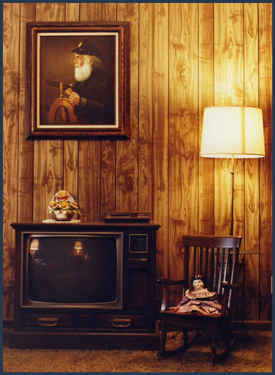
dark corner, bare bulb, square
one thought. hearth with care-
ful ashes. rocker, unoccupied.
embroidered shrine: marriage’s framed
zygotes. cow-eyed portraits.
all-season ancestors,
carpet. everlast bricks
irrelevant. modern kitchen defunct.
growl morphs into rattle. a thimble
of ouch matches brown
accessories. whatever works.
a little string, a little dust.
take a pinch of salt
and measure it.
One of my favourite retreats on the ship was the far end of the stern behind the chains of the rudder. Leaning over the side, I gazed at the wake for hours on end. The waves came one after the other to lure my vision into their spirals, and to look away required a strong effort. The curls, the circular ripples, the bedlam, the eddying wavelets, the dances of the foamy trails, the struggles between the waves that reunited behind the keel, clutching and writhing, the formation of swift funnels trailing clusters of transparent bubbles in their vortex—all these little dramas of drop and foam held my attention with an irresistible fascination. Beyond the swift and twisting line of the wake, large surfaces of foam passed by, thrown aside to the right and left by the prow of the ship. Islands, archipelagos, and continents coalesced, broke apart, diminished, dissolved and vanished.
In reality, there is not a great difference, geologically speaking, between these continents of foam and the continents of land that we inhabit. Small or large, all phenomena are analogous: our continents also will dissolve and reform elsewhere, like clusters of white bubbles carried along by the wake of the vessel.
—Elisée Reclus
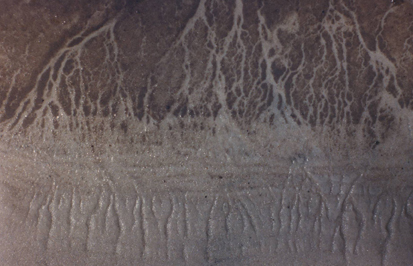
Map of Mississippi River Delta, from Reclus' Voyage to New Orleans
The above passage is from Voyage to New Orleans by French anarchist and geographer Elisée Reclus (1830-1905). In 1851, Reclus was exiled from France because of his protest of Louis Napoléon Bonaparte’s coup d’état. He traveled to Louisiana and in 1855 published an account of his voyage through the Caribbean and up the Mississippi delta, and his stay of several years in the city of New Orleans. His essay is a remarkable account, not only of geographical observations, but also of life in antebellum New Orleans from the perspective of an anarchist thinker. He astutely observed the political and religious corruption in the city and writes a moving condemnation of slavery after witnessing a slave auction.
I was drawn to this three-part gem because of the rich, poetic language of the young Reclus and because of his many astute observations about the natural world and human behaviour. In the summer of 1997, I translated it into English, and after polishing it with John P. Clark, we published it in 1999 as Voyage to New Orleans: Anarchist Impressions of the Old South.
Selections from this translation were recently reprinted in Harald Bauder and Salvatore Engel-Di Mauro’s Critical Geographies: A Collection of Readings (Kelowna, Canada: Praxis (e)Press, 2008).
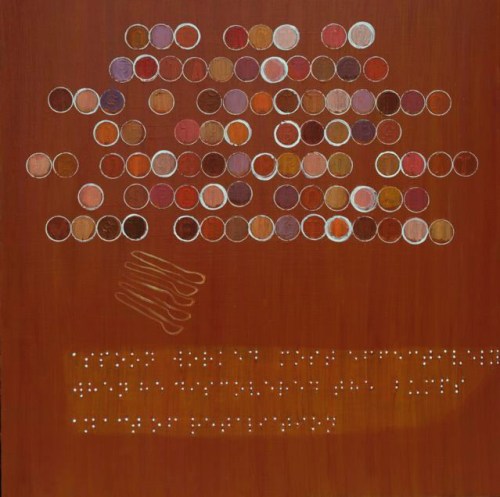
I was excited today to discover the visual art of Gail Tarantino through three works in the December 2008 issue of Cricket Online Review. Her bio tells of her “not-so-secret desire to be literary” in her work, and her weaving of “compressed narratives and distilled description” with the “rhythmic and musical aspects of language.” Like artists such as Ann Hamilton, there is a conceptual sophistication in the way that Tarantino uses language in her work. Interestingly, both have used Braille. For the 1989 Venice Biennale, Hamilton rendered Charles Reznikoff’s Testimony: the United States (1885-1915) into Braille in an installation entitled Myein. On a much smaller scale, Tarantino’s One Act in Cricket features a sentence in Braille:
Gail Tarantino, One Act
In order to understand the interplay among the images in the three horizontal fields, it is necessary to decipher the Braille, something that I at first resisted. But my curiosity prevailed and I arranged the work on my screen next to a Braille alphabet and proceeded to decipher the sentence, letter by letter, yielding the following:
a spoon worked most effectively
when he discovered the bumps
an act of retaliation
As I progressed, the act of decoding it became easier, due to my increasing familiarity with the configuration of dots and the fact that after a few letters, guesswork came into play. A long word beginning with “effe . . .” can be guessed pretty accurately. But the slowness of my reading made me aware of how much take reading for granted, in a similar way that I take eating with a spoon for granted. Mulling over each letter in Braille slowed down the process. My brain, racing ahead of my slogging pace, was thinking of various possibilities, leading me to make incorrect assumptions a couple of times. I was taking too long to think about the text, so my mind was impatiently filling in the gaps in an effort to understand.
After deciphering the words, I realized that my effort was roughly analogous to a child learning to eat with a spoon: both are, as the title suggests, “one act.” This analogy is supported by the echoing of the shape of the Braille’s background colour, which is reminiscent of a spoon.
Tarantino compels viewers who do not know Braille to experience the unfamiliarity of the text and the opacity of its meaning until we decipher it, letter by letter. And in the act of doing so, we become conscious of the configurations of dots in each letter, recalling our original experience learning to read as a child, tracing the shape of each letter, as well as discovering the shape and usefulness of a spoon. Our reward is discovering something about writing as medium for communication, its thingy existence, as opposed to it being a system endowed with inherent meaning.
Significantly, the understanding of the Braille sentence is crucial to speculating on the meaning of the middle and top portions of the work. The middle portion consists of a series of spoons, one rather flat, like a knife, and the others in the familiar rounded concave shape.
The top half of One Act consists of scores of what look like little bowls. Some are missing, so that the pattern echoes the Braille in the bottom half. They are also different colours, resembling perhaps little pots of paint or perhaps bowls of soup, or food in the concave part of the spoon, the reward of the savvy child.
The question arises as to why Tarantino would describe the act of learning as on of retaliation, assuming that I am understanding the Braille sentence correctly. Retaliation requires first an act to retaliate against, so it seems plausible to assume that “he’ is retaliating against the opaque meaning of the spoon’s shape prior to his figuring it out, an opaqueness that strikes him as an act of hostility, which he counters by learning the usefulness of the spoon’s “bump.”
Carrying over the ideas in the message to the analogy of learning to read, the Braille sentence might suggest the concept of violence in the act of understanding. This idea is expressed in a set of conceptual metaphors in English, such as “to attack (or tackle, or surmount) the problem,” “to struggle with the meaning of something,” and “to fight ignorance.” These all suggest that understanding is a process of overcoming that which we don’t at first apprehend: the child “overcomes” the spoon’s unintelligibility; the uninitiated tackle the illegibility of Braille. And that violence is a retaliation against the violence of opacity, of being faced with something that is (at first) illegible.
Derrida’s theories on the violence of writing come to mind here, of writing regulating meaning, inscription as prohibition, law, circumscription. Before we deciphered the Braille, its meaning was opaque to us; it shunned our desire to understand it. Thus it might appear that Tarantino is turning the tables on the idea of violence inherent in writing, for the text (or the spoon) do their violence by remaining unintelligible, and the reader retaliates by learning and understanding. The violence of the reader is not the same as the violence of writing, for in Tarantino’s work, the reader’s violence is against illegibility. And meaning, interpretation, writing, and learning are not inherently acts of violence.
I may be overreaching in my musings here, and I certainly don’t mean to suggest that this is the only way of approaching this work. As One Act implies, there can be many different rewards to learning how to use a spoon, as the many bowls of soup in different colours attests, and by extension many different ways to understand a text.
In any case, I sense an acute intelligence at work in Tarantino’s work. It grapples with (to continue the conceptual metaphor) questions of representation, writing, legibility, and meaning in a condensed yet open-ended work. Did I mention that it’s also beautiful?
I highly recommend her website, where many of her works can be found:
One night a house suddenly rose up from the ground and went flying through the air. It was dark, & it is said that a swishing, rushing noise was heard as it flew through the air. The house had not yet reached the end of its road when the people inside begged it to stop. So the house stopped.
They had no blubber when they stopped. So they took soft, freshly drifted snow & put it in their lamps & it burned.
They had come down at a village. A man came to their house & said:
Look, they are burning snow in their lamps. Snow can burn.
But the moment these words were uttered, they lamp went out.
Inugpasugjuk. “Eskimo Prose Poems.” Technicians of the Sacred. Ed. Jerome Rothenberg. Garden City, NY: Anchor Books, 1969.









 Rogue Embryo