Category Archives: poetry

Charles Borkhuis and Superfluity: “Write What I Say”

[Below is the poem followed by a brief discussion. A more detailed reading of the poem will follow in a couple of days.]

Write What I Say

write what I say

said someone face over
water in the weeds

drown the instant in ink
flickering eyelight to eros
walk your shadow across the wall

a small red ball hangs from a string

the naked woman in the window
steps behind the curtain

“I’ve been running in place all my life”
sneers a fat man on tv

an empty train pulls into the station
enter with the others and stare
at the smudged glass

write what i say

               ~

flesh-dwelling memories
caught in a lover’s mandibles
or carved
into a bird-lit tree stump

languorously finger-writing
her name on the window
while we circle the runway

down we go

               ~

scribbling on the underside
of night (the little hairs
that go unnoticed)

the recitular residue
of dead skin and ash
stains at the bottom of the cup
talk in riddles
dream in code

awaken
with the outward manifestations
of a displaced metaphor
poised at the eye

a photo of the last of her
sitting at the fountain
the relaxed angle of her arm
on cold stone

write what I say

               ~

emptiness folds into itself
giving birth

(parentheses vibrating)

a man’s exhausted
habit-swollen face
on a stalled train of thought
our eyes lock and load

lock and load

               ~

where the words lead and then
abandon us . . .

like the scent of our own flesh
that’s always too much
and not enough

like the sea gull fallen
between parked cars
her motionless eye staring
at no one in particular

like the man on the train
who stands and apologizes
before shooting into the crowd

like the coyote trapped
and gnawing off its foot

like your tongue tracing the ridges and valleys
of your lover’s scars

that’s not what I meant

winced the sole survivor
of the burning 747

write what I say
 
 
“Write What I Say,” from Alpha Ruins (Bucknell UP, 2000)
 
 
          The title of Borkhuis’ poem is ironic: the poem offers many images of excess, of the overdetermination of signs, symbols, utterances, so that writing down what a person says is no more guarantee of pinning down its intended meaning than eavesdropping on the mumbling of an absent god through thick walls.
          A less ironic version of the poem’s title might be, “Write what you think I say when I say what I think I’m thinking.” Which is to say that as soon as I start to tease out meaning from the poem, I feel caught up in a catch-22: the poem sings the superfluity of tracing its outlines with my own signifiers. It invokes shadows, drowning, hovering, weedy waters, and above all, the superfluous action or situation that overflows its context (or inversely, invented contexts that overdetermine an event). That which exceeds its bounds metaphorically stands in for linguistic excess, the signified that overdetermines origin, context, intent.
          It’s tempting to say that in this poem Borkhuis captures the essence of poetic language, but of course his poetry does not celebrate essences but rather the infinite splaying of experience in which the words that name it abandon us in a wilderness whose colours language can paint only in wisps, elusive brushstrokes, evocative traces. And in the process of interpretation, I become acutely aware of other meanings lurking behind the ones I choose in order to create my stories, my opera, of the poem.
          The work strikes me as an example of the metapoetics in language poetry that echoed deconstructionist thinking; it brings to my mind Derrida’s “Signature, Event, Context” in Limited, Inc. Has this approach to poetry really fallen in popularity (if I can use such a word to describe a tendency in experimental poetry) in recent years, perhaps following Derrida’s somewhat fallen stock? Is the gesture of pulling the rug from under signification taken for granted and somehow absorbed into political and social critique? My question is vague and problematic, but who these days, among the younger generation of poets, is writing more or less explicitly about writing, speech, words, language, la rupture?
          For now, though, my aim here is to show, in my own way, how Borkhuis explores such issues brilliantly. In a couple of days, I’ll post a more detailed reading of the poem that I’ve been mulling over.

Camille Martin
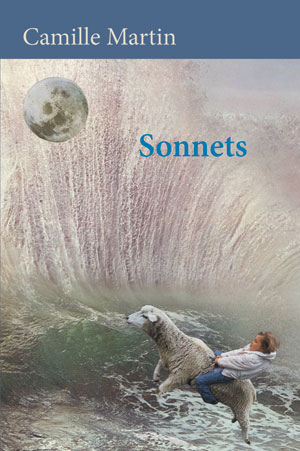
Sonnets
Sonnets – European reading tour

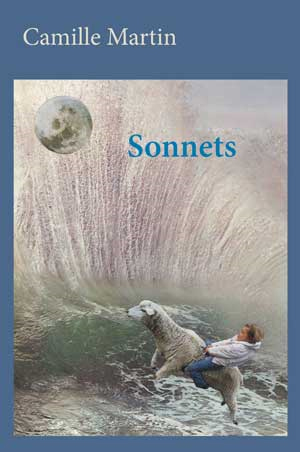
Vulcan is cooperating for now, so my reading tour in the UK, Ireland, and Paris to celebrate the publication of my new book Sonnets by the fabulous Shearsman Books is on. A recent review and ordering information follows the itinerary below. If you are going to be in any of these places, please come!

London, England
7:30 pm, Tuesday, May 4
Shearsman Reading Series
Swedenborg Hall, Swedenborg House / 20/21 Bloomsbury Way
Readers: Camille Martin (publisher’s launch of Sonnets) and Alasdair Paterson

Bangor, Wales
7:30 pm, Thursday, May 6
Blue Sky Cafe / High Street
A triple launch – Camille Martin’s Sonnets, Ian Davidson’s Into Thick Hair, and the new issue of Poetry Wales

St. Helier, Isle of Jersey
8:00 pm, Saturday, May 8
PoAttic Reading Series
The Attic in the Jersey Opera House

Cork, Ireland
Monday, May 10
6:30 – 8:00 pm: workshop
9:00 pm: reading
Ó Bhéal Reading Series / The Long Valley

Salford, England
6:00 – 8:00 pm, Tuesday, May 11
University of Salford
Two-hour session with students in the MA in Creative Writing program

Paris, France
7:30 pm, Tuesday, May 18
Ivy Writers Reading Series
Le Next / 17 rue Tiqutonne, Paris

A recent review of Sonnets by rob mclennan:

There are so few that seem to know how to bring something new to an often-used form that when it happens, it’s worth noting, and such is the case with Toronto poet Camille Martin in her second trade poetry collection, Sonnets (Exeter, England: Shearsman Books, 2010). Martin, an American relocated north after Hurricane Katrina, writes with the most wonderful sense of clarity, thought and play in these poems . . .

Read the entire review here

See the Shearsman webpage for ordering information, or go straight to SPD.

Cheers!
Camille Martin

reinventing stairs . . .

For National Poetry Month, Angel House Press recently published one of my poems from a work in progress, nomadic slant. Click below to read the poem:

reinventing stairs takes a plot . . .

Camille Martin
http://www.shearsman.com/pages/books/catalog/2010/martin.html

rob mclennan reviews Sonnets

There are so few that seem to know how to bring something new to an often-used form that when it happens, it’s worth noting, and such is the case with Toronto poet Camille Martin in her second trade poetry collection, Sonnets (Exeter, England: Shearsman Books, 2010). Martin, an American relocated north after Hurricane Katrina, writes with the most wonderful sense of clarity, thought and play in these poems, and with a flavour . . . (read more)

Barbara Guest’s Musicalities

The following is Guest’s poem “Musicality,” then a brief essay about it. This post is a follow-up to the previous one, “Musicality in Poetry.”

Musicality


        To dive right in:

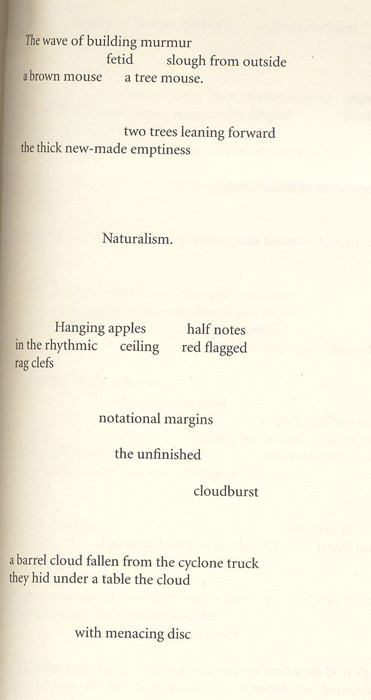
                The wave of building murmur

What is “building murmur”? A crescendo of indistinct, hushed voices in a wave gathering momentum? That interpretation would give the poem from the start a reflexive turn, an awareness of its own murmur of words building on themselves. And the juxtaposed sounds of the two words are pleasing: the multiple, concentrated consonants (“b-l-d-n-g”), including the two plosives (“b”and “d”), contrast with the repeated syllables in “murmur.” And a crescendo of a murmur is like a wave gaining momentum. The onomatopoeia of “murmur,” the soft nasal m’s and liquid r’s of which imitate the soft, low sounds that the word describes, suggests Guest’s concern with the connection between the sound of a word and its meaning. That’s a clue to what is to come.
        The next line contrasts the increasing wave with a stagnant body of water:

                fetid           slough from outside

The alliteration of the fricatives “f” and “s” alternate with the plosives “t” and “d”—producing a rich interplay of sounds. Does the meaning of these words also come into play? A stagnant miasma of water might smell bad from an outside perspective, but what if one is on the inside? A fish whose home is a stinky swamp doesn’t think its home smells bad. A difficult poem might seem like a “fetid slough” but from the inside, it is possible to get past the murkiness of the water to appreciate the wealth of interweaving sounds and meanings.
        Is the next line a non-sequitur?

                a brown mouse           a tree mouse.

I think it’s possible to appreciate the disjunctiveness of the leap from a stinky swamp to mice at the same time that we perceive some continuities and development of previous ideas. Here Guest continues her play of repetition (“mouse” and the repeated “ow” sound) as well as her theme of nature (wave, slough, mouse, tree). She also introduces the pair idea, things happening in twos, which the next line echoes:

                two trees leaning forward

I like the tension in the image of the trees “leaning forward,” as if in hushed anticipation. Are they murmuring? Maybe that’s a hermeneutic stretch, but I like taking the cognitive leap. This line picks up an image from the previous line, “tree,” and recontextualizes it. That’s a kind of music – picking up a motif previously stated and presenting it as a variation.
        And the next line develops the dichotomy between the wave (the poem) and the slough (the perceived impenetrability of the poem):

                the thick new-made emptiness

“Thick” resonates with “slough”—I think of soupiness. And the idea of making something is echoed many times in “Musicality”: Guest is the poet, the maker (hearkening to the Greek root of “poet”) as well as the composer, creating—emptiness? Why emptiness, and why is it newly made? The next word helps, a sort of keystone on the page with a presence that sets it apart:

                Naturalism

It’s capitalized, it’s centred on the page, and the other lines give it a wide berth—note the space that separates it from the lines above and below it. Its apartness gives it a monolithic quality, as though it were carved in stone: a rule, a prescription for language.
        The literary movement of naturalism relied heavily on mimetic correspondences to produce a transparent texture of language that may be heavily descriptive but that aims to convey a precise image of reality, a window made of language from which to view not only colours and details but also the historical contingencies of human motivation, in its own way a valuable psychological contribution. Nonetheless, the characteristics of naturalism are generally antithetical to many of the concerns of high modernism and avant-gardism, which tends to de-center perception, knowledge, language, meaning, identity, and motivation.
        So is naturalism the “thick new-made emptiness”? The lines and ideas in Guest’s poem are not isolated; they gain meaning in relation to other lines and words, so “naturalism’s” isolation is striking, daring us to associate the word itself with something else, to take naturalism not as the rule but as one idea among others, and as one entity in the poem that chameleon-like shifts its colours according to surrounding or juxtaposed ideas—and Guest does just this by bringing the category of naturalism into play with its surrounding words, allowing it to be changed. It is not simply naturalism changing language to its own tenets and beliefs about the function of language. Guest allows other words to colour naturalism itself.
        Perhaps emptiness refers to the transparency of language in naturalism, the quality of sheerness that conveys us without much reflexivity from word to referent. But how can emptiness be thick? Guest implies that the lens of the medium of language is thick with its own inherent possibilities. This idea is consonant with Guest’s exploration of language as a kind of music.
        In my previous post, I talked about the kind of music that Walter Pater might have been alluding to when he said that all art aspires to the condition of music: non-programmatic “absolute” or instrumental music that tends to create a self-referential world producing meaning from the “tonally moving forms” (Herzog 125) of its own medium. Musicality in poetry sidles away from a mimetic function of language towards a self-referential interplay of sounds and motifs, in a similar way that music does.
        In the next three lines, we shift gears again—are do we?

                Hanging apples           half notes
                in the rhythmic           ceiling           red flagged
                rag clefs

“Hanging apples” is a good naturalistic image, but immediately Guest compares apples hanging on their stems with half notes, which also feature a round part with a stem:

This comparison brings together two major strands in the poem: nature (the natural) and music (the made). This shift again focuses our attention on the idea of language being not only a conduit to describe the world but also a path to its own world, its musicality. Thus the juxtaposition of apples and notes returns us to the idea of language (words, sounds, images) as music. In the second line, a ceiling is “rhythmic.” If we look up to see the hanging applies, we might see them against the ceiling of the sky, articulating that backdrop to produce rhythm, as if they were notes on a staff.
        I want to give detailed attention to the phrases “red flagged” and “rag clef.” First, let’s consider the interplay of connotations and denotations of these words, in particular the semantic chiasmuses between the two phrases. Each phrase has musical significations. In musical notation, a flag is the little banner projecting from the stem of a note to indicate its duration: a single eighth note has one flag, and a sixteenth note has two. In the second phrase, a clef is a symbol that indicates the particular register of a staff: treble clef or bass clef, for instance. These are both symbols in musical notation. Also, “flag” resonates with “rag”: not only do the words rhyme, but also both indicate things made of fabric. And sonically, “red” echoes “rag.” Moreover, the related consonant sounds in “flagged” and “clef” are almost the exact reverse of each other:

                f-l-g / c-l-f

In the simultaneity of all of these correspondences can be heard—for lack of a better analogy—a polyphonic interplay of motifs and sounds.
        The medium of Guest’s musical language produces not a description of a place or person, not anything classifiable as strictly mimetic, not a building wave of description that prompts the readers to say (to quote Helen Vender) “Heavens, I recognize the place, I know it!” According to Vendler, the reader’s eureka moment resulting from the accumulation of descriptive language “is the effect every poet hopes for.” Oops, she forgot Barbara Guest, whose work instead displays a fascination with the possibilities of language itself. A composer might ask, what would happen if I have a flute echo this motif introduced by a violin? Guest asks, what would happen if I put these words and sounds in various contexts, producing motifs that repeat but that also express rich variation?
        Here I’ll hit the pause button—I’ve gone on longer than I had intended for only nine lines. But this process for me is so rewarding. And it takes a slow, leisurely pace of reading and thinking to get to this level of detail. And I realize that my interpretation is very subjective—one person’s response to the poem. But for me these discoveries open up new dimensions of the poem, which is I go after in poetry. An acutely intelligent mind has placed these words on the page. The pleasures lie in wait, unrealized notes on a staff, for the reader-musician’s careful attention.

A Postscript

        As I look over my analysis of “Musicality,” I can see that my close reading of the poem, with its complex overlapping of layers of experience, is much more detailed than I had anticipated. As soon as I start strolling instead of galloping through the woods, I start seeing and hearing so much more. And the deeper I probe into the microcosm of the poem, the more correspondences I start to find between the smaller scale and the larger scale.
        This is starting to sound like structuralism—to use an analogy in music, the Schenkerian analysis that relies on the structural correspondences between the large-scale background harmonic movement (its skeletal tonal structure) and the small-scale foreground tonal movement. Inevitably, there emerged dogmatic Schenkerian music theorists who claimed that such analysis leads to the (one and only) inner truth of a musical composition.
        As I analyzed “Musicality,” I realized that all I have done is to open one or two doors in a room that has many doors. Once you start believing in one musicality, you become something other than an interpreter; you become an arbiter of interpretations. As I tried to demonstrate in my previous post, musicality in poetry isn’t monolithic. And just as there’s more than one way to create a symphony of words, there’s more than one way to hear it.
        I used to know a rather orthodox Shenkerian analyst. Sadly, the dogmatism of his belief in tonal structuralism precluded his appreciation of Western music written beyond a certain point in the nineteenth century when the increasing chromaticism turned its sound waves into a “fetid slough” in the ears of the theorist, who had been trained to hear only the exquisite harmonic and melodic structures he had built up from, say, a Mozart sonata. Wolf, Debussy and Webern were unintelligible to him because they were resistant to his surgeon’s tools.

Camille Martin
http://www.camillemartin.ca

Musicality in Poetry


The continuation of this essay is the next post, “Barbara Guest’s Musicalities.”


1. “Tin” or “to die for”?

        It’s easy to say that some poetry is musical, and when we come across such poetry, we may quietly nod inside as though its musicality were a self-evident characteristic that need be acknowledged only on a barely conscious level. We say that a particular poet has a tin ear, whereas another has an ear to die for. We know when poetry sounds clunky and we know when we feel we’re hearing a string quartet in words. What gives poetry (or any other text, for that matter) the quality of musicality?
        I suspect that what people mean most often is musicality on the close-range level of the poem: the timbre and rhythm. Timbre in music refers to the configuration of sound waves and overtone series that produces the difference between, say, a clarinet and a violin. One way to think of that trait in terms of poetry is on the microcosmic level of the phoneme: the particular combination of consonant and vowel sounds that create a range of sounds from the colourful to the monochromatic, or to stick with the musical model, from the richness of sounds in a Stravinsky orchestra to the relative sameness of, say, Philip Glass’s compositions for saxophone quartet. Alliteration, assonance, and rhyme, whether obvious or subtle, can add richness to the sound and layers to the meaning of poetry. Kenneth Burke’s “On Musicality in Verse” offers a detailed analysis of this microcosmic manifestation of musicality in poetry.
        I think of metre or rhythm as occurring in the foreground of composition, like timbre and melody. It’s not only ritualistic or condensed poetic language that exhibits musical rhythm; ordinary conversation can be extraordinarily musical. For example, Frank O’Hara gives us the rhythm of drama, tempestuous or quiet, in his rants and chats.
        We also call some poetry “musical” in the sense of “painterly”—words used as colours and texture painted onto a canvas, arranged in such a way to give aesthetic or intellectual pleasure. Narrative, descriptive and representational coherence take a backseat to the play of forms: juxtapositions, repeated motifs, and layers of signification whose meaning derives from the relatively abstract play of images and sounds.
        Yet another sense of musicality is the one that we mean when we speak of James Joyce’s famous fugue in prose in the Sirens chapter of Ulysses. The voices of the fugue are translated into voices of characters, and the repetition of fugal melodies are represented by subject matter or rhetorical mode (description, for example). Similarly, once could make a case for the abrupt changes in perspective and style in Milan Kundera’s Book of Laughter and Forgetting corresponding with the abrupt rondo-like changes in some compositions by Janacek, who was the teacher of Kundera’s musicologist father. Raymond Queneau’s Exercices de style might be considered as a theme and variations.
        Correspondences between the arts, of course, are not precise but suggestive. Polyphony, for example, can be suggested by the simultaneity of thoughts, dialogue, or action by the characters, as in the eight voices of the fugue in Ulysses (Zimmerman 108-13).

2. Pater’s condition of (instrumental) music

        With all of these manifestations of musicality in poetry comes an emphasis on the material and materiality of language—its sounds, its formal play, and its patchwork play of motifs and connotations. This emphasis brings to mind Walter Pater’s statement almost fifty years earlier than the writing of Ulysses: “all art constantly aspires towards the condition of music.” Despite the absolutism of such a sweeping statement in its assertion of the aesthetic primacy of music and musicality as the ideal toward which all art aspires, it does suggest some possibilities for correspondences between music and literature in a way that moves away from mimetic concerns toward an appreciation for formal play. Patricia Herzog speculates that the ideal state of music that Pater champions as the Parnassus of the arts is not vocal music or a gesamtkunstwerk such as opera but rather instrumental or chamber music:

               Absolute music would be ideally suited to exemplify
               Pater’s thesis since it contains nothing extraneous to
               the medium of music itself, a medium consisting
               solely of tonally moving forms arranged melodically,
               harmonically and rhythmically. The form and the
               content of absolute music would thus appear to be
               identical. (Herzog 125)

        Herzog states that Pater’s musical ideas consisted of “”the obliteration of the distinction between matter and form” and the embracing of “imaginative reason” over the “senses and the intellect operat[ing] in isolation” (126). In other words, art’s goal is “pure perception,” and to achieve that ideal state, it must abdicate “its responsibilities to its subject or material” (127). For Pater, matter and form should be “so welded together” that the intellect is not the only faculty stimulated by the content, and the senses not the only faculties stimulated by the form. Instead, the blending of form and matter should “present one single effect to the ‘imaginative reason,’ that complex faculty for which every thought and feeling is twin-born with its sensible analogue or symbol.”
        Herzog stresses that the experience of such musicality in art is more aesthetic than logical, since “music’s ideal content is perceived entirely and only through its own, tonally moving forms.” Whereas the literary and visual arts (of Pater’s time) are dependent upon mimetic representation, music’s meaning is revealed through “aesthetic self-sufficiency” (130).
        The distinction that Herzog makes between the aesthetic and the logical in musical content isn’t clear, since music’s “tonally moving forms” can possess their own kind of logical interplay. However, what I find most interesting about Herzog’s fleshing out of Pater’s aphoristic championing of music is the movement, in the concern with musicality in poetry, away from mimetic concerns to language’s drawing attention to itself as a medium: words as musical motifs or brushstrokes. The musical analogy, to my mind, offers more complex possibilities than painting (but this could be simply because music was my first discipline): just as a motif can be varied (inverted, embellished, rhythmically augmented, and so forth), so can a word be varied by context, connotations, and so forth.
        And one of the poets who, it seems to me, best exemplifies this kind of musicality is Barbara Guest. If I can get my act together to continue this thread, I’d like to take a close look at one of Guest’s poems as if it were a musical composition (despite the limitations inherent in that kind of analogy).

Works Cited

Burke, Kenneth. “On Musicality in Verse.” Poetry 57 (1940): 31-40.

Herzog, Patricia. “The Condition to Which All Art Aspires: Reflections on Pater on Music.” The British Journal of Aesthetics 36.2 (1996): 122-134.

Zimmerman, Nadya. “Musical Form as Narrator: The Fugue of the Sirens in James Joyce’s Ulysses.” Journal of Modern Literature 26.1 (2002): 108-118.

Camille Martin
http://www.camillemartin.ca

Roundup: Poetry Close Readings and Appreciations

Hello, friends! My blog is now almost eight months old—I hope that you’re enjoying the posts.

I’m entering a busy time, with teaching responsibilities and readings to launch Sonnets, and I’m also in a reflective mood. So for this post I’m providing internal links to my close readings and appreciations of various poets over the last few months, with the most recent ones first.

As always, feel free to leave comments and to subscribe to my blog. Also, a link from your blog to mine would be greatly appreciated, and I’ll be happy to reciprocate with a link from mine to yours (unless you’re into shower cams or vengeful ex-wife pics—my most recent spammers).

Cheers!
Camille Martin

Trevor Joyce: Let them eat fire
Barbara Guest: “Bleat”
Ann Lauterbach’s Pilgrim of Desire
Connie Deanovich’s Essence of Saint
“G” is for Genre: Maxine Chernoff’s Todorov
“how many years / without death”: Larry Eigner’s memento mori
Miklos Radnoti (1909 – 1944)
Run Through Rock: Besmilr Brigham (the poem)
The Place of Place: Besmilr Brigham’s Run Through Rock (the essay)
We are all Walloon poets
“I know I am traveling all the time”: The Twilight Dreams of Artur Lundquist
Interview on rob mclennan’s blog
The Majlis Collaborative Experience
Anamorphosis (Creeley/Clemente): Death and the Stuff of Dreams
Alberta Turner: What do you mean, mean?
Empty Lawns and Battered Days: Rupert Loydell’s “Slow-Motion”
Anselm Hollo’s Heavy Jars: “Hard to say whether the jars’ve gotten any lighter.”
Rae Armantrout’s Waves of Punchlines

* * * * *

Camille Martin
http://www.camillemartin.ca

Toronto Launch of Sonnets


If you’re in Toronto, please come to the launch of Sonnets at This Ain’t the Rosedale Library on Tuesday evening. I’ll be reading with Fred Wah, who is premiering his latest collection of poetry, The False Laws of Narrative, and Jim Smith, whose Back Off, Assassin! New and Selected Poems was recently published by Mansfield Press.
 
Tuesday, February 23, 2010
8:00 pm – 11:00 pm
This Ain’t The Rosedale Library
86 Nassau Street near Bellevue in Kensington Market
Toronto, ON


Camille Martin
http://www.camillemartin.ca

Trevor Joyce: Let them eat fire


the poem, then a brief essay

The Fishers Fished

dark within darkness
let them approach
that dry estuary
whose waterless wave
brings down
the gravel of worlds
to a bed of sand
because the diamond
is feeble and restless

leave them be guided
to the motionless storm
by the evidence of trees
and mineral structures tumbling
slowly through the hushed light
so they may see
this still disturbance
reach deep within the wrenched metals
making them whole

have them discover
flame without fire
where it adjusts itself
brooding on wood and stone
that they may bind
apes and lower vertebrates
and lay them under its blue claws
and later gather them again
unharmed and whimpering

they may set
nets below
the fish leaps
nets above
the fowl flies by
fires within
the flame scorns
withdrawing
through stone
or settling
in the open sky

then they are snared by water
wind devastates their dreams
and fire nests savagely
above the derelict jaw

Trevor Joyce, With the First Dream of Fire They Hunt the Cold, 157-58

        Trevor Joyce’s parable of the exploitation of nature reads like a ritualistic curse, such as those found in Psalms. Compare, for example, its imperative formulations (“let them approach . . . leave them be guided . . . have them discover”) with the petitions against enemies found in Psalms (“let them be put to shame,” “let them be turned back”). In Joyce’s poem, the speaker first petitions an unnamed power to let humans see the beneficent forces of nature. The second part of the poem is where the curse packs its punch: if humans continue to abuse nature, they will taste its destructive forces.
        The poem’s paradoxical images of nature (“waterless wave,” “motionless storm,” “flame without fire”) are not ordinary phenomena but rather nature’s destructive powers transformed into agents of healing. First, the “waterless wave” lays gravel onto a bed of sand (as opposed to breaking down the gravel into sand) because the diamond, a symbol of wealth, has grown “feeble and restless.” (Of the three images, that one is the most elusive, and I’m not convinced that mine is the best reading.) Next, the “motionless storm” permeates the metals that have been “wrenched” from the earth by greedy humans and makes those metals “whole” again. And lastly, the “flame without fire” binds all life forms from apes to lower vertebrates (humans, the true destructive agent in the poem, being significantly absent) and casts a spell on them with the “blue claws” of its healing flame, later “gather[ing] them again / unharmed and whimpering.”
        Thus in the first part, the speaker asks that the fishers bear witness to each of the three acts of healing. In the second part, he places a spell or curse on the fishers, who try in vain to net fish and fowl, which easily evade the nets. Now it is the fishers who are acted upon by the forces of nature, but this time the water, wind, and fire are not so benevolent. Instead, water “snares” the fishers (who were just thwarted from snaring fish and fowl), wind destroys their ambitions, and fire “savagely” makes its nest (an echo of the birds unsuccessfully caught) in the mouth of the fisher (bringing to mind the hook in a fish’s mouth).
        Thus if the fishers continue their exploitative ways, their fate will be similar to that of the fishes and birds they have caught: in the end, they themselves will be snared and hooked. The title’s double meaning is apparent: “the fishers fished” can be both a sentence in the active voice, in which the fisher does the fishing, or a phrase in which “fished” modifies “fisher.” In a twist of poetic justice, the fisher fishes, and is in turn fished.

Camille Martin
http://www.camillemartin.ca

Barbara Guest: “Bleat”

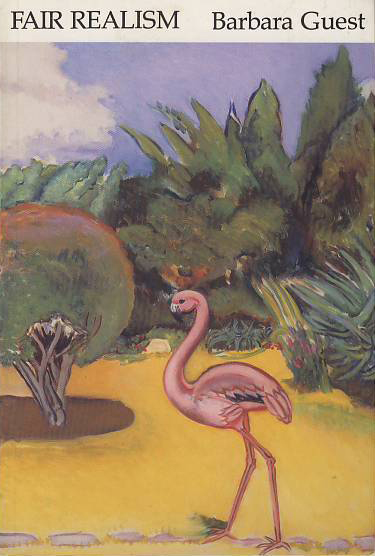
I just ordered Barbara Guest’s Collected Poems (Wesleyan, 2008), edited by daughter Hadley Hayden Guest and prefaced by Peter Gizzi. I’m only familiar with Fair Realism, so I’m looking forward to experiencing the trajectory of her work, the changes that it underwent during her life. I love the musicality of some of the work in Fair Realism. “Fugue” is sometimes used to describe such poetry. It’s not an exact parallel, but it does capture the idea of intertwining motifs and echoes—sonic, semantic, and metanymic—as well as the idea of the poem being a language and a thing unto itself, opaque yet also, strangely, lucid. Guest’s music isn’t so decentered as to be dodecaphonic. Instead, hers is a music on the brink of atonality yet still somehow still exerting a centripetal force through its hints of tonality and its recurring motifs—akin, perhaps, to Messiaen, Bartok, and Stravinsky. Janacek also comes to mind.

Below is “Bleat,” a short poem from Fair Realism.


Barbara Guest, Fair Realism (Los Angeles: Sun & Moon Press, 1995)
 
 
Bleat
 
drawn on the burden of light
the pottery throw
in bleat turning
 
ballast makes fingers twitch
shutters close
“going to pour”
 
wet to root and pavement
tent sagging like an oyster
 
“the city has another soul”
 
gnat passes someone swallows
“another soul”
 
figurines
 
“the city also”
stole the bench and echoes
 
blight and shuttered bleat
soul chews a wilted corner
 
 
Camille Martin
http://www.camillemartin.ca

Sonnets is now available! Read its first review . . .

You can find ordering information for Sonnets here.

I was pleased to read an enthusiastic review of Sonnets recently in Stride Magazine. Here’s an excerpt:
 
        “Sonnets is a delightful body of work. Even though we wander
        into the oblique there is never alienation because the words
        are too beautiful …. Incredible poetic craft.”
             —James Mc Laughlin, Stride Magazine

Read the review here.
 

Cheers!
 
 
Camille Martin
http://www.camillemartin.ca

Ann Lauterbach’s Pilgrim of Desire


Ann Lauterbach, And for Example (New York: Penguin, 1994)

the poem, then a brief essay

Rancor of the Empirical

A lavish pilgrim, her robes unbound,
checks into a nearby hotel.
Let us spread the wealth.
Let us speak in such a way
we are understood, as a shadow
is understood to assuage these prisms
and these mercurial clasps. She was told
yes and she was told no
which is how she became excessive, spilling
over the sequestered path, her wild garments
lacerating stones.
She took pills against rain.
She slept under tinfoil.
In that country, there were no heroes
to invent a way to fill the hours
with parables of longing, so her dreams
were blank. Sometimes she imagined
voices which led to her uneven gait
and to her partial song. Once she was seen
running. A child said he saw her fly
low over the back meadow and into the pines, her
feet raving in wind. The child
was punished for lying, made to eat ashes
in front of the congregation. The priest said,
You have made a petty story. Now enter duration.
 
 
        I love this poem by Ann Lauterbach, which speaks to the sad consequences of the repression of desire and the imagination, with echoes of Puritanism and the Platonic distrust of poetry. The allegorical “lavish pilgrim” enters a new country where no poets are born, or else if they are (like the visionary boy who is able to see the spirit of desire), they are punished by puritanical clergy, made to “eat ashes” (associated with death and penitence) and “enter duration,” presumably a monochromatic place of temporal stasis. There are no “heroes” of the imagination to compose “parables of longing” and unleash the latent desires of a populace. Continue reading

Stoning the Devil on my sonnets in moria magazine

Adam Fieled’s review and thoughtful analysis of some of my sonnets published in moria magazine:

“I was excited to find a group of wonderful sonnets from Camille Martin. What I at first dimly suspected has now been affirmed; there is as much vitality, craft, and genuine art being transmitted via the Web as there is being released via print journals. Martin’s sonnets deserve a closer look. I have chosen two of the six to look at . . .”
             —Adam Fieled, Stoning the Devil
 
Click here to read more.
 
Camille Martin
http://www.camillemartin.ca

“The night is tough”: Voices of hope from two Haitian poets

Although the following excerpts from two Kreyòl poems by Haitian writers refer to calamities other than the recent earthquake, they speak across decades of misery to the hope for a better life.


.

Pou fèt mwen m’ta renmen
Tou peyi-a
Kouvri ak rivyè k’rekonmanse chante
Pou tout wout dle ap rezonnen.

.

For my birthday I want Continue reading

“something gets lost in the translation, and it’s not me, friend.” — more from “nomadic slant”


Recently published: three double sonnets from “nomadic slant,” a work in progress, in Reconfigurations: A Journal of Poetics & Poetry / Literature & Culture.
 
Camille Martin
http://www.camillemartin.ca

Connie Deanovich’s Essence of Saint


the poem, then a brief essay

Requirements for a Saint

think of a saint
and you think
of the incredibly dull clothing of a saint
 
perhaps extreme temperatures
or the difficult terrain they travel
(everything about a saint draws attention to itself)
 
think of a saint
and your thought is not
of a train thrusting through lightning
 
but of wind that smells of wood
or a wet disease
(saint world is the world of the empty hand)
 
breath is sometimes banged out of copper
and so is a saint
often with bell attachments
 
I’ll make you a saint
from an unblemished code book
that must be read
 
in a German restaurant
where beer is served in glasses
wrapped in brown leather
 
when the cuckoo strikes twelve
this will be the moment
of ascension

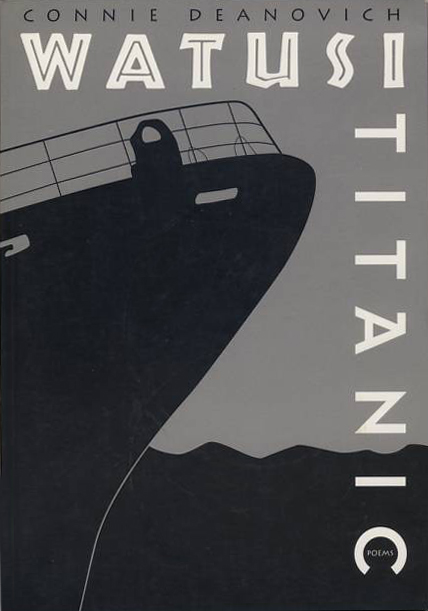
Connie Deanovich, from Watusi Titanic (New York: Timken, 1996)

        When I think of Connie Deanovich’s “Requirements for a Saint,” I think of chairs—or rather, the chair, the mental image of the one that can reasonably represent the entire category of chairs. I see in my mind’s eye Van Gogh’s straw chair or my idea of a generic dining room chair. Actually, there’s no such thing as a completely generic chair (a visualization has to look like some kind of chair), but rather chairs of our quotidian experience. What I don’t automatically see is a lounge chair, an antique commode chair, or Lily Tomlin’s giant rocking chair. Continue reading

ditch,

Six from my work-in-progress entitled “nomadic slant” are featured in the January 2010 issue of ditch,.

ditch, has also produced an online anthology of Canadian innovative poets, which includes my six double sonnets along with the work of thirty-two others: Continue reading

“G” is for Genre: Maxine Chernoff’s Todorov

Cover image: Susan Bee


the poem, then a brief essay

Todorov at Ellis Island
 
The secret of narrative
in the sight of the lovely
original fixtures,
the false accusations,
the “K” for insanity.
An indigent writer,
specifying the predicate,
fear of fire in ramshackle
buildings, the ghost
of the fantastic looking
across frozen water.
He felt swallowed up
by the 200 stairs,
by a procedure based on
external criteria,
plot and genre likely
to become a public charge.
While from the mountains
of Northern Italy, refused
admittance, a girl acting
mad, alluding to hermits
and saints. For to destroy
does not mean to ignore,
does not meant to build
the story-machine nor to feel
the grass under foot, but
to turn, as if spoken to,
into what we represent.

Maxine Chernoff, from World
 
      Maxine Chernoff’s “Todorov at Ellis Island” implicitly critiques Tzvetan Todorov’s structuralist theories of genre and narrative. In essence, Todorov posits a literary taxonomy according to a universal grammar of types: he is the Noam Chomsky of narratology and genre studies. The guiding principle in Todorov’s schemas is differentiation: defining boundaries and deciding what to include within those boundaries and what to exclude. And it is the idea of exclusion that Chernoff satirizes in her poem.
      Chernoff anachronistically situates Todorov on Ellis Island during its heyday as a screening station for new immigrants. Continue reading

scattering dust is good practice

Four of my double sonnets have just been published in Stride Magazine, edited by British poet Rupert Loydell. The link:

http://www.stridemagazine.co.uk/
 
 
Camille Martin
http://www.camillemartin.ca

Sonnets redux


I just finished proofing my upcoming book, Sonnets, which will appear in mid-March from Shearsman Books. I feel very close to this book—there was much pleasure in its writing.

And I’m excited about my tour of the U.K. following the London launch in early May. I just added a reading in Bangor, Wales, thanks to Zoë Skoulding. Iechyd da!

Here are a couple of my recently-published sonnets:
 
 
*
twigs with tiny
variations bob
against the blue.
no gunshot, no
sprint. earth murmurs
on its axis, volume turned
off. no hearts beating
to drums. seeds hook
animal fur. no countdown,
but a desert blossoming
between one and zero.
droplets fed by tiny
catastrophes dangle
from twigs.
  Continue reading