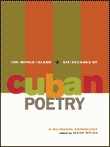
 The Whole Island: Six Decades of Cuban Poetry
Edited by Mark Weiss
Berkeley: University of California Press, 2009
When I was in New York a few years ago to give a poetry reading, I was fortunate to spend some time with poet and translator Mark Weiss, who was at the time working on his monumental project of compiling and translating Cuban poets for a bilingual anthology, The Whole Island: Six Decades of Cuban Poetry. I knew next to nothing about Cuban poetry then, and now, having read the anthology, I understand his excitement about the project. Weiss has done the English-speaking world a tremendous service by bringing attention to some of the most significant post-World War II poets of Cuba.
I knew that I’d be engaging with a literature that had evolved in historical and cultural contexts quite different from those I’ve been steeped in much of my life as a poet and literary scholar. I might want to read Weiss’s chronologically-ordered anthology with notions of development parallel to the succession of “-isms” in Europe and North America more familiar to me. But due to the unique history of the island, I also knew that I would need to approach the poetry on its own terms.
A number of questions came to mind before I began reading The Whole Island. Under state censorship, what kind of poetry was allowed? To what degree have poets who remained in Cuba written in relative isolation from the rest of the world? What international influences shaped the evolution of Cuban poetry? How have Cuban poets of the post-Revolution diaspora dealt with exile? What role did socialist realism play in Cuba’s literary production? Would there be within officially sanctioned verse covert symbols bearing witness to resistance?
In retrospect, I realized that these questions primarily related to Cuban poetry after 1959. I’m a child of the 60s, and news about embargo, hijackings, escape, exile, and censorship loom as large in my mind as the face-off of Kennedy and Castro during the Bay of Pigs invasion and the Cuban missile crisis—not to mention the incessant American propaganda about the domino theory of the spread of Communism. So a broader set of questions would inquire about the rich history of pre-Revolution poetry and the indigenous and international cultural forces that shaped it. And after reading Weiss’s incisive introduction to the anthology and the poetry itself, I came to realize that answers to these and other questions were far more complex than I had imagined.
Weiss’s introduction and selection of poems in The Whole Island draw the curtain to reveal, not only important poetry previously unknown to much of the Anglophone world, but also the ongoing drama of exile and repatriation, revolutionary zeal and disillusionment, debate and the suppression of debate, close official scrutiny guiding publication and censorship, and the tension between poets who’ve remained diehard apologists for the regime and those who secretly hold illegal poetry salons. In the background is a tug of war in which the state (and some poets) pull poetry towards the camp of servile revolutionary optimism, and poets of resistance seek strategies to elude that pull: by writing poetry that somehow survives within the political framework, by going into exile, or by resigning themselves to a life of obscurity in their native home and elsewhere.
Weiss’s introduction delineates two general and occasionally stridently opposed tendencies that have emerged in Cuban poetry during the past few decades: conversacionalismo (also known as vanguardismo or coloquialismo) and neobarroco. Conversacionalismo, as one might expect, espouses accessible language, a sort of Wordsworthian commitment to colloquial diction. After Castro’s takeover in 1959, it was this tendency that was deemed more expedient to convey Marxist ideology than the neobarroco with its constantly shifting frames of reference, its polyphony of images, and its embracing of process rather than logic. Pushed to its extreme during the darkest days of the regime’s censorship, the colloquial style in the hands of some poets became a hollow receptacle for ideological messages.
But the more interesting drama is at once more sophisticated poetically and perhaps even more tragic than the spectacle of Potemkin poetry. In a story that epitomizes a great irony in the history of post-revolution Cuban poetry, Weiss describes a political drama played out between Heberto Padilla (1932–2000), an exponent of conversacionalismo, and José Lezama (1910–1976), a major poet of the neobarroco. In 1959, close on the heels of the revolution, Padilla was quick to publically denounce the poetry of Lezama as counter-revolutionary in its individualism, obscurity, and disinclination to deal with social realities. Padilla’s work continued to appear in state-approved publications, and during this time Padilla was also participating in the open expression of concerns regarding individual liberty and the practice of sending “undesirables” (including homosexuals) to labour camps.
Meanwhile, in 1968 Padilla’s poetry collection Fuera del Juego won Cuba’s Julian del Casal Award, with his nemesis Lezama on the jury. However, Padilla’s book was deemed to be counter-revolutionary by the Interior Ministry. In 1971, Padilla was arrested, interrogated, and imprisoned for about a month, after which he gave a dramatic confession of his “sins” against the revolution and denounced a number of his colleagues, including Lezama. As a result, Lezama’s works were banned and did not appear in print again until after his death. Padilla was allowed to leave Cuba in 1980 to immigrate to the United States. Ironically, both conversacionalismo and neobarroco lost in favour of the state’s poetics of choice: knee-jerk praise of the party line. Perhaps, as Weiss observes, the so-called Padilla Affair was a strategy for taking out both aesthetic thorns in the revolutionary ideal.
Weiss’s anthology also brings into focus the influence of Walt Whitman on Cuban poetry. José Martí (1853–1895), Cuban national hero and poet, had first introduced Whitman to Cubans in an essay of 1887, and Whitman’s poetry was translated into Spanish by Chilean poet Pablo Neruda. Since then, Leaves of Grass has been warmly embraced in Hispanic literature. The influence on Cuban poetry of the Whitmanesque vox populi and long, free verse lines can be discerned in both coloquialismo and neobarocco. Skimming through the 602-page anthology, the pervasiveness of Whitman’s influence is immediately noticeable in the expansive lines of many poems. An example from “Animus” by José Kozer, a Cuban poet who has lived in the United States since 1950, shows the spirit of Whitman in a neobarroco context:
In Ecbatana the rainbow is only visible in a state of holiness.
The grove to the right among the ruins is clogged with corn flowers.
Within each flower is lost another star another blue corpuscle of God.
Although Kozer has revised Whitman’s all-encompassing ego into a self with a less grandiose relationship to the universe, the continuing legacy of Whitman is present.
Equally fascinating is the influence of the Spanish baroque and French symbolist and surrealist poetry on Cuban poetry. Baudelaire was championed by Cuban poet Julián del Casal, and it was Casal’s introduction of Baudelaire to Cuba that gave rise to the prose poem there and in the rest of Latin America.
Weiss points out that his choices for inclusion and exclusion of poets in an anthology in which political positions are hotly contested are subject to interpretation of partisanship. However, Weiss attempts, and successfully in my opinion, an even-handed approach, presenting the poetry “within an evolving context that Cuban poets and readers might recognize, not as North Americans might wish it.”
I’m profoundly grateful to Mark Weiss for his efforts in assembling this excellent and long-overdue survey of recent Cuban poetry. My one cavil—and it is a small one in the face of the magnificence of this anthology—is that a few of the translations seem too literally rendered into English, and thus otherwise powerful poetry occasionally slows down to a less-than-graceful trot. However, the effective translations far outnumber the few duller ones. And I must point out that Weiss’s own translations are outstanding because Weiss thinks in the English language like a poet who understands its rhythmic maneuvers and melodic registers. The artistry of his translations is especially apparent with the neobarroco poets—he hones the syntax to make the polyphony sing clearly even through its complexity.
Anthologies can serve as springboards for deeper explorations, and for me, one of Weiss’s achievement in The Whole Island is to offer a rich and engaging preparation to delve deeper into the work of Cuban poets of which a small taste has whetted my appetite for more. Now I know which poets I want to explore further.
Weiss has graciously given permission for me to offer a sampling of six poems from The Whole Island. In the following selection, my bias toward the neobarroco branch of Cuban poetry is evident, though I find some of the work of conversacionalists intriguing as well. All of the poems below are translated by Mark Weiss.
José Lezama Lima (1910–1976)
THEY PASS THROUGH THE NIGHT
At midnight a station wagon
filled with musicians
rattles old stones
shot through with silver
like the ones I saw
when I entered Taxco.
The fat actress
and the scrawny romeo
fall by accident
against the window crank—pretentiousness,
and they tear out their hair—.
Screams and bells,
the flush of a cheek,
slide to the roar of the piss
of swimming horses, parasols
above their inflated haunches.
Terrestrial brown
and violet flashes
boast of the bouncing
that the streetlight once deciphered.
A vacant house,
theatrically empty,
invigorates the passing musicians.
And there beyond the car’s window
a covetous arm’s apostrophe lingers
frosted with various feathers.
The great hall clock chimes in,
bumping into the raucous laughter
of those musicians sunk
in their ball-fringed pillows.
Time’s tassels,
creative as Montecristo’s pistols
or the river’s deflated sperm sacs.
And the cock?
It spread its legs
pointed its finger
and crowed
in the glow of a cigarette.
Gastón Baquero (1914–1997)
COUNT CAGLIOSTRO’S CAT
I had a cat named Tamerlaine.
And all he ate were poems by Emily Dickinson
and Schubert melodies.
He traveled with me: in Paris
they served him on lace doilies
chocolate confections made for him and him alone
by Madame Sévigné herself.
To no avail: he waved them off
like a Roman emperor
after a night or orgies.
Page by page, verse by verse
he wished only to chew on
old editions of Emily Dickinson’s poems
and he listened incessantly to Schubet melodies.
(In Munich, in a German pension, we met
Katherine Mansfield, and she,
who held within her all the world’s
delicacy, for Tamerlaine played sweetly on her cello
Schubert melodies.)
Tamerlaine passed away in the most appropriate manner:
we were on our way through Amsterdam, through the ghetto, to be exact,
and as we passed the front of the oldest synagogue
Tamerlaine stopped, looked at me with all love’s splendor in his eyes
and leaped into the interior of that dark temple.
Since then, each year,
I send a bunch of poems as a present to the old
synagogue of Amsterdam.
Poems that were wept one day in Amherst
by Emily, that melancholy lady,
Emily Tamerlaine Dickinson.
CHARADA FOR LYDIA CABRERA
One horse, two butterfly, three sailor,
look at the horse, look at the sailor,
look at the butterfly.
The sailor is dressed in white
the horse’s hide is white,
the white butterfly laughs.
Three sailor, two butterfly, one horse,
the sailor flies over the white horse,
the butterfly over the sailor,
two butterfly, one horse, three sailor,
the horse looks at the butterfly,
the sailor looks at his horse’s white laughter,
the butterfly looks at the sailor, looks at the horse,
the horse flies, the sailor sings
the butterfly a lullaby,
the horse sleeps and dreams of the sailor,
the butterfly sleeps and dreams it’s the horse,
the sailor sleeps and dreams of becoming a butterfly,
one horse, two butterfly, three sailor,
three butterfly, two sailor, one horse,
one sailor, one horse, one butterfly
José Kozer (1940–)
ANIMA
In Ecbatana the rainbow is only visible in a state of holiness.
The grove to the right among the ruins is clogged with corn flowers.
Within each flower is lost another star another blue corpuscle of God.
Antares (white) Alpha Centauri (black) Regulus (purple) Aldebaran (blue) (even now its blue not true-blue); orange (Arcturus) silver (Altair) gold (Vega).
Vega’s blue is more intense perhaps: its corpuscle now scores the gold reshapes to the right a last clump of corn flowers in the grove.
The name of that star still darkens one of Beatrice’s family names, still darkens (lapis lazuli, remembered) Guadalupe’s pregnant body: it doesn’t (at bottom) acknowledge the statue of salt. The blue intensity of the corpuscle in Guadalupe’s gaze (guides) to the right side of the grove.
To the left (at bottom) the salt is crumbling (the statue noticed): beneath the midday sun a dark green pool reflects the intensity of the myrtle.
Lead me, myrtle, to fields of corn flowers (lead me) past the pillar of salt to Guadalupe’s lapis lazuli eye to the imperishable sphere (Beatrice) of the star in the ruins now overhead to the left (Guadalupe) to the right (at bottom) lead me from jasper to amethyst to the foot of the hill of splendor.
Raúl Hernández Novás (1948–1993)
from “Over the Cuckoo’s Nest”
II.
What sugary gull skimmed the waves
of those Virginia seas
where the ship of fools sails with all of us aboard
with all of us Billy with all of us
my god we’re just a bunch of cowards
a bunch of crazies on a spinning boat
and we toss sails and anchors and rudder into the sea
and we let the enemy wind take us and we wait
we await Jaws and Jaws doesn’t come
and the ship doesn’t sink and the whale while
as a crystal tomb doesn’t come
Mac Mac Mac Where have you gone
you’ve left me at the helm and I don’t know how
to steer this ship and you hid you hid with candies
but instead of laughing you were sad
tell me why you hide with the gloss
of candy on your lips and left us alone why brother
why father have you left us alone on this ship of fools
that I don’t know how to steer
give me the logbook
that the sirens thumbed
with those green cloudlike hands
those hands of seaweed and hyacinth
And in the logbook
after the sterile night without sweets or games
after the dreamed-of game without candies
no sugar star in the mouth
the heavenly piñata empty
and the tender club in our hands the club
with which we strike blindly without hitting the piñata
pinning the shameful tail and ears on the unspeakable donkey
without finding the ball that’s as round as the world in the empty stadium
after the rainy Halloween of closed doors
(they’ve poisoned the candy hid needles in the apples)
and mute unlit pumpkins her pumpkins
next to the body of a twinkling star
in the white logbook Billy I write
rien as the king did
after his empty wedding-night
Alessandra Molina (1968-)
A CHILDISH ROUND
From albino lashes
no thicker than pollen in light
her personal allergy descends
in the form of a sudden sneeze.
Allergic, albino, she could be a goddess
if despite her finicky eating
her transparent skin exploded in purple blotches,
and her eyes distended
as if the rush of blood were a sacrifice.
In this place without seasons or ancient goddesses,
here where there are no crimes,
where a fiction is better than crime,
she recounts what a neighbor, a
voice teacher, the newlyweds, the goatherds, the young
novelist, the psychologist tell her.
They repeat a childish round of shrill stories that approach
and exceed the wildest of tales in their trashy
projections of horrors.
They speak of a broken doll, the foot of a girl,
a whole toy store hanging among the branches;
they speak of the copulation of nocturnal beasts.
In this place without seasons or ancient goddesses
or authentic toads.
Camille Martin
 Four poems from Blueshift Road are in the Alien Swimsuit issue of Fell Swoop: “Identity as Finnish Tango,” “Blink,” “Newfangleness,” and “Sugar Beach.”








 Rogue Embryo