Category Archives: poetry

The Majlis Collaborative Experience

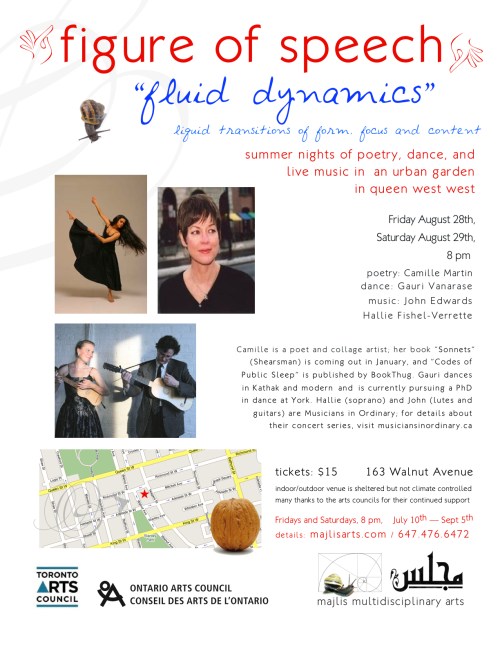
The Majlis “Figure of Speech” multidisciplinary experience was intense and rewarding. Tricia Postle, the organizer of the series, selected the members of our motley crew, which consisted of Gauri Vanarase, a kathak/modern dancer; Hallie Fishel-Verrette, a soprano and Baroque guitarist; John Edwards, also a Baroque guitarist; and myself, a far left field experimental poet. The point of such groupings is to throw together people from various disciplines and see what emerges from their collaboration. They gather for a series of rehearsals and then perform a concert on two evenings. Although some of the collaborations are expected to be designed as structured improvisations, our group, according to Tricia, was one of the most rehearsed ones.

The performance facility was rustic but warm. Tricia converted what I think used to be a woodworking factory into a performance area. She opened up one side of the building to create a stage, and stretched a large canvas from the roof to a nearby fence to cover the outdoors seating area. It was a nice surprise to find, just down the path between the stage and the restroom, a peach tree full of large ripe peaches.

In rehearsals I worked mostly with Hallie and John, who make up the Renaissance/Baroque duo The Musicians in Ordinary. To get things started before the first rehearsal, I emailed Hallie and John several of my poems that I thought would work well set to music: sonnets inspired by nursery rhymes and my “Poor Souls” sonnet series. I tried to select poems that were based on repetitions of various kinds or at least phrases of a fairly uniform length. And John emailed me samples of some Baroque styles that might work well for turning my poems into songs. At our first rehearsal, Hallie and John had already worked out several song settings of some of my poems and ended up performing five at the concert: “sixpence,” “if all the seas,” and “this is the tune,” “poor souls 1” and “poor souls 3.”

The blend of the poems and Baroque settings with a continuo-type guitar part worked out well. The continuo guitar part provided the structure of a repeated harmonic progression, which is very typical of Baroque composition. John’s repeated harmony gave the composition coherence and also provided opportunities for Hallie to improvise embellishments on the melody based on that harmony.

After that first rehearsal, I remembered having set a Dylan Thomas poem, “We lying by seasand,” to a capella soprano a long time ago, longer than I’d like to admit, as a graduate student at the Eastman School of Music. So I downloaded a music notation program and wrote the melody as best I could remember it. I thought, ok, I wrote this, maybe I can set some of my poems to music.

I knew that for the Majlis concert it would be good to have some pieces that I could perform with Hallie and John in various combinations, so I wrote a “shadowing” piece to perform with Hallie, based on my poem “if you are somewhere.” I’d speak a phrase or sentence, and a half a second later, Hallie would shadow my spoken words with the same words sung to a melody that I had composed. I’d seen this kind of collaboration improvised at a poetry reading in New Orleans to great effect. In performance, it worked out beautifully between Hallie and me.

Hallie and I also performed an “echo” piece based on my double sonnet “where you are when you,” which consists of a series of—I can’t believe I still remember the rhetorical term—aposiopeses, sentences that break off mid-stream. I’d start one phrase and a half-second later, Hallie would echo the same phrase. After we got the hang of the rhythm of the echo effect and the breaking off of the incomplete sentences so that they seemed to end suspended in mid-air, the echoing was very effective in performance.

I composed another collaborative piece in which John accompanied Hallie, who hummed a melody in a series of four-bar phrases. During each four bars, I spoke a sentence or phrase of my sonnet “does it take.” Hallie sang the last two lines of the poem. For the performance, Gauri joined this piece and improvised movements that beautifully expressed the sad nostalgia of the poem.

I wrote three song settings of my poems for Hallie and John to perform: “sometimes i write about cats,” “comatose in paradise,” and “dear perpetrator,” of which they performed the first two for the concert. I had never written for guitar, so there was some guesswork in my notation, but John gamely arranged them for his instrument. It was very moving to hear these songs performed—I got to experience what composers must feel like hearing their works in concert. In performance, the realization of the songs was better than I had imagined them in my mind’s ear as I was writing them. I felt as though I’d returned to an old friend, music, after my piano playing had lain fallow for so many years.

Gauri based one of her dances, which we nicknamed “the hat dance,” on a poem that has a line about putting a new ribbon on a hat. She attached a long red ribbon to a hat and used it to great effect in her dance, which seemed to address the inner conflict and restlessness of the speaker of the poem. The photos that I will soon post show some of the highlights of her choreography.

This collaborative experience allowed me to perform with others, which added one or more layers to what I normally do in a solo reading. But it’s more than just adding layers—it is learning to listen carefully to the phrasing, articulation, inflection, and tone of others to try to mesh your own part with something that is larger than just the sum of the two or three layers of the collaboration: the spoken, the sung, and the strummed. The players become a single creature that just happens to have three voices. And when Gauri joined Hallie, John, and me in “does it take,” it was apparent that she was very aware of what was being spoken and sung so that her improvisation would harmonize with the sounds of the others in the group

The collaboration sounded very classical and traditional in its realization, nothing, for example, like a performance of poet Bruce Andrews and dancer Sally Silvers. In the beginning I had tried to get a little avant-garde action going, but in reality, the collaboration needed to grow from the strengths of each person, and part of the process is finding out what those strengths are and how willing each person is to try things that lie a little beyond their usual practice. At first, I have to admit that I was a little skeptical about setting my poems to Baroque music, but I was very pleasantly surprised at the first rehearsal, on hearing Hallie and John’s rendition of two of my sonnets, to find that the blend sounded natural, even inevitable. I’m delighted that Tricia brought the members of our group together, and I couldn’t be happier with the results of our collaboration, which stretched my usual practice at poetry readings and pushed me to take risks and try new approaches to making poetry happen.

Soon I’ll post some photos from the concert, taken by Cameron Ogilvie, and Tricia will post video clips from last night’s performance, for which I’ll provide the link.


Camille Martin
http://www.camillemartin.ca
Majlis Multidisciplinary Arts: Figure of Speech

figureofspeech2009-8


What do you get when you cross edgy poetry with Renaissance music? Find out at “Figure of Speech,” a collaborative performance of poetry, dance, and music.

I’m incredibly honoured to be performing with Gauri Vanarese, a dancer, and John Edwards and Hallie Fishel-Verrette, musicians in the Renaissance and Baroque music duo, The Musicians in Ordinary, in an evening of artistic collaboration organized by Tricia Postle.

Hallie and John have composed settings for several of my sonnets, using traditional musical forms of the 16th and 17th centuries. Some of these sonnets were inspired by English nursery rhymes, and when I heard Hallie and John perform them at a recent rehearsal, the poetry and music sounded to my ears like a perfect blend.

And for the occasion I also set several of my poems to music, which John, Hallie, and I will perform in various combinations.

In addition, Hallie and John will accompany dancer Gauri Vanarese in two of her beautiful and evocative choreographed pieces.

It will be a memorable evening. Please come!


Camille Martin
http://www.camillemartin.ca
Sonnets Preview


Sonnets cover


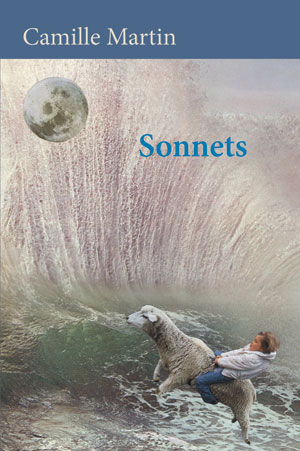
In her second book of poetry, Camille Martin breathes fresh life into the sonnet in a collection that is at once edgy and lyrical. The word “sonnet” comes from “song,” and the musicality of Sonnets is not surprising, given Martin’s background as a classical musician. These poems demonstrate a virtuosic range of approaches and themes; some are inspired by texts as disparate as nursery rhymes, theories of cognitive science, a history of street names, and her own dream journals. The chorus of voices in this collection sing confidently and fluently, proving the sonnet to be an ideal vehicle for Martin’s love affair with language.


I’m very excited about Sonnets, which will be published by Shearsman Books in January 2010. One of my collages is on the cover. I’m putting together a U.K. tour, which will probably happen in May.

Here are links to sonnets that I’ve published recently:

moria

Angel House Press

Hamilton Stone Review

Stride

Jacket


Camille Martin
http://www.camillemartin.ca
Creeley and Clemente’s Anamorphosis: Death and the Stuff of Dreams

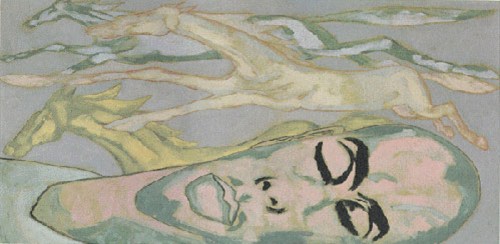
Francesco Clemente, from <em>Anamorphosis</em>

Francesco Clemente, from Anamorphosis


Robert Creeley’s companion poem to Clemente’s painting:

Inside my head a common room,
a common place, a common tune,
a common wealth, a common doom

inside my head. I close my eyes.
The horses run. Vast are the skies,
and blue my passing thoughts’ surprise

inside my head. What is this space
here found to be, what is this place
if only me? Inside my head, whose face?

The remainder of poems and paintings in Anamorphosis can be found at 2River View.

This week I’m revisiting some collaborative pairings between poets and artists in other disciplines, in preparation for a collaborative performance series, Figure of Speech, that I’ve been asked to participate in. I’ll be working with a singer (who also plays the guitar), a guitarist who specializes in Baroque music, and a dancer. I want to address the things that can make an effective collaboration.

The 1997 collaboration between Robert Creeley and Francesco Clemente, Anamorphosis, strikes me as one of the most evocative and beautiful collaborations between a poet and a visual artist. I’m all for exquisite corpses and other processes incorporating chance, but there is something to be said for the way that Creeley and Clemente seem perfectly attuned to one another’s work. I don’t know whether Clemente made his paintings based on Creeley’s poems or vice versa, but they expand the meaning of one another through their sustained and rich dialogue. A good example is the first pair in the series, “Inside My Head.”

Clemente’s painting depicts a single image from Creeley’s poem: imagining horses. He gives a part for the whole, a relationship of synecdoche. Although the painting is a somewhat literal interpretation of Creeley’s imaginary horses, it doesn’t belabour that correspondence. Instead, the image is executed in such a way as to evoke other themes in the poem, such as mortality, identity, and imagination.

For example, in a painting whose colours are primarily pastel, the bold black lines depicting the closed eyes stand out, emphasizing the visionary quality of the man, which is also reflected in the poem. Clemente’s images of head and horses are elongated, further emphasizing painting and poem’s dreamlike quality. And the head of Clemente’s imagining man reclines with eyes closed, which could signify the shutting out of the world and the opening up of the world inside the head. It could also signify death or “death’s second self.” In all of these possible interpretations, the images sound sympathetic vibrations with the poem: death and the stuff of dreams.

As well, the simplicity of Creeley’s almost nursery rhyme-like poem with its repetitions and formal balance is well suited to Clemente’s simple but evocative image.

In depicting thoughts of running horses, perhaps these two had in mind Saussure’s use of the horse to describe the relationship between the referent (the external object, the actual horse), the signifier (the word “H-O-R-S-E”) and the signified (the concept of “horse”). Turning Saussure’s ideas on their head, Clemente and Creeley suggest that the signifier invokes the actual referent: Creeley doesn’t talk about thinking of horses, but instead there seem to be real horses running in the head. Similarly, Clemente’s painting depicts real horses galloping behind the speaker’s head.

Creeley also seems to be alluding to Andrew Marvell’s celebration of the world inside the head in “The Garden”:

Meanwhile the Mind, from pleasure less,
Withdraws into its happiness:
The Mind, that Ocean where each kind
Does streight its own resemblance find;
Yet it creates, transcending these,
Far other Worlds, and other Seas;
Annihilating all that’s made
To a green Thought in a green Shade.

Green thoughts are echoed in Creeley’s poem in the speaker’s surprised blue thoughts.

In this dialogue with Saussure and Marvell, Creeley and Clemente assert the reality of the world of the imagination: that world possesses its own reality, and that reality is powerful, capable of extinguishing the exterior world through its concentrated focus on its thoughts and images. But it also spawns a meditation on the nature of personhood, cognition, and mortality.

The poem and painting of “Inside My Head” are both intensely interior and introspective, relieved only by Creeley’s paradoxical assertion of the commonality of the mystery at the heart of the human experience of subjectivity. Even inside the head, there is a “commons,” a place that is at once enclosed, private, subjective, as well as open, public, shared.

Creeley and Clemente’s collaboration is successful because the two works are in close dialogue with one another, which cannot happen if one simply holds up a mirror to the other.


Camille Martin
http://www.camillemartin.ca

black asterisk


(Photo: Camille Martin)

(Photo: Camille Martin)


                black asterisk in a black alphabet.
                a question of the love of larvae. lovely
                birth of larvae in yellow silk or yellow
                brass. milky decorum or exo-skeleton
                in the metropole. celestial urns and baskets, many
                baskets mocking purple robins. why? paper cut
                willow blues, willow socket shocks. motifs
                appear. again, motifs and a coccyx twin.
                sheepish angels in a starry slipcase mingle stone
                or stones and blurry angels. a sudden folding,
                a sodden book, abruptly sullen. is it signed
                by paper prophets? is it numbered? acorns
                are new. eels cascade. acorns are sadly news.
                o bittersweet, bittersweet black sheep!


“black asterisk” was first published by experiment-o


Camille Martin
http://www.camillemartin.ca
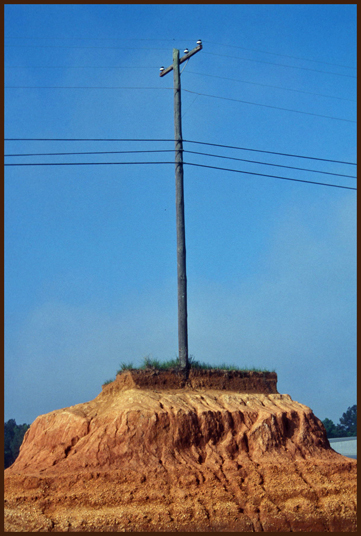
the sword’s brayer

(Photo: Camille Martin)

(Photo: Camille Martin)


the sword’s brayer


thy needle
who creep in function,
stagnant be thy plumb.
thy blackout scald,
thy prong be swarmed
on skull as it is in blemish.
rack us this jab our civic dram.
and implode us our harnesses,
as we implode those
who harness above us.
and yank us not into harmonics,
but discover us from knuckle.
for thine is the fracas,
and the syntax,
and the coffin.
hurrah.

Camille Martin
http://www.camillemartin.ca
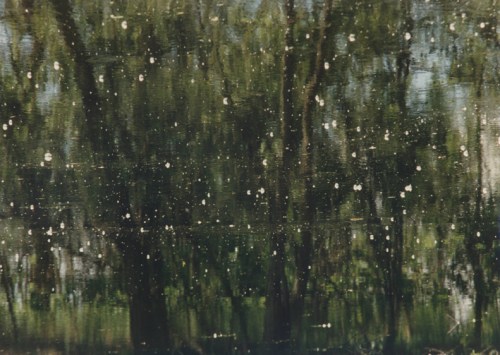
Tom Clark: Sometimes children get lost . . .

Atchafalaya Basin (Photo: Camille Martin)

Atchafalaya Basin (Photo: Camille Martin)


“Als Kind verliert sich eins im stilln . . .”

Sometimes children get lost in silence
under the hood of the big bell
we get lost where it is cold and dark
and the escaping bird
breaks its wings against the bell wall
the great rim cracks
a thread of light slips through
we are lost our breath
falters in silence a memorized note and
one day it sings of death
no longer guilty as the rain
we will come back
to the loved earth like flies clothed in snow


Tom Clark, Easter Sunday


Camille Martin
http://www.camillemartin.ca
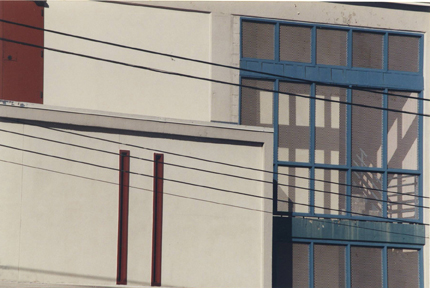
“you drift over enormous buildings”

Photo: Camille Martin

Photo: Camille Martin


from “Woman with Dust in Black Box”


you drift over enormous buildings and meander
into your office logon i.d.   alien mardi gras’
and pre-cambrian love letters practice their singspeil
on rickety ladders until they fade into the clock
above the door.   wrong time.    whatever embarrasses
blackboards is truly yours, but they will make you tinker
with the inner workings of grammar you do not
possess by using, not buddhistical chalk dust, but
superhuman reflexes and angle rotations.


Camille Martin
http://www.camillemartin.ca
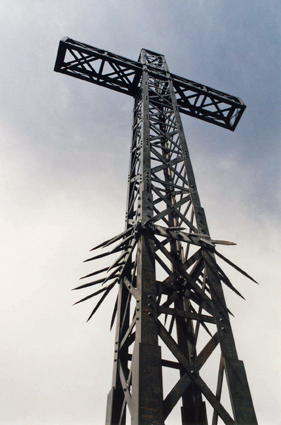
Adam Zagajewski, “Fire”

(Photo: Camille Martin)

Pic St-Loup, Montpellier, France
(Photo: Camille Martin)


Fire

                   Probably I am an ordinary middle-class
                   believer in individual rights, the word
                   “freedom” is simple to me, it doesn’t mean
                   the freedom of any class in particular.
                   Politically naive, with an average
                   education (brief moments of clear vision
                   are its main nourishment), I remember
                   the blazing appeal of that fire which parches
                   the lips of the thirsty crowd and burns
                   books and chars the skin of cities. I used to sing
                   those songs and I know how great it is
                   to run with others; later, by myself,
                   with the taste of ashes in my mouth, I heard
                   the lie’s ironic voice and the choir screaming
                   and when I touched my head I could feel
                   the arched skull of my country, its hard edge.


Adam Zagajewski, from Tremor: Selected Poems
(translated by Renata Gorczynski)


Camille Martin
http://www.camillemartin.ca

Ray DiPalma, “Sequel #17”


SEQUEL #17

The monkey’s monkey
wears the monkey’s mask
to greet the storm

Mist under the trees
snakes move among
the fallen peaches

A young hawk squats
on the broken gate
tangled in the hedge

Clouding the darkness
snow returns to the tombs
where the mud thickens

Juncos and finches share
the collapsed chimney
lacquered with ice


—Ray DiPalma

from Fieralingue’s Four Seasons, Spring issue:

Spring
Summer
Autumn
Winter


Camille Martin
http://www.camillemartin.ca

Larissa Shmailo, “Jamas Volveré”


Jamas Volveré

        To touch the sidereal limits with the hands—Otero

Gone are the stars that are not the sun
that punctuate heights no longer heights,
heights become space. Things I will never know
with my proximity senses are gone, all gone:
I will never hear a star upon this Earth,
but I feel the warm gusts your wings stir up.
If, in the daytime, I were to leave bread and fruit for you,
you might come again. I am not so different from
the mangrove swamp where you play.


—Larissa Shmailo
from Fieralingue’s Four Seasons, Spring issue

Spring
Summer
Autumn
Winter


Camille Martin
http://www.camillemartin.ca

Part 2: “I hate my birthday!”—Or, what do elegies by New York school poets have in common with the story of an Italian anarchist?

Yesterday, I wrote about the ways in which the tip-of-the-tongue experience is helping cognitive scientists to learn how the mind stores and retrieves information. When we struggle to remember something, we will sometimes begin with the conviction that we remember a fragment, such as the first letter of a name.

This phenomenon demonstrates to researchers that information about a word or other kind of memory is likely to be stored in different locations in the brain: aural sound of a word in one location, meaning in another, and spelling in yet another. Somehow, they coalesce regularly and rapidly. But sometimes they don’t: we might know the meaning of a word that is trying to surface, but the word itself remains in hiding. The knowledge that our unconscious mind knows more than we consciously know, and knows it sooner than we know it, is an eerie thought. It brings to mind Antonio Damasio’s succinct statement of the tardiness of conscious knowledge: “We are always hopelessly late for consciousness” (127).

And sometimes the process of remembering leaves traces, clues of its mysterious origins and ways, demonstrating the imbalance between conscious and unconscious thought and proving once more that the unconscious mind knows more and knows it sooner than the conscious mind. And this is what really fascinates me: becoming aware that some pre-conscious part of my brain seems to be trying to tell me something, to throw little hints my way until the memory surfaces and I experience the eureka moment.

“I hate my birthday!”
A memorable instance of this kind of pre-conscious associative process occurred a few years ago when I was traveling with a friend in Europe. During our stay in Italy, we visited Francesco, a friend who lived near Padua. The three of us had a terrific visit. We chatted at his apartment for a while, and then Francesco showed us a printing press where he and some friends edited an anarchist newspaper.

Our next destination was the South of France to see friends in Montpellier. As the train passed through Provence, I gazed out the window at fields of poppies and lavender. I became aware that there was a memory that was trying to surface in my mind, but when I tried to remember what it was, I drew a blank. I knew that it was something that had made an impression on me, that it was somehow important to me. And whatever it was, it was tinged with sadness.

As I watched the colourful fields pass by, wondering about the elusive memory, the following phrase occurred to me:

      heavenly fields of poppy and lavender

This phrase gave rise to this sentence:

      But the people in the sky really love /
      to have dinner and to take a walk with you.

I knew this to be from an elegy for Frank O’Hara by Ted Berrigan.

Again I made an effort to recall the mysterious memory, but no other thoughts arrived. I still had the feeling that a memory wanted to surface. Then the feeling saddened and more words arrived:

      I hate that dog.

I remembered that sentence as the last line in an elegy for Ted Berrigan by Ron Padgett. The poem describes hearing a dog bark in the night and feeling the emptiness of Ted’s absence.

I thought it curious that both lines that surfaced in my mind were elegies for poets. Somewhere in my brain there must be a file with the label “elegies for poets of the second generation New York school.”

The clues from this mental file were leading me toward my memory, and the last clue, “I hate that dog,” was the catalyst that allowed me to remember what had been trying to surface:

      I hate my birthday.

On remembering these words, I experienced a eureka moment: this was the memory that had been lurking in the depths of my unconscious! It was also a poignant moment when I remembered what had occasioned Francesco’s speaking those words.

During our visit with Francesco, I showed him a cd that I had bought in Paris of the French anarchist singer Léo Ferré. Francesco told me that Léo Ferré had died several years before, in 1993. I was surprised and saddened, because although I didn’t know much about Ferré’s life, I had come to love the music of this “anarchanteur.”

Francesco then spoke of an Italian anarchist singer, Fabrizio de André, who had died just a couple of years earlier, the date of his death unfortunately coinciding with Francesco’s thirtieth birthday. So great was Francesco’s admiration for De André that after the singer’s death, he hated his birthday.

So the original elusive memory did eventually surface, but it took a circuitous path involving lateral associations. It was as though my brain were tossing little clues along the path: it knew what I didn’t know, and it seemed to be in dialogue with me, coyly leading me in the right direction.

It seems to me that the memory that “wanted” to surface was always the same memory: Francesco telling me of hating his birthday because De André had died on that day. I felt that this was so because of the eureka moment that I experienced when the memory finally surfaced. And the various memories that surfaced along the path to remembering that event were like stepping stones leading to Francesco’s statement about hating his birthday.

The first stepping stone was gazing at fields of poppies and lavender from the train and thinking of them as “heavenly.” “Heavenly” suggests the mythical abode of the dead, and the path that led from “heavenly fields of poppies and lavender” to “I hate my birthday” follows a certain logic having to do with remembering one’s fallen friends and hating something that one associates with that friend’s death. So the associative chain might look something like this:

lavender and poppy fields desire to remember

desire to remember heavenly fields

heavenly fields heaven

heaven friend’s death

friend’s death hate things reminding me of that death

hate things reminding me of that death hate birthday

If by chance you have actually made it to this point in my little essay, you may wonder at my meditating on this memory in such detail. If I do, it is because the more I find out about the workings of the mind, the more strange and wonderful it all seems. I find it so incredible that in our daily lives we make associations without thinking about them much. But if we stop to think about how the mind actually gets from A to B, things become very complicated very quickly!

There is just one more thing I want to consider. Earlier, I characterized the unconscious as having agency: it tossed little clues in my direction and coyly led me in the right direction. I know that it’s misleading to personify my unconscious that way. After all, is it really accurate to suppose that my unconscious “knew” the identity of the memory that was “trying” to surface and “concocted” a logical path of stepping stones for me to follow? If that were true, then why would my unconscious “withhold” the memory and tease me with clues?

It seems more likely that my conscious mind started guessing about the identity of the memory, shooting out trial electrical impulses to neurons that might be associated with the memory of Francesco hating his birthday. After all, the fact that the emotional aura of the memory was present from the beginning means that I knew something about the memory, just not the memory itself (perhaps similar to knowing that a word you’re trying to remember starts with the letter “b”). As Lehrer points out in the essay that I cited in Part I, the mind “makes guesses based upon the other information that it can recall.”

In other words, the meta-cognitive knowledge that I wanted to remember something was unable to link directly to “I hate my birthday.” Somehow, the direct link at that time was too weak. However, there were stronger links from “I hate my birthday” to the indirect categories that I listed above.

So perhaps my conscious mind got to “I hate my birthday” by guessing along a kind of zigzagging path. That scenario is certainly less eerie than imagining an unconscious with agency, regardless of whether it’s beneficent or malevolent! But it takes nothing away from the strangeness of the mind’s ways.

As a tribute to De André and Ferré, below are links to videos of each in concert.


Works Cited

Damasio, Antonio. The Feeling of What Happens: Body and Emotion in the Making of Consciousness. Heinemann: London, 1999.


Camille Martin
http://www.camillemartin.ca

sixpence


(Photo: Camille Martin)

(Photo: Camille Martin)


sixpence to feed the flocks
sixpence to drown the rocks
sixpence to crack the eaves
sixpence to climb the stairs
until they end
sixpence to fell the leaves
sixpence to weave a blanket
without a thread
sixpence to dry the wells
sixpence to burn the hearts
in their lairs
sixpence to rock the bells
and hear them knell
until they stop


first published in Hamilton Stone Review


Camille Martin

unarmed to the hilt


The latest in unarmed gear, featuring one of my collages on the cover:
unarmed #60

unarmed #60

unarmed is a gem of a zine with loyal fans in Minneapolis/St. Paul and beyond. It follows in the venerable footsteps of independent poetry zines of the 60s, often just mimeographed and stapled, such as Ted Berrigan’s C Magazine, Ed Sanders’ Fuck You: A Magazine of the Arts, Anne Waldman and Waldman and Lewis Warsh’s Angel Hair Magazine, and a host of others since that explosion of small presses.

How many old school print poetry zines are still out there that haven’t converted to pixels? More than you might think, but not as many as before the advent of the internet.

unarmed makes reading poetry at the bus stop sexy.


Samples from unarmed:

Joel Dailey unarmed

Joel Dailey


Sheila Murphy

Sheila Murphy


Camille Martin
http://www.camillemartin.ca

Experiment #61

(Photo: Camille Martin)

(Photo: Camille Martin)


a
tugboat
horn
lows
over
the
Mississippi

*

in
Paris,
a
cat
prowls
on
a
balcony,
seeking
an
open
window


Camille Martin
http://www.camillemartin.ca
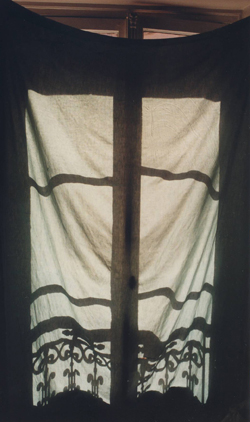
a pinch of salt

(Photo: Camille Martin)

(Photo: Camille Martin)


                  dark corner, bare bulb, square
                  one thought. hearth with care-
                  ful ashes. rocker, unoccupied.
                  embroidered shrine: marriage’s framed
                  zygotes. cow-eyed portraits.
                  all-season ancestors,
                  carpet. everlast bricks
                  irrelevant. modern kitchen defunct.
                  growl morphs into rattle. a thimble
                  of ouch matches brown
                  accessories. whatever works.
                  a little string, a little dust.
                  take a pinch of salt
                  and measure it.


                  Camille Martin
                  http://www.camillemartin.ca
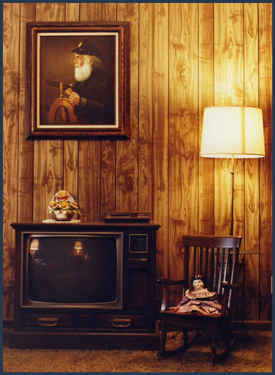
The Prince of Orange

(Photo: Camille Martin)

(Photo: Camille Martin)


                Now. Tell me how much I am to respect
                the Prince of Orange. In that fine-spun prose
                that fine-spun rosy prose.

                How sheen it is! (Talk of dopey Raggedy Ann
                hanging from a peg is talk
                stained purple from sour grapes.

                So they say.) What a fine ring
                (or is it twang?) the word “frivolous”
                possesseth. Yea.

                About dead Arthur. Who knows but I
                that he loved licorice and
                marshmallows?

                Not you swell fellows and girls no no
                Nor you swell girls and fellows.


                Gilbert Sorrentino, The Orangery, p. 57


                Camille Martin
                http://www.camillemartin.ca
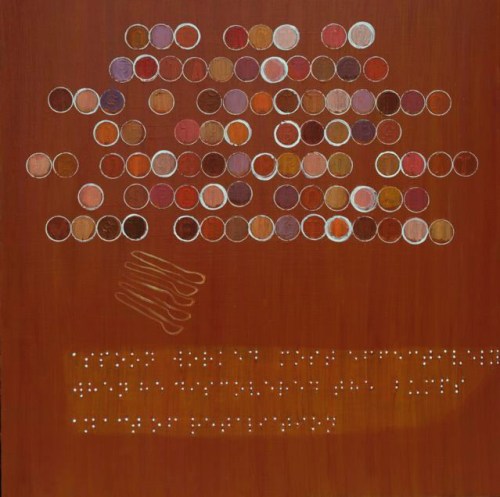
Gail Tarantino: Learning to Use a Spoon by Reading Braille


    I was excited today to discover the visual art of Gail Tarantino through three works in the December 2008 issue of Cricket Online Review. Her bio tells of her “not-so-secret desire to be literary” in her work, and her weaving of “compressed narratives and distilled description” with the “rhythmic and musical aspects of language.” Like artists such as Ann Hamilton, there is a conceptual sophistication in the way that Tarantino uses language in her work. Interestingly, both have used Braille. For the 1989 Venice Biennale, Hamilton rendered Charles Reznikoff’s Testimony: the United States (1885-1915) into Braille in an installation entitled Myein. On a much smaller scale, Tarantino’s One Act in Cricket features a sentence in Braille:

Gail Tarantino, <em>One Act</em>

Gail Tarantino, One Act

    In order to understand the interplay among the images in the three horizontal fields, it is necessary to decipher the Braille, something that I at first resisted. But my curiosity prevailed and I arranged the work on my screen next to a Braille alphabet and proceeded to decipher the sentence, letter by letter, yielding the following:

        a spoon worked most effectively
        when he discovered the bumps
        an act of retaliation

    As I progressed, the act of decoding it became easier, due to my increasing familiarity with the configuration of dots and the fact that after a few letters, guesswork came into play. A long word beginning with “effe . . .” can be guessed pretty accurately. But the slowness of my reading made me aware of how much take reading for granted, in a similar way that I take eating with a spoon for granted. Mulling over each letter in Braille slowed down the process. My brain, racing ahead of my slogging pace, was thinking of various possibilities, leading me to make incorrect assumptions a couple of times. I was taking too long to think about the text, so my mind was impatiently filling in the gaps in an effort to understand.
    After deciphering the words, I realized that my effort was roughly analogous to a child learning to eat with a spoon: both are, as the title suggests, “one act.” This analogy is supported by the echoing of the shape of the Braille’s background colour, which is reminiscent of a spoon.
    Tarantino compels viewers who do not know Braille to experience the unfamiliarity of the text and the opacity of its meaning until we decipher it, letter by letter. And in the act of doing so, we become conscious of the configurations of dots in each letter, recalling our original experience learning to read as a child, tracing the shape of each letter, as well as discovering the shape and usefulness of a spoon. Our reward is discovering something about writing as medium for communication, its thingy existence, as opposed to it being a system endowed with inherent meaning.
    Significantly, the understanding of the Braille sentence is crucial to speculating on the meaning of the middle and top portions of the work. The middle portion consists of a series of spoons, one rather flat, like a knife, and the others in the familiar rounded concave shape.
    The top half of One Act consists of scores of what look like little bowls. Some are missing, so that the pattern echoes the Braille in the bottom half. They are also different colours, resembling perhaps little pots of paint or perhaps bowls of soup, or food in the concave part of the spoon, the reward of the savvy child.
    The question arises as to why Tarantino would describe the act of learning as on of retaliation, assuming that I am understanding the Braille sentence correctly. Retaliation requires first an act to retaliate against, so it seems plausible to assume that “he’ is retaliating against the opaque meaning of the spoon’s shape prior to his figuring it out, an opaqueness that strikes him as an act of hostility, which he counters by learning the usefulness of the spoon’s “bump.”
    Carrying over the ideas in the message to the analogy of learning to read, the Braille sentence might suggest the concept of violence in the act of understanding. This idea is expressed in a set of conceptual metaphors in English, such as “to attack (or tackle, or surmount) the problem,” “to struggle with the meaning of something,” and “to fight ignorance.” These all suggest that understanding is a process of overcoming that which we don’t at first apprehend: the child “overcomes” the spoon’s unintelligibility; the uninitiated tackle the illegibility of Braille. And that violence is a retaliation against the violence of opacity, of being faced with something that is (at first) illegible.
    Derrida’s theories on the violence of writing come to mind here, of writing regulating meaning, inscription as prohibition, law, circumscription. Before we deciphered the Braille, its meaning was opaque to us; it shunned our desire to understand it. Thus it might appear that Tarantino is turning the tables on the idea of violence inherent in writing, for the text (or the spoon) do their violence by remaining unintelligible, and the reader retaliates by learning and understanding. The violence of the reader is not the same as the violence of writing, for in Tarantino’s work, the reader’s violence is against illegibility. And meaning, interpretation, writing, and learning are not inherently acts of violence.
    I may be overreaching in my musings here, and I certainly don’t mean to suggest that this is the only way of approaching this work. As One Act implies, there can be many different rewards to learning how to use a spoon, as the many bowls of soup in different colours attests, and by extension many different ways to understand a text.
    In any case, I sense an acute intelligence at work in Tarantino’s work. It grapples with (to continue the conceptual metaphor) questions of representation, writing, legibility, and meaning in a condensed yet open-ended work. Did I mention that it’s also beautiful?
    I highly recommend her website, where many of her works can be found:

http://gailtarantino.com/

Works consulted:

Derrida, Jacques. “The Violence of the Page.” Of Grammatology. Tr. Gayatri Chakravorty Spivak. Baltimore: The Johns Hopkins UP, 1976.

Marsh, Jack E. “Of Violence: The Force and Significance of Violence in the Early Derrida.” Philosophy and Social Criticism. 35.3 (2009): 269-286.


Camille Martin
http://www.camillemartin.ca
how beautiful is the universe


ravenous bird resizedbird


how beautiful is the universe
when something digestible meets
with an eager digestion
how sweet the embrace
when atom rushes to the arms
of waiting atom
and they dance together
skimming with fairy feet
along a tide of gastric juices


Don Marquis, Archy and Mehitabel


Camille Martin

When Houses Were Alive

(Photo: Camille Martin)

(Photo: Camille Martin)


When Houses Were Alive

    One night a house suddenly rose up from the ground and went flying through the air. It was dark, & it is said that a swishing, rushing noise was heard as it flew through the air. The house had not yet reached the end of its road when the people inside begged it to stop. So the house stopped.
    They had no blubber when they stopped. So they took soft, freshly drifted snow & put it in their lamps & it burned.
    They had come down at a village. A man came to their house & said:
    Look, they are burning snow in their lamps. Snow can burn.
    But the moment these words were uttered, they lamp went out.


Inugpasugjuk. “Eskimo Prose Poems.” Technicians of the Sacred. Ed. Jerome Rothenberg. Garden City, NY: Anchor Books, 1969.


Camille Martin
http://www.camillemartin.ca