
BEAN (photo: Camille Martin)
Camille Martin
http://www.camillemartin.ca
http://www.camillemartin.ca

Alberta Turner (1919-2003)
http://neglectorino.blogspot.com/
. . . which I just did: Alberta Turner. Her most recent publication, I believe, is a new and selected collection, Beginning with And (Bottom Dog Press, 1994). It’s available from Small Press Distribution.
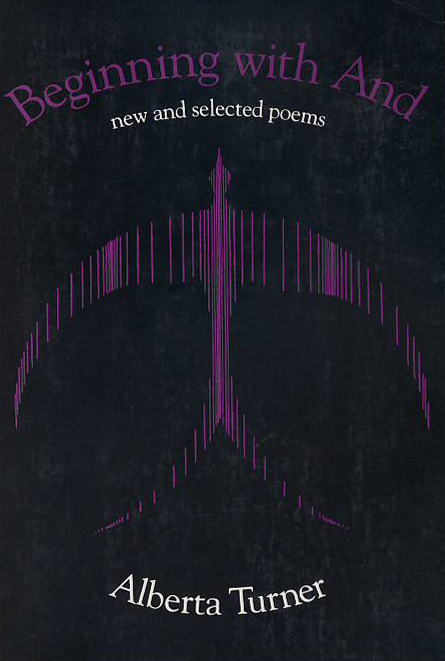
Bottom Dog Press, 1994
Perhaps she’s less neglected a poet than I am assuming. Out of curiosity I searched the Poetics archives and found narry a mention of her (except for one post by me a couple of years ago). On that listserv, her death in 2003 didn’t register a tremor on the Richter scale. I also checked some long-standing and prominent poetry blogs of Poetics List members, and again, no mention. So I don’t think that she is particularly well known among the more experimentally inclined.
Thematically, she is a poet of the quotidian: she observes the minute moments of ordinary life and turns them inside-out to bring to light the contents of their pockets. She also knocks the icon of the domestic goddess off her pedestal.
In a sonnet entitled “Accounting,” a woman putters around the house, cooking in the kitchen, getting dressed, and tying her shoelaces that have come undone. All the while, she obsessively counts things in the kitchen and then her own multiple selves that seem to be reflected in a domestic hall of mirrors:
Accounting
Twenty of them. Count
five with heads
eight with holes
seven of some soft stuff—
You put boots on the cat,
a diamond bracelet on the crow.
Look at yourself grinning out of the spider web,
stuffing your twins into a pouch.
Two of you have identical spoons,
four go to the same shelf for salt,
three return to the fifth stone from the door
to tie your shoes.
A dried bee crunches underfoot.
Two of you will crunch bees.
Lid and Spoon (1977)
Her sardonic response to the tiresome, petty activities of daily life is evident in her reference to food she is preparing (“seven of some soft stuff”) and her self-mockery dressing before a cracked mirror (“stuffing your twins into a pouch”). She also inserts an element of absurdity and self-deprecation in her dressing, which is described in the language of the folk tale: “You put boots on the cat” (perhaps a reference to puss-in-boots, a children’s tale) and “a diamond bracelet on the crow” (“old crow” being derogatory slang for an unattractive woman).
Her counting exercise magnifies her sense of ennui performing repetitive mundane actions—holding a spoon, reaching for salt on a shelf, getting dressed before a cracked mirror, and hearing the crunch of stepping on dried insects. And her reference to herself in the second person reveals her alienation from herself. It is as though she were outside her body observing with subtle and good-humoured mockery her multiplied selves do chores.
Turner experienced the women’s movement of the 60s during her 40s; thus she spent the first twenty years of her adulthood in an overtly sexist society in which women were still by and large expected to function in traditional domestic roles. Turner, with sly humour, makes fun of her role, which she obviously doesn’t relish, of perfoming household duties.
Turner is not only a poet of domestic dissent. Her work, while largely accessible, is edgy and often disjunctive, qualities that threw off some critics, such as Margaret Gibson, who reviewed Lids and Spoons in the Library Journal in 1977. Gibson disparages Turner’s “astigmatic” vision in her “surreal collages” and “oracular riddles.” On the other hand, she praises Turner’s poems that form “organic wholes anchored in a world we can recognize for ourselves.” Critics who were accustomed to more accessible poetry were puzzled by her work’s experimental qualities such as odd juxtapositions, fragmentary phrases, and, as in the following poem, the unsettling use of nouns for verbs:
Mean, MEAN
Little eggs—blue, specked.
Laid, they grape;
feathered, they bead;
beaded, they
bird
very small birds
blur or brown, bellied
in white
What they mean is small:
beak-bite, spur prick,
brittle
spike.
*
I heard you,
MEAN!
Because hinge? Because tile’s hollow—
and straws and legs?
Because feet have the soles of feet?
Pockets for tails. A tail graft in
Capetown has held three weeks.
*
The soft part of conchs,
the stuff between shells.
I have bells of pods, necklaces of
teeth, but my tools
are spoon—somewhere a
pulp needs me—a drying juice,
an unhoused snail.
Learning to Count (1974)
The title, with its imperative to produce a more transparent meaning, could be a response to her critics who would tame the syntax and bridge the gaps. The first section begins quietly with a line designed, perhaps, to appeal to her critics. It is an image fairly bursting with preciosity: “Little eggs—blue, specked.” Then Turner slyly subverts the syntactical normalcy by splashing the parts of speech wherever she likes with quick, sure strokes: “Laid, they grape; / feathered, they bead; / beaded they bird.” Next follow three lines describing the “very small birds” in a tone similar to the first line.
She seems to turn to her critics to tell them what the poem means in case they missed it: “small.” The final three lines contain only six words, but they are so thick with alliteration, assonance, and near-rhymes that their meaning fades into the background and their sounds take precedence:
beak-bite, spur prick,
brittle
spike.
In their dense musicality, these short, energetic lines are reminiscent of troubadour poet Arnaut Daniel, particularly his chanson “L’aur amara,” which is also about birds, a favourite subject of Daniel:
L’aur amara
fa’ls bruels brancutz
clarzir,
que’l dous’espeis’ab fuelhs,
e’ls letz
becx
dels auzels ramencx
te babs e mutz,
pars
e non pars,
. . .
Even if you haven’t learned Medieval Occitan (and who has the time for it these days?), you can tell the extreme care with which Daniel selected each word to achieve a complex sonic weaving. *
In Turner’s three lines,
beak-bite, spur prick,
brittle
spike.
the “beak,” “spur,” and “spike” are tiny in relation to a bird’s body. But smallness is also expressed through the sounds of the words, which have a short, pecking quality to my ears, signifying the tiny motions of the bird’s beak, just as the sounds of Daniel’s lines might suggest the chirping of birds.
In the second section, Turner again seems to turn to her critics who would have her write more “meaningful” poetry, this time with extreme annoyance: “I heard you, / MEAN!” She then asks why she should mean, but her very questions belie her tendency to disjunction rather than “organic wholes”:
Because hinge? Because tile’s hollow—
and straws and legs?
Because feet have the soles of feet?
The last two lines are delightfully indecipherable. At this point, she is off the beaten track of clear meaning, talking in dry reportage style about “pockets,” “tails,” and a “tail graft in / Capetown.”
Turner has it her way in the third section, and this time, no critics are invited. The musicality of Turner’s range of tones and timbres is again reminiscent of Daniel:
The soft part of conchs,
the stuff between shells.
I have bells of pods, necklaces of
teeth, but my tools
are spoon—somewhere a
pulp needs me—a drying juice,
an unhoused snail.
In spite of its disjunctiveness (spoons and mollusks), the poem’s images echo impressionistically—although perhaps not in Gibson’s desired “organic unity.”
I’ll post one other poem by Alberta Turner, without comment:
HOOD BUTTON SHELL FUR
Gravity and wind so bells
feet in pairs ring pant legs
sausage curls clang hoods
domes hunch on traffic lights that lift
and swing
also cold its squirrel tail its nose drop
and cannon mouths their coin
*
One slave
to fasten the clasp of her cross
one
to slice her butter onto her toast
And she is fatherless
fed the bully to the meanest hog
sewed his buttons on a girl’s coat
*
Assume
that custard is smooth
that blue is sad and kind
Assume a god
ladle of fish
ladle of glue
And why not perch the snail shell on the log
as if the snail were still climbing out?
*
Three beans in a row red beans
three snows with no salt between
Ladder perhaps?
“Stop” And I would
But without wheels? Without road?
Stop an axe drop a hand
And fur is as angry as I can today
Lid and Spoon (1977)
* Ezra Pound, an admirer and translator of Daniel’s chansons, renders these lines as follows:
The bitter air
Strips panoply
From trees
Where softer winds set leaves,
And glad
Beaks
Now in breaks are coy,
Scarce peep the wee
Mates
And un-mates
Camille Martin
http://www.camillemartin.ca
Like many other people, I experience visual, auditory and sensory halluciations during that twilight state just before sleep, especially when I’m falling asleep reading a book. I’m still looking at the page of words, but the page has been transformed into colourful geometric patterns. It’s a bit like looking at one of those tests for colourblindness, only with letters instead of dots:
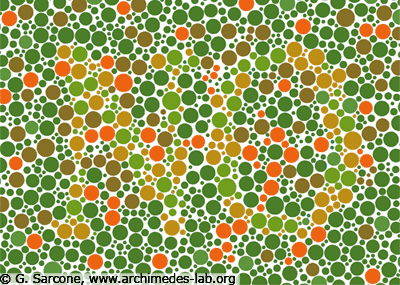
Sometimes the colours of the letters are aligned in diagonal stripes; they are always colourful and incandescent. I can no longer read the actual words; however, I’m aware that I’m still looking at the page when I fall into this state. Although the patterns don’t move, it does seem as though the page is a living thing. They are beautiful and strange.
Another kind of hypnagogic experience is what I call the “giant body.” I often have this experience lying down, although I have also experienced it, for example, driving a car on a monotonous highway. At its onset, I feel a heightened sense of proprioception – the sense of my body’s location in space. This segues into the feeling that my body has become very, very large. I’m a giant, like Gulliver in Lilliput. I feel myself expanding until I’m not sure of the boundaries of my body anymore.
Sometimes, the hypnagogic experience takes the form of seeing a succession of faces, each of which is distinct yet unknown to me. It’s as though each face were projected onto a mental screen for a few seconds before fading into the next face. In a variation on that kind of dream, I sometimes hear a crowd of voices buzzing incoherently. Every now and then, a louder and understandable voice emerges from the white noise of the crowd. The words, alas, are of a fairly mundane nature. I have dreamed short poems before, but it is unclear to me whether these would be called true dreams or hypnagogic dreams.
The last kind of hypnagogic experience is the most frustrating because of my inability to remember the insight or sequence of thoughts that came to me in that state. I know that I just had an interesting thought, but I cannot seem to make it surface again, so it remains an inchoate jumble. It’s as though, looking at the night sky, stars are less distinct when you try to look directly at them.
Hypnagogic dreams are more common than one might think. An 1996 essay in the British Journal of Psychiatry reports on a survey of 4972 people, ranging in age from teens to centenarians. According to the results, 37% claim to have had hypnagogic experiences. Fewer (12.5%) report experiencing the sleep-to-waking kind of dream called “hypnapompic hallucinations.”
Furthermore, none of the types of hypnagogic hallucinations that I have experienced is particularly unusual. The literature about hypnagogic dreams is full of descriptions of colourful geometric hallucinations, feelings of the dissolution of body and ego boundaries, visions of people and objects, auditory sensations, and the conviction that one could reveal brilliant insights into the meaning of life—if only one could remember them.
I note two striking qualities of my own hypnagogic dreams. First, the hallucinations are involuntary. That is, I can sometimes fully awaken myself if the dream state is shallow enough, but I cannot stop or direct the hallucinations while I’m in the hypnagogic state. Also, there is a noetic quality to the experience: it seems very real as it is happening. I have never mistaken a hallucination for reality, at least in the twilight states in which I do have some consciousness. I know that I am hallucinating and that my body isn’t really turning into a giant. But the hallucinatory experience has a reality of its own; somewhere in my brain, I am “seeing” geometric colours in front of me.
It is these two characteristics of the hypnagogic experience that remind me of synesthesia. As a child, I experienced musical tones as colours: C was white, D was yellow, E was orange, F was green, G was blue, and so forth. I knew that I was not actually seeing colours “out there,” yet the experience was in its own way very real, and also involutary.
I have studied a fair amount of the literature on synesthesia, and these two qualities are often mentioned in relation to the synesthetic experience. The case study by Richard Cytowic of a man who tasted shapes, for example, reports that when the man tasted mint, he experienced smooth columns before him. He found that taking amyl nitrate heightened his synesthesia; his reaction to mint became a visceral sensation of a thick forest of cool marble columns.
I’m not sure whether or how the experience of synesthesia and hypnagogic dreams are related. However, some people have reported synesthetic experiences during hypnogogia (Andreas Mavromatis, Hypnagogia: The Unique State of Consciousness between Wakefulness and Sleep.
John Franklin’s Ten-Year Hypnagogic Streak
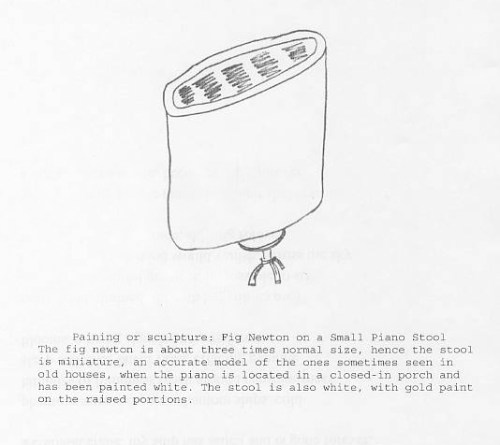
My experiences of hypnogogic dreams seem to be of the garden variety, and not particularly creative. However, I recently found by chance an article by John Franklin on the subject of hypnagogic dreams that documents his hallucinations during such states. Franklin reports that in 1977, he started having hypnagogic dreams of surreal images, both two- and three-dimensional, as well as phrases and sentences charged with strange poetic juxtapositions.
Although Franklin claims not to have any special talents in poetry or art, his ten-year experience of hypnogogic experiences show a very imaginative capacity to juxtapose fairly unrelated images or ideas. The experiments of surrealism such as automatic writing come to mind.
He was able to draw the hypnagogic images from memory on awakening, but the texts presented the problem of being able to memorize only fragments before returning to full consciousness and writing down the words. Nonetheless, he was able to copy a great deal of them, perhaps improving with practice.
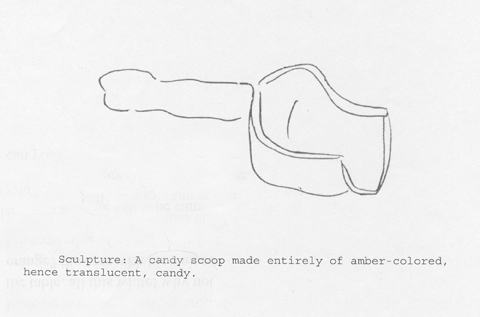
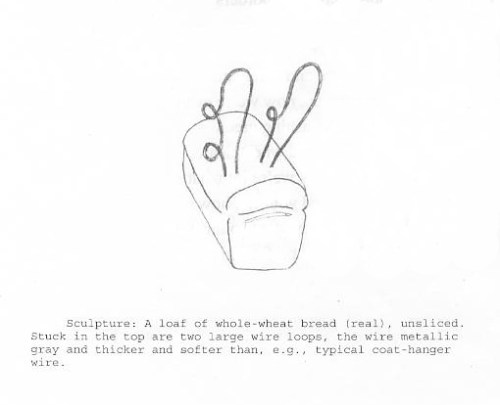
The “Fig Newton on a Small Piano Stool” that opened this post is one of his visions, followed by his description of it. Below are two more images and a few of his remembered poetic fragments.
I will only note that some of Franklin’s images and texts do not seem entirely random. Suppositions about the etiology of the odd juxtapositions would be guesswork. But an obvious example of an image hat has a rich palette of associations is the clever candy scoop made of candy. The reflexivity of this image strikes me as analogous to a metapoem: the candy scoop is not distinguishable in material from the candy that it picks up, in a similar way that a poem’s subject is itself or its creation.
Another example is the loaf of bread with the curled wires sticking out of it. The fact that I subconsciously erred in naming the image file “toaster” attests to a possible relationship: the wires seem to me to represent the curled heating elements inside a toaster.
The texts that Franklin reports are often poetically evocative:
“In a corner under scriveners
4 children played under water
In order for (some of) you to become scriveners
Children must play under water”
Assuming a close identity between the scriveners and the children, one interpretation could be that imaginative writers must be able to play “underwater,” perhaps a metaphor for the role of the subconscious in creativity.
Sometimes the words are mysteriously poignant: “Why some people have felt so different alone in the same sweater”
I suppose that in my brief and rather superficial attempt to attribute meaning to these images and words I’m grappling with the problem of how these hallucinations came to be in the first place. Why does the dreaming brain produce such odd cognitive hookups? To what extent are they random or meaningful? I wonder whether any scientist has used brain imaging technology to try to find out which parts of the brain are firing when a certain kind of hallucination is being produced. Franklin doesn’t report that he ever underwent such imaging, but it seems to me that his kind of very specific hallucinations of paintings and sculptures might yield some interesting insights.
For Franklin’s complete article and journals of images and texts, go to
http://www.thoughtsandvisions.com
“It is this: wife has cheese;
It is this: eyes have breath;
Every patient rack and chain go to him.”
“Air cooled in lungs
Air shined in frost”
“In a corner under scriveners
4 children played under water
In order for (some of) you to become scriveners
Children must play under water”
“Grasp the litter,
Hate the ladder,
Bend the letter of the law.”
“Hot sun on an afternoon wall
‘Tomorrow the trip is ended’
Tired bones, tired water In the lakes.
‘Who do These blue pots belong to?’
‘Oh, just let the grass grow!’”
“pithrametic revelation of gold guitars”
“Why some people have felt so different alone in the same sweater”
“Lavish upon me the next-to-nothing of fine wood”
Camille Martin
http://www.camillemartin.ca
One hot afternoon driving in heavy traffic, inching along Kaliste Saloom Road, I took these pictures of billboards whose layers had been peeled away by the gusts of Rita. The power of hurricanes evokes in my mind images of uprooted trees and roof shingles blown off houses—and worse. It seemed odd to see this more subtle manifestation of their power.



Camille Martin
http://www.camillemartin.ca
Posted in Hurricane Rita, photography
Tagged Camille Martin, Hurricane Rita, photography
everything’s more or less
rube goldberg
—Larry Eigner
The video above is only a short clip from a 1987 thirty-minute film of a Rube Goldberg machine that Peter Fischli and David Weiss constructed from ordinary objects such as tires, candles, fuses, tape, bottles, boards, rags, and chemicals—stuff that one might find lying around in a garage or basement workshop.
I thought it would be interesting to compare their machine with those entered in Rube Goldberg machine contests, such as the Japanese television show Pythagora Switch or the student competition at Purdue University, first held in 1947 and now in its twenty-second consecutive year (Townsend). The comparison might lead to some revelations about The Way Things Go by showing what it is not.
The element of competition, of course, creates an aura of sensationalism as the camera follows one event to the next. The souped-up hype of the Japanese announcer tries to increase suspense about whether the machine will move like clockwork until the final goal of the exercise in inefficiency is accomplished (cracking an egg into a dish, for example), or whether the machine will grind to a halt due to a broken link.
By contrast, The Way Things Go is not particularly suspenseful: early on in the film one can guess that this will be a documentation of a fully functioning machine. This lack of emphasis on suspense allows the viewer to concentrate on the metaphysics of causality and not on the relatively mundane thrill of nervous anticipation similiar to the car chase in an action/adventure film: will the chain of events set in motion by the car chase enable the hero to save the world and rescue the woman?
Also, Fischli and Weiss’s machine runs rather slowly in comparison to the relatively hyperactive machines in the competitions, which must hold the attention of a live audience:
The slower speed of The Way Things Go is partly a result of the larger scale of the machine, which the two men built in a warehouse. There is an expansiveness about the documented events that enables the viewer more time to meditate on the implications of such extreme inefficiency.
For me, the most compelling difference that sets Fischli and Weiss’s machine apart from the contest machines lies in its relatively nonrepresentational quality. In the case of the Purdue competition, points are awarded for the machine’s theme, for example, Jurassic Park, or this one based on the board game Clue:

(Townsend)
But The Way Things Go is qualitatively very different from these examples. The causal connections are ingenious—that goes with the territory of constructing an imaginative machine of extreme inefficiency. Sometimes they are humorous, sometimes beautiful (the flaming cloth torch spiraling down a little pole like a blazing volleyball is particularly compelling aesthetically). Yet they never slide into preciosity with overt references to symbols (such as an arrow shooting a heart) or a doll-house-like miniature reality (such as a ski lift). The events in the causal chain remain fairly abstract. In the machine, things often do what they are intended to do in the real world (tires roll, catapults hurl objects, a torch sets a pile of straw ablaze), but these agents of change are less likely to remind the viewer of the experience of actual causal sequences beyond a single link in the sequence: the elements in the chain are fairly unrelated representationally.
This abstract quality of the machine allows the focus to remain on the idea of one thing causing another to do something—the “way things go.” This focus facilitates a wider field of possible associations as one wonders, What triggers catastrophes in the world? A war is started over a casual insult blown out of proportion, setting off a chain of events ending in mass slaughter. Chaos theory’s “butterfly effect” asks the question, poetically expressed in the title of a talk by Edward Lorenz, whether “the flap of a butterfly’s wings in Brazil [can] set off a tornado in Texas.”
And there are countless other small “catastrophes” in the world that go on without our being aware of their processual underpinnings. For example, the sequence of events that results in a person seeing something is incredibly complicated. In The Amazing Brain, Robert Ornstein and Richard F. Thompson present a simplified illustrated tour of the process of vision, demonstrating the complex sequence of events that must happen in order for David to recognize his mother, who has come to visit him on his marble plinth:

In a more than twenty-page guided tour that is reminiscent of a Rube Goldberg machine, the authors show the step-by-step process of sight, from an image entering the pupil to the inversion of the image by the lens, the projection of the image onto the retina, and the transmission of that information via the optic nerve to the visual cortex, where a complex system of layers and columns and neurons analyzes the information. After further complex processing in the brain, David recognizes his mother and smiles:

MAMA!
The authors point out that their “greatly simplified tour of an incredibly complex chain of events has taken as least several thousand times longer to read than the fraction of a second in which the actual event occurred” (129). Indeed, if humans had to be conscious of every decision that their bodies made, they would soon perish. Seeing a rhino about to charge doesn’t suddenly turn a person into a philosopher but a runner. Through evolution, adaptive changes are selected that allow many functions and processes to take place routinely and unconsciously. Similarly, Fischli and Weiss’s machine suggests the complex network of events that lie beneath the surface of what we perceive to be a single, simple event.
And the events in their film also suggest the moment at which an object being changed reaches the point of no return: the “straw that broke the camel’s back” phenomenon. Within Fishli and Weiss’s delicately precise sequence, the point at which cause becomes effect can be identified or at least imagined. For example, sparks from fireworks shoot into the air, but only one spark is needed to travel far enough set afire the pool of gasoline a few feet away. Water pouring into a jar gradually fills it up, and the added weight of the jar causes the lever upon which it rests to move down. We can imagine that only a drop is needed to make the difference between stasis and motion. I’m reminded of the field of catastrophe theory, which studies small changes in a dynamic system resulting in large consequences.
The insights and pleasures of The Way Things Go are at once aesthetic, scientific, and metaphysical. The rough ordinariness of the objects draws our attention to the mundane phenomenon of causality that we take for granted on so many levels of our lives. There is a hypnotic beauty in the slow unfolding of events. And the abstract little machines within the larger machine facilitate meditation on the very nature of causality. I’m reminded of Galileo’s early experiments on gravity, such as the Inclined Plane Ball:

I imagine that a physicist would have many more layers of understanding of The Way Things Go.
Buddhist philosophy as well as science has a history of focused meditation on the nature of cause and effect. Nagarjuna, for example, a third century precursor of late twentieth-century deconstructionist philosophy, posits that causality is an illusion, since there is no essential quality of cause or effect residing in any particular agent of change.
And that brings me to the larger theme of the film: change, ephemerality. The chain moves from one event to the next in a seemingly endless series that explores the nature of change and, by extension, mortality. In a Rube Goldberg machine, as in a dominoes chain reaction, there is no going back. And the way things go is inexorably forward (to use a conceptual metaphor of time moving ahead of us). And since the links in the chain are displaced or destroyed in their implementation, the machine can be recreated only by constructing the machine afresh. The film evokes the trajectory and cycle of life, full of inefficiencies and absurdities, and shot through with the certainty of change.
Works Cited
Eigner, Larry. “Complexities (October 9 91).” readiness / enough / depends / on. Los Angeles: Green Integer, 2000. n.p.
Ornstein, Robert, and Richard F. Thompson. Illus. David Macaulay. The Amazing Brain. Boston: Houghton Mifflin, 1984.
Townsend, Allie. “Rube Goldberg Machines Go Green at Indiana-Based Contest.” Popular Mechanics. March 31, 2009. http://www.popularmechanics.com/science/research/4311263.html
Camille Martin
http://www.camillemartin.ca


Rupert Loydell
Slow-Motion
Our baby swings slow-motion against the sky
chuckling as she comes towards us,
before reversing away still laughing.
I waited for a friend in the dark by the cathedral.
Life revolves around it, but no-one needs it any more;
we take for granted that meaning exists.
The sun swings slow-motion across the sky.
I push our baby, asleep in her buggy,
around the streets. Time passes so slow.
I have never known these suburbs so well:
the empty lawns, blank windows, tidied streets.
The days pile up, battered at both ends.
Doubt swings slow-motion across my life,
questioning how I spend my time,
muttering persistently about love.
With apologies to Loydell in case I miss the mark, I’d like to offer the following appreciation of his poem in an old-fashioned close reading.
Despite the cheerful opening image of a laughing baby on a swing, a sadness permeates Loydell’s poem due in part to the emphasis on the passage of time, exemplified by the motif of the slow-motion arc. The melancholic mood is also expressed in other motifs: the missed connections, the alienation of the speaker from his own existence, and the feelings of futility in the passage of time.
Failed or absent connections are the norm in the poem. The baby swings joyfully, but if hands connect with his body to push him, they are not evident. The speaker awaits a friend but doesn’t say whether or not the friend ever arrives. A feeling of oppressive ennui haunts the speaker’s stroll with the sleeping baby in the buggy. Instead of feeling comforted by his familiarity with the neighbourhood, he instead observes the clean orderliness of the suburban landscape with its “empty lawns,” “blank windows,” and absence of people.
Because of the speaker’s keen awareness of the present moment, time seems to pass slowly: the swinging arc of the baby and of the sun are depicted as is they were slow-motion film clips. Despite the unhurried pace of life, the days inexorably “pile up,” and the speaker feels less than satisfied with the meaning of his life, the days being “battered” both in the past and in the anticipated future. He knows that meaning exists, even though religion no longer provides the framework, but that meaning is subordinated to his feelings of separateness from others and anxiety about the trajectory of his life.
The personified doubt of the last stanza swings across the sky marking the passage of time and “muttering persistently about love.” Doubt appears as the mouthpiece of time, which accumulates the days in a futile pile.
In the second stanza, doubt’s skeptical turn of mind questions the necessity of God to give meaning to existence: “no-one needs [the cathedral] anymore.” Doubt might also cause us to take an ironic stance toward anything that smacks of certainty or sincerity. But here, doubt, instead of urging a cynical attitude towards love, instead seems to encourage a questioning of the things that humans do that lead to the absence of feelings of connectedness, of expressions of love. Doubt doesn’t loudly trumpet an imperative to connect, to bridge the gulf separating self from other and self from self. Instead, it “mutter[s] persistantly” like the speaker’s cranky conscience urging him to re-examine his life and to embrace human connection.
Loydell’s table-turning gesture to have doubt, not a more positive agent, muttering about love as though it were the underlying drone in the noise of life, is an apt stroke. Instead of encouraging us simply to fill the gaps in our lives with love, doubt urges us to question what it is that created the gaps in the first place.
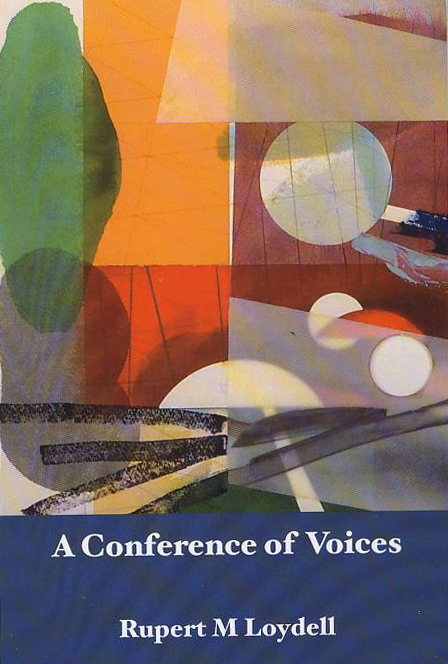
Shearsman Books, 2004
Link to Loydell’s online magazine:
Stride Magazine
Camille Martin
http://www.camillemartin.ca
Posted in poetry
Tagged A Conference of Voices, Camille Martin, poetry, Rupert Loydell, Shearsman Books
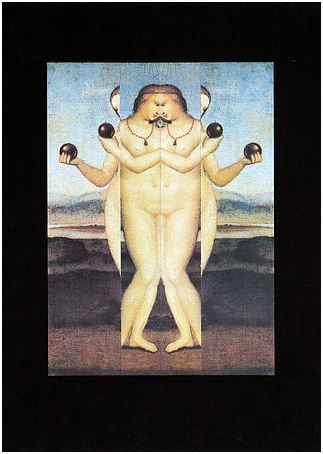

I have admired these since I was first exposed to the work of Kolář at an exhibition at the Albright-Knox Gallery in Buffalo. He uses as source material Raphael’s painting of the Three Graces holding the apples of the Hesperides, which are supposed to grant immortality.
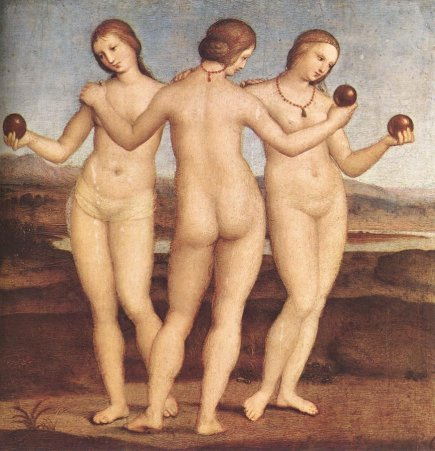
The depiction of the three Graces of ancient mythology traditionally shows two facing the viewer and the third in front of them, with her back to the viewer. Kolář seems to be playing with that traditional positioning, manipulating the bodies of the Graces using symmetry and mirror imaging so that the three seem to be merging into two in the first collage, and into one in the second collage.
Around the same time that I was studying these collages, I began thinking of Southern photographers, like Clarence Laughlin, Bellocq, and Emmet Gowin. A search for images by Gowin led quickly to a photograph very familiar to me, Nancy, Danville, Virginia, 1969, featuring a double-jointed girl who intertwines her arms in front of her and delicately holds an egg in each hand.

Here’s where the question of serendipity started to surface. I found correspondences between Kolář’s Three Graces panels and Gowin’s Nancy to be striking: both have an otherworldly, delicate quality, and both depict females with oddly manipulated or twisted arms, holding round objects in their hands. I couldn’t help but wonder whether the association was entirely serendipitous or whether my mind had been leading me to Gowin’s photograph by a process of nonconscious association.
It’s possible that the association was fortuitous, but I don’t think that the idea of an associative process unbeknownst to consciousness is too far-fetched to be plausible. I can demonstrate stranger and more involved associative pathways in which my nonconscious mind seems to be feeding me hints, like a criminal toying with a detective, until the detective experiences the eureka moment and the elusive felon once again slips away.
But how can we really know whether a particular association, like my pairing of Three Graces with Nancy, occurred by chance? Neuroscientist Michael Gazzaniga notes that the brain is like an iceberg: upwards of 90% of cognitive functions are not available to conscious awareness. This unavailability of much cognition to consciousness can make it seem as though there were another thinking entity (or perhaps multiple entities) within us, one that knows far more than our imaginary little conscious homunculus knows, and knows it before the homunculus gets clued in. Here’s an outdated depiction of how the mind works, with all processes coming together in a central location to be understood by a central processor (shown here as the homunculus):
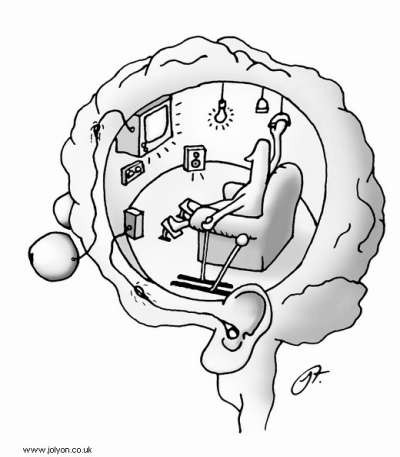
Of course, there isn’t anything like a little person inside our heads, or anything like a control centre in the brain, a central processing unit where perception and thought come together and the will of the cognitive CEO gets executed. This dualistic fallacy is known as the endless regression of homunculi:
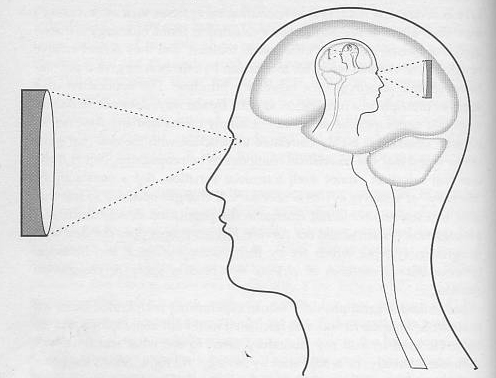
"The endless regression of homunculi. The idea of instruction or information processing requires someone, or something, to read it. But a similar entity is then required to read the resulting messages, and so on, endlessly." Gerald M. Edelman, Bright Air, Brilliant Fire: On the Matter of the Mind, p. 80
After we have traced back our mental associations, the realization that something had been brewing in the deeps all along and that, as Antonio Damasio claims, “we are always hopelessly late for consciousness,” is unsettling. But I wouldn’t trade the dialogue with my teasing “felon” for a homunculus, or for serendipity, for that matter. In Kolář’s two collages, merging and symmetry have the effect, not of producing unity, but of accentuating disintegration. In the first collage, disembodied limbs and faces emerge out of nowhere, and in the second collage, the seemingly unified body is in reality disconnected from her head and feet.
Similarly, we can never merge our cognitive Graces or know them completely. That proposition once again buys into the idea of the mind as having a converging point of information, whereas scientists have discounted hierarchical and linear systems in favour of a multiplex system of connections that are “parallel, recursive, feedforward, and feedback” (Richard Cytowic, The Man Who Tasted Shapes, 156).
The idiom “my mind is playing tricks on me” aptly expresses the idea of a divided mind. Kolář’ plays tricks on our eyes with the mirrored image of the Graces merging towards a centre that can never unify them but only further discombobulate them.
I haven’t found a third panel in Kolář”s Three Graces series, but one can imagine that further unification of the image along the mirror’s edge would cause the Graces to vanish into thin air.
Unity is dysfunction, disappearance, stasis. A monotheistic brain cannot create a world.
Discombobulation is function, fertility.
And however mysterious and unavailable to consciousness are the tricks the Graces play on themselves, these tricks enable the mental associations from which we create our worlds. Like the girl holding the eggs in her twisted arms, they affirm creation and bring new realms into being.
Camille Martin
http://www.camillemartin.ca
Posted in cognitive science, collage, painting
Tagged Albright-Knox Gallery, Antonio Damasio, Bellocq, Camille Martin, Clarence Laughlin, cognitive science, Emmet Gowin, endless regression of homunculi, Gerald Edelman, homunculus, Jiri Kolar, mental associations, Michael Gazzaniga, Nancy Danville Virginia 1969, Raphael, Richard Cytowic, Three Graces
And how’s that for burying the lead? Jensen’s poem hasn’t lost any of its appeal since I first read it about fifteen years ago.
“Bad Boats”
They are like women because they sway.
They are like men because they swagger.
They are like lions because they are king here.
They walk on the sea. The drifting
logs are good: they are taking their punishment.
But the bad boats are ready to be bad,
to overturn in water, to demolish the swagger
and the sway. They are bad boats
because they cannot wind their own rope
or guide themselves neatly close to the wharf.
In their egomania they are glad
for the burden of the storm the men are shirking
when they go for their coffee and yawn.
They are bad boats and they hate their anchors.
Laura Jensen, Bad Boats
The Ecco Press, 1977
Visit Laura Jensen’s blog:
http://spicedrawermouse.blogspot.com/


Camille Martin
http://www.camillemartin.ca
Posted in cognitive science, poetry
Tagged Bad Boats, Camille Martin, Clarence Laughlin, cognitive science, Laura Jensen, poetry
Rainbow Market Square Gallery (Toronto)
Sublime Scraps: The Collage Prints of Camille Martin
Ten of my collage prints will be exhibited.
80 Front Street East between Church and Jarvis
April 1 – April 30, 2010
Publication of Sonnets by Shearsman Books
Late 2009 or early 2010. Stay tuned for book launch information and tour dates. Sonnets will be distributed in Canada, the UK, and the US.
Shearsman Books Reading Series
UK Sonnets launch: early May 2010 (Click here)
Swedenborg Hall, Swedenborg House
20/21 Bloomsbury Way, London, England
Camille Martin
http://www.camillemartin.ca

Camille Martin
http://www.camillemartin.ca
http://www.eratiopostmodernpoetry.com/issue12_Martin.html
And speaking of sonnets in e.ratio, check out Nathan Thompson’s three:
http://www.eratiopostmodernpoetry.com/issue12_Thompson.html
It’s nice that Gregory Vincent St. Thomasino published the two sets of sonnets side-by-side, as I think there is an affinity between them, the reflexive slant in some of them, for one thing. Nathan tells me that his set of sonnets will be coming out as a chapbook with Skald (Zoe Skalding’s small press). I look forward to seeing this work, and not only because I’m on a sonnets jag.
Camille Martin
http://www.camillemartin.ca
Posted in poetry
Tagged Camille Martin, e.ratio, Gregory Vincent St. Thomasino, nathan thompson, poetry, Skald, sonnet, Zoe Skalding
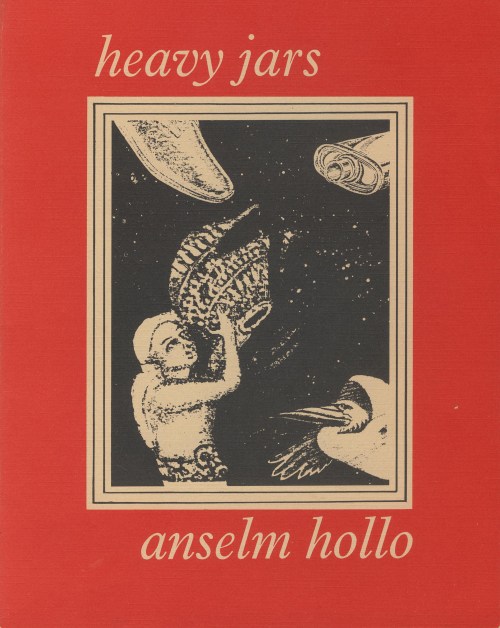
This little gem by Anselm Hollo is one of the most beautiful books, physically, in my collection. It’s a slim but perfect-bound book of 26 poems, of which only one spills onto a second page. The now-defunct Toothpaste Press used letterpress on fine paper and headed each poem with an ornate gold number.
The book’s title is one of those perfect puns, like bpNichol’s “Catching Frogs”: “jar din.”
In the poems of Heavy Jars, quiet, ordinary, even intimate moments are writ large, extrapolated into the universal human condition. Hollo’s subtle lyrics follow the cognitive path from moment to moment and often bubble with his signature twinkling humour. There’s a largeness of heart in these poems, which are also unabashedly musical, as in the first eight lines of “awkward spring”:
awkward spring
has spilled its
golden ink
all over the angels’ bibs
& off
the swan’s soft chest
white feathers fall
into the swamp
The short “i” sounds in the first stanza offer a delicate and ping-y quality, and the soft s’s, f’s, and “o” sounds give a contrasting luxuriant effect – both of which sounds suit the season.
Hollo also has an amazing ear for rhythm, as the above stanzas demonstrate as well as the lines “as the water goes / go / go / as the water goes.”
Heavy Jars contains two of my all-time favourite poems bar none: “awkward spring” and “big dog.” I’m also fond of the book because it contains this poignant inscription from Anselm: “Hard to say whether the jars’ve gotten lighter.” I like to think that he’s the first person ever to write “jars’ve.”
Camille Martin
http://www.camillemartin.ca
Posted in poetry
Tagged Anselm Hollo, bpNichol, Camille Martin, Heavy Jars, letterpress, musicality, poetry, Toothpaste Press
Posted in photography, poetry
Tagged Camille Martin, Lafayette Louisiana, New Orleans, photography, poetry, Rae Armantrout

Wires dip obligingly
between poles,
slightly askew
Any statement I issue,
if particular enough,
will prove
I was here.
There is something here that reminds me of Anselm Hollo, that quality of self-awareness, reflexivity, immediacy, the poem enacting its own claim, the poet conjuring her own DNA sequence in the particularity of the translation of perception into language. I remember years ago hearing Rae read in New York. I had only read her poetry on the page and didn’t really connect with it. But hearing her read was a revelation. The only way that I can describe it is that it sounded like waves of punchlines washing ashore, splashing over me. I felt exhilarated to connect with her work so suddenly and viscerally.
Camille Martin
http://www.camillemartin.ca
Posted in digital art, poetry
Tagged Camille Martin, digital art, Peter Ciccariello, poetry, poetry reading, Rae Armantrout, Uncommon Vision, Versed
The third question of the false start: for poets who also practice some other kind of art, what is the relationship between the poetry and the other discipline? In the case of my poetry and collage, are the two in dialogue? I pondered this issue as I struggled to write a meaningful statement about my collages in preparation to contact galleries about a possible exhibition. I thought it relevant to mention my work as a poet, and found myself also making connections about my readings in cognitive science. Here is what I came up with:
* * * * * * *
Artist’s Statement: Camille Martin
I am both a collage artist and a poet. The two media are not mutually exclusive; they inform one another. My approaches to language and images are closely related: I gather materials (in the case of poetry, words or phrases; in the case of collages, backgrounds and cut-out images) and try different combinations until something larger than the juxtaposed elements emerges. After creating the collages, I digitally scan them and create enlarged archival prints on fine art paper mounted on white dibond.
The startling juxtaposition of images is key to my work. Lautreamont, a nineteenth-century writer, described beauty as “the chance encounter of a sewing machine and an umbrella on a dissection table.” That statement, which became a sort of anthem for surrealists, speaks to me of the mysterious charm that ensues from the dialogue among the images that I marry with scissors and glue. The images might start telling a narrative, or their meaning might remain mysterious and absurd.
One thing that we humans do best is to fill in the gaps of seemingly illogical juxtapositions: to “confabulate,” to tell stories in order to explain. Confronted with oddness, the mind rushes to fill the aporia between the unlike images, like water rushing to fill a depression in the earth: a snake levitates in the air, lifting with it a marble staircase; a mountain breaks apart to reveal to a climbing statue a secret city with buildings adorned with feathers; a broken puppet falls from the sky like Icarus; a naked mole rat watches enviously as two mating turtles fly across the night sky. The gaps that we fill with narratives are openings for the creation of our very selves, which is unending.
It is equally possible, confronted with the illogical, to allow the strange gaps to remain a mystery and to experience what the poet John Keats called “negative capability”: the capacity to allow the presence of uncertainties without trying to rationalize them, to allow “mysteries, doubts, without any irritable reaching after fact & reason.” The snake carries the staircase: that reality can exist in its own world, resistant to the attempt of any brain to reason with the oddness of it.
It’s important for me as an artist to allow both possibilities: interpretation and mystery; narrative and an irrationality that resists narrative. The interplay of these two possibilities constitutes for me the richness and playfulness of my work. There is magic and meaning—and poetry—in both states.
* * * * * * *
I recently sent a portfolio to the Women’s Art Resources Centre in Toronto in order to get a critique from a knowledgable artist and curator. I am still basking in her assessment, which was very positive in regards to the art (she writes that she is “impressed with the quality of the execution and the composition of the collage work” – woo-hoo!). Her main suggestion had to do with my artist’s statement: to situate my collages in a more contemporary context in order to place my work in the stream of a more recent tradition. Excellent advice.
Sage advice also from Snoopy, who responded to sourpuss Lucy’s refusal to dance the day away: “Four hundred years from now, who’ll know the difference?” That’s as good a response to Eliot’s weary despair as I’ve ever heard.
. . . . . .
I record here my website address, in what is probably a useless attempt to get Google to index it:
Camille Martin
 Rogue Embryo



 Rogue Embryo