Kiln, Mississippi

Photo: Camille Martin

Photo: Camille Martin

from Richter 858

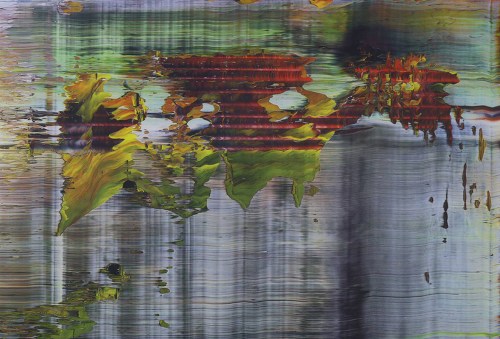
Gerhard Richter: Detail, 858-4

Gerhard Richter: Detail, 858-4


Michael Palmer, from Richter 858, “Passages”


Scale


The

The red vowels, how they spill
then spell a sea of red

And the bright ships—
are they not ghost ships

And the bridge’s threads
against flame-scarred hills

And us outside
by other worlds


So

So the promise of happiness?
he asked a frog

then swallowed the frog
And the buzz of memory?

he asked the page
before lighting the page

And by night the sliding stars
beyond the night itself


A

A table erased
It is not realism makes possible the feast

Grey face turned away
Jam jar of forget-me-nots

Girl with gold chain
cinching her waist

But is it true
And what will become of us


As

As if the small voices—
one-erum two-erum

pompalorum jig
wire briar broken lock

then into and into
the old crow’s nest—

and so when young,
before all the rest


Crease

Crease in the snowy field
of evening within us

How the owl stares
and startles there

fashioning mindless elegy
So the remembered world’s

songs and flooded paths
This heap of photographs


This

This perfect half-moon
of lies in the capital

Crooks and fools in power what’s new
and our search has begun for signs of spring

Maybe those two bluebirds
flashing past the hawthorn yesterday

Against that, the jangle of a spoon in a cup
and a child this day swept out to sea


But

But the birth and death of stars?
The birds without wings,

wings without bodies?
The twin suns above the harbor?

The accelerating particles?
The pools of spilled ink?

Pages turning themselves
in The Paper House?


Soon

Soon the present will arrive
at the end of its long voyage

from the Future-Past to Now
weary of the endless nights in cheap motels

in distant nebulae
Will the usual host

of politicians and celebrities
show up for the occasion

or will they huddle out of sight
in confusion and fear


Camille Martin
http://www.camillemartin.ca

The Place of Place: Besmilr Brigham’s Run Through Rock

(See my previous post for Brigham’s complete poem.)

The Place of Place: Besmilr Brigham’s Run Through Rock*

                       In order to imagine a place
                       must we inhabit it?
                       and by inhabiting, raze the imagination
                       that made it?

                                              Catherine Kasper (1)

          Place, according to geographer Miles Richardson, is “both grounded in the physical world and . . . lodged in the world of symbolic discourse,” “something fixed and fleeting, something you can walk on and something you can speak.” (2) These two conceptualizations of place intertwine in “Run Through Rock, Why It Quivers” by Besmilr Brigham: an unresolved dialogue is set in motion between place as lived perceptual experience and place as a human and social construct. Recent theories of place by humanistic geographers and cultural anthropologists provide a helpful framework for understanding how some Southern poets such as Brigham depart from traditional representations of place.
          During the past twenty to twenty-five years, humanistic geographers and cultural anthropologists have been re-visiting theories of place in order to reveal unchallenged assumptions about the relationship between place and human culture. The concept of place seems to allow only the slipperiest of holds. The more you try to pin it down, the more elusive it becomes. Place presents itself to us as simultaneously solid and symbolic, and any attempt to separate the two becomes hopelessly entangled in paradox. Key to understanding what is at stake in place theory is a theme articulated in James Clifford’s questions: “What does it mean, at the end of the twentieth century, to speak . . . of a ‘native land’? What processes rather than essences are involved in present experiences of cultural identity?” (3) Re-thinking place as a site of discontinuity with the cultures that inhabit it and with other places exposes the essentializing nature of that construction.
          Akhil Gupta and James Ferguson offer a critique of discontinuity in a theorizing of the “contact, conflict, and contradiction between cultures and societies,” in which “space itself becomes a kind of neutral grid on which cultural difference, historical memory, and societal organization are inscribed.” (4) The tendency to construct places as relatively autonomous and culturally homogeneous can conceal power structures that affect social transformation. Citing examples of borderline cases such as “immigrants, exiles, expatriates . . . and the hybrid cultures of postcoloniality,” (5) Gupta and Ferguson contend that places must instead be considered as both internally diverse and externally interdependent with other places. Arjun Appadurai draws an analogy between the tendency to nativize, exoticize, and totalize the other, and physical incarceration. (6) This tendency poses that cultures are wholes and that “the intellectual operations of natives are somehow tied to their niches, to their situations. They are seen, in Lévi-Strauss’s evocative terms, as scientists of the concrete,” a concrete that can be inscribed “as the poetry of confinement.” (7) Appadurai points out that “natives, people confined to and by the places to which they belong, groups unsullied by contact with a larger world, have probably never existed.” (8)
          A related question is that of representation and of multiplicity in addressing place and voice. As Appadurai observes, “[t]he problem of voice (‘speaking for’ and ‘speaking to’) intersects with the problem of place (speaking ‘from’ and speaking ‘of’).” (9) And according to Margaret Rodman, “[A]ttention to multilocality as well as multivocality can empower place conceptually and encourage understanding of the complex social construction of spatial meaning. . . . Places are not inert containers. They are politicized, culturally relative, historically specific, local and multiple constructions.” (10) Considerations of internal and external multiplicity and interdependence militate against totalized constructions of place and human culture, and against essentialized constructions of “observer” and “observed,” or of “we” and “they.” As Rodman points out, in an interdependent world, “there really are no ‘others.’” (11)
          The larger philosophical issue is the dichotomy that arises continually in anthropological and geographical discussions of place theory. Richardson posits place as “a curious and uneasy product of experience and symbol.” (12) Others have restated this dichotomy in different terms. Yi-Fu Tuan explores the dialectic between the human desire for feeling “in place,” rooted and stable, and the desire to transcend place when that rootedness is infused with feelings of “bondage and powerlessness.” (13) And J. Nicholas Entrikin points out “the underlying polarity between the subjective,” (14) “a centered view in which we are a part of place and period,” and “the objective,” “a decentered view in which we seek to transcend the here and now.” (15) According to Entrikin, theories of place need to recognize the “tension between a decentered universalism and a centered particularism.” (16) Both views are needed, for “[t]he theoretical reduction of place to location in space [cannot] effectively capture . . . the sense of place as a component of human identity, and the opposing reduction tends to treat place solely as a subjective phenomenon.” (17) Both reductions can lead to an essentialized outlook regarding the relationship between human culture and place.
          If both views are to be retained, it is equally important that the ensuing paradoxes should remain, without the need to resolve them into a stabilized balancing act or compromise, or, as Richardson puts it, to achieve a “muddled middle ground” (18) between them. Instead, he suggests an approach to the dichotomy between the particular and the general, and between the subjective and the objective, that “keep[s] phenomena whole.’” (19) By this, Richardson is not suggesting a philosophy of totalism, but rather an approach that does not reduce the problem to one side or another, or that insists upon a reduction of tension between the two. Instead, he suggests that we keep alive the paradoxical nature of the dichotomy by engaging in a continually circulating and unresolved dialogue between its terms. For example, he states that it is important to “ask how . . . we experience place and how . . . we simultaneously transform that experience into symbols, symbols that then communicate the experiential meaning of the place and, in so doing, bring [place] into being.” (20) Thus, experience and mind are involved in a continual process of mutual creation. For Tuan, paradox is inherent in the act of cognition: “Thinking involves the thinker in paradoxes. . . . [It] both connects and disconnects. It makes the near seem distant and the distant near. . . . [It] binds us to the world with the threads of precise and detailed knowledge . . . . And yet this knowledge, because of its remoteness from direct experience, makes the world seem abstract and distant.” (21)
          Richardson hints at the possibility of an underlying identity of the opposed terms of subject and object, perceiver and perceived, experience and symbol, when he suggests a relationship of interdependence between the transformation of place experience into symbols and the creation of place through the communication of “the experiential meaning of the place.” (22) Mind both communicates with and constructs place. Might we not also consider cognition a place as well, sharing with the concrete world its materiality and participating with that world in a mutually constructing process?
          In the poetry of Besmilr Brigham, place is vitally important, but not in the sense of describing a place so precisely that, as Helen Vendler puts it, readers will be “rewarded for our imaginative participation [in the poem] by a sudden moment of recognition, as some detail strikes us as pertaining directly to ourselves: ‘Heavens, I recognize the place, I know it!’” (23) According to Vendler, the reader’s eureka moment prompted by the descriptive translation of place “is the effect every poet hopes for.” (24) This hoped-for realism may be true of the poets that Vender admires. However, Brigham’s work is more likely to elicit questions about the nature of place, rather than less complexly to invite recognition and its emotional accoutrements through a set of symbolic markers.
          Brigham lived for many years in the small town of Horatio, Arkansas. Of Chocktaw heritage, she considered herself to be a Mississippi poet. Brigham is not simply a nature poet who extols and lovingly describes the natural world. She is a deeply philosophical poet who activates a dialogue between cognitively constructed reality and shared physical existence, and who blurs boundaries between putatively opposed realms.
          Her poem “The Run Through Rock, Why It Quivers” (25) describes a place, yet Brigham does not constitute her experience of that place as continuous and linear. Instead, she represents place as occurring in and with consciousness, as well as experienced in the here and now. To be sure, the poem contains place markers such as “wet leaves,” a “run through rock,” “piercing stalks,” “birds flying in through dark,” a fallen grackle, “downpours of growing water,” a moon going through its phases, a field and wind, the sun charting its course through the sky, and a long “perpetual summer.” Amid this catalogue of natural objects and processes are a body, mind, and brain, which also participate in natural processes: the body “di[es] bare,” the mind forgets, and the brain hardens.
          Yet the poem does more than simply bring human existence into the fold of a mutable and mortal natural order. It also posits a radical permeability, indeed, an identity, between human and nature—between the warm brain and the snow, between the dying body and the dying bird, and between the forgetful mind and the “repetitious tree.” The title as well enacts this reciprocal relationship between human and nature in the word “run,” which means “creek” but also puns on the more common meaning of “run” as human motion. And “running through rock” invites the image of a person merging with rock. Brigham also implies an intertwining relationship between subject and object that does not resolve into a hierarchy of an active subject perceiving and thinking about a passive object. The last few lines demonstrate this reciprocal relationship:

                    a stone
                    that falls
                    lying from light, where
                    light draws up
                    no color, no fire fiercer than

                    the brain (a warmth in snow

A stone falls from light, and light draws up a brain that is fiercer than color and fire, and that is like “a warmth in snow.” The brain exists in reciprocal relation to stone, light, color, fire, and snow. Moreover, the fierce brain, which constructs its world, is in this case not the active cogitator, but instead something that is drawn up by the light. The brain, instead of taking in an illuminated world as fodder for cognition, is itself lifted up by the light. And if we understand the phrase “draws up” also in the sense of rendering a picture of something, perhaps the light also creates a representation of the brain, a reversal of the normal order of active perceiver and passive object. Thus subject and object are engaged in mutual and reciprocal creation, and Brigham implies an underlying identity between the two.
          The representation of place that emerges in Brigham’s poem is indeed a “wild range” in which the brain “run[s] loose,” as opposed to a static and passively represented place, an exterior locality that pertains to the self, as Vendler has it. Tuan’s words come to mind in our consideration of Brigham, the native. Brigham’s poem suggests a “deeply rooted” native self living in the eternal now of a “perpetual summer,” despite, or perhaps more accurately, because of, the radical impermanence in the hardening, forgetting, and dying around and within that self.
          Brigham shows the self to be both in place and out of place, constructing place from the distance of mentation yet also inextricably implicated in a material place. The self in “Run Through Rock” is far from being the kind of incarcerated and immobilized native that Appadurai calls “creatures of the anthropological imagination.” (26) Instead, she embraces the internal diversity within places, assumes the continuity of place rather than the reality of constructed boundaries, recognizes otherness as ultimately illusory, and enacts a continually circulating and reciprocal dialogue between a constructing self and an encroaching place. In short, she acknowledges the “fixed and fleeting” nature of place.

Works Cited

(1) Katherine Kasper, Blueprints of the City (Denver: Transparent Tiger Press, 2000), 20.

(2) Miles Richardson, “Introduction,” in Place: Experience and Symbol, Geoscience and Man, ed. Miles Richardson, vol. 24 (Baton Rouge: Geoscience Publications, Department of Geography and Anthropology, Louisiana State University, 1984), 1.

(3) James Clifford, The Predicament of Culture: Twentieth-century Ethnography, Literature, and Art (Cambridge, Mass. : Harvard University Press, 1988), 275.

(4) Akhil Gupta and James Ferguson, “Beyond ‘Culture’: Space, Identity, and the Politics of Difference,” Cultural Anthropology 7, no. 1 (February 1992): 6-7.

(5) Ibid., 7.

(6) Arjun Appadurai, “Putting Hierarchy in Its Place,” Cultural Anthropology 3, no. 1 (February 1988): 38-39, 41.

(7) Ibid., 38.

(8) Ibid., 39.

(9) Arjun Appadurai, “Introduction: Place and Voice in Anthropological Theory,” Cultural Anthropology 3, vol. 1 (February 1988): 17.

(10) Margaret C. Rodman, “Empowering Place: Multilocality and Multivocality,” American Anthropologist 94, vol. 3 (September 1992): 640-1.

(11) Ibid., 646.

(12) Richardson, “Introduction,” 1.

(13) Yi-Fu Tuan, “In Place, Out of Place,” in Place: Experience and Symbol, Geoscience and Man, ed. Miles Richardson, vol. 24 (Baton Rouge: Geoscience Publications, Department of Geography and Anthropology, Louisiana State University, 1984), 3.

(14) J. Nicholas Entrikin, The Betweenness of Place: Towards a Geography of Modernity (Baltimore: The Johns Hopkins University Press, 1991), 7.

(15) Ibid., 1.

(16) Ibid., 2.

(17) Ibid., 24, 25.

(18) Richardson, “Introduction,” 1.

(19) Ibid.

(20) Ibid.

(21) Tuan, “In Place, Out of Place,” 9.

(22) Richardson, “Introduction,” 1.

(23) Helen Vendler, “Contemporary American Poetry” in The Harvard Book of Contemporary Poetry, ed. Helen Vendler (Cambridge, Mass.: The Belknap Press of Harvard University Press, 1985), 17.

(24) Ibid.

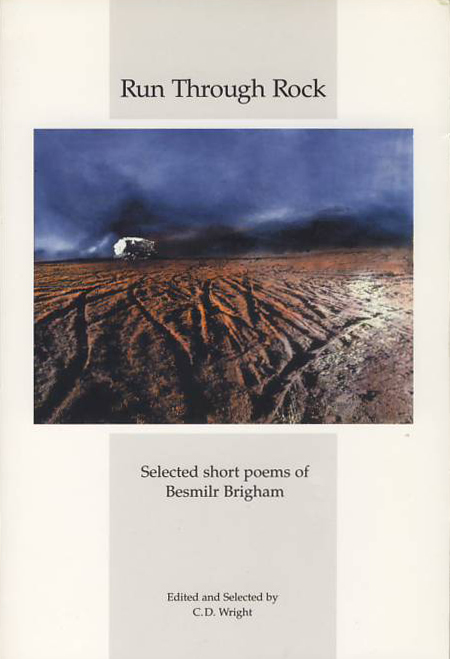
(25) Run Through Rock: Selected Short Poems of Besmilr Brigham, ed. C. D. Wright (Barrington, R. I.: Lost Roads Publishers, 2000) 109-10.

(26) Arjun Appadurai, “Putting Hierarchy in Its Place,” 39.


Camille Martin

Run Through Rock: Besmilr Brigham

Besmilr Brigham

The Run Through Rock, Why It Quivers

                                    light
                       composite that makes a fiercer
                       (light
force
to live all one breath before air,
shaped to cry out
over wet leaves, for piercing stalk:
washed in
downpours of growing water
fragile as fire
 
rooted in places where birds
        fly in through dark
        flaying black wings above all sound their
        individual chatter:
        a changed moon, perpetual summer
 
who finds a grackle fallen—?
or leaf, in pushing rush
pouring down from a brevity of field
out from wind;
a rampage of piercing reds
    made dark with undertones
 
the hardening brain
(still wild range)
running loose in separate known
regulation, difference tight as
the sun’s course
                                    longer more certain;
the mind forgets

under that repetitious tree that throws up
limbs of flowing stalks, the fragile
abundance
that the body is like a bird, dying
bare
    a stone
that falls
lying from light, where
light draws up
no color, no fire fiercer than
 
the brain (a warmth in snow


Camille Martin
http://www.camillemartin.ca

All That Glitters on the Spiderweb: Myth, Race, and Denial

          After living for ten years in upstate New York, where I had never quite felt at home, I decided to return to my hometown of Lafayette, Louisiana, where flowers grew year round, people spoke in the soft, lilting accents of Cajun French, and I could eat crawfish étouffée to my heart’s content. No doubt there was a hefty dollop of romanticized nostalgia in my decision. In any case, I packed up my belongings and drove a big U-Haul south. Three days later, the humidity felt just about the right thickness, and I knew I was home. I took an apartment in Bayou Shadows, a sterile complex probably named by a focus group, and got a job as a secretary in a company that provided tools and labour for offshore oil rigs.
          Over the next few months, I reacquainted myself with the local culture, attending celebrations like the Frog Festival in Rayne, the Cajun Music Festival in Mamou, and of course, Mardi Gras. I also visited Vermilionville, a recreated Cajun village on the banks of Bayou Vermilion showing life in Acadiana from settlement (1760s) to the late nineteenth century. It was recommended to me by my cousin, whose partner had a job demonstrating for the tourists the making of bousillage, a mixture of bayou mud and dried moss that the Cajuns used to plaster their walls. I felt a little sad to see the period costumes, Cajun-style homes and furniture, and farm tools, all authentically recreated and frozen in time.
          When I was growing up, there were still some survivals of this old way, such as the “gar’ soleil” a practical bonnet that my grandmother wore to shade her face from the harsh sub-tropical sun, and the old plow pulled by mules that my grandfather was still using for his cornfields when I was a child. That way of life was gone, though you could still buy Cajun bonnets as a souvenir in the gift shop at Vermilionville. Seeing artifacts from the my culture ossified in a museum, I felt as though a part of my past were now being recaptured, tested for authenticity, and put on display. It was a lesson in impermanence that I was reluctant to learn.
          While I was away in upstate New York, my father had immersed himself in genealogy. He and my mother collected hundreds of photographs and paintings of ancestors, and filled boxes upon boxes of documents photocopied from court records: marriage certificates, wills, contracts. They also collected and framed farm implements such as old cattle brands, correctly assigned to their owners. My father was becoming a kind of living Cajun icon, obsessively collecting the paper trail of his ancestors as a way of holding on to a culture that was swiftly dissipating as assimilation into the “mainstream” took its toll.
          But nostalgia takes its toll on history, and the longing for a lost arcadian past tends to flatten the complex layers of history. What remains is an idealized mythology that takes the form of whatever fantasy nostalgia has invented. Perhaps it’s a vision of happy-go-lucky Cajuns whose unadulterated culture thrived in relative isolation from “les Américains.” Or perhaps it’s a fantasy of the good old antebellum days of oligarchy in the Deep South: wealthy plantations, elegant ballroom manners modeled after European nobility, and ultra-cheap labour. Whatever the fantasy, nostalgia creates a vision of life that used to be simple and pure, uncomplicated by the complexities of cultural hybridity and the inhumanity of slavery. This was another lesson that I was reluctant to learn. After all, I was in search of Cajun authenticity, and I was on the verge of buying into this vision of a lost culture innocent of divisions and contradictions; it was the misty, sunlit, and idealized vision of a lost childhood. Growing up during Jim Crow and witnessing the turmoil of the Civil Rights movement and the first attempts to integrate a society of institutionalized racism left an indelible mark on my psyche. But returning to Cajun country full of wistfulness, on some level I still clung to the belief, despite evidence to the contrary, that racism was not imprinted onto the Cajun social fabric.
          After my move home, I would sometimes drive in the countryside around Lafayette, with no particular destination in mind. I was looking for “authentic” Cajun life in the small towns where life wasn’t self-consciously re-enacted for the benefit of tourists, where life had not become a series of footnotes and framed antique tools. On one of those drives I found myself in St. Martinville, a town where many of the Acadians had first settled after arriving in Louisiana from Acadie, now Nova Scotia, in the 1760s.
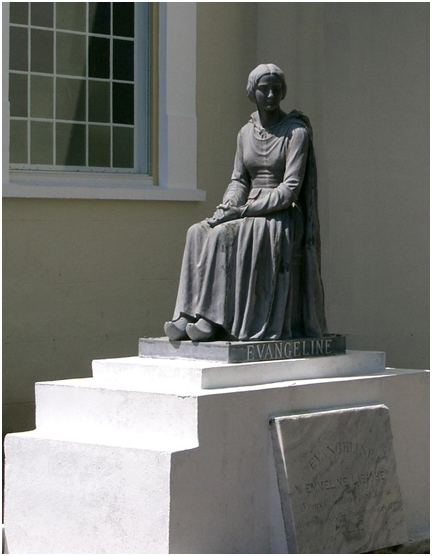
          I had been to St. Martinville several times as a child to visit the St. Martin de Tours Catholic Church. To me, it was the quintessential Cajun shrine: an historic eighteenth-century church built by the early Acadian settlers. Next to the church was a statue of a virgin—not Mary, but Evangeline, symbol of the Acadian diaspora.

Evangeline Statue

          Evangeline was a character invented by Henry Wadsworth Longfellow in his long tragic poem based on the French Acadian expulsion by the British from Nova Scotia in 1755. Families were often split up as they were forced to hurriedly board ships during “Le Grand Dérangement,” and in Longfellow’s poem, during the loading of the Acadians onto the ships, Evangeline becomes separated from her betrothed, Gabriel. According to one version of the legend, on arriving in Louisiana years later, Evangeline discovers that Gabriel has already married another. After becoming mentally unhinged due to the shock, she dies of a broken heart and is buried under an ancient live oak tree in St. Martinville.
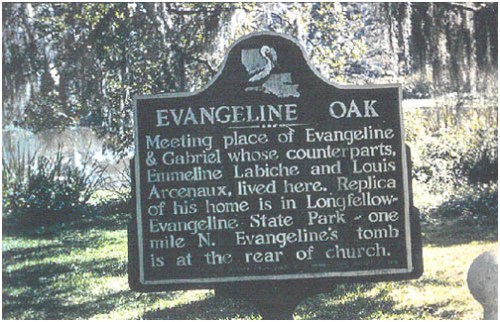
          Even though she is an entirely fictional character, the tourism industry perpetuates the myth that she was based a real person (Emmeline Labiche, another fabricated character) and is actually buried under a live oak near St. Martin de Tours Church.

Evangeline Oak

Layers of truth and myth are easily confounded where there is the desire to believe. Of course, there must have been many Evangelines and Gabriels, lovers separated during the expulsion of the Acadians, but none buried under the old oak tree at St. Martin de Tours.
          I sat near the statue of Evangeline, which used to represent to me a fixture of the Cajun imaginary, an icon of the Cajun diaspora. The plaque at the base, translated into English, reads as follows:

* * * * *
Evangeline
Emmeline Labiche
Old Cemetery of St. Martin
In Memory of the Acadians Exiled in 1755
Statue of Evangeline, heroine of the Acadian deportation to Saint Martinsville in Louisiana.
* * * * *

Although there was no mention of a model, I remembered that the statue was in fact a replica of Delores Del Rio, the Mexican-American actress who played the lead role of Evangeline in the 1929 film.

Delores Del Rio

Even Hollywood kitsch merges into the legend and takes on an aura of authenticity. Before the statue knelt two elderly Cajun women solemnly praying before the image of the tragic peasant maiden.
          I walked inside the church, which contained the usual sentimentalized Catholic iconography as well as a simulation of piled-up stones surrounding a statue of Mary, a representation of the Grotto of Lourdes. The stones seemed more simulated than I had remembered as a child, but other than that, the church and grounds were pretty much the way I had known them. It was the kind of place I mentally file as a shrine that is still rooted in a living culture but that, once tourism grew into a serious commodity, became embellished with colourful folklore, complete with sacred landmarks and an empty grave. It seems that the more that fictional accoutrements spring up around a myth, the more credible the tale becomes. Even the locals wanted to believe.
          Next to the church was a little museum. I entered the first floor gift shop and chatted with an affable middle-aged woman behind the counter about the interior of the church. She informed me that “It was a octoroon built the Grotto of Lourdes in the west nave. And do you know, he had never been to Lourdes before?”
          Octoroon? It was bizarre to hear that antiquated word. Here we were, a good thirty plus years from the official end of Jim Crow, and this woman was still using, in all earnestness and without historical context, the long-outdated and legalistic term—common in the nineteenth century—for a person who was one-eight African-American. I felt transported to a different era. Or maybe a Flannery O’Connor story about the absurd underbelly of life in the rural Deep South.
          She then pointed me in the direction of the museum exhibit upstairs, which she said I could see for one dollar. She seemed mysterious about the nature of the exhibit, only saying that “It’ll all explain it when you see it.”
          Expecting an historical display about the church or the Cajun settlement in St. Martinville or some nonsense about the grave of Evangeline, I soon realized that I was about to enter one of those surreal zones—“geo-psychic wonders,” as a friend calls them—that you sometimes come across in South Louisiana. Like the little roadside chapel that I found on one of my countryside excursions, with stained glass windows depicting Houma Indians. Or the Saturn Bar in New Orleans, featuring a painting of the ringed planet on the ceiling along with a dangling mummy and a giant taxidermic turtle—for starters.
          I climbed up the stairs to the museum on the second floor. The first clue was jagged strips of green camouflage cloth festooning the beam at the entrance. The mottled green fabric was crudely decorated with glitter in the shape of spider webs. As I crossed the threshold and walked into a single large room, something told me that this was not going to be a display created by the St. Martinville Historic Society. The entire room was bedizened with lurid, sparkling spiderwebs. Around the perimeter stood department store mannequins in stiff poses, dressed in gaudy eighteenth-century-style satin costumes of purple, green, and gold, the traditional colours of Mardi Gras. Plastic spiders perched on sequinned webs adorned the gowns.
          A placard on the wall explained that these costumes were worn at a recent local Mardi Gras ball whose theme was an 1850 double wedding that took place on a nearby sugar plantation, the Oak and Pine Alley. According to this legend, apparently well-ensconced in the town’s lore, Charles Durand, the wealthy plantation owner and father of two young women engaged to be married, decided to throw the most lavish and memorable wedding anyone had ever seen. He imported spiders from China and set them loose among the live oak trees. On the day of the wedding, he had slaves spray gold and silver dust from bellows onto the spiderwebs, wet from dew, creating a glittering canopy for the ceremony.
          The mannequins’ Mardi Gras ball gowns, a tribute to this wedding steeped in fantasy, seemed a bizarre conflation of Spider Woman, bordello madame, and Bo Peep debutante. At the far end of the room, a mantelpiece decorated in red felt with candelabras at either side served as an altar, complete with a male mannequin dressed in the colourful robes and sashes of a priest, ready to ward off errant spiders with his magic sceptre. In the middle of the room sat a dollhouse model of the plantation house and its oak grove, a kind of fuzz strung between the trees to depict the spiderwebs.
          The unabashed campiness of the “museum exhibit” was hypnotic. Surrounding me were the symbolic fetishes of the legendary wedding—a cheesy fertility shrine in which images of spiders bring good fortune and Cajun rugrats to newlyweds. I lingered among the arachnophile mementos, imagining a future mutated version of the story: locals praying to spider spirits to grant favours, and dangling plastic spiders from their rear-view mirrors. Bridegrooms in Spiderman costumes at ritualistic weddings ravishing Miss Muffet brides. Evangeline would of course join the hagiography of the new syncretistic Catholicism. The sequel to her hallowed tale would tell of spiders interceding on her behalf to roll back the tragic diaspora and deliver her faithful lover Gabriel, whom she’d marry under the oak tree that now marks her tomb amidst showers of gold and silver glitter purchased from the local craft store.
          After my reverie had played itself out, I thought about the woman downstairs, remembering her “octoroon” comment, and suddenly the invisible subtext of the exhibit came into focus. Previous experience told me that this latter-day celebration of plantations in the Deep South, whose owners had amassed huge fortunes from the labour of slaves, was nothing unusual. The at-best unthinking extolling of this dream wedding wasn’t only the result of seeing Gone with the Wind too many times or visiting plantations in which the tour guides attempted to rationalize slavery, minimize the suffering of the slaves, and glorify the expensive mahogany furniture and chandeliers in the roped-off rooms of the mansion.
          Years earlier, I had toured the so-called San Francisco Plantation near New Orleans, open to the public for a fee. Women in large hooped skirts, evoking the stereotype of the Southern belle, served as tour guides. As the guide for my group showed us the kitchen, an outbuilding about a hundred feet from the mansion, she explained that a slave carried the prepared food from that structure along a stone path to the dining room. Especially when the slave was carrying a pie, she said, the master would require the slave to whistle so that he could be assured that the slave wasn’t eating the pie. I heard tittering among the all-white group of tourists. This was a geo-psychic wonder steeped in myth and mired in denial.
          The racist backdrop of commemorations of plantation life such as the spider-wedding fades into invisibility, much like bringing up the suffering of the blacks during the plantation tours was taboo: it would have spoiled the fantasy. I looked back at the display of mannequins and diorama and felt both attracted to its absurdity and repelled by its sanitized history. This was home alright.


Camille Martin
http://www.camillemartin.ca

We Are All Walloon Poets

walloon poetry

          In an age when the Goliaths of the world’s languages are edging out diminishing pockets of diversity, and languages are estimated to die at the rate of about two per month,* writers are increasingly faced with the dilemma of whether to write in their native tongue or to enjoy a broader audience. Nigerian writer Chinua Achebe (b. 1930) chose the latter, writing in English instead of Igbo. On the other hand, French writer Max Rouquette (1908 – 2005) decided to write in his mother tongue, Occitan, now considered to be almost moribund. I met Rouquette years ago in Montpellier; he was introduced to me as a living treasure in the Languedoc region, where he lived and wrote, against the odds, in his native language.
          Is anyone today writing and publishing poetry in Walloon, the traditional dialect of the French population in southern Belgium? Perhaps writing in relative isolation, but publishing? During the nineteenth century, Walloon’s viability was reasserted, and there was a critical mass of Walloon speakers to make it a vibrant, living language with at least three dialects. Guillaume Apollinaire even learned Walloon and wrote a few poems in it. But that time has passed. It is not spoken much these days, having been largely supplanted by standard French.
          Nonetheless, in 1979 an anthology of twentieth-century Walloon poetry was published. It is likely the last printed manifestation of poetry in Walloon, a relic of a nearly-extinct cultural expression.
          In a way, we are all Walloon poets writing in a language that is destined, sooner or later, to be learned only by scholars and translators. The language so familiar to us that we may assume it to be immortal, will die by attrition or absorption, or else it will evolve to the point that our words will be unintelligible to our descendents. Language is the original product with built-in obsolescence. Today’s Ashbery is tomorrow’s Chaucer.
          A poet once told me that poets should not use slang or name any TV shows because the next generation would need footnotes to understand the references. If there were an English equivalent to the Académie Francaise, I’d nominate her for one of its immortels.

* David Crystal, Language Death (Cambridge UP, 2000)

* * * * * *
          The poems below are reproduced from The Colour of the Weather, a translation into English by Yann Lovelock of the anthology of Walloon poetry. It was published by The Menard Press and may still be available at Small Press Distribution.


Gabrielle Bernard (1893 – 1863)

Cobwebs

Their skeins stretch
like white silk between the hedges
as October rusts the woods.

Mornings grow cooler,
frost whitens the pastures.

Gossamer down flume-sides
webbed by the dew with pearls . . .

The north wind whispers a winter warning.

Is it white mourning for the bright summer,
this gossamer everywhere,
spun from witches’ fingers over beck and dyke?

Roadside gossamer;
dreams of old days to come;
the farms have gathered in the harvest.

Slopes of gossamer . . .

Webs on the bushes,
white shivering weeds of the good season,
trembling on leaves already withered . . .

Gossamered temples . . .
what use is plenty in the barns
when heart and arms are empty?


Albert Maquet (1922 – 2009)

Sick man

The man who had eyes in place of his hands and nothing in place of his eyes lay bedridden till yesterday.

I brought him a cup of camomile and while I stirred the sugar with a silver spoon his hands watched my eyes while his eyes did nothing.

*

What time is left he passes
Watching it grow like a flower
His hand glued to the window,
His long thief’s hand.

The others, huddled by the fire,
Drowse and contract
As their frosting dreams
Freeze to the pane.

Make no noise to wake them,
Be still if you enter.
Hand, flower, and window
Are not what you think.

Stranger

Folk, all the acquaintances I’d had
Would make believe they were dead to cut me.
The others would watch me pass like the plague
From the shelter of their narrow windows.
Wherever I’d be, no-one there but myself.
Nothing hidden but at my approach.
Water, the ponds would rebuff my face
And my shadow itself leave no trace now.
It would be a day that never ended,
As if the darkness flinched back before it.
And so quiet you could hear a fly!
I’d search for a sign to say I existed;
Then feel so alone all at once
I wouldn’t know where to go any longer.
I’d stretch out there full length on the stones
And see the sun through my lids.
I should think of nothing. Let myself get well.
Would hear the sound of my blood pumping madly.
And before I needed to come to myself
I’d take my life up, unwrinkled, at will.


Camille Martin
http://www.camillemartin.ca

suppose flatness. what then? suppose even surface is made up. what then?

Photo: Camille Martin

Photo: Camille Martin


Camille Martin
http://www.camillemartin.ca

“I know I am traveling all the time”: The Twilight Dreams of Artur Lundquist


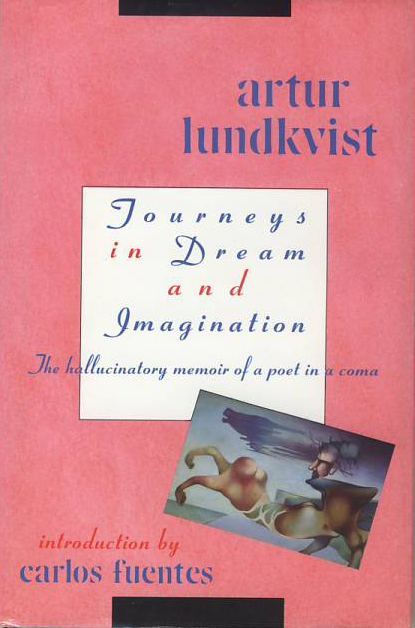
Excerpts from Artur Lundquist’s Journeys in Dream and Imagination (New York: Four Walls Eight Windows, 1991),
then a brief essay.


                                               I know I am traveling all the time, possibly with no interruptions, also with no tremors or noises, soundlessly and softly, and then I am no longer lying in my bed but stepping out into the world where everything is awake, sundrenched, comforting, and I am there clearly as a visitor, and I am quite at ease,

                                               it must be a dream journey I have undertaken, a definite dream journey where all is real precisely the way all journeys ought to be, but maybe one has to be dead in order to journey like that,

                                               by the way, how can I know I am not dead, even though I have no sensation of being dead, and it is as if I rest in a middle zone without feeling either warmth or cold or hunger or any human needs

* * *

                                               No wind, not even the slightest breeze, complete stillness and silence, yet I am traveling or have a definite sense of traveling, but how can it happen without a sound or feeling of movement,

                                               can I travel motionless or glide onwards without the least resistance from the earth or the air, can it be that time has stopped or speed no longer has a meaning, that I have reached the crossroads beyond motion and stillness . . .

                                               but yet I am here, can feel my body and sense my breathing, it is a nothingness that is definite, but without any wind or air or sound whatsoever, as if all but my own being has ceased existing,

                                               it amazes me somewhat, but it actually does not matter, why should I need wind and sound, that which exists does exist nevertheless, and I must be the one perceiving it, and that is surely sufficient to make me alive and capable of perceiving,

                                               I do not know what time has passed, but now I begin hearing something, at first vaguely, then with increasing strength, and soon, I can recognize a distant song by women, a choir like in a church but heard from a distance, the song rises and falls rhythmically, with different voices blending, lighter ones and darker ones,

                                               It is actually not beautiful, but it still makes an impression by its inherent certainty and power, yes, the song bears witness of a conviction that conquers silence and nothingness as if journeying by its own force and conquering all resistance,

                                               I feel that I am again traveling, that immobility and silence no longer reign, but I don not know what the women are singing or what the song means, it is simply there, filling the room which was only silence and emptiness

* * *

                                               The silence is like a fine spiderweb against my face, I cannot rub it off, it is simply there without being tangibly real, it does not flutter like a leaf in the breeze, nor is it entirely immobile, it feels like the impression of a wind that is already becalmed, it is hardly the beginning of the weave and it does not betray a pattern, it is the most insignificant matter, yet it makes itself known

* * *

                                               My dreams are of iron, so strong, so durable, but they soon begin to rust, eventually they fall off like flakes of rust and nothing is left of them, then I shift to dreams of dough so that I might bake and eat them, almost like bread,

                                               suddenly, as I sit at the table in good company, I am nauseated, I do not even have time to stand up and run to the toilet before I spew out a snake that curls out of my mouth, one piece with each spasm, like a birth,

                                               the snake lands in front of me, on the plate that is still empty, it is curled up, mottled, with a zigzag pattern on its back, more beautiful than a sausage and much longer,

                                               the snake raises its head and opens its jaws as if to say something but at that moment, I faint and I do not hear it.


I’m attracted to unusual states of consciousness in the history of literature, such as Hanna Weiner’s poetic conversations with the words that she saw projected, involuntarily, onto surfaces; and those “Kubla Khan’s” written during drug-induced altered states of consciousness. One of the most remarkable poetic records of an altered state of mind is Artur Lundkvist’s Journeys in Dream and Imagination: The hallucinatory memoir of a poet in a coma.

In 1981, at the age of 75, Swedish poet Artur Lundquist had a heart attack while giving a speech on Anthony Burgess. A friend administered artificial resuscitation and he was rushed to the hospital, where he lay in a coma in the intensive care unit for two months, his life sustained by a heart-lung machine. He gradually regained consciousness over the next few months, maintaining awareness for greater and greater periods of time. As soon as he was able to write again or at least to dictate to his wife, he attempted to re-capture the now-elusive dream visions that illuminated the two months of his coma as well as to set down the waking dreams that he experienced during the first year of his convalescence, intense and vivid ones in which his eyes remained open and during which reality mixed with unreality in a half-aware reverie. Such dreams are not uncommon for persons who have experienced a change in breathing patterns, as is the case being on a lung machine (1). Fortunately, Lundquist’s linguistic abilities were rusty but intact, and he was able to document his fantastical visions that arose during this fertile period of dreaming.

The memorable opening of his poetic journal of dreams, “I know I am traveling all the time,” suggests that he’s aware of his altered condition, and that the background noise of his mental state is his impression of traveling, paradoxically in “complete stillness and silence” and “without a sound or feeling of movement.” He exists “without distance in time and space” yet he feels that he is traveling “through time or space.” He can’t tell if he’s “lying in the same place” or “traveling without interruption.” He’s unaware of minutes and hours passing, “yet time is moving somehow.” It’s as though he existed in suspended animation while riding a train. He describes his state of mind during his convalescence as being full of contradictions: moving yet stationary, timeless yet in time, lonely yet also belonging, unaware yet on some level conscious. In this twilight state, while he’s on life support in the hospital, he dreams, sometimes about his own death and sometimes about the annihilation of the earth. Fantasies of nothingness, purposelessness, and oblivion haunt him in his awareness that his own consciousness could easily fritter away and end rather than be revived, and that eventually nothing will be left of the earth and all its life forms: “nothing that can see or feel or think remains in existence.”

His journey is metaphorical as well as viscerally sensed. The point of departure of the journey is a state of suspension in a world of silence and paralysis, as if he were in a cocoon. He seems to be neither conscious nor unconscious, and sometimes, for brief periods, he perceives the objects and people in his hospital room, but he’s helpless to make contact with them. The journey is one of transformation, and his destination is consciousness, the regained ability to speak and read, and ultimately, the ability to write about the journey of his dreams.

Yet he has no sense of destination in his dream journeys. What he has lost—his consciousness of place, of his body in a particular space, situatedness—becomes an obsession in his dreams. In a particularly poetic entry that is reminiscent of Stephen Dedalus’ meditation on place, telescoping from self to universe (2), Lundquist describes a village of farms in some detail, then zooms away:

                                               behind that the forest began, and the moors, the meandering creek and the half-overgrown lake, the cows who grazed without fences, knew the paths and followed them, and returned when it was milking time,

                                               then there was the church village and the whole parish, the district and the county and the whole country, and it was on earth in the universe, below the sun, the moon, and the stars, with years carved into tree trunks without revealing if the world was actually old or still young

Like Dedalus’ list, Lundquist’s image of an ever-expanding view tells of his wished-for certainty of place in an orderly world in which you know exactly where you are, even though there is a mystery about where you’re precisely bookmarked in the age of the world. When he does feel, in his dreams, a strong sense of self, that self feels alien to him: he doesn’t recognize the echo of his own shouting voice. It is absence and loss that most often shape his dreams, as when he envisions a couple buried alive after a strong earthquake, or a living, sentient stone mountain that is being cruelly and terrifyingly quarried by men who are more murderers than miners, or himself as the village idiot, “carry[ing] within [him] something that has never fully blossomed.” He’s in purgatory, a guest lost in a vast hotel, a village hidden in a mist. Corporeality and consciousness are absent or impaired, and desire—for life, for sexuality, for communication—is thwarted since the means necessary to fulfilling these desires are in a liminal state, halfway between action and immobility and unable even to know with certainty whether he is alive or dead.

Journeys in Dream and Imagination is a record of meta-dreams, meditations on Lundquist’s state of consciousness, dreams about the dream state. In the beginning of his journey, his dreams are “of iron, so strong, so durable.” However, this strong state of consciousness gradually starts “to rust,” and the dreams “fall off like flakes of rust” until they vanish entirely. He then switches “to dreams of dough,” which he bakes and eats, “almost like bread” that nourishes him through this period of amorphous half-consciousness. The metaphor of the consumption of dreams describes the interiority of his state of mind, and the next image of vomiting a snake that is also a giving birth to speech seems to signify his ability or desire to engage once more in communication with the world outside his twilight prison. Within his dream state, he sometimes interprets the vision he has just experienced, as when he sees trees growing between his toes and believes that dream to be a good omen, a “sign that life continues to grow inside me.” It is as though his consciousness were trying to solve the puzzle of its own impairment.

The necessarily interior turn during this period when perception of the outer world was subdued or shut off perhaps accounts for his awareness of his body, which he felt to be in a state of flux (the sensation of traveling, for example) and transformation: he has become something of a shapeshifter. In two successive dreams, he is transformed into a giant and then a miniature person, in the manner of Gulliver’s Travels. Proprioception is the brain’s ability to locate the position of the body relative to its own parts as well as to the exterior world. Since altered states of consciousness (during meditation or praying, for example) can change the strength of a person’s feeling of separation from or continuity with exterior space, other people, or objects, I wonder whether Lundquist’s dreams reflect disturbances in his proprioceptive sense of self in relation to others. During his convalescence, his brain was repairing itself—but was it also rehearsing, in a sense, the process of its own repair? Is this what the image of consuming the nourishing bread of his dreams signifies? If reinforcing the lessons of the day in a kind of rehearsal of knowledge is part of the function of dreams, as some neuroscientists studying sleep now believe, what was the purpose of Lundquist’s dreams, if indeed they can be said to have one? Why do so many of them have the feel of meta-dreams about the journey towards consciousness?

Regardless of the purpose of these dreams, it seems likely that Lundquist’s hallucinatory visions, alternately peaceful and nightmarish, represent his fears of being forever in a coma and his hopes of someday rejoining the realm of real people, objects, places. In his dreams, he creates worlds of uncertainty, where nothing can be pinned down as completely familiar and habitual; where communication is problematic or impossible, consciousness is present in some way but still suspended in a timeless, placeless journey; and where he is alien to himself and inhabits a world that is strange and unrecognizable.

His limbo is real and extreme, but there is something oddly familiar about his dilemma dramatized or described in his dreams, something that elicits the feeling that you’ve been there, too, in moments of doubt or frustration, when order dissolves, when thought fails to render its shiny nugget, when self seems irremediably scattered, when you feel alone on a teeming planet that seems to belong to another dimension, when talking to others falters and stumbles, when you no longer know who or why you are, and the world, faced ultimately with demise, seems pointless but stubbornly present. In his meta-dream stories investigating suspended being, the often surreal analogies for these states are almost endlessly inventive. But in them one can also read a description of what it is to be human, or to exist in “negative capability,” as Keats called the ability to live with “uncertainties, Mysteries, doubts without any irritable reaching after fact & reason.”

Part of the pleasure of Lundquist’s record is becoming aware that even in a coma, the mind can cut seemingly endless facets in which to reflect itself and rehearse the dramas—miniscule or vast—of its journey through the interior. If his world seemed to be a solipsistic nightmare from which he couldn’t completely awaken, he peopled that world with rich possibilities and a self-awareness that sometimes comes across as more lucid and knowing—for all its twilight uncertainties—than the consciousness he so desperately wanted back.

(1) I gleaned most of the information in this narrative of Lundquist’s heart attack and recuperation from Carlos Fuentes’ introduction to the book.

(2) He turned to the flyleaf of the geography and read what he had written there: himself, his name and where he was.

Stephen Dedalus
Class of Elements
Clongowes Wood College
Sallins
Country Kildare
Ireland
Europe
The World
The Universe


Camille Martin
http://www.camillemartin.ca

Parallel Universes Redux – St. Joseph’s Altar in New Orleans, a Hybrid Feast

(photo: Camille Martin)

(photo: Camille Martin)


(photo: Camille Martin)

(photo: Camille Martin)


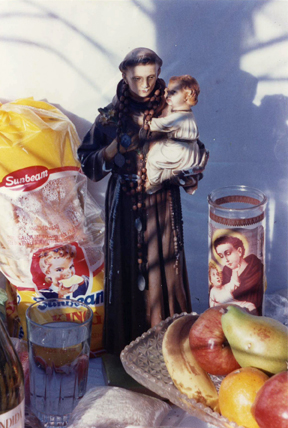
Another time warp in my Louisiana series: a St. Joseph’s Altar created in 2003 on the front porch of a house in Carrollton, the New Orleans neighbourhood where I used to live. The tradition of creating and decorating altars devoted to St. Joseph every year on March 19 was brought to New Orleans by Sicilians and adopted by some African-American devotees of the popular saint in the Catholic pantheon.

Non-meat food offerings embellish the altars and are usually given to the poor at the end of the celebration. Bread offerings are often baked into shapes of carpenters’ tools such as ladders or saws, but this altar keeps it simple and efficient with a loaf of Sunbeam bread. The beads of moisture condensed inside the plastic bag are a typical phenomenon in subtropical New Orleans, which can be warm and muggy even in mid-March.

During the day, people knelt at the altar and prayed. In the second picture, the woman might appear to be reverently bowing her head, but she was actually dismantling the altar at the end of the day: many of the food offerings have been removed, but the rows of candles remain.

The adoption of Sicilian traditions by African Americans in New Orleans is not an unusual type of cultural phenomenon: the blurring of cultural and religious boundaries is the rule rather than the exception in southern Louisiana, which has historically attracted settlers from all over the world looking for opportunities in spite of the prevalence of diseases and natural disasters, and forcibly brought people from Africa as slaves. For many, survival meant mutual aid within their ethnic communities and interdependence among their diverse neighbours.

Louisiana’s “cultural gumbo” is not a cliché for nothing. Louisiana, especially along the Mississippi Delta, was—and is—a mixture of Spanish, French, African-American, Irish, Italian, Native American, Croatian, Cajun, Creole, German, Czech, Hungarian, British, Isleño (from the Canary Islands), Filipino, Mexican, Cuban, Guatemalan, Chinese, Vietnamese, Laotian, Thai, and more.

As a result of intermingling among ethnic and national groups in Louisiana, Germans along the Côte des Allemands, for example, became more French, translating their names from Zweig to Labranche, and from Troxler to Trosclair. Many of the original Louisiana Germans came from the Alsace region, which partly accounts for the ease with which they shared customs with Louisiana’s French. Some Louisiana Germans have become so distanced over time from their origins that they believe their ancestry to be Cajun or French Creole.

African-Americans intermingled and intermarried with French Creoles, Cajuns, Italians, and Native Americans, among others, and survivals of these blends among blacks can be seen in the French Creole language, St. Joseph’s Day altars, Zydeco music, and the customs of the Mardi Gras Indians.

It would be hard to find a group not influenced by black African and Caribbean culture in Louisiana. And the whole world, late in the twentieth century, tried to become Cajun by eating crawfish and dancing to Beausoleil.

Some groups in Louisiana seem to have had more permeable boundaries than others. Croatians, many of whom developed the oyster industry, created relatively close-knit communities with a tendency to preserve their own cultural heritage and not to mingle their customs with those of other groups.

And generally speaking, in the early settlement of North America, French colonists were more likely than British to intermingle their customs and blood with other groups. When I was researching Acadian culture in Nova Scotia, I discovered the extent to which the Acadians and the Mi’kmaqs, for example, had developed a close and interdependent relationship. One manifestation of the friendship between the two groups was of course their not-infrequent intermarriage. Another striking example of the degree to which both groups let down their boundaries was the syncretistic nature of a spring celebration that evolved: the return of the geese came to be celebrated in a hybrid feast blending Easter rituals with the Mi’kmaq Festival of Dreams and Riddles. I can imagine the consternation of the priests.

From the beginning of their settlement in Louisiana, the Cajuns continued to synthesize the customs that they brought from Acadia with the customs they found in their adopted land. A study of Cajun music, for example, shows influences from hillbilly music, blues, and Texas swing. If the Cajuns were viewed by the rest of the United States as unique and isolated, it was only by comparison with that amorphous category called the “mainstream.”

Throughout much of the first half of the twentieth century, the United States government instituted a policy of assimilation of the Cajuns in Louisiana, and until the late 1960s, many aspects of their culture were finally succumbing to decades of this unenlightened approach. Without a boost from the schools, the French language in Louisiana would probably soon have died out, for mine was the first generation of Cajuns, generally speaking, whose first language wasn’t French and who were increasingly unable to speak in the mother tongue of their parents and grandparents. With the advent of CODOFIL (Council for the Development of French in Louisiana), a more enlightened view of Cajun culture and heritage has permeated the curricula of primary and secondary schools of Acadiana, where Francophone teachers from France and Quebec have been hired to teach children the language of their parents.

Ironically, the movement for the preservation of the Cajun heritage threatened to turn a living culture into ossified museum artifacts. Cajun historical villages such as Vermillionville and Acadian Village recreated for visitors “typical” life in nineteenth- and early-twentieth-century Cajun communities, and people flocked to south Louisiana to experience “authentic” Cajun culture. Some forms of historical reflection, however informed or uninformed or misinformed, however laden with stereotypes or invested in historical accuracy, can contribute to the dying of a culture if there is an impetus to petrify it into some notion of its past–especially a past purified of other influences–instead of allowing it to grow, breath, change, and, most importantly, transform and renew itself from contact with other cultures.

One of the consequences of the policy of assimilation was an overall feeling of inferiority on the part of the Cajun people, a conviction that their culture was backwards and their French language less correct that that of their distant Parisian cousins. But pride is not without its pitfalls—pride in some notion of Cajun-ness, of a Cajun purity that never was and never will be. From the moment that the Acadians set foot on the shores of what is now Nova Scotia, they were influenced by the Mi’kmaqs and by the British, with whom they traded and fought. From the time that they settled along the bayous and swamps of the Atchafalaya Basin in Louisiana, they gathered still more influences in their vocabulary, food, customs, stories. Like any migrating group, they brought with and they borrowed from. Purity is an attitude that bears no resemblance to the infinitely re-folded layers of human culture.


Camille Martin
http://www.camillemartin.ca
On Homunculi, Steam Locomotives, and Hans Clodhopper (interview by rob mclennan)

Please have a look at my “12 or 20 questions” interview just posted on rob mclennan’s blog:

http://robmclennan.blogspot.com/2009/09/12-or-20-questions-with-camille-martin.html


Camille Martin
http://www.camillemartin.ca
St. Roch Chapel in New Orleans, a Parallel Universe

St. Roch Chapel (photo: Camille Martin)

St. Roch Chapel (photo: Camille Martin)


Stepping into St. Roch Chapel in New Orleans feels like entering a shrine that isn’t quite real, like a movie set for the nineteenth-century yellow fever epidemic or a recreation of a voodoo shrine at an anthropological museum. I like to imagine that maybe it’s a place that is kept intact as a tourist attraction. I mean, does anyone still hang replicas of body parts on the wall of the chapel in gratitude to St. Roch for a miraculous healing? Or is it like the surreal gray moss dripping from crepe myrtle trees: something you suspect was hung there for the benefit of the tourists?

At places like this in New Orleans, it’s easy to feel as though you’ve crossed some invisible line and stepped into one of those parallel universes that string theorists talk about. The pennies and cockroach carcasses on the floor paved with bricks inscribed with “THANKS TO ST. ROCH” were sprinkled there by a movie director in the eighth dimension or a tour guide in the eleventh, to make the the place more convincingly reproduce the “authentic” dimension.

But no, it’s as real (or unreal) as the old ladies in Baton Rouge that I used to see praying to the statue of Huey P. Long on the grounds of the state capitol. And that reality is suspended in liminal space, trapped in a time capsule that seems as though it will always bear a close resemblance to whatever age in which its seal is broken.

I imagine sometimes that I feel nostalgic about living in New Orleans, especially when I rummage through my photographs, but really it’s mostly sadness that I feel, not a yearning to be there. St. Roch Chapel got about five feet of water. My neighbourhood was lucky. The area of Carrollton where I lived got only about two feet. I know many people whose homes were destroyed or heavily damaged.

But I didn’t leave New Orleans because of Katrina. Katrina only delayed my move to Toronto. There was a sickness at the heart of the city that caused me seriously to re-think living there. I could walk down my street and point to places where serious crimes had occurred: murder, rape, car-jacking, armed robbery. The racial tension was thick. Poverty, endemic. Public schools and other services, chronically underfunded.

I could easily turn this into a rant about the problems of New Orleans, pre- or post-Katrina. But I started off talking about the chapel. The tradition of placing a replica of one’s healed body part in a shrine or temple is at least as old as the ancient Greeks. There must be a lineage, a thread of tradition, that could be traced from those times all the way to St. Roch Chapel. Across the ages, the appeal to deities to be healed is ubiquitous. I suspect no one will ever put a replica of the city in the chapel, thanking god or saint for healing it. It’s a city whose inertia–whatever the cause–renders it in a state of constant deferral, steeped in nostalgia for what it perhaps never even was. When I think of the song “Do You Know What It Means to Miss New Orleans?” I can imagine it sung only in New Orleans. It’s when I was living there that I missed it.


Camille Martin
http://www.camillemartin.ca
Majlis Multidisciplinary Arts: “Figure of Speech” concert photos

Here are some photos of our multidisciplinary concert
on Saturday, August 29. The performers, in order of
appearance in the photos:


Hallie Fishel-Verrette
John Edwards

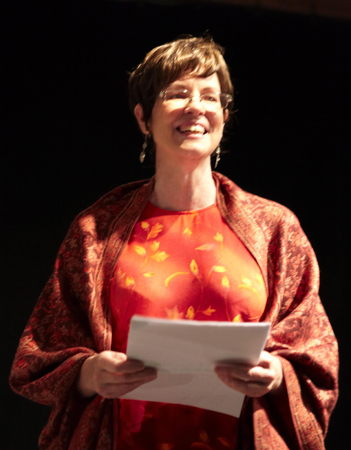
Camille Martin
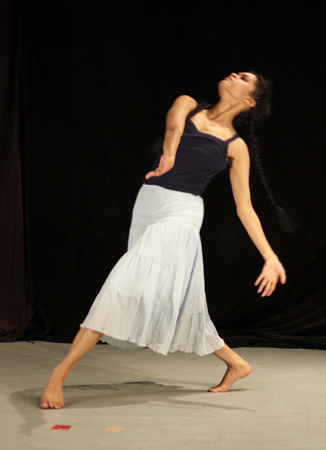
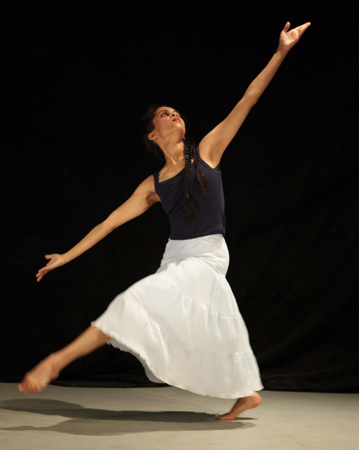
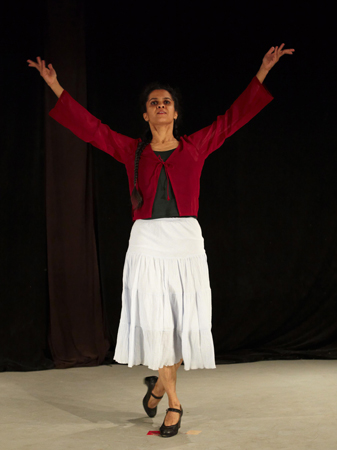
Gauri Vanarase


For my musings on the collaborative experience, please see
yesterday’s post.


Hallie and John performing their setting of “this is the tune
that paper sang” (one of my “nursery rhyme” sonnets, based on
“This is the house that Jack built”):

Photo by: Cameron Ogilvie

Photo by: Cameron Ogilvie

<font face="Times New Roman" size="+.5" color="#302226">Photo by: Cameron Ogilvie</font>

Photo by: Cameron Ogilvie

Photo by: Cameron Ogilvie

Photo by: Cameron Ogilvie


My solo reading:

Photo by: Cameron Ogilvie

Photo by: Cameron Ogilvie


Hallie and I performing a “shadowing” setting of
“if you are somewhere.” I read and Hallie “shadowed”
me by singing the same words:

Photo by: Cameron Ogilvie

Photo by: Cameron Ogilvie

Photo by: Cameron Ogilvie

Photo by: Cameron Ogilvie


Gauri performing “Folia d’Italiana,” accompanied by
Hallie and John on guitars:

Photo: Cameron Ogilvie

Photo: Cameron Ogilvie

Photo by: Cameron Ogilvie

Photo by: Cameron Ogilvie

Photo by: Cameron Ogilvie

Photo by: Cameron Ogilvie


Hallie, John, and I performing “Does It Take” (Gauri also
performed in this piece). Hallie hummed and John played
guitar while I read, and Hallie sang the last part of the poem;
Gauri performed a haunting interpretation of the poem:

Photo by: Cameron Ogilvie

Photo by: Cameron Ogilvie


Gauri performing “Folia d’españa”:

Photo by: Cameron Ogilvie

Photo by: Cameron Ogilvie


Curtain call with Gauri’s red ribbon and heart balloon:

Photos by: Cameron Ogilvie

Photos by: Cameron Ogilvie


Mingmar, multidisciplinary muse:

Photo by: Cameron Ogilvie

Photo by: Cameron Ogilvie


Camille Martin
http://www.camillemartin.ca

The Majlis Collaborative Experience

The Majlis “Figure of Speech” multidisciplinary experience was intense and rewarding. Tricia Postle, the organizer of the series, selected the members of our motley crew, which consisted of Gauri Vanarase, a kathak/modern dancer; Hallie Fishel-Verrette, a soprano and Baroque guitarist; John Edwards, also a Baroque guitarist; and myself, a far left field experimental poet. The point of such groupings is to throw together people from various disciplines and see what emerges from their collaboration. They gather for a series of rehearsals and then perform a concert on two evenings. Although some of the collaborations are expected to be designed as structured improvisations, our group, according to Tricia, was one of the most rehearsed ones.

The performance facility was rustic but warm. Tricia converted what I think used to be a woodworking factory into a performance area. She opened up one side of the building to create a stage, and stretched a large canvas from the roof to a nearby fence to cover the outdoors seating area. It was a nice surprise to find, just down the path between the stage and the restroom, a peach tree full of large ripe peaches.

In rehearsals I worked mostly with Hallie and John, who make up the Renaissance/Baroque duo The Musicians in Ordinary. To get things started before the first rehearsal, I emailed Hallie and John several of my poems that I thought would work well set to music: sonnets inspired by nursery rhymes and my “Poor Souls” sonnet series. I tried to select poems that were based on repetitions of various kinds or at least phrases of a fairly uniform length. And John emailed me samples of some Baroque styles that might work well for turning my poems into songs. At our first rehearsal, Hallie and John had already worked out several song settings of some of my poems and ended up performing five at the concert: “sixpence,” “if all the seas,” and “this is the tune,” “poor souls 1” and “poor souls 3.”

The blend of the poems and Baroque settings with a continuo-type guitar part worked out well. The continuo guitar part provided the structure of a repeated harmonic progression, which is very typical of Baroque composition. John’s repeated harmony gave the composition coherence and also provided opportunities for Hallie to improvise embellishments on the melody based on that harmony.

After that first rehearsal, I remembered having set a Dylan Thomas poem, “We lying by seasand,” to a capella soprano a long time ago, longer than I’d like to admit, as a graduate student at the Eastman School of Music. So I downloaded a music notation program and wrote the melody as best I could remember it. I thought, ok, I wrote this, maybe I can set some of my poems to music.

I knew that for the Majlis concert it would be good to have some pieces that I could perform with Hallie and John in various combinations, so I wrote a “shadowing” piece to perform with Hallie, based on my poem “if you are somewhere.” I’d speak a phrase or sentence, and a half a second later, Hallie would shadow my spoken words with the same words sung to a melody that I had composed. I’d seen this kind of collaboration improvised at a poetry reading in New Orleans to great effect. In performance, it worked out beautifully between Hallie and me.

Hallie and I also performed an “echo” piece based on my double sonnet “where you are when you,” which consists of a series of—I can’t believe I still remember the rhetorical term—aposiopeses, sentences that break off mid-stream. I’d start one phrase and a half-second later, Hallie would echo the same phrase. After we got the hang of the rhythm of the echo effect and the breaking off of the incomplete sentences so that they seemed to end suspended in mid-air, the echoing was very effective in performance.

I composed another collaborative piece in which John accompanied Hallie, who hummed a melody in a series of four-bar phrases. During each four bars, I spoke a sentence or phrase of my sonnet “does it take.” Hallie sang the last two lines of the poem. For the performance, Gauri joined this piece and improvised movements that beautifully expressed the sad nostalgia of the poem.

I wrote three song settings of my poems for Hallie and John to perform: “sometimes i write about cats,” “comatose in paradise,” and “dear perpetrator,” of which they performed the first two for the concert. I had never written for guitar, so there was some guesswork in my notation, but John gamely arranged them for his instrument. It was very moving to hear these songs performed—I got to experience what composers must feel like hearing their works in concert. In performance, the realization of the songs was better than I had imagined them in my mind’s ear as I was writing them. I felt as though I’d returned to an old friend, music, after my piano playing had lain fallow for so many years.

Gauri based one of her dances, which we nicknamed “the hat dance,” on a poem that has a line about putting a new ribbon on a hat. She attached a long red ribbon to a hat and used it to great effect in her dance, which seemed to address the inner conflict and restlessness of the speaker of the poem. The photos that I will soon post show some of the highlights of her choreography.

This collaborative experience allowed me to perform with others, which added one or more layers to what I normally do in a solo reading. But it’s more than just adding layers—it is learning to listen carefully to the phrasing, articulation, inflection, and tone of others to try to mesh your own part with something that is larger than just the sum of the two or three layers of the collaboration: the spoken, the sung, and the strummed. The players become a single creature that just happens to have three voices. And when Gauri joined Hallie, John, and me in “does it take,” it was apparent that she was very aware of what was being spoken and sung so that her improvisation would harmonize with the sounds of the others in the group

The collaboration sounded very classical and traditional in its realization, nothing, for example, like a performance of poet Bruce Andrews and dancer Sally Silvers. In the beginning I had tried to get a little avant-garde action going, but in reality, the collaboration needed to grow from the strengths of each person, and part of the process is finding out what those strengths are and how willing each person is to try things that lie a little beyond their usual practice. At first, I have to admit that I was a little skeptical about setting my poems to Baroque music, but I was very pleasantly surprised at the first rehearsal, on hearing Hallie and John’s rendition of two of my sonnets, to find that the blend sounded natural, even inevitable. I’m delighted that Tricia brought the members of our group together, and I couldn’t be happier with the results of our collaboration, which stretched my usual practice at poetry readings and pushed me to take risks and try new approaches to making poetry happen.

Soon I’ll post some photos from the concert, taken by Cameron Ogilvie, and Tricia will post video clips from last night’s performance, for which I’ll provide the link.


Camille Martin
http://www.camillemartin.ca

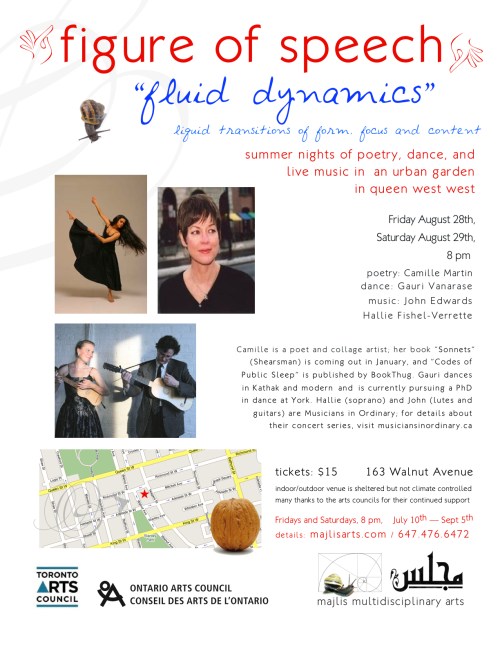
Majlis Multidisciplinary Arts: Figure of Speech

figureofspeech2009-8


What do you get when you cross edgy poetry with Renaissance music? Find out at “Figure of Speech,” a collaborative performance of poetry, dance, and music.

I’m incredibly honoured to be performing with Gauri Vanarese, a dancer, and John Edwards and Hallie Fishel-Verrette, musicians in the Renaissance and Baroque music duo, The Musicians in Ordinary, in an evening of artistic collaboration organized by Tricia Postle.

Hallie and John have composed settings for several of my sonnets, using traditional musical forms of the 16th and 17th centuries. Some of these sonnets were inspired by English nursery rhymes, and when I heard Hallie and John perform them at a recent rehearsal, the poetry and music sounded to my ears like a perfect blend.

And for the occasion I also set several of my poems to music, which John, Hallie, and I will perform in various combinations.

In addition, Hallie and John will accompany dancer Gauri Vanarese in two of her beautiful and evocative choreographed pieces.

It will be a memorable evening. Please come!


Camille Martin
http://www.camillemartin.ca
Zydeco Gallery Four


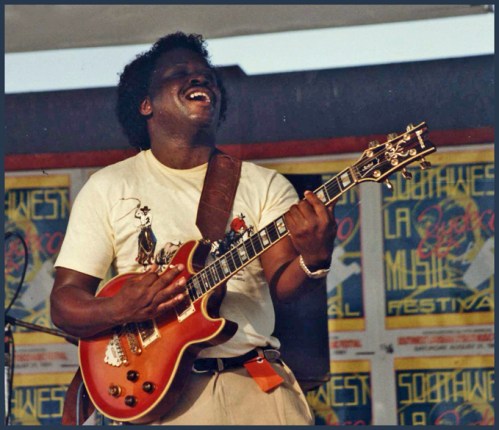
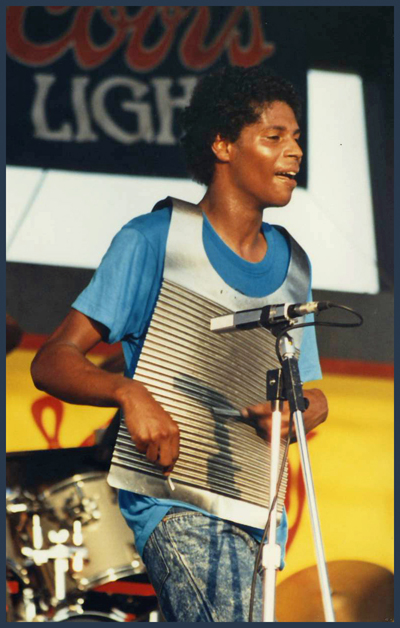
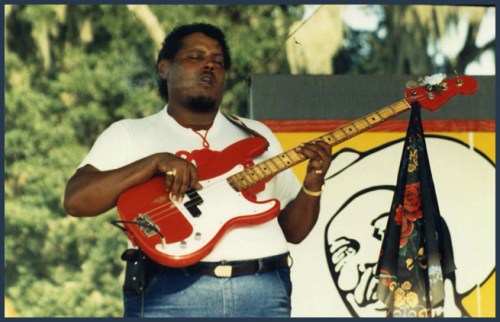
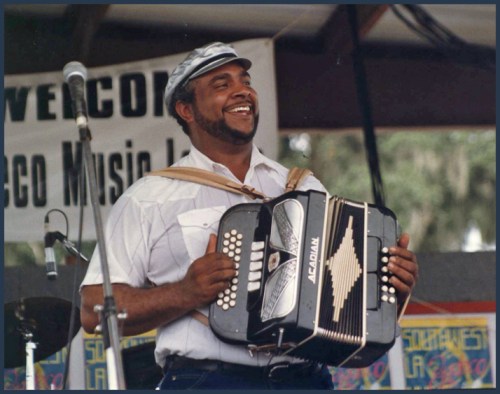
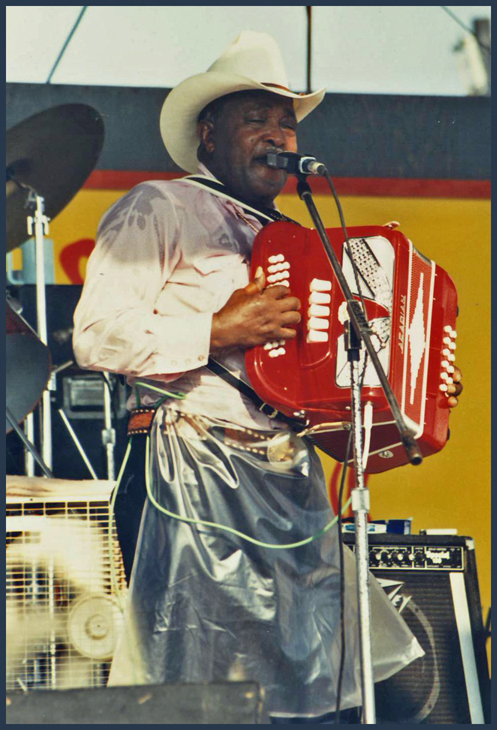
Here’s the last gallery of photographs from the Zydeco Festival of 1989.


(Photo: Camille Martin)

(Photo: Camille Martin)


(Photo: Camille Martin)

(Photo: Camille Martin)


(Photo: Camille Martin)

(Photo: Camille Martin)


For more information about the Zydeco Festival, see the official Zydeco Festival website:


Camille Martin
http://www.camillemartin.ca
Sonnets Preview


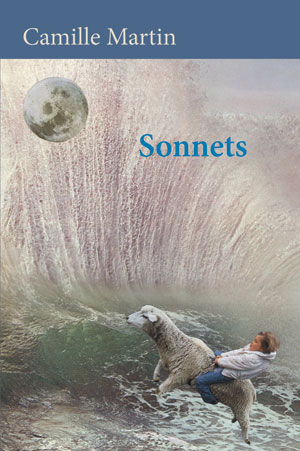
Sonnets cover


In her second book of poetry, Camille Martin breathes fresh life into the sonnet in a collection that is at once edgy and lyrical. The word “sonnet” comes from “song,” and the musicality of Sonnets is not surprising, given Martin’s background as a classical musician. These poems demonstrate a virtuosic range of approaches and themes; some are inspired by texts as disparate as nursery rhymes, theories of cognitive science, a history of street names, and her own dream journals. The chorus of voices in this collection sing confidently and fluently, proving the sonnet to be an ideal vehicle for Martin’s love affair with language.


I’m very excited about Sonnets, which will be published by Shearsman Books in January 2010. One of my collages is on the cover. I’m putting together a U.K. tour, which will probably happen in May.

Here are links to sonnets that I’ve published recently:

moria

Angel House Press

Hamilton Stone Review

Stride

Jacket


Camille Martin
http://www.camillemartin.ca

Creeley and Clemente’s Anamorphosis: Death and the Stuff of Dreams

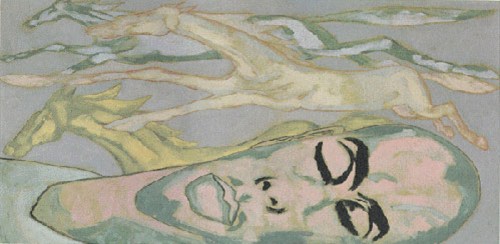
Francesco Clemente, from <em>Anamorphosis</em>

Francesco Clemente, from Anamorphosis


Robert Creeley’s companion poem to Clemente’s painting:

Inside my head a common room,
a common place, a common tune,
a common wealth, a common doom

inside my head. I close my eyes.
The horses run. Vast are the skies,
and blue my passing thoughts’ surprise

inside my head. What is this space
here found to be, what is this place
if only me? Inside my head, whose face?

The remainder of poems and paintings in Anamorphosis can be found at 2River View.

This week I’m revisiting some collaborative pairings between poets and artists in other disciplines, in preparation for a collaborative performance series, Figure of Speech, that I’ve been asked to participate in. I’ll be working with a singer (who also plays the guitar), a guitarist who specializes in Baroque music, and a dancer. I want to address the things that can make an effective collaboration.

The 1997 collaboration between Robert Creeley and Francesco Clemente, Anamorphosis, strikes me as one of the most evocative and beautiful collaborations between a poet and a visual artist. I’m all for exquisite corpses and other processes incorporating chance, but there is something to be said for the way that Creeley and Clemente seem perfectly attuned to one another’s work. I don’t know whether Clemente made his paintings based on Creeley’s poems or vice versa, but they expand the meaning of one another through their sustained and rich dialogue. A good example is the first pair in the series, “Inside My Head.”

Clemente’s painting depicts a single image from Creeley’s poem: imagining horses. He gives a part for the whole, a relationship of synecdoche. Although the painting is a somewhat literal interpretation of Creeley’s imaginary horses, it doesn’t belabour that correspondence. Instead, the image is executed in such a way as to evoke other themes in the poem, such as mortality, identity, and imagination.

For example, in a painting whose colours are primarily pastel, the bold black lines depicting the closed eyes stand out, emphasizing the visionary quality of the man, which is also reflected in the poem. Clemente’s images of head and horses are elongated, further emphasizing painting and poem’s dreamlike quality. And the head of Clemente’s imagining man reclines with eyes closed, which could signify the shutting out of the world and the opening up of the world inside the head. It could also signify death or “death’s second self.” In all of these possible interpretations, the images sound sympathetic vibrations with the poem: death and the stuff of dreams.

As well, the simplicity of Creeley’s almost nursery rhyme-like poem with its repetitions and formal balance is well suited to Clemente’s simple but evocative image.

In depicting thoughts of running horses, perhaps these two had in mind Saussure’s use of the horse to describe the relationship between the referent (the external object, the actual horse), the signifier (the word “H-O-R-S-E”) and the signified (the concept of “horse”). Turning Saussure’s ideas on their head, Clemente and Creeley suggest that the signifier invokes the actual referent: Creeley doesn’t talk about thinking of horses, but instead there seem to be real horses running in the head. Similarly, Clemente’s painting depicts real horses galloping behind the speaker’s head.

Creeley also seems to be alluding to Andrew Marvell’s celebration of the world inside the head in “The Garden”:

Meanwhile the Mind, from pleasure less,
Withdraws into its happiness:
The Mind, that Ocean where each kind
Does streight its own resemblance find;
Yet it creates, transcending these,
Far other Worlds, and other Seas;
Annihilating all that’s made
To a green Thought in a green Shade.

Green thoughts are echoed in Creeley’s poem in the speaker’s surprised blue thoughts.

In this dialogue with Saussure and Marvell, Creeley and Clemente assert the reality of the world of the imagination: that world possesses its own reality, and that reality is powerful, capable of extinguishing the exterior world through its concentrated focus on its thoughts and images. But it also spawns a meditation on the nature of personhood, cognition, and mortality.

The poem and painting of “Inside My Head” are both intensely interior and introspective, relieved only by Creeley’s paradoxical assertion of the commonality of the mystery at the heart of the human experience of subjectivity. Even inside the head, there is a “commons,” a place that is at once enclosed, private, subjective, as well as open, public, shared.

Creeley and Clemente’s collaboration is successful because the two works are in close dialogue with one another, which cannot happen if one simply holds up a mirror to the other.


Camille Martin
http://www.camillemartin.ca
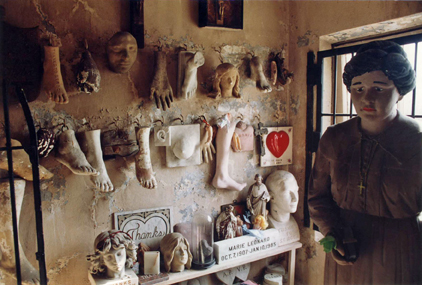
black asterisk


(Photo: Camille Martin)

(Photo: Camille Martin)


                black asterisk in a black alphabet.
                a question of the love of larvae. lovely
                birth of larvae in yellow silk or yellow
                brass. milky decorum or exo-skeleton
                in the metropole. celestial urns and baskets, many
                baskets mocking purple robins. why? paper cut
                willow blues, willow socket shocks. motifs
                appear. again, motifs and a coccyx twin.
                sheepish angels in a starry slipcase mingle stone
                or stones and blurry angels. a sudden folding,
                a sodden book, abruptly sullen. is it signed
                by paper prophets? is it numbered? acorns
                are new. eels cascade. acorns are sadly news.
                o bittersweet, bittersweet black sheep!


“black asterisk” was first published by experiment-o


Camille Martin
http://www.camillemartin.ca

Zydeco Gallery Three


More photographs from the Zydeco Festival of 1989 or 1990. If you know the names of any unidentified musicians, please let me know in the Comments box below.


(Photo: Camille Martin)

(Photo: Camille Martin)


(Photo: Camille Martin)

(Photo: Camille Martin)


(Photo: Camille Martin)

(Photo: Camille Martin)

“Boozoo Chavis”


(Photo: Camille Martin)

(Photo: Camille Martin)


For more information about the Zydeco Festival, see the official Zydeco Festival website.


Camille Martin
http://www.camillemartin.ca
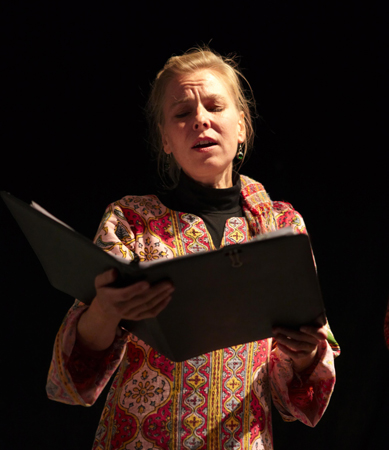
Square Foot Show, Toronto


I’m excited about the first public showing of my collage-prints, at the Square Foot Show in Toronto. The main stipulation for this group show is that the works be exactly one foot square. It’s a huge show, so there will be lots and lots to see. If you’re in Toronto, come to the reception or visit the gallery while the show is up.

100A Ossington Avenue, Toronto
(a few blocks north of AWOL Gallery)
Show dates: Saturday, August 15, – September 6, 2009
Artists Reception: Saturday, August 15, 2009, 7 pm
Gallery Hours: Th – Sa 12-6 pm / Su 1-5 pm

A recent work (obviously not in the show):

mermaid-resized-450


Camille Martin
http://www.camillemartin.ca