Category Archives: visual art

Film Noir collage

I just added the collage below to the “Americana” gallery of my website:

The alternating strips are stills from two different films noirs. When I was researching the genre for this project, I found a lavishly illustrated book of film noir posters. Some were in monochromatic half-tones, which inspired me to tint the two stills as a way to allude to this type of poster as well as to contrast the alternating strips. I had tried several combinations of images, but the arrangement of these two seemed to allow a mysterious and compelling interaction between the characters and shadows.


Camille Martin

ROBERT ZEND: Poet of exile, citizen of the cosmos

The Canadian Encyclopedia recently published my entry on Robert Zend (click to read it):


Camille Martin

Group art exhibition at the Elgin Theatre


Camille Martin’s Rescue at the Elgin Theatre group exhibition

Also in the exhibition: works by Stacey Camp, David Marshak, Romas Astrauskas, Zora Buchanan, Ila Kellermann, Menno Krant, Myriam Levy, Andrew M. Smith, Jay McCarten, Frances Ferdinands and Adi Zur.

Good things are happening with my art as well as my poetry, and more in the wings very soon . . .


Camille Martin

Robert Zend’s “Typescapes”: Concrete poetry from a Renaissance man of Canadian letters


detail from Robert Zend’s typescape Peapoteacock

          A few months ago, I wrote a brief essay about Daymares, Robert Zend’s collection of stories, poems, and concrete poetry, one of his few books still in print. Zend (1929-1985) was a Hungarian-Canadian writer who immigrated to Canada in 1956, the year of the Hungarian Uprising. He settled in Toronto and worked for many years for the CBC. He was one of the most versatile Canadian writers, producing poetry, concrete poetry, novels, short fiction, essays, and plays. He was also a composer, a filmmaker, and a creator of mertz-like sculptures made of found objects.
          While researching the Toronto Reference Library’s holdings of Zend’s works, I came across a thirty-year old treasure in the Special Art Room Stacks: Arbormundi (Tree of the World), a portfolio of seventeen of Zend’s concrete poems created on a typewriter, for which he coined the word “typescapes.” Although Zend didn’t invent typewriter art, he did seem to have created it without knowledge of any forebears in that genre. Below is the cover page. Following this brief essay are five more samples of typescapes from Arbormundi.

          Zend’s typescapes are remarkable for their meticulous execution, which often involves superimposed shapes and figures. At the areas of intersection of these shapes, the effect is far from being muddied or heavy. Instead, they retain the delicacy that is characteristic of the whole.
          Part of the beauty of these concrete poems is the ethereal effect produced by the transparency of the overlaid shapes. The result of this diaphonous quality is that it is difficult to determine which object is in front or behind the other: The objects seem to blend into one another, a visual legerdemain made possible by the open spaces of the typed letters and symbols: a superimposed “x” and “p” gives little hint as to which was typed over the other. Therefore the realm in which the ghostly forms interact spatially and symbolically is flattened into a plane of shared patterns and meanings. Zend’s often punning titles also reflect this idea of blending, as for example in “Peapoteacock,” where he brings “teapot” and “peacock” into verbal and visual contiguity so that one is contained within the other.
          Another aspect of the beautiful intricacy of the overlaid objects is that the areas of intersection naturally produce darker areas, which form shapes of their own consisting of outlines of both objects (as overlapping circles in a Venn diagram produce a shaded area formed with arcs from both circles). The interplay of the shapes of each object with the shapes produced by their overlay creates an impression of both dialogue and unity between the objects.
          The miracle of these concrete poems is that from what must have been a slow and painstaking process of planning and execution using paper inserted into a clunky machine come visions of airy lightness and delicate movement.
         All of these effects harmonize with Zend’s recurrent themes of commonality and universality: the Other within the I, and the endless cycle of creation and destruction. They seem to be part of Zend’s spiritual expression of the continuities of life and death; as Zend puts it in Daymares, from the “prenatal . . . to the land of time-spacelessness; to the tiny centre point of our individual self which strangely coincides with the three-billion other human centre-points, with those of the dead ones, with those of our more ancient ancestors: swimming, crawling and flying creatures, rooting-stretching plants and perhaps even with the centre-points of other alien-living-units, of agitatedly swirling atoms and majestically rotating galaxies.”
          Below are five typescapes from Arbormundi, which was published by blewointment press in 1982. A note to the portfolio states that “Zend creates them with a manual typewriter; no electronics, computers or glue involved.”
          Following this sampling is a typescape by Zend based on a portrait of him by Hungarian artist Istvan Vigh.


Vivarbor (May 16, 1978)


Detail of Vivarbor


Orientopolis (Eastern city) (June 1, 1978)


Uriburus (April 13, 1978)


Rhumballion (May 14, 1978)


Peapoteacock (May 16, 1978)


Zendscape by Robert Zend, based on a portrait by Istvan Vigh


Camille Martin

And/Or: Word – Image – Provocation

After all these years, my heart still skips a beat when I get a poetry magazine in the mail, and I’m usually ripping into the envelope and flipping through the pages even before I’ve walked back down the hall to my apartment.
         A few days ago I received my contributor’s copy of And/Or, Volume 2 of the perfect-bound indie journal dedicated to experimental writing and graphic art. I have to admire a magazine that embraces the word “experimental” in its description—I’ve never had a problem with that word, not least because it shares a Latin root with “peril.” And what’s not to love about perilous poetry?
         I hope there will be many more issues of And/Or—it’s beautifully produced and edited and it has a focused mission. Its 144 pages feature poetry, prose, and visual art, plus work in the aptly-named category “and/or”: hybrids that don’t neatly fit the usual slots. Contributors come from places as diverse as Sugar Tit, South Carolina (yes, the author may be punking us, but such a hamlet actually exists), and a more believable “old house in Kolkata, India.”
         I read magazines for some of the same reasons I read anthologies—I’m likely to encounter the work of people I know and admire, but there’s also the excitement of discovering voices previously unknown to me. My copy of And/Or is already marked up with checks next to the names of writers whose books I’d like to follow up with in the future. And—not incidentally—creating a palimpsest of the page with your own pencil is one of the joys of print journals.
         A poetic salute (however you want to envision that) to Editor-in-Chief Damian Ward Hey, Managing Editor Mike Russo, and the other editors. The admirably indecisive And/Or can be ordered here.
         Below are a couple of samples that snagged my attention. I deliberately chose younger writers whose work I’d never read. First, an excerpt from Kelley Irmen’s short prose sequence, “This Is Not Voyeurism.” The whole sequence is worth the price of admission.
         Second, a work by Joshua Ware classified in that undefinable “and/or” rubric. A short poem is followed by absurdly pedantic exegesis and nested footnotes. It’s tongue-in-cheek tone and process reminds me a little of Gass’s Willie Master’s Lonesome Wife, or Nabokov’s Pale Fire, in miniature.
         Lastly, a painting by the inimitable Bunny Mazhari, who was kind enough to send me a jpeg of the work to share on Rogue Embryo.
          Oodles more great stuff have found a home in this issue, including poetry by Dawn Pendergast, Christophe Casamassima, and Donna Kuhn; and art by Danielle Tunstall. And much more.


Kelley Irmen, from “This Is Not Voyeurism”

          His boots are unlaced and he says, “You have to write this in fragments. Fuck a beginning. There’s no beginning. Fuck their middle—because there’s no middle, we’re in the middle; you can’t catch it while it’s happening. And fuck, fuck the ending because there won’t be an ending either. These are scenes. We come here to eat, to bullshit with you and a few other people. These are scenes. And you writing about Eddie and how he shot the moon out of the sky at five in the morning—that’s a scene that won’t mean shit to anyone but the person who saw it fall out of the sky, you know what I mean?”


Joshua Ware, “cities, / thought becomes”

Noetic cities
empty into assembly
line after
noons.

Swirl
sing sounds
index im
possibility.

A
symmetrical
words fade in
two hysterics

____________

The above poem attempts to undermine rational thought through a series of clever interactions between form and content. Such tactics are problematic, in that “cleverness is becoming stupidity,” and moreover, “clever people have always made it easy for barbarians, because they are so stupid*.”

Given this fact of cleverness, it may be of more interest to discuss an aesthetic concern unrelated to the above poem**. The EXPLANATORY NOTE for “Moonrise Paints a Lady’s Portrait” states that “poetry is the act of metamorphosing disparate images.” While certainly correct, this is but one aspect of poetry***. Poetry can also be thought of as sensation, or that which has “one fact turned toward the subject, and one fact turned toward the object. Or rather, it has no face at all, it is both things indissolubly . . . at one and the same time I becomes sensation and something happens through sensation, one through the other, one in the other (Deleuze, Francis Bacon 25).” Sensation, in other words, is the process of becoming faceless****; to this extent, sensation is not the subject nor the object, but the movement that takes place between the subject and the object: a transitive state: a verb that creates ephemeral and conditional nouns as effects of its action in highly specific contexts. Poetry, stated differently, is the movement of the subject (i.e. the poets as writers or readers) through and within the object (i.e. the text, whether materially, linguistically, or conceptually) that perpetually alters them both. As such, one may claim that “sensation is realized in the material,” while the material, concomitantly, “passes into sensation (Deleuze and Gauttari, What is Philosophy? 193).” If and when the movement ceases, both the subject and the object territorialize into rigid loci of the State; there is no longer poetry, but something else (e.g. stagnated nouns, information, communication, order words, commodities, exchangeable goods, etc.).

“While the poets agree that there is a certain amount of cleverness in the above poem, they do not necessarily agree with the EXPLANATORY NOTE’s assessment of cleverness, nor do they believe that it is the poem’s overriding concern.

**The poets do not believe that the aforementioned “aesthetic concern” is unrelated to the above poem. In fact, they are of the impression that it is very much related.

***Poetry, indeed, should be considered a multiplicity if one has any chance of understanding it, or better stated, moving comfortably through and within it.

****Foucault once wrote: “I am . . . not the only one who writes to have no face (Archaeology of Knowledge,19).”


Bunny Mazhari, Francis Bacon


Camille Martin

Collage: An Interview with Camille Martin

Monica Golding interviews Camille Martin for Open Book Toronto

On Writing, with Camille Martin
“Camille Martin talks to Open Book about her work as a visual artist, the development of her writing, her upcoming poetry collection, Looms, and more.”
Click here to go to the interview.


Gimme! (for National Poetry Month)

Gimme, one of my ransom note collages, is featured today on the National Poetry Month website, curated by Amanda Earl. This year, the focus is on visual poetry. Every day, an image by a different visual poet will be uploaded on her site.

Here’s a peek:

Click here to see the whole paean to greed.


Camille Martin

Collages by Derrick Tyson

          Thanks to Derrick Tyson for referring me to his wonderful collages—below are some of my favourites You can see more of Tyson’s photos and collages here.
 
 
dream sequence
dream sequence
 
 
Ozymandias Complexitus


[untitled]


Camille Martin

Scissors and paper and glue—oh my!

          The photos below are from a collage workshop that I recently facilitated for a fifth grade class at Homestead Public School. The students were so excited and absorbed in their “hand art”—what a privilege it is to see children’s minds at work!
          Many thanks to the students’ teacher, Ms. Danforth, and principal, Ms. Norman, for making my visit possible; to Alexus for her smart and on-target interview questions; and to each member of Ms. Danforth’s class for sharing their creations with me.

Beautiful!

The students displaying their colourful "hand-art"

interview with Alexus


Camille Martin

Robert Zend: Dreams Report the Bankruptcy of Words


Robert Zend (1929-1985)
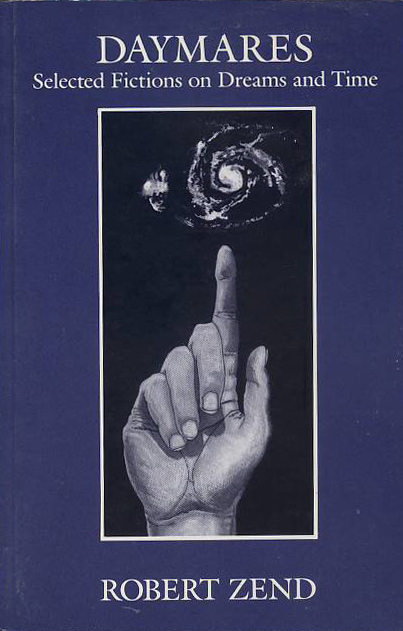
Daymares: Selected Fictions on Dreams and Time
Vancouver: Cacanadadada Press, 1991

          About a year ago, a frend who used to live next door to Robert Zend gave me a copy of Daymares. Already having a stack of unread books at my bedside, I put it on my shelf for another day. Recently, I came across his name and retrieved the book from the tail-end of my short story collection. Now I can hardly put it down.
          Zend’s stories continually involute expectations about identity, time, and the distinction between reality and illusion. Shape-shifting characters, dreams within dreams, anachronisms, and paradoxes keep the reader adrift in a fantastical realm whose often dark irrationality explores mysteries of humanity: uncharted cognitive depths, the burdens of history, and the continuities between self and other.
          Daymares is a genre-blending work containing mostly short stories but also poetry and concrete poetry (“typescapes”). Some of the stories offer twists on religious mythology, including “The End of the World,” a comical revision of the Apocalypse in which the narrator scoffs, “Mankind, shmankind!” and boffs his neighbour’s wife as the four horsemen gallop toward the annihilation of the earth into smithereens—sort of. Others, such as “A Dream About the Centre,” explore the vastness of human cognition in the blink of a waking dream. One of the most moving stories, “My Baby Brother,” confounds time and identity in exploring issues of Holocaust death, survival, and the continuity of life.
          This Hungarian-Canadian writer will appeal to anyone with a penchant for Jorge Luis Borges’ mind-bending labyrinths, paradoxes, and dreamscapes. But Zend is an original swimming in a similar stream of fantasy and dream, navigated with keen intellect and feeling for the human condition. Borges wrote to Zend: “You consider me one of your masters, yet you were my pupil even before reading my work.”
          After relishing Daymares, I eagerly sought other works by Zend and ordered From Zero to One, a collection of his poems. Click here for Glenn Gould’s tribute to Zend on the back jacket.
          Below I’m reproducing an excerpt from Zend’s introduction to the book as well as two poems and two typescapes.

from “Introduction to an unpublished manuscript entitled
Selected Dreams”


          Although the Sun declared it a false doctrine, we still secretly accept the creed of Darkness, which teaches us that the land of dreams is common for everybody: it is not three-billion individually enclosed lands, but one. It obeys not three-billion personal laws, but one. It is a common land where we all meet each other, and these meetings will be unremembered during the linear Sun-time, by the vertically erected individuals who intermingle on the curved, collective male-plane. We all believe—though we know it isn’t true—that the land into which we submerge (while our horizontal bodies rest, tossing and turning about) is real, as real, if not more, than that from which we sank down. Originally, we were all the sons and daughters of Darkness: that was our prenatal land, the Atlantis-womb before the ejaculating rays of the aroused Sun-lord fertilized it, generating us who grow and pop out into the light. We never lose our nostalgia for the cool, dank, soily shadow-shapes of the womb.
          This is the world of dreams from which, at the very beginning of our personal lives it was so hard to be torn away. This is where we spent most of our early time, sleeping. Gradually, as the duration of our sojourns in that world decreased, our time in the clear, collective, articulate world correspondingly increased. The sword of merciful death finally liberates us forever, from the task of wasting even short hours in this male-reality, so that we can return completely to virgin mother-existence. Death allows us back to the land of time-spacelessness; to the tiny centre point of our individual self which strangely coincides with the three-billion other human centre-points, with those of the dead ones, with those of our more ancient ancestors: swimming, crawling and flying creatures, rooting-stretching plants and perhaps even with the centre-points of other alien-living-units, of agitatedly swirling atoms and majestically rotating galaxies.
          The real difficulty, for both the individual and the race, is not to learn the language of Darkness, but rather to learn the language of the Sun. Only the minuscule peak of our iceberg-soul uses Sun-speech. Its bulky expanse hidden under the surface still speaks the ancient language of Darkness: we consist mainly of dreams and only negligibly of wakefulness. By collective agreement between the Sun-ruled ego-peaks, which engage themselves in labyrinthine sociopolitical mythologies, this original language is marked with the stamp of insanity. This “insanity” lurking in all of us, even at high-noon, never stops giving whispered suggestions to our seemingly sane, wakeful structures. That is why we periodically grow sick of them and, through bloody revolutions, try to change them back to the original Utopia which had existed in the Atlantean womb-past, and not, as is erroneously hypothesized, in the Sun-like, glowing erection-future. All these attempts are, of course, futile. It is impossible to convert rocks into clouds, father into mother, iron into fantasy. We don’t have to learn to speak the language of dreams because we never forget to speak it: we practise it a third of every day; we all come from it, persons as well as species. It is our real mother tongue: translations into it are impossible. Everything else: literature, communication, institutions, law, family, society, love, cities, technology, religion, art and science, is already a translation from it—and unsuccessful translations at that: like ruins disintegrating in an alien environment.
          You can dream of a lion which is as harmless and cute as an Easter Bunny, or of a motionless pillar, which is as menacing as a rapist. You can dream of lovemaking as unpleasant as slavery, or of bland, grey flower-pots as warm and sensuous as rosy-hued flesh. Translating them with Sun-lit words gives rise to impenetrable jungles of misunderstanding in which sameness means difference; nearness, distance; flux, solidity; consecutiveness, simultaneity and repetition, comparison. This language knows no word, its events do not provoke emotions, its objects do not lend themselves to symbolization. On the contrary, it informs us of the bankruptcy of words: its emotions provoke events and its abstract objects are expressions of solid symbols.
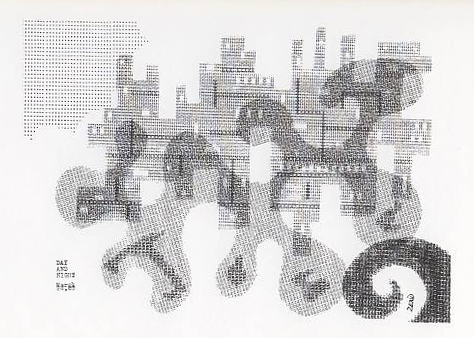
Day and Night (1983)


The Dream-Cycle

Nothing dreams Something
  but Something is mostly Void

    Void dreams Matter
      but Matter is mostly Vacuum

        Vacuum dreams a Universe
          but the Universe is mostly Ether

            Ether dreams Galaxies
              but a Galaxy is mostly Space

                Space dreams Solar Systems
                  but a Solar system is mostly Sky

                    Sky dreams Celestial Bodies
                        but a Celestial Body is mostly Hollow

                          Hollowness dreams Beings
                            but a Being is mostly Empty

                              Emptiness dreams Consciousness
                                but Consciousness is mostly Sleep

                                  Sleep dreams Wakefulness
                                    but Wakefulness is mostly Irrational

                                      Irrationality dreams Knowledge
                                        but Knowledge is mostly Chaos

                                          Chaos dreams Existence
                                            but Existence is mostly Nothing

Nothing dreams Everything
before it is ready to awake

1973

Awakening from Dreams (1983)


After I Die

After I die
Time will be Space
and I will move back and forth in it
    every step a generation
    and I will watch
    the child I was
    the Man I was—
        After I die
        “I” will be “he”

After I die
Now will be Then
and I will remember all who lived
    Napoleon and Socrates
    and Columbus and Leonardo
    and Moses and Gilgamesh
    and all the nameless ones
    will be like days in a long life—
        After I die
        “I” will be “they”

After I die
Here will be There
and I will expand or shrink at will
    the soul of atoms and their particles
    of suns and their planets
    of galaxies and their solar systems
    of universes and their galaxies
    will be my soul and they will rotate in me—
        After I die
        “I” will be “it”

After I die
If will be When
and I will fill all holes with existence
    making things that were not made
    living lives that were unlived
    growing histories that could have happened
    creating worlds that had been aborted
    realizing possibilities that never were—
        After I die
        “I” will be “god”

After I die
I will be nothing
and I am just dreaming about the impossible
projecting a tunnel under the prison wall
    but tomorrow: to go
    tomorrow: to talk
    tomorrow: to work
    tomorrow: to play
    tomorrow: to cope
    tomorrow: to survive—
        After I die “yes” will be “no”
        and everything will become so easy

Wednesday, September 20, 1973

Photo credit: Aniko Zend


Camille Martin

Miro Malish art opening (Toronto)

A rare opportunity to see a substantial collection of oils and pastels by Miro Malish, Czech-Canadian surrealist:

death’s head redux

bounty from the sea


I posted a collage for the anthropomorphic category in Poemicstrip. Check out the fantastic work there!

Continuing a recent post about my breast cancer, this collage is another of the death’s heads that started popping up in my collages and some of the poems in Sonnets following my diagnosis four years ago. I didn’t think until after the collage was finished about the significance of the two masks under the wings: breasts, either cleansed of the disease or drained of life.

Thanks to Piotr Szreniawski for sharing Poemicstrip.
“bounty from the sea” first appeared on the cover of Fell Swoop 86.


Camille Martin

shell bud (for Hanna)


Camille Martin
http://www.camillemartin.ca

Poemicstrips

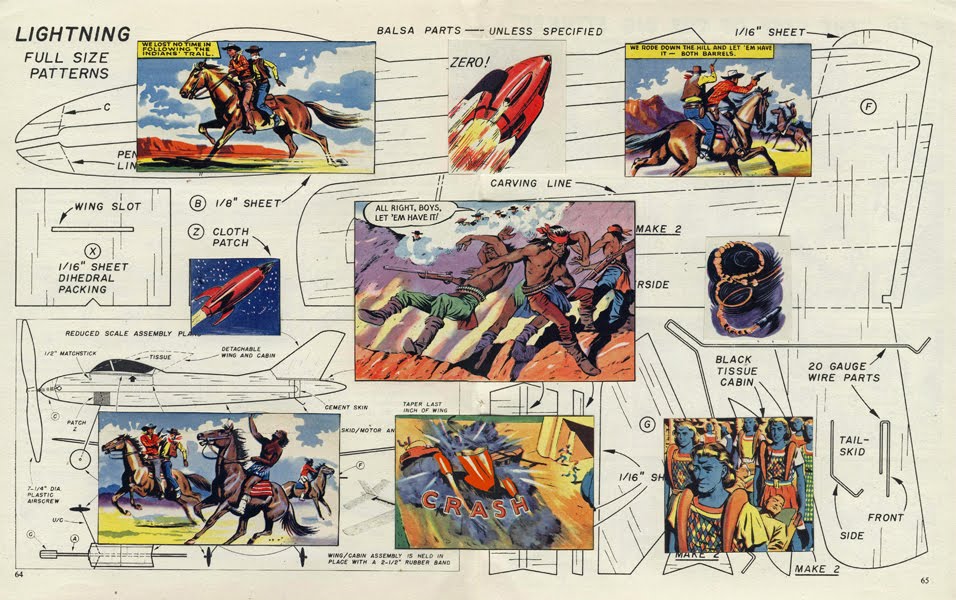
I just posted a comic strip collage, “Full Size Patterns,” at Piotr Szreniawski’s Poemicstrip blog – contributions also by Gary Barwin, Sven Staelens, Rappel, and others. I think Piotr is looking for other contributors, so check it out!

About Full Size Patterns:
I alternated frames of “cowboy and Indian” and sci-fi comic strips from 1950s British Boy Scout magazines, narratives that play out the idea of the “other” in society. In one narrative, the cowboys kill the Indian “others,” a failure of their civilization to recognize the humanity of the native people. In the other narrative, the earthmen’s rocket fails and crashes, but instead of the alien “others” killing the earthmen, they help them.


Camille Martin

two collages

a double exposure remembers


full circle


Camille Martin
http://www.shearsman.com/pages/books/catalog/2010/martin.html

Jiří Kolář

My partner, Jiri, just arrived back from Czechoslovakia and Paris and brought home some gifts from Jan Sekal, a friend in Paris who is a professional photographer: for Jiri, a black rabbit felt fedora that suits him to a T (without making him look orthodox). For me, a signed, original collage by Jiří Kolář:

The collage consists of two postcards, one of La Place des Vosges with the central grounds torn out, and the other of Portrait des trois hommes by Vincent François André showing through the gap. It’s fairly simple in its execution, but deceptively simple in what it evokes. The gap looks alternately like a reflecting pond in a small-scale model of the Place des Vosges, in which two giants are reflected (the third giant is out of sight, just to the right of the gap), and a window into the fantastical depths of the earth. It also looks like what it is, its process. The materials are found, as in so many collages: two superimposed postcards in dialogue with each other through the torn hole.

I was holding an original collage by one of my most admired artists, and felt a visceral connection with the past that has inspired some of my collages. I felt a little giddy.

Jan also gave us both some of his own photographs, which I will post in the next couple of days.

Thanks, Jan.

Camille Martin
Sonnets

a collage for the new year


under the dome

collage: Camille Martin

collage: Camille Martin


Camille Martin
http://www.camillemartin.ca

The Birth of Newton

Collage by Camille Martin

Collage by Camille Martin


more collages
here


Camille Martin
http://www.camillemartin.ca