Category Archives: poetry

debut-esque

Editors Amy King and Ana Bozicevic just debuted a terrific new online magazine, esque. A unique feature is the division into two parts: “oetry” (“the kitchen sink”) and “ifesto” (“everything but”). An excerpt from the former:

Cole Swensen, from “Stele”

. . . .

Click on the excerpt to read the rest of the poem as well as work by the other contributors.

Camille

“not all slopes are tragic . . .”


Anny Ballardini kindly posted a poem of mine from “Looms,” a work-in-progress, to update her Fieralingue / Poet’s Corner website:


from “Looms”

*

not all slopes
are tragic. . . .

Click on the poem to read the rest of it.


Camille Martin

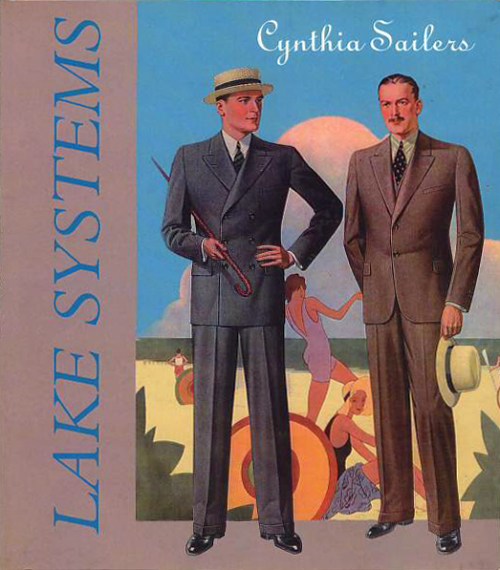
Cynthia Sailers: from Lake Systems


Cynthia Sailers, Lake Systems
(Oakland, Tougher Disguises Press, 2004)

Recently plucked a book more or less at random from my poetry bookcases and was delighted to rediscover one of my favourite book covers (and books): Cynthia Sailers’ Lake Systems. Those monumental men with knife pleats remind me of Anton Räderscheidt’s self-portrait—like Räderscheidt doing an ad for Coppertone.

It was a pleasure to re-read the poems in this collection, whose style swings from Ashberian lyrical to flarfish. I admire a book (and a poet) that doesn’t shirk from such swings, that doesn’t necessarily strive for cohesion or (shudder) authentic voice. Here are two:

from “10 Americans”

And yet we were the individuals who do not relate
to one another. When we find there’s a desire
to be crowded, to be all the numbers, or the observers
who would see in the faces that those faces were not
the answer. That those faces only pointed to
the amphitheatre of the mind in an hour of romantic
enthusiasm. If only we were immigrated, if only
we were knowledge, not like gardens, but underneath
it all, a shape of equal vividness, constrained by the one
thought we thought we wanted. A tracing of ourselves
against the beauty of lakes and grasses and colonial houses.
To be brushed along and kept close to the skin.
We were prepared to admit a solution for the lower forms
of life, for the seductive centuries and a break with
the past. And yet we were oscillating between the part
of ourselves that was set in motion and the part that lives
underground. I would sometimes get the feeling that
these parts were wanting to identify with the other, to find
another place to be free. A place with a view, a place
inside. To be freethinkers, to be identified with astrology.
If only their astrology was now moving them to new
places, moving them out of their feeling of oppression.

from “Lake Systems”:

The I(s) I Follow After

for Joan Retallack

I will not democracy churches conjecture
I pornography circa 1930 mockery
the bird I (pornography) usually suspect
dustbowl I situate o, love I imitate(or)
automatic I pepto-bismol I
juction boobs of new country I
laminate I New Jersey I, I
sensual topical bloom
I double-parked yoga live
grammatical attachment I office
I too numerous too non-union I life-
lessly convene I abstract mass
adulterous subject I promising water deficiency
I witness prison language I advances
western I p.s. represent misanthropic I
mid-century I nepotism I lost cause
I necessitate the point of impact I polygraph


Camille Martin

Poetic Polyphony in Scott Thurston’s Internal Rhyme

Shearsman Books, 2010


          In a previous post on musicality in poetry, I discussed the translation of simultaneity in music into a comparable literary expression. By simultaneity in music I mean polyphony, the vertical dimension of notes on the staff: the notes in a chord sound simultaneously as do the voices in a fugue. In literature, polyphony can be suggested by the simultaneity of thoughts, dialogue, or action by characters, as in the eight voices of the fugue in Joyce’s Ulysses.
          Scott Thurston’s Internal Rhyme beautifully translates the melodic and harmonic dimensions of music into poetry. The spatial division of each poem into quadrants allows both a horizontal (melodic) and a vertical (harmonic) reading of the lines. The vertical resonates with the horizontal, and the dialogue between melody and harmony opens up the semantic field. To use another musical analogy, what emerges from this dialogue is harmonic overtones, the acoustic phenomenon that enriches the experience of music.
          Because the most startling aspect of this collection is its formal innovation, I’d like to focus on possible strategies for the reader. Here’s an example from Internal Rhyme:

                    what I give myself to            haunted by surface
                    a polished shine                    or cloudy patina
                    it takes art to maintain         a perpetual crisis
                    taking everything                  you have

                    I want to give                        my heart out
                    to your ideal world                in its tension
                    I have to wait                        for the memory
                    for the poem                          to make it right

          At first blush, the possibilities presented by the quadrants seemed to me a kind of combinatorics, a conceptual experiment that reminded me a little of Raymond Queneau’s Cent mille milliards de poèmes, a series of ten sonnets whose interchangeable lines offer to the reader an almost inexhaustible series of permutations—to be mathematically precise, one hundred trillion sonnets can be generated from the conceptual machine of the ten original sonnets. Queneau’s Oulipian experiment stretches the limits of the readability of the set of ten sonnets in all of their permutations—an impossibly large number sonnets for the mortal reader to consume.
          In the case of Thurston’s quadrants, three obvious possibilities occurred to me: line-by-line (horizontally), left column-right column (vertically), and four vertical columns (left, right, left, right). But there was something disasatisfying about treating each of these readings equally, so I needed to find a more natural way to integrate the horizontal with the vertical. It occurred to me that treating the page as a musical score gave me a more rewarding entry into the intricacies suggested by the quadrants. In other words, I read the poem as horizontal (melodic) lines and allow my peripheral vision, so to speak, to note vertical (harmonic) configurations of three or four lines that enrich the reading, perhaps turning the poem on itself or opening up other semantic possibilities.
          First, my conscious mind gravitates toward a traditional line-by-line reading—partly from habit and partly because the syntactical flow of the poems in Internal Rhyme is most apparent that way. For example, in the above poem, although there’s no punctuation, my mind readily creates syntactical clusters and sentences from a horizontal reading.
          Note also the division into two equal parts that such a reading suggests: “what I give myself to” opens the first stanza, and “I want to give” opens the second. Metapoetically, the poem juxtaposes the poet’s experience and perception (what he gives himself to) with his translation of that experience into poetry (his desire to give himself over to the tension in the ideal world of the poem: the “perpetual crisis” that poetry sustains). The last two lines constitute the poem’s volta, in this case the condition upon which that translation into poetry is contingent: waiting for his memory of tension within his own experience.
          But the spatial division of the poem into quadrants compels me to notice the vertical possibilities as well. In the above poem, for example, a horizontal reading yields

              I have to wait / for the memory / for the poem / to make it right

whereas a vertical reading might yield

              I have to wait / for the poem / for the memory / to make it right

          Thus waiting for the memory of tension (in the previous reading) is aligned with waiting for the poem to emerge for the memory to “make it right.” The boundaries between experience, memory and poetic creation are thus nicely blurred into a riddle: is it unresolved memory that drives the poem into creation, or the poem’s creation that illuminates cognitive mysteries?
          Such an overlay of readings expands the poem exponentially as the mind picks up, consciously or subconsciously, variations in the configurations of lines. Reading the poems in this way allows me to blend the melodic and the harmonic dimensions to create a kind of polyphonic experience. To return to a musical analogy, the intricate texture of this overlay is like the harmonic overtones that enrich the experience of music.
          The analogies between music and poetry are ancient, and the innovative musicality of Internal Rhyme offers a richly legible and resonant kind of poetic polyphony.

* * *

From the Shearsman Books website:
Scott Thurston lectures at the University of Salford where he runs a Masters in Innovative and Experimental Creative Writing. He co-runs The Other Room reading series in Manchester, edits The Radiator, a little magazine of poetics, and co-edits The Journal of British and Irish Innovative Poetry with Robert Sheppard. He has published three collections with Shearsman.


Camille Martin

Time-Sensitive Material

There’s a new poetry blog in town: Toronto poet David Dowker’s Time-Sensitive Material.

David edited The Alterran Poetry Assemblage, a literary magazine published from 2000-2005—it’s a treasure trove, and David has taken the trouble to have the contents archived by the National Library of Canada Electronic Collection.

A recent post on his blog consists of links to contributions to The Alterran Poetry Assemblage from Lise Downe, Chris Stroffolino, Lisa Robertson, Charles Alexander, David Dowker, Fiona Templeton, and many more (I’m in there somewhere).

I look forward to future postings!


Camille Martin

Looms in Talking Writing

Three poems from “Looms” (a work in progress) and a collage (Divers Remember the Naming of Gifts) recently appeared in Talking Writing: A Literary Magazine.


Camille Martin

Poemicstrips

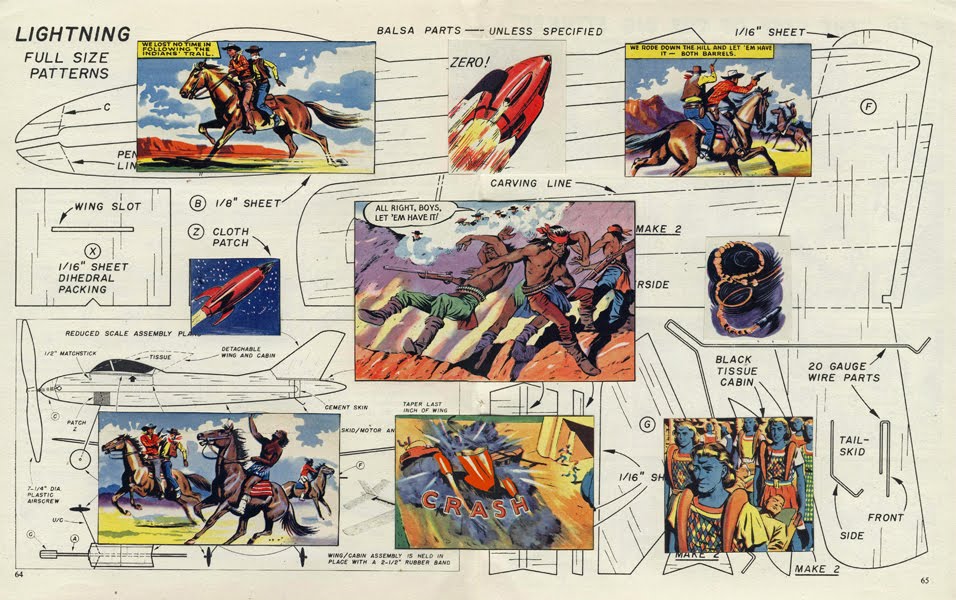
I just posted a comic strip collage, “Full Size Patterns,” at Piotr Szreniawski’s Poemicstrip blog – contributions also by Gary Barwin, Sven Staelens, Rappel, and others. I think Piotr is looking for other contributors, so check it out!

About Full Size Patterns:
I alternated frames of “cowboy and Indian” and sci-fi comic strips from 1950s British Boy Scout magazines, narratives that play out the idea of the “other” in society. In one narrative, the cowboys kill the Indian “others,” a failure of their civilization to recognize the humanity of the native people. In the other narrative, the earthmen’s rocket fails and crashes, but instead of the alien “others” killing the earthmen, they help them.


Camille Martin

The Lowly Eye: Samuel Greenberg’s Platonic Argument

         Shortly after my previous post about American poet Samuel Greenberg (1893 – 1917), Mark Woods gave a link to it from his website wood s lot: the fitful tracing of a portal along with a poem by Greenberg that I hadn’t mentioned. I love the idea of people having a favourite Greenberg poem, and Michael’s post brought to my attention one that I hadn’t yet read, “Memory” (64), which begins with the startling line “Gluttonous helium of thought’s endowment.”
          I had mentioned irony in Greenberg’s poems, which first occurred to me as I read “Immortality” (62), a poem that owes its own immortality in part to Hart Crane’s appropriation of some of its lines in “Emblems of Conduct.” Because of his lack of formal education, Greenberg is sometimes viewed as a naive poet whose rather purplish style implies an uncritical and rapturous praise of the powers of poetry to describe nature and express emotions. But in my further readings of Greenberg’s poems, I found that his tone is more ironic than previous critics have noted. For example, L. S. Dembo’s comparison of Hart Crane’s “Emblems of Conduct” (which is mostly a pastiche of lines from various poems by Greenberg) and Greenberg’s original lines is an admirably sustained and insightful analysis whose purpose is to demonstrate that Crane “has changed the whole tone of Greenberg’s work from romantic enthusiasm to irony” (320).
          However, in the following I want to show that many of Greenberg’s poems investigate the problematic duality of perception’s illusion and an ungraspable reality through argumentation that sometimes relies on irony. Greenberg’s philosophical and aesthetic stance, which is in essence a version of Platonism, sometimes ironically attributes authority to poetry and the senses and then dethrones them to show the necessarily mediated reality that arises from human attempts to experience and describe the world.
          I’d like to preface my analysis by stating that the ambiguity of Greenberg’s punctuation and syntax make interpretations speculative to an extent, and because of the difficulty of reading his work and to explain how I arrived at my interpretation, I’ll attempt “translations” of his lines. Prosaic and faulty as these glosses may be, I nonetheless hope that they show his deliberately ironic tone in working out a philosophical problem.
          For example, “The Laureate” (57) might at first blush seem to be unadulterated praise of the poet’s powers, but on closer study Greenberg’s argument comes through clearly. The first clue to the poem’s irony is in the title’s rather pompous reference to the poet. Greenberg’s opening apostrophe poses the central question of his sonnet:

                    Poet O soul! hast thou within thy wing the raise
                    That nature doth disown with complete color,
                    The enlightening beat of Heaven’s plausive royalty?—

          The question mark is an addition of the 1947 collection, a plausible assumption of the intended syntax, perhaps something like the following: Poet, does the flight of your inspiration fall short of nature, with its complete range of colour (as opposed to the limited human palette with which you describe nature)? Does your poetry contain the enlightening rhythms of heavenly authority?
          In the lines that follow, Greenberg extols the poet’s inspired vision of nature by contrasting clouds and earth:

                    As the clouds in their nudity softly sensate,
                    Uplift the sordid earth from dark slumber
                    And deviate spirits mystic woob,
                    Create animations about the hidden angels,
                    Regulate love in lofty nobles’ helm.
                    Conquer, but to unconquer self’s tomb,
                    Knight the command of universal thought,
                    Thou who art the stream of souls’ flow.

In other words, just as the softly perceptible clouds uplift the base earth from its dark sleep and womb of strange spirits, so does the poet animate hidden angels, give meaning to love, conquer mortality (but also embrace it), and express universal thoughts and feelings. These lines seem to praise the “laureate’s” divine powers.
          But it is the last three lines that reveal the irony behind his adulation of poetry:

                    O Lyre, ne’er can’st thou forgive praise,
                    For joy hides its stupendous coverings;
                    The quality of senses create and overthrow.

To Greenberg, poetry should not become conceited by such praise because its joys conceal its own “stupendous coverings,” its illusory colouring and symbolizing of reality. Our very senses create the qualities that poetry ascribes to reality. However, in the last word of the poem, “overthrow,” perhaps he metapoetically conveys the idea that the poet’s senses are also capable of revealing those qualities for the illusions that they are, thus justifying his own poem.
          It’s possible that I’m over-reading with my thoughts on “overthrow,” but I hope that the above offers a general idea of his sonnet’s argument regarding human perception and expression: poetry and the senses give pleasure, but these are illusory expressions of a reality that cannot be grasped by limited human means. The senses can experience, and poetry can describe, but the strong, unmediated light of reality lies beyond the ability of mere mortals to see.
          In “Enigmas” (49), Greenberg describes this dichotomy as “the beam / Of fire from the sun” versus his own “slumber in imagination of spheres . . . and moon-like shapes.” In “Nature’s Cover” (10), reality has a “[s]mooth, tangible, accessible skin / That gives its sensual, carnal kin,” unlike the unknowable “glossy smoke” and “spongy blue” of the “heavens.” In “The Cloud” (12), the poet’s power is mere “gilt” compared with the cloud that is “far from our souls.” And in “Daylight” (50), he addresses reality’s light as the “[g]leam” that with its “all-power[ful]” rays (“strings”) assists the poet’s “muse” to express “desire”:

                    The horizon hues give vent
                    To thousand lofty thoughts of poetry.
                    The floating marble-like clouds
                    Form incomprehensive molds;
                    But the lowly eye views this all
                    And, from within, peals its classic melancholy folds.

The clouds and horizon, in Greenberg’s symbolism, imply the unknowable realm. On the other hand, Greenberg often uses forms and colours to signify limited (“incomprehensive”) human apprehension of nature through imperfect faculties. Thus the poet’s limited perception sees only the colours of the horizon, inspiring poetry, and perceives only shapes from the clouds, whose resemblance to marble contributes to their aura of permanence and perfection. Perception’s “lowly eye” views an ultimately unknowable nature, attributes qualities and symbols to it, and creates cognitive images that are inherently limited. The reality beyond human grasp is transformed by the poet’s “melancholy folds” into poor representations of what the mind and senses cannot directly apprehend.
          In fact, a fairly consistent set of symbols attesting to these concerns can be traced throughout Greenberg’s oeuvre: the unknowable is figured as divinity, heaven, eternity, truth, scepters, immersion, essence, nature, clouds, strong light, or the unseen realm beyond the horizon. On the other hand, the relatively frail human perception is figured as a world of dreams, memories, reflections, echoes, veils, webs, specks, vapours, hues, shapes, or shadows; base earth; or the illusory charms of beauty and language.
          The religious implications of this symbolism are obvious, and I’ll address the influence of Jewish spiritual tradition below in my discussion of Greenberg’s image of a “spiritual gate.” As well, his aesthetic stance follows the Renaissance recapitulation of Platonic philosophy and is similar to Michelangelo’s succinct statement: “The true work of art is but a shadow of the divine perfection.” This idea permeates Greenberg’s poetry and is at the heart of the irony in many of his poems, notably in “Immortality,” which I’ll quote here in full and try to untangle Greenberg’s gnarled syntax:

                    But only to be memories of spiritual gate,
                    Letting us feel the difference from the real;
                    Are not limits the sooth to formulate
                    Theories thereof, simply our ruler to feel?

This passage is especially tricky, but inverting the syntax helps to sort things out: Art is a limited human expression of a truth or divine reality, a kind of theory that we formulate in order to feel close to the divine. Isn’t the limitation of artistic expression, which allows us to sense our separation from an ungraspable reality, actually a memory of a spiritual gate to the divine?
          The next few lines give examples of the apparent power of artistic expression:

                    Basques of statuettes of eruptions long ago,
                    Of power in symmetry, marvel of thought
                    The crafts attempt, showing rare aspiration;
                    The museums of the ancient fine stones
                    For bowls and cups, found historians
                    Sacred adorations, the numismatist hath shown,

Here Greenberg states that the arts are ambitious: they create bodices of statuettes, and they show advancements in the power of human thought. The numismatist shows the love of historians for bowls and cups of precious stones in museums of ancient art.
          In this passage, Greenberg ironically praises the mimetic powers of art. That irony consists partly in the artistic objects that he chooses to invoke: not Michelangelo’s David, but statuettes, bowls, and cups. Even these more humble works of art (which he ironically describes as “showing rare aspiration” and expressing “marvel of thought”) show our attempt to recreate something of an unreachable divine reality. And the term “numismatist” contributes to Greenberg’s exploration of this duality, for the coin collector emphasizes the idea of the utilitarian and commercial side of human creative expression, further lending an ironic tone to his praise of art. And to emphasize his original question, Greenberg ends with the opening four lines, thus framing his examples of artworks with the idea of their “spiritual gate” to the divine.
          I’d like to dwell for a moment on Greenberg’s image of the “spiritual gate,” which might have roots in his Jewish faith. Marc Simon points out that “[p]robably much of what might be termed the Jewish experience had permeated Greenberg’s life, despite relatively little religious training in a schoolroom” (7). From 1901 until 1907, when he had to leave school at grade seven to work in a leather factory, he attended a public school, not a cheder. In his autobiography, he remembers, tongue in cheek, the “fancy problems,” “polished desks,” and “abnormal cheer” of his classrooms, where he describes himself as a “reaper of hard fact and geographical bliss,” “material” that nonetheless “served as an unconscious guide in my spiritual labors.” He would have absorbed Jewish faith and traditions at home, for his parents were observant Jews. And indeed, Greenberg’s poetry contains many references to his faith.
          In Jewish symbolism, a gate can refer to the gates of the Temple or the gates of heaven; open gates imply a closeness to God. The service that ends Yom Kippur is called “Ne’ilah,” which refers to the closing of the gates of prayer. According to Milton Steinberg in the Machzor Hadash, on Yom Kippur “the Jew saw a spiritual gate, an entranceway to a new relationship with God, an opportunity to change, to begin again” (761).
          Thus the spiritual gate in “Immortality,” an idea that infuses Greenberg’s poetics, may bear a relation to Jewish tradition. And although sometimes Greenberg seems to admire the power of poetry as a medium with which enter the “spiritual gates” and transport the mind to inspired heights, he also points out that after all, it is but a shadow of a divine reality.
          Greenberg’s work does present difficulties to the reader because of its effusive style and ambiguous syntax. But as several of his admirers have shown, careful readings of the poetry demonstrate him to be more sophisticated in his choices than it might at first appear. For example, Marc Simon’s study of the influence of Greenberg on Crane takes a positive tack in his revelation of Crane’s use and honing of Greenberg’s “techniques of repetition” (52).
          Likewise, Evalyn Shapiro, in her 1947 review of the collection edited by Holden and McManis, attributes originality to Greenberg’s work when she concludes that although Greenberg may have borrowed certain types of images from such sources as Palgrave’s Golden Treasury of the Best Songs and Lyrical Poems in the English Language, nonetheless during “the brief five-year period of his creative life he managed to evolve a poetic style of his own, including an idiom, a metric, and a symbolism” (160-61).
          And although John Berryman agrees with Allen Tate’s assessment of Greenberg’s work as “turgid and bathetic,” he also asserts that while Greenberg may have been “inexperienced” in his editing of his work, “he was not naïve.” Berryman also points out that because Greenberg “has been thought of so far, when thought of at all, as mad or simple . . . insistence is necessary upon the deliberate sane craft visible, at least by intention, all throughout [the 1947] volume” (505-506).
          As I mentioned in my previous post, Charles Bernstein appreciates Greenberg’s syntactical acrobatics and ambiguities as characteristics of a “radically modernist dimension”: “His swerve from syntax as a principal of clausal subordination and hierarchy opens up the field of serial apostrophe that pushes to liberate itself from the confines of ‘literary diction.’”
          In keeping with these positive assessments, I hope that my analysis shows that Greenberg’s poetic tone is not so simply a case of overblown Romantic enthusiasm, and that through a sometimes ironic tone he is working out a philosophical and spiritual problem in his awareness of the limitations of human perception.


* There is debate as to whether (or to what extent) editors should alter Greenberg’s spelling and punctuation to clarify meaning. For the sake of consistency, I’m presenting the versions in Poems by Samuel Greenberg: A Selection from the Manuscripts, the 1947 collection edited by Harold Holden and Jack McManis. Readers might want to refer to Michael Smith’s website Samuel Greenberg: American Poet, which presents less edited versions of some of the poems that I discuss.


Works Cited

Bernstein, Charles. “Samuel Greenberg & Grammatic Truth.” Sibila: Poesia e Cultura.

Berryman, John. “Review: Young Poets Dead.” The Sewanee Review 55.3 (1947): 504-514.

Dembo, L. S. “Hart Crane and Samuel Greenberg: What Is Plagiarism?” American Literature 32.3 (1960): 319-21.

Deutsch, Gotthard, Cyrus Adler, and Francis L. Cohen. “Ne’ilah.” Jewish Encyclopedia.

Greenberg, Samuel. Poems by Samuel Greenberg: A Selection from the Manuscripts. Eds. Harold Holden and Jack McManis. New York: Henry Holt, 1947.

Hirsch, Emil G. “Gate.” Jewish Encyclopedia.

Shapiro, Evalyn. “Review: From Nowhere.” Poetry 71.3 (1947): 158-62.

Simon, Marc. Samuel Greenberg, Hart Crane and the Lost Manuscripts. Atlantic Highlands, NJ: Humanities Press, 1978.

Smith, Michael, ed. Samuel Greenberg: American Poet.

Steinberg, Milton. Machzor Hadash.

Woods, Mark, ed. wood s lot: the fitful tracing of a portal.


Camille Martin

Samuel Greenberg’s Braided Secrets

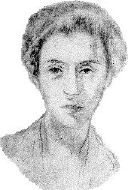
Self portrait, 1915


          Taking a cue from Charles Bernstein’s championing of the poetry of Samuel Greenberg (1893 – 1917), whose promise was cut short by tuberculosis at the age of twenty-three, I’ve been reading some of the poems readily available online through Michael Smith’s excellent website.
          Reception of Greenberg’s poems has been mixed. Allen Tate finds some of his work “turgid and bathetic,” although he also judges that “poetry of the twentieth century in the United States could not be complete without the publication of the poems of Samuel Greenberg.”
          Part of the difficulty of Greenberg’s work that gives rise to Tate’s claim of turgidity is its often vague or ambiguous syntax, its nonstandard punctuation, and its archaic poeticisms of diction and syntactical inversion. In a 1947 review, John Berryman judges that “Greenberg had with rare exceptions so little control over syntax (‘of grammatic assistance unguided’) that the best of them are inevitably those that . . . follow a catalogue development.” But while Berryman grants that the reader’s “allowances” in reading Greenberg’s can be “justifi[ed] in biography” (by which he means, I suppose, a less than ideal education), he also points out that time invested in the poems is often worthwhile, rewarding the reader with the realization that here is not vague inspiration (or, as James Laughlin, intending to be critical, put it, “unconscious dictation”) but instead craft and intention. Reading Berryman’s several astute interpretations of Greenberg’s poems, I gained an appreciation for Greenberg’s wielding of syntax.
          If Berryman’s attitude toward Greenberg’s syntactical acrobatics and ambiguities alternates between accepting them as limitations and elevating them to the level of deliberate craft, Bernstein’s assessment is less ambivalent: he appreciates them as characteristics of a “radically modernist dimension”: “His swerve from syntax as a principal of clausal subordination and hierarchy opens up the field of serial apostrophe that pushes to liberate itself from the confines of ‘literary diction.’”
          For me, both are true to a degree. Greenberg’s work does sometimes suffer from overwrought syntax and diction, but at the same time he is pushing the possibilities of language into a kind of musicality that cannot be expressed in a plainer style. The seemingly off-kilter clauses of his sentences, nudged out of the standard hierarchy, create a complex, braided language that withholds secrets. And the floating strands of that texture counter-intuitively creates more possibilities in which readers can interweave meaning.
         Below are three of his more interesting poems. In a subsequent post, I’ll discuss one of them in more detail and address the question, Is there sometimes an ironic stance at the heart of what Tate calls Greenberg’s bathos?

Immortality

But only to be memories of spiritual gate
Leting us feel the difference from the real
Are not limits the sooth to formulate
Theories thereof, simply our ruler to feel?
Basques of statuets of Eruptions long ago,
Of power in semetry, marvel of thought
The crafts attempt, showing rare aspiration
The museums of the ancient fine stones
For bowels and cups, found Historians
Sacred adorations, the numismatist hath shown
But only to be memories of spiritual gate
Leting us feel, the difference from the real
Are not limits, the sooth to formulate
Theories thereof, simply our ruler to feel?,

Night

Night! the lute as daylight But dim
A cloister strangly near a hill
Rang the evening chimes of prayor
The shadows of the miniature lamps
Shaped strange unseen, frightful creatures
Of horrid ghosts, vailed in pale caps
The solitude teeming in its hush
Let the unseen noises of insects clear
Buzz in their melancholy wiery hum
Dreams are short, But their Beauties are
Rare, night is long, causes thought
Its Freedom, of Fantasie to acquire
The grey demon clouds covered Heaven
Which hid the moon, but stars retreating fought

The Glass Bubles

The motion of gathering loops of Water
Must either Burst – or remain in a moment
The violet colours Through the glass
Throw up – little swellings that appear
And spatter – as soon as another strikes
And is Born – so pure are they of coloured
Hues that we feel the absent strength of
its power – when they Begin – they gather
Like sand on the Beach – each buble
Contains a complete eye of water.


Camille Martin

unarmed & in living colour

Michael Mann has just produced a couple of colourful issues of unarmed, his modestly produced little treasures of magazines and chaps. unarmed #62 features a collage by Steve Dalachinsky on the cover:

Included in this issue are one of mine, “The Sword’s Brayer” (a homolinguistic satire on The Lord’s Prayer), as well as poems by Simon Cutts, Joel Dailey, Sheila E. Murphy, Michael Basinski, Vernon Frazer, Nicholas Ravinkar, Tom Weigel, Michael the Mann himself, and many others. Here are a couple of samples from the issue:

39.
by Tom Weigel


The lark sings a shut case
but to be quick there’s nothing I want
only bird friends chatter & congregations
functional stuff without guile
ripe grapes of an old German novella
read at night against a cold snap in Spring
it’s back there with film & the art of letters
picking up the odd piece of scrap iron
the words SILVER FLOSS on a can of sauerkraut
I think of LOVE on a slow walk
among drowsy lilacs away from noise
when the ice cream truck sounds its chimes
down the streets of hopscotch & whiffle ball
past the car mechanic describing a special wrench

* * * * *

“nothing can be more contemptible
than to suppose public records to be true” wm blake (1757-1827)

by Michael Mann

my pockets carry the odor of sharpened coins
and flower-like meanings from the extremities of success
from which the upticked “twist-points” anchor the unknown

a just-never that unfolds in a spectacle of confusions
cat’s eye-bright in its scattering of the warners from the commons
the few communist-saints remain only to wait on our mudflap lady

still my luck holds its tongue in a rhapsody of reticence
a silence more reliable than passion, of lyrics made from time’s
contention that it was once forbidden to forbid

i tarry too with rules of cruelty
my polished shoes the progressive experience
of evolutionary hardware on the rivers of the medes

fearless oil-whatever-the-politics dilutes the absolute
in words perfect for both halting and advancing
the proof of which irrealists must watch through their fingers

an inly response to the unavailing spinozistic distaste for courage
my heroes, our carcerals, and the habits of flesh
“together in one bed (the dears)”

* * * * *

And the chap that came with #62,  Change of Address by Jake St. John, features on the back and front covers water colours by Kimball Lockhart:

An excerpt by Jake St. John:

Yesterday

seems far removed
from today
but the leaves
are now falling
from the recently
potted plants
and the photographs
have worn
at the corners
and faded slightly
over the young faces
that have now seen
many years
since the
meticulous crawl
of westward expansion


Camille Martin

Sonnets

Codes of Public Sleep

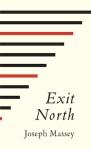
The Language of Desire to Speak: Joseph Massey’s Exit North


          Another just-received and welcome addition to Jay MillAr’s BookThug brood: Joseph Massey’s chapbook Exit North.
          In these poems, Massey depicts experience as a cross-hatch of perspective, sensory traces, and memory interlaced with symbols that continually learn and put to the test their nature-shaping patterns. If perception’s chaos is sorted out, linguistically occupied, cross-referenced with emotion and memory, it is also underlaid with emptiness: the page on which so much was believed to be written turns out to be blank.
          Experience lures language, which just as inevitably fades into silence just out of reach of the desire for the culmination of the senses in names, familiar and knowable. Attempts to understand, to order, to see yield “rhythms / looped through / the musicless field.” And this filtered experience of clamour full of trenchant detail leaves its traces as “an echo / gathering more / and more silence.”
          Massey’s poetic language enacts the rich mental process of knowing laced with the futility of perceiving the “sky clouded / by cloudlessness.” If, however, in the end we are left only with the desire to name, “to find / a word there,” that desire mitigates the abject state of being within impenetrable confusion: “the impulse [to speak] is enough.”
          A sampling to whet the appetite:

The Process

Cross-stitched
outside sounds
double the day’s

indoor confusion.
How to untwine
noise, to see.

There’s the bay,
highway slashed
beneath; water

a weaker shade
of gray than this
momentary sky’s

widening bruise.
The page turns
on the table, bare

despite all
I thought was
written there.

* * * *

Backdrop

From this hill’s vantage
all things become
whatever wind
makes them.

Electronic church bells
peal past overlapped
crow calls—

one left
circling,
recircling
a car lot.

* * * *

Bench

Cut grass, gasoline,
mound of rotted
weeds in a vacant lot

—the scent cast,
dense, with
each breeze—in

flustered shade.
What’s in a day’s
name: its slowly

summoned rhythms
looped through
the music-

less field—after-
noon’s clamor:
huddled

cars, deflated
bass lines
at a red light,

an argument
rattling the blue
aluminum trailer.

* * * *

Camille Martin
http://www.shearsman.com/pages/books/catalog/2010/martin.html

Monty Reid’s The Luskville Reductions: Poems from a Phantom Settlement

          Just received: Monty Reid’s Luskville Reductions (London, Ontario: Brick Books, 2010) Wonderful to become acquainted with Reid’s work and in particular with the lovely and meditative poems of loss explored in this collection. Luskville, as Reid points out, is a “phantom” settlement,which implies to me a ghost town.
          Well, perhaps not exactly. A phantom settlement might never have contained a population substantial enough to merit a place name on a map much less incorporation as a town, but there it is on Google Earth or MapQuest, a name mysteriously planted in the midst of fields or perhaps at a deserted crossroads. Population: a couple of families of armadillos and a fox den. And perhaps a few human ghosts seeking a hamlet that never was.
          Reid explains in a brief preface that “Luskville is a phantom settlement on the Ottawa River in western Quebec. I lived there for five years, until my partner, nursing a suite of dissatisfactions, returned to Alberta in 1994.  Before she left, she planted a dozen varieties of daylilies.” The phantom settlement is the appropriately poignant location for the theme of the failed relationship in which the beloved has moved away, and left a reminder of her presence with a garden of daylilies.
          The word “reductions” hinges on at least a couple of meanings that resonate throughout the book. Most obviously, the phantom settlement of Luskville as well as the life of the speaker of these poems have been reduced by the absence of his lover. And the places and objects in Luskville that constantly remind the speaker of his loss become reduced or distilled with reminders of her, and he displaces his grief onto the world that she once inhabited, rehearsing through these distillations stubborn traces of their life together that infuse the present with the past. The concentrated loci of presence of the lost lover within her absence form the predominant trope in these poems.
          The poems aren’t all explicitly about the loss of his partner, but even when he’s describing a garden hose and the traces of its “soul” in the kinks and dead bugs that remain as he is storing the hose for winter, the more devastating loss and its traces hover over all of these poems, whose emotional impact is most effective when the correspondence between phantom and displaced grief is most understated.

A sample:

The rain is finished

but the way rain beads on the dented fenders
of what has been loved

isn’t.

The rain is finished

but the sheen of rain still on the concrete
isn’t.

Rags of light
pegged behind the thunderclouds.

The rain is finished
but there is always something

in the lid of the body
that resists

and something with bigger holes in it
than the holes in rain.

**
**

I am awake
again

a slight fragrance in the room
or the memory of a slight fragrance

like the lotion I rubbed into your shoulders
and the hard little scar low on your back
where you had the mole removed

dead skin you said

but at night it would shine a little
anyway.

How far away
is it, again?

Rub the stars
and the glow still finds us

even though the source is vanishing
at incomprehensible speed.

**
**

Camille Martin

Reading the Minds of Events: Leslie Scalapino’s Plural Time

The following essay was published in a critical feature on Leslie Scalapino in HOW2 2.2 (Spring 2004).


Reading the Minds of Events:
Leslie Scalapino’s Plural Time

Camille Martin


In a stream of reassuring
argument the memory
forms a flight of steps
swinging out over the

Void …

—Norma Cole1

Narrative is neither an oppressor to be obliterated nor the validating force of all literary impulse.

—Carla Harryman2

          One of Leslie Scalapino’s primary concerns in her poetry is to question conventional ways of thinking about time in relation to event, experience, memory, and narrative. Her work relentlessly interrogates narrativistic categories and exposes essentialist ways of thinking about time and memory. Scalapino does not deny narrative’s causal and sequential linkage of events as a phenomenon in its own right. Instead, she uses narrative to question commonly accepted immanences within its framework.
          Unlike some work in the experimental literary realm with which she is associated, Scalapino’s poetry seems at first blush referentially and syntactically normative—or at least much of it is not so disjunctive that the reader cannot discern an underlying conventional sentence structure. People, events and objects often seem to be situated in a specific time and place, even though that place might not be described with many details. Indeed, the tone of her poetry can seem flat and stark, particularly to those unaccustomed to reading her work or unfamiliar with her philosophical project. The work seems to lack dimensions that might lend it the texture, feeling, or depth to which readers are accustomed in more conventionally descriptive or narrative writing. In her poetry, people sometimes seem faceless; activity takes place without psychologized or emotional drama; poetic sequences often omit a definite temporal or spatial orientation (instead, things seem to exist and occur in relation to all other things); and boundaries between self and other, public and private, past and present are everywhere transgressed. In addition, the iteration of actions or images in varying contexts gives the work a radically unfamiliar quality.
          It is just this feeling of an unfamiliar mental terrain that Scalapino constructs in order to demonstrate the illusions of hierarchy that conventional structuring of language can create and to show how this hierarchy influences the interpretation of one’s experience. For example, conventional narratives tend to place events along a temporal echelon of past, present, and future and to impose a structure of causality on events and phenomena. These temporal and causal conventions structure events and thought so that “activity and time per se” become “a condition of tradition.” Thus “both time and activity are a ‘lost mass’ at any time,” 3 and experience is drained of the kind of intelligibility that Scalapino associates with the non-hierarchical and simultaneous presentation of past, present, and future.
          In her writing, Scalapino attempts to imitate experience, as opposed to representing it according to a preestablished order, and to allow the multiple layers that create the memory of a single event to exist simultaneously without structuring them in an arrangement of prominence, causality, or in a psychologized drama. She reveals the simplest and most mundane of events to be instances of “social and interior constructions.” 4 She thereby demonstrates the radically impermanent nature of these events once they are no longer abstracted from present experience and attached to a constructed temporal order within a narrative or linked by allusion to other histories. She avoids the emblematic and descriptive framing of experience and resists the coalescing of experience into ordered wholes. Instead, her writing allows events (including memories themselves as events) to exist dependent upon one another, while avoiding the temptation to reify or essentialize experience. For when we attribute intrinsic existence to the phenomena of events, perceptions, or thoughts, it can seem deceptively natural to shape those phenomena into a conventional order whose relationship to the world seems transparent, inevitable, and even preordained. Scalapino chooses a more difficult kind of writing that critiques the construction of hierarchical dualities of inner and outer being, private and public experience, and the representation of events in time. She critiques the effects of such ordering by means of blurring conventional categories of existence and action in time and space.
          In the relentless thoroughness with which Scalapino attempts to dissolve putative boundaries separating dualistic realms, attribute a radical impermanence to all phenomena, and critique any last vestige of essence and immanence, her poetry resonates with certain strains of Eastern thought, and in particular with the thought of the ancient Buddhist philosopher and poet Nāgārjuna. Scalapino’s sympathetic reading of the philosophical verses of Nāgārjuna is evident not only in some of her essays but also in much of her poetry. My purpose in this essay is to show Scalapino’s treatment of the phenomena of time, memory, and event in her poetry by analyzing three works: a poem from the series “The Woman Who Could Read the Minds of Dogs,” a brief passage from New Time, and “bum series” from Way. I will also demonstrate the close affinity between the underlying philosophy of Scalapino’s poetry and Nāgārjuna’s philosophy of the Middle Way.
          Before elaborating on the influence of Eastern philosophy on Scalapino’s work, let us first read an early poem from the sequence “The Woman Who Could Read the Minds of Dogs.” Doing so will place in poetic context her concern with the relation between experience and the memory of past events, a theme that she continues to explore in subsequent books. A close reading of “on itself. His red hair was standing up) ‘I just began to weep’.” reveals how intertwined events and memories function within the poem to produce a feeling of temporal disorientation, and how the poem’s syntactical idiosyncrasies work in tandem with the content. 5 Here is the poem:


on itself. His red hair was standing up) “I just began to weep”.

Much later, after I had ceased to know the man who had once
described to me how , driving his new car with its top down
around and around the block (with his 1st wife in the car—
he said that he had been downtown with her drinking in a bar) ,
while he was looking for the entrance to the hotel parking lot ,
he had collided, or rather, had grazed the sides of 3 parked
cars ; as I said, it was much later when I was standing
on the jetty of a marina and watching a man standing up in
a motor boat, while he turned it around and around in circles.
“Well, (I remembered the man I had known saying about himself
—as I watched the man in the motor boat turning it slowly
on itself. His red hair was standing up) “I just began to weep”. 6


          Like many of the individual poems in “The Woman Who Could Read the Minds of Dogs,” “on itself” presents a narrative within a narrative. In the first of these, the speaker relates a story told to her by a friend in which he, driving with his first wife and circling around the block trying to find the entrance to a hotel parking lot, sideswipes three parked cars in the process. After this, he “just began to weep.” The speaker then relates a second incident, in which she sees a man in a motor boat going around in circles. In the second incident, her experience of seeing the circling boat reminds her of her friend’s story of circling in his car. The main common element in the two stories is the circular motion of the boat and car.
          Scalapino juxtaposes these two events and also conflates them through syntactical structures that disorient the reader’s sense of their discrete nature. In order to demonstrate how the syntax works to create a distinctive sensibility in regard to time, memory and experience, it may be helpful first to analyze the layers of time that overlap and spill into each other. There are five identifiable layers, in which (in chronological order):

1) a man and his first wife circle around a block in a car
2) the speaker hears the man tell of his experience in the car
3) the speaker sees a man circling in a boat
4) Scalapino writes the poem
5) the reader reads Scalapino’s poem

The list does not include events of remembrance, in which, for example, the man remembers his experience in the car, the speaker remembers the man telling of his experience in the car, and so forth. Such events of memory exist in potential infinitude.
          The poem opens with the third time frame in which the speaker, standing on the jetty of a marina, sees a man in a boat going in circles: “Much later, after I had ceased to know the man who had once / described to me how , driving his new car . . .” (emphasis added). The poem immediately switches to its two prior events: the man tells the speaker of circling in the car with his first wife, and prior to that, the event of circling around the block takes place. Midway through the poem, the speaker returns to the marina incident: “as I said, it was much later when I was standing / on the jetty of a marina . . .” In a parenthetical exegesis toward the end, Scalapino juxtaposes the three in simultaneity: “‘Well’, (I remembered the man I had known saying about himself /—as I watched the man in the motor boat turning it slowly / on itself. His red hair was standing up) ‘I just began to weep’.” By withholding syntactic closure and suspending the emotional gesture toward which the poem seems to be leading (“I just began to weep”), the whole poem seems like one long periodic sentence. The long subordinate and independent clauses, parenthetical interruptions, and grammatical solecisms are not resolved until the very end. However, unlike the formal result that might be expected of a sentence that is structured hierarchically, the effect of this periodic sentence that is more than the resolution of its parts is not order but temporal disorientation; one’s sense of time, place, and point of view is dislocated, suspended. The poem’s syntactical complexity and elliptical twists confound the events of narration and memory so that a sort of temporal reciprocity occurs among them: the playing field on which time, event, memory unfold is leveled. Furthermore, the superimposition of several narrative strands creates momentary confusion and produces a plurality of time frames. Thus the nature of historical events as discretely communicable phenomena is placed under question.
          If the dispersed sense of time and the syntactical ambiguities reticulate experience and memory rather than centralize it, they also move toward convergence, if not resolution. First, a simultaneity of events is suggested by the syntactical overlapping of the imagined time, the recalled time, and the current time. Second, there is a convergence of coinciding elements within the narratives; its topology resembles the converging of tributaries into one commingling and transformed river. Following the description of the man in the boat, the impetus of a linear narrative would logically be expected to continue in the context of the speaker and that man. The final gesture of weeping, although belonging semantically and originally to the man circling in his car, is attributable also to the speaker. If one disregards the parenthetical remark and the quotation marks in the last three lines, which refer to the context of the man in the car:


Well”, (I remembered the man I had known saying about himself
as I watched the man in the motor boat turning it slowly
on itself. His red hair was standing up) “I just began to weep
”. [Emphasis added.]


the syntactical inertia indeed impels us toward a weeping speaker, and by transference, to Scalapino and to the reader. The repetition of “standing” in reference to both the speaker and the man (“I was standing / on the jetty of a marina and watching a man standing up in / a motor boat . . . His red hair was standing up”) further implicates the speaker and the man in the boat in the same gesture, therefore facilitating the transference of “weeping” from the man to the speaker. Nevertheless, although weeping constitutes the emotional crux of the poem, the temporal disjunctures and clausal ambiguities result in the text’s resistance to the stabilization of the locus of the weeping and to the centrality of that emotional response.
          These simultaneous movements of divergence, reticulation and convergence generate much of the tension and instability of the poem. They also suggest metaphorically the schism between event and narrative; the associative infinity that, through the fractured (and fracturing) self, destabilizes the discrete historical event we know through conventional wisdom; and the coincidence (as in the simultaneity of “weeping”) of recreated events through that association.
          Scalapino is concerned to demonstrate a rupture between phenomena and our perception and memory of them, and ruptures between successive remembrances of a particular past event: “Perception itself is phenomena,” 7 and Scalapino is careful to distinguish between an event and the perceptual interpretation of that event. She is also concerned to demonstrate the same principle regarding writing as phenomenon. A consideration of the implied time frame of the writer further demonstrates this phenomenon of contradictory motions. First, the writing of narrative inherently exhibits the rupture between the writing and the event narrated: “The camera lens of writing is the split between oneself and reality. Which one sees first—view of dying and life—is inside, looking out into untroubled ‘experience.’” 8 Writing creates both a distancing from and a transformation of experience, in which the writer makes visible what was concealed. Scalapino’s writing of history involves the interplay among moments remote in time, as well as between those moments and the associations spawned by them in the speaker’s mind (and by extension, the reader’s mind). Such interplay, in a potentially infinite network recreating the past, is made accessible and public. The mind as creator of events and the writer as recorder of a thus pluralized history constitute the true narrative, for “No events occur. Because these are in the past. They don’t exist.” 9
          Lastly, there is the time frame of the poem’s reader, who also participates in and reconstructs the events of the narrative. In a phrase that echoes reader response theories, Scalapino writes, “Reading as imposing syntax, is creating reality as imposition on a formation of one’s thoughts and actions,” and again, “reading impos[es] a reality on us.” 10 For Scalapino, the reader recreates recorded events as they collide with his or her own remembered narratives, transforming them in the process into narrative phenomena in their own right.
          The actual and mnemonic events in “on itself” do not seem to lead to climax and closure as is often the case in conventional narrative, but rather these events suggest an infinite network of possible junctures and intersections of narratives. The coincidence of narratives suggests a circuity in events that “come up as the same sound pattern.” 11Scalapino’s poem reveals and expands meaning through the network of juxtaposed narratives. And through correspondences in thematic material, she explores the interplay of experience, memory, and written history. Scalapino would claim that events do not exist—other than as they are recreated and associated in the mind.
          She also addresses the inevitable lament that if events do not exist, then humans are forever alienated from any meaningful experience of reality. This would be the case, however, only in a philosophy founded on the possibility of epistemological certitude. Scalapino recovers experience by positing observation or “attention of itself as an activity,” 12 which is different from approaching experience with a drive for accurate or certain knowledge, and viewing the result of experience as a body of perceptional and mnemonic data that one possesses as a storehouse of one’s own experience. Instead, one attends to the process of observation, which is an event of attention, or as Scalapino has it, “watching as being itself action.” 13
          In her more recent writings, Scalapino acknowledges that she has been greatly influenced by traditions of eastern philosophy, and in particular by the writings of the early Indian Buddhist philosopher and poet Nāgārjuna, who lived approximately during the second century C.E. Nāgārjuna founded the Mādhyamika (Middle Path) schools of Mahāyāna Buddhism. His longest and most significant text is the Mūlamadhyamakakārikā (translated by Jay L. Garfield as The Fundamental Verses of the Middle Way). 14 The influence of Nāgārjuna’s systematic revelation of the emptiness of all conceptual, nominal, and conventional categories is evident in Scalapino’s thinking about the dispelling of conceptual illusions. 15 Given the influence of Nāgārjuna’s philosophy on Scalapino’s work, it will be useful to present a summary of some principal doctrines in his unrelenting critique of ontological and epistemological categories. 16
          In the Mūlamadhyamakakārikā, Nāgārjuna speaks of two realities or categories of truth. Conventional or nominal truth refers to the human conceptual framework. This is the quotidian reality that is shaped by social consent, the reality of common sense observation whose categories and referents seem accurate enough to our human judgment. We accept this everyday truth in order to get on in the world without spending an undue amount of time making simple decisions. Conventional existence, in this philosophy, is dependent upon the referential nature of language. However, Nāgārjuna argues that this conventional and nominal reality, while extremely useful, and while existing on a practical level, does not correspond to an independent reality. 17 Ultimate truth, on the other hand, is reality free of subjectivity, free of the linguistic constructions through which we interpret our perceptions of objects and events. It is independent of the perceptual and conceptual reality that always mediates human knowledge of the world. It denotes “the way things turn out to be when we subject them to analysis with the intention of discovering the nature they have from their own side, as opposed to the characteristics we impute to them.” 18 This truth can never be known from its side, but only through our perceptions of it. By means of an exhaustive and rigorous analysis, Nāgārjuna attempts to dispel every shred of illusion regarding the inherent existence of any category of reality, including emptiness itself. Emptiness cannot be upheld as a reality that is less empty than human categories, an essential void that stands beyond the pale of conventional reality. It is, like all other categories, itself empty, part of the nature of conventional reality. And it is the emptiness of emptiness that for Nāgārjuna is the link that keeps the two mutually contradictory realms in relation to one another, and that in fact explains their paradoxical unity. He demonstrates that the two realities are in a subtle, paradoxical and dependent relationship to one another.
          Nāgārjuna suggests that “what counts as real depends precisely on our conventions,” 19 yet he goes to great pains to demonstrate the emptiness of those conventions. And even emptiness has no inherent or independent existence, but is itself empty. To see an object as empty (of inherent or essential existence) is to see it as dependently arisen and as conventional reality. Any object “depends upon the existence of empty phenomena,” therefore “emptiness itself is empty.” 20 And for Nāgārjuna, the doctrine of the emptiness of emptiness is inextricably interwoven with the doctrine of the deep identity between the two truths of conventional reality and ultimate reality. Our interpretations of the world are ultimately empty of essence, and yet because emptiness is itself also a dependently arising phenomenon, it is also empty.
          Nāgārjuna’s Buddhism is not nihilistic in its denunciation of inherent existence. He does not intend to imply that reality is nothing at all, an absolute void without matter or shape. Instead, “the actuality of the entire phenomenal world, persons and all, is recovered within that emptiness.” 21 When he speaks of the lack of existence, he speaks of what we might call “essence” or “inherent existence,” that is, an existence with properties apart from human attribution of a bounded entity with properties, as if there were a direct correspondence between language and the object it describes. Morality and salvation are just as crucial to Nāgārjuna’s philosophy as his emphasis on pervasive emptiness. For Nāgārjuna, the recovery of the former is, paradoxically, dependent upon a full understanding of the latter. His critique of inherent existence insistently breaks down all conventional and nominal categories, which impose hierarchies and attributes that humans often come to believe as fixed and stable. His philosophy is one of radical impermanence and emptiness, yet it is also profoundly concerned with morality.
          Thus Nāgārjuna’s philosophy is not dualistic, nor is it nihilistic. The doctrine of emptiness is closely interwoven with the doctrine of the identity of the two truths or realities, and within this doctrine is recovered a strongly soteriological and moral ground. For, Nāgārjuna’s logic goes, with an essential or inherent nature, how could one hope to effect the change necessary to become enlightened?
          The brief explanation above offers an overview of some important points within Nāgārjuna’s complex and subtle argumentation in the twenty-seven verses of the Mūlamadhyamakakārikā. For my purposes, one of the most important features of his philosophy of the middle way is the holding of two contradictory truths at one time (their radical difference), and the simultaneous erasing of the boundaries between them (their deep identity). Nāgārjuna does not set “ultimate reality” on a pedestal as the more important of the two realities, but instead seems to keep the two in perpetual tension, mutually informing one another in a relationship of balanced dependence and dialogue.
          Scalapino’s reading of Nāgārjuna profoundly influenced her thought and work, which engages in a critique of essentialized thinking about phenomena, and invites the reader to consider the ultimate emptiness of our constructions and interpretations and to realize that “all phenomena and perception are groundless.” 22 The poetry that she values

articulates a critique of ‘one’s assumptions’ (one’s observation, or of perception itself as cultural) by perceiving or rendering perception as being without basis. At the same time, this examination of subjectivity in fact can work as a critique and revelation of our culture.
          In other words, by undercutting the observer, one has a perspective of place that is both spatially ‘interior’ and ‘outside’—a relativity. 23

“The observer” to be undercut is the idea of the individual’s unique perspective on reality and his or her unawareness of that perspective as socially and individually constructed—in other words, its status as a category that, in Nāgārjuna’s sense, is empty of inherent or transcendental quality. “The deconstruction of our view of reality is oneself in one time not maintaining either one’s own subjective view or the social or phenomenological interpretation of occurrences. Nor is this ‘not holding a view.’” 24 Instead, one must maintain a “perspective of place” that is simultaneously interior and exterior, aware of the mediation of one’s perception yet also attempting “to find out what’s there, as occurrence.” 25 Perception may indeed be empty, “without basis”; however, its critique is paradoxically arrived at through the very nominal categories called empty. And thus this very practical vehicle of the critique is not devalued in relation to ultimate reality.
          In Scalapino’s view, neither the phenomenon itself nor its apprehension by the mind has inherent existence. 26 She attempts to demonstrate this in her writing through her treatment of narrative, which dismantles sequential events by showing that narrative as well as one’s sense of the discrete division of time into past, present, and future has no basis outside our conceptual framework. 27 On the other hand, her work does not try to demonstrate the inferiority of narrative. To the contrary, she paradoxically investigates narrative through narrative and imagines a presentation of phenomena unfolding in time that is radically different from the conventionally linear ordering of events that are held together by the glue of causality and intentionality. Thus she criticizes “[t]he contemporary poetic-polemics association of ‘narrative’ as being only convention—‘experience’ thus denigrated, not regarded as exploratory,” for this position “in fact does not allow scrutiny of one’s own polemic.” 28 If avant-garde poets see their task as being only the dismantling and denigration of conventional constructs of time and narrative sequence, then they deny from the outset the very thing that is crucial to a dialectical development of their critique. What is needed is a dialogue between the natural and human impulses to link events in a narrative sequence and the recognition of the emptiness of that linkage from the standpoint of extrasubjective reality—Nāgārjuna’s ultimate reality. And that critique, according to Scalapino, must also include self-scrutiny.
          An examination of passages from two of her works demonstrates her “middle way” of conceptualizing events occurring in time and the process of remembering and recording them. New Time, a recent book-length work by Scalapino, effectively demonstrates some of the notions that have been a constant concern in her poetry and poetics. 29 In this work, she also makes expressively clear the political implications of one’s attitude toward such categories as history and narrative. New Time is a long meditation on how time might be thought if one were to dispense with many of the hierarchies that one takes for granted in the experience of actions and thoughts and in the writing of these events. If one is to dispel one’s illusions of the inherent existence of memories and their correspondence to actual events in a continually receding present moment, then one must realize the extent to which language shapes one’s interpretations of perceptions. 30
          For Scalapino, writing itself is an event that is as remote from a past event as one’s memory of it. According to her, writing about an event does not have a causal relationship to the event itself, which also has no inherent existence since it is in the past. Writing about an event (like thinking about an event) is an event itself, a new time in its own right, a present experience that attempts to recall a nonexistent event yet is tinged with all other events perceived since the experience of the event that prompted the writing: “Remembering everything, all layers at the same time, writing is the mind’s operations per se and imitation of it at the same time.” 31 Herein lie two meanings of “new time”: it is at once a new way of conceptualizing time as well as a guide for a more zen-like experiencing of the “new time” of the present moment.
          In her discussion of her play The Present, Scalapino describes this phenomenon of writing as a means of revealing the mind in the act of structuring reality yet also as a means of creating its own reality. In the play, the characters speak their actions as well as enact them. These verbalized and acted movements are followed later by “sequences of observation or discursive commentary,” which are “spoken and also shown as handwritten phrases on slides.” The separation of the passages of action and those of conceptualization causes these obverse phenomena “to collapse becoming one—always being separate. It is ‘as if’ we’re seeing and reading mind structuring.” The events are simultaneously related (they “becom[e] one”) and individuated (“always being separate”). 32 The boundaries between event, conceptualization, and writing (narrative) are collapsed at the same time that each of these phenomena is held to be a discrete event in its own right. Conceptualizing events by verbalizing or writing them tends to cause one to blur the boundaries between narrative and event, as if one is reliving a phenomenon that somehow still exists through the recreation of it. The artifice of narrative obscures the speaking and writing of an event as events themselves: “Writing not having any relation to event/being it—by being exactly its activity. It’s the ‘same thing’ as life (syntactically)—it is life. It has to be or it’s nothing.” Writing is both an imitation of the motion of the mind (and indeed, of perception itself) constructing and categorizing and associating events, and an event, a motion, an activity, in its own right. Scalapino’s writing

inverts the insight that social constructions are always necessarily mediated through language . . ., suggesting instead that these vehicles of mediation are themselves the central constituents of experience—hence the text becomes the act. Scalapino asks that the reader acknowledge that the text doesn’t simply represent reality for us (albeit in an ideologically governed way) but produces a reality on its own terms. (emphasis in original) 33

Scalapino writes the mental terrain as experience and reveals the process by which we construct that terrain. This process renders us more consciously aware of the rupture between an event and its interpretation or imitation in writing, as well as of the phenomenon of writing as life.
          New Time, like many of Scalapino’s previous works, is in the form of a series of short blocks of text. Each block in the series consists of one or more paragraphs. Here is the first block:

          there’s still on the rim of night (having been in it) which is (in night) there as his horizontal lying rest in snow—breathing in breath ‘at’ the light day

          overwhelming the mark being ‘by’ his ‘action’—there—only. one’s—only breathing in breath—not night or day.

          past cold, the man kneeling in snow—outside, one—which is horizontal waiting—in ‘falling snow’ overwhelming of the mark, the other being in it—only. as being the only overwhelming of rim.

          that he’s—‘running’—by being forward ‘lying’ which is waiting (outside): ‘by’—on the ground in rim of snow dropping on sky and floor only. 34

In this brief and rather disorienting episode are encapsulated some of the thematic materials that undergo many permutations during the course of the sequence, giving the impression of an infinity of possible recontextualizations. The whole does not have a conventional climactic narrative shape, but instead proceeds incrementally and elaborationally. Its line of development is not a trajectory moving toward a goal but an investigation in a psychologically flattened field in which neither the outside¬ realm of discursive, socially sanctioned language nor the interior language of individual subjectivity are allowed to settle into anything resembling a conventional descriptive or historical account. Instead, interior and exterior states of being are allowed to become blurred, to commingle and to critique one another so that the language of neither individual psychology nor the larger political and social realm can be reified or seen as having an essential or separate existence. Nor can the recounting of events be construed as uncomplicated history. Instead, the writing posits itself as phenomenon and tends to resist at every successive reading any stable interpretation. Its structure and syntactical displacements complicate dualities of time, perception, and history, and destabilize hierarchical formation.
          The setting, point of view, and action in time can only be described in plural and provisional terms. The time of day shifts so that the passage, taken as a whole, does not clearly seem to take place at either night or day, dawn or dusk. Or rather, it is all of these and thus also none of them. It is a place and time “on the rim”; the time is “not night or day” but instead a state between darkness and light, night and day, action and rest, subjective and objective, inside and outside. This middle ground state is reminiscent of Nāgārjuna’s formulation of the middle way in the Mādhyamika school of Buddhism. It is a state on the cusp that is empty of determinable coherence, yet that is continually “overflowing the mark,” its significance overdetermined at every turn as various themes and events are repeatedly recontextualized and perceived in different time frames. This state recalls Scalapino’s description of “a relativity” in which both inside and outside, past and present, can occur simultaneously. Scalapino acknowledges the hierarchy imposed by interpretation and conceptual categorization and posits a new time that exists not as a reflection of the past or a reference to the future: “[New Time] is ‘about’ time in that a new time occurs outside as being the present moment ‘then,’ which is separate from either the text or the interaction between the people (and separate from the interaction between one’s reading and one’s present mind) but arising ‘between’ these.” 35 In this rather difficult passage, Scalapino theorizes an in-between state of apprehending the new time. This temporality is not equivalent to any of the discrete time frames associated with an event, the recording of the event as written text, the performance of the event for an audience, or the reading about the event by an individual. It is not the occurrence of any of these phenomena alone as somehow representing any other occurrence, yet it is also all of them. It is a temporality outside them (not restricted to a point of view) and also between them. It is a temporality not separate from the event.
          In the text, dawn and dusk are interchangeable; their relatedness consists in the fact of their having both once been in the present, and their recurrence as a phenomenon of the writer’s and reader’s experience of the text, occurring with no basis for intrinsic reference: “Dawn is at the same time as dusk ‘as’ present time. Syntax ‘there’ (of the text) is relational as if a ‘time’ of . . . muscular physical motion. . . . It is a ‘time’ not as speech or sound per se—but as the reader’s experience of simultaneous relating and dis-connection only. There is ‘to be’ no basis.” 36 Scalapino posits timeframes (dawn and dusk) as syntactical constructions and shows their relation to the actual “muscular” events of physical movements as one of dissociation. Yet they are also related in the mind in the experience of the reader. The experiences of “relating and dis-connection” are, paradoxically, simultaneous, with no hierarchical positioning between them.
          Scalapino posits a radical critique of rationality at its earliest, most elemental inception—the moment of perception and the incipient work of the brain to interpret perceived phenomena, including that of reading a text. Indeed, “Perception itself is phenomena,” just as the perceived event is a phenomenon:

My focus is on non-hierarchical structure in writing. For example, the implications of time as activity—the future being in the past and present, these times separate and going on simultaneously, equally active . . . suggest a non-hierarchical structure in which all times exist at once. And occur as activity without excluding each other. 37
. . . . .
          (My) intention—in poetry—is to get complete observing at the same instant (space) as it being the action.
          There’s no relation between events and events. Any. They are separate. Events that occur—(regardless of their interpretation—). (But also that they are at once only their interpretation and only their occurrence.) 38

The repetition of the word “only” in the opening of New Time suggests just this separation of events through the emptiness of their causality. In other words, events are separate because no matter what spin we put on the causal relationship between them, they are, according to Nāgārjuna’s category of “ultimate truth,” free of subjectivity, perspective, linguistic construction, interpretations, and intentions. But as Scalapino hastens to add, since the reality of our interpretations and nominal attributions are not to be denied or negated, and since we have only perception and thought with which to judge existence, events are simultaneously our interpretation of them. Scalapino’s is not a nihilistic universe but instead one in which perception has been radically de-hierarchicalized and critiqued in order to realize its merely apparent essential correspondence with exterior reality:

A phenomenon hasn’t inherent existence—as it is not based on a single moment of a mind, nor on successive moments of a mind, as such moments arise dependently (don’t exist inherently, not being that phenomenon itself—though appearing to be). In other words, the apprehension or the ‘moment’ of the mind appears to be the phenomenon itself, which the mind itself is seeing. Neither exists inherently. 39

The “onlyness” of events, which I take Scalapino to mean the emptiness of causality between events, is similar to Nāgārjuna’s (and more generally, the Buddhist) doctrine of “dependent co-origination.” Nāgārjuna rigorously deconstructs the notion of any phenomena’s inherent or independent existence. Our perceptions may convincingly persuade us of their identity with their object, of their direct and correspondence with an independent reality. However,

An existent entity (mental episode)
Has no object.
Since a mental episode is without an object,
How could there be any percept-condition? 40

Our perception posits no direct correspondence to phenomena; instead, our perceptions give the illusion that what we see gives us knowledge about the actual object, knowledge that corresponds directly to that object. What we perceive is, in effect, the mind seeing its interpretation of what is out there. According to this view, our experience is dependent upon interpretations of perceptions, which are dependent upon the structure and functions of our body, including its production of language, and its interactions with other bodies and phenomena. 41 Nothing within or without human existence has permanent, inherent, essential, or independent qualities. The aim of a conceptualization of perception based on dependent co-origination is to yield a view of reality freed of the illusions of a model of direct correspondence and simultaneously to posit the ultimate emptiness of such dualisms as inner and outer, public and private, subject and object. For each term of a duality is contained within the other, indeed in a sense is the other and is dependent upon the other, without, however, necessitating a causal link between them in which the one somehow inherently brings about or influences the other. Scalapino suggests the emptiness of this causal link above when she states that “[t]here’s no relation between events and events.” As we have seen, Nāgārjuna posits a deep identity between the doctrines of conventional and ultimate reality, opposed doctrines that at first introduction to his philosophy might seem like a definitively dualistic formulation.
          For Scalapino, writing that attempts to capture one’s memory of experiences in descriptive detail or narrative and causal links can perpetuate illusions about the ways that we actually perceive, encode, and recall phenomena. Her project is instead the persistent disillusionment of notions regarding any notion of permanent or essential nature of experience, memory, and perspective. Our interpretation of phenomena depends upon our perception and memory, and Scalapino goes to these roots of cognition to investigate how we formulate and come to believe in mnemonic illusions. Her process demonstrates the constructed, impermanent, and creative nature of memory. To alter Heraclitus’ maxim slightly, she demonstrates that one is never able to step into the same mnemonic river twice. This phenomenon is what Scalapino refers to when she says that

A segment in the poem is the actual act or event itself—occurring long after it occurred; or acts put into it which occurred more recently. They somehow come up as the same sound pattern.
The self is unraveled as an example in investigating particular historical events, which are potentially infinite. 42

The text itself is an event that reenacts the prior event it records, and intersects or collides with other “acts which occurred more recently.” Indeed, events related by the speaker become interrelated moments that exist in potential infinitude in the mind. Such recreated and recreating events are exposed through the unraveling of the self in the writing of these moments.
          Thus Scalapino does not negate the convention of narrative, which would lead to a dualistic position not admitting dialogue between conventional or nominal reality and an imagined reality empty of the subjective creation of categories and temporalities. Instead, her work engages both realities in a dialogue that acknowledges narrative convention and its illusions. Her work leads the reader to become hyper-aware of the artificiality of the tenses and causalities that one constructs in narrating events and of the illusory nature of the project of reproducing events linguistically, so that one feels that the words somehow intrinsically correspond with or attach to a phenomenon. To recall an event is, according to Scalapino, its own event. This notion is a truism within cognitive science. As neuroscientist Richard Cytowic states,

memory . . . is a creative process during which the state of the brain’s electrical fields change. The sensory cortices generate a distinct pattern for each act of recognition and recall, with no two ever exactly the same. They are close enough to cause the illusion that we understand and have seen the event before, although this is never quite true. Each time we recall something it comes tainted with the circumstances of the recall. When it is recalled again, it carries with it a new kind of baggage, and so on. So each act of recognition and recall is a fresh, creative process and not merely a retrieval of some fixed item from storage. 43

Even though humans often have the illusion of thinking of memory as a simple process of retrieval of stored information, and that each time a memory is recalled it is a faithful repetition of the first time it was recalled, this is not the case. As far as memory is concerned, there is no such thing as repetition. And this phenomenon of the fundamental non-identity of events and memory goes to the heart of Scalapino’s revision of notions of narrativity.
          Considering her emphasis on the radical impermanence as well as the emptiness of essence at the heart of any narrative endeavor, it is fitting that her work never arrives at a stasis but instead constantly produces a paradoxical relationship between its narrativistic and anti-narrativistic impulses, that is, between passages that describe phenomena and those elements that disrupt such description. Scalapino is not engaged in a denial of story. Indeed, within her works she tells many stories. Rather, she is concerned in her work to level the field that includes an actual event and the narrative that describes it so that they occupy more or less equal regions on a plane, so to speak. Each is a phenomenon in its own right, and each has properties of impermanence and the lack of an essence that can be fixed temporally or semantically. And neither is subordinate to the other: narrative is not subordinate to the event that it attempts to mimetically reproduce, and the event is not subordinate to a notion of a lasting monument of its description. Instead, Scalapino shows the two terms to be mutually dependent: they are in constant dialogue with one another, interrogating one another’s position so that neither is seen as predominant or superior to the other.
          One point that is crucial to the consideration of Scalapino’s project of questioning our conceptual habits of structuring time is that cognitive science prioritizes motion before time. No matter how we express ideas of time, they are always dependent upon the particular kind of metaphor used, and it is misleading and fallacious to reify what were conceptual metaphors in the first place. In her works, Scalapino often isolates motion and merges time frames, as if time were not an outwardly reified entity passing along a linear continuum (a metaphorical conceptualization), but something created and recreated inwardly, in a blooming, buzzing confusion of present, past, and future.
          Scalapino’s poetics attempts to reverse the impulse to reify and to give priority to ordered and hierarchicalized time (tradition) and to make motion and the experience of time subservient to tradition. Such a cultural imperative tends to impoverish experience, which in a conservative worldview must be understood as a condition of the conceptualization of motion and events. Relinquished in Scalapino’s view is the articulation of public and private spheres, so that the possibility for action and present experience to be recovered outside conventional conceptualization remains alive:

Activity is the only community. The conservative gesture, always a constant (any ordering, institutional and societal) is to view both activity and time per se as a condition of tradition. As such, both time and activity are a “lost mass” at any time. “For just as modern man has been deprived of his biography, his experience has likewise been expropriated.”

The recovery of experience allows community interactions to take place in a greatly enriched field of possibility, without the necessity to integrate dualities, but also with an understanding that the drive to order and prioritize them is not a determinant of an order of truth that exists outside us.
          In “bum series,” a section within her book-length poem Way, Scalapino explicitly shows the interdependent relationships among entities. Moreover, she confounds perspectives and time-frames so that if a reader is expecting a psychologized narrative describing how the “bums” came to live—and die—on the street or how the “I” enters the causal sequence of events, such expectations are everywhere deflected. Events and relations, not time, are primary. The insistent dashes in the poem string together interruptive clauses, constantly reminding the reader of the relationships among entities in the poem, as in the first four stanzas:

the men—when I’d
been out in the cold weather—were
found lying on the street, having
died—from the weather; though
usually being there when it’s warmer

the men
on the street who’d
died—in the weather—who’re bums
observing it, that instance
of where they are—not my
seeing that

cranes are on the
skyline—which are accustomed
to lift the containers to or from
the freighters—as the new
wave attire of the man

though not muscular
—but young—with
the new wave dyed blonde hair—seeming to
wait at the bus stop, but
always outside of the hair salon

Scalapino fashions a temporal poetics in which time does not consist of a series of discrete beings or things occurring in a sequence of measured moments and happenings among which can be traced a narrative held together by the glue of causality. Objects, persons, and events do not possess discrete or inherent existence; instead, they always arise in a relationship of dependence, or rather interdependence. They are recorded in a web of motions and events that we only seem to perceive as the phenomenon itself. Not only are boundaries between subjectivities and tenses blurred, but also the more conventional narrative and descriptive ordering is actively destructured and flattened. This ordering occurs as a series of related or dependent phenomena.
          For example, although the title focuses attention on the morally charged primary event of the series, the death of the bums, the bums and their deaths are brought into relation with several other events, consciousnesses, and entities, including cranes, freighters, a man in new wave attire who works in a garage, the “dumb” speaker, oil rigs, and the “present president.” The event that was invisible to the community—the death of the bums—is brought into ordinary, matter-of-fact relation to surrounding people, events, and things and to the sphere of political and economic power. The very invisibility of the event is a barometer of the community’s malaise: its snobbery, uncaring attitude, and ignorance. The poem enacts the relations among the various persons and entities yet resists their dramatization, which would assign a causal relationship and hierarchical ordering to events. Self-sufficiency seems absent in the series. Instead, all movements, events, and entities exist and function in relation to others. The writing enacts the relation between the “public figure” and “the freighter,” “[the relation] of the man with the dyed / blonde hair and / new wave attire—and / the freighter,” “[the relation] of our present / president . . . to the freighter,” the relation of the “social struggle” of the bums “to the freighter,” the relation of “the person of / new wave attire . . . to / the freighter,” and so forth. The writing also demonstrates that the relationship of self to self is a complicated one, conditioned by the interpretations of others and one’s interpretation of one’s own identities: “[T]he man in the new / wave attire” exists not inherently or independently but “as the relation / of him / being another person,” and “as / the freighter” and also as “his and its relation.”
          However, some entities and events seem to be in an inverse or negative relation to others, notably the “present president” in relation to the bums and their social struggle. To the president, the bums are “abroad,” not in his own country and therefore in a vacant locus, always elsewhere and never included. Or rather they are included (living within the city limits, haunting its streets, and in the potential care of the state and community) as an exclusion (relegated to exist and perish outside that care). In a protectionist state, they exist outside the rope that separates those who belong from those who do not merit the paternalistic beneficence of the state. Thus the president is in an inverse relation to the bums “when there’s a social struggle in their whole setting, which is abroad.” But the bums themselves seem unaware of the social struggle, involved instead in the struggle for existence and survival on the streets. Not to “have desire—of the present” is to remain “dumb,” ignorant of social struggle and social interrelatedness.
          Although the speaker confesses her ignorance, she also has the possibility not to remain as “unrepaired” as the car, not to remain in a senseless time, unable to experience the presence or to sense—in the sense of both understanding and perceiving—the interrelatedness and dependent nature of existence. She “almost froze” at the same time as the bums, “and realized I / could die from it.” Then she both doesn’t care and also realizes that it’s not possible for her not to care, since she and the bums cannot have inherent existence atomistically separated from each other. “[W]hen that’s senseless,” when not caring makes no ethical sense, her ignorance has been repaired, as the car may be repaired. However, the car has not been repaired at the time that the bums die from the cold. Thus, as if in sympathetic vibration with a broken-down car in the same setting, the bums are, even in their death, experiencing “grinding and / movement in relation to it.” The ending brings home the critical issues at stake for Scalapino in a dark and starkly comical moment.
          Scalapino doesn’t so much shock us into the recognition of the bums’ relation to the various parts and to the whole of the community as make us feel discomfort at the metaphysical rug of time and description and their hierarchical accoutrements being pulled from under us. And it is in this zone of unease, in which we no longer have the comfort of temporal and causal handles, of hermeneutical certainty, or of the truth-correspondence of perception and cognition to an extrasubjective reality, that we find ourselves adrift in the free-floating strangeness of a world of phenomena and events in dependent relation. Discrete things and happenings do not ineluctably and irretrievably recede into a past that we continually try to recapture through historical representation of a selective narrative with causal links. Instead, Scalapino uses writing to invite critique of the experientially alienated self, the self incapable of experiencing movement and event, bound instead to a dualistic, atomistic, and mechanistic conception of existence. In “bum series” she presents the possibility of a “dumb” existence lost to the universe of becoming, prioritizing lost time and reifying time and its passage.
          She also, however, presents the possibility of disabused existence in which the present event is given priority and in which inner and outer clocks only seem to correspond to reality. The speaker has awareness and the possibility for self-critique that the other “snobs” do not seem to have. In the writing, then, is the possibility of greater self-awareness and the realization of Nāgārjuna’s dependent co-origination of the phenomenal world. This view of reality is opposed to what cognitive scientists call the illusion of the “homunculus,” which is to say the discrete, disembodied, rational mind that is independent of other homunculi and that believes in the capacity to capture the past with a truth that somehow corresponds with external reality.
          Scalapino’s project of paying close attention to one’s perception of ongoing motions and events in an attempt to recover experience not yet steered into temporal categories and trajectories is closely related to the project of recovering experience in a reality that is constantly being shaped (often without one’s consciousness of it) into categories of intersubjective relations and private and public realms of experience. Her poetry aims to open the field of possibility for experience, both individual and social.


Notes


1Norma Cole, Desire and Its Double (Saratoga, Calif.: Instress, 1998), n.p.

2Harryman, “Toy Boats,” in Animal Instincts, 109.

3Leslie Scalapino, The Public World / Syntactically Impermanence (Hanover, N.Y.: Wesleyan University Press, 1999), 3.

4Leslie Scalapino, R-hu (Berkeley: Atelos, 2000), 83.

5Ibid., 33.

6Leslie Scalapino, “The Woman Who Could Read the Minds of Dogs,” in Considering How Exaggerated Music Is (San Francisco: North Point Press, 1982), 31-50, originally published as The Woman Who Could Read the Minds of Dogs (n.p.: Sand Dollar, 1976).

7Scalapino, The Public World / Syntactically Impermanence, 53.

8Leslie Scalapino, How Phenomena Appear to Unfold (Elmwood, Conn.: Potes and Poets Press, 1989), 22.

9Ibid., 21.

10Ibid., 30.

11Ibid., 21.

12Scalapino, The Public World / Syntactically Impermanence, 13.

13Ibid., 13.

14Jay L. Garfield, “Introduction to the Commentary,” in The Fundamental Wisdom of the Middle Way: Nagarjuna’s Mulamadhyamakakarika, by Nagarjuna (New York: Oxford University Press, 1995), 87.

15Scalapino’s discussion of her affinity for Nagarjuna’s work is contained in her essay “The Recovery of the Public World,” in The Public World / Syntactically Impermanence (Hanover, N.H.: Wesleyan University Press, 1999), 53-62.

16In my discussion of Nagarjuna, I am indebted to Garfield’s clear analyses of the often puzzling and obscure verses of the Mulamadhyamakakarika . See his introduction and commentary in The Fundamental Wisdom of the Middle Way: Nagarjuna’s Mulamadhyamakakarika, 87-359.

17Garfield, “Introduction,” 88-89.

18Ibid., 298.

19Ibid., 89.

20Ibid., 316.

21Ibid., 94-95.

22Scalapino, The Public World / Syntactically Impermanence, 55.

23Ibid., 55.

24Ibid., 54.

25Ibid.

26Ibid., 53.

27Ibid., 55.

28Ibid., 20.

29Leslie Scalapino, New Time (Hanover, N.H.: Wesleyan University Press, 1999).

30For example, in the preceding sentence, my description of the past as “receding” uses a common metaphor in which the future is in front of oneself, the present is where one is located, and the past is behind oneself. This metaphorical structure for temporality is common among cultures worldwide, but is not the only way of conceptualizing time. As Lakoff and Johnson point out in Philosophy in the Flesh, in the language of Aymara, spoken by a Chilean people of the Andes, the past is in front of oneself and the future is behind oneself. Lakoff and Johnson claim that an analysis of metaphors for time is important to philosophy because it is easy to be led astray by such metaphors. The force of linguistic habit leads us to take these metaphors as literal fact instead of as a useful conceptual apparatus. For example, if one thinks of an event as taking place within a duration of time, then one may be led to believe that the event and the duration are separate phenomena, and therefore that time has “a metaphysical existence independent of events.” See Lakoff and Johnson, Philosophy in the Flesh, 156-57. The entire chapters on “Time” (137-69) and “Events and Causes” (170-234) are helpful to understand how cognitive categories shape ways of thinking about time, events, and causality.

31Scalapino, The Public World / Syntactically Impermanence, 4.

32Ibid., 12.

33Nicky Marsh, “‘Notes on My Writing’: Poetics as Exegesis,” Postmodern Culture 8, no. 3. Retrieved September 9, 2002, from the World Wide Web: http://muse.jhu.edu/journals/postmodern_culture/v008/8.3r_marsh.htmlMarsh, 2, paragraph 4.

34Scalapino, New Time, 1.

35Scalapino, The Public World / Syntactically Impermanence, 35.

36Ibid., 36.

37Ibid., 3.

38Ibid., 16.

39Ibid., 53.

40Nagarjuna, The Fundamental Wisdom of the Middle Way: Nagarjuna’s Mulamadhyamakakarika (New York: Oxford University Press, 1995), 4.

41See Garfield, commentary to “Examination of Conditions,” The Fundamental Wisdom of the Middle Way, 117-18: “If we consider a particular moment of perception, the object of that perceptual episode no longer exists. This is so simply because of the mundane fact that the chain of events responsible for the arising of perceptual consciousness takes time. So the tree of which I am perceptually aware now is a tree that existed about one hundred milliseconds ago; not one that exists now. The light took some time to reach my eye; the nerve impulses from the eye to the brain took some time; visual processing took still more time. So if the story about how the tree is the percept-object condition of my perception according to which the tree exists simultaneously with the perception and exerts a causal power on my eye or visual consciousness were accepted, perception would be impossible.”

42Scalapino, How Phenomena Appear to Unfold, 21.

43Cytowic, The Man Who Tasted Shapes, 192-93.

44Scalapino, The Public World / Syntactically Impermanence, 3. Scalapino is quoting Giorgio Agamben, Infancy and History: The Destruction of Experience, translated by Liz Heron (London: Verso, 1993), 13.

45Leslie Scalapino, “the bum series,” in Way (San Francisco: North Point Press, 1988), 49-61.


Camille Martin

Remembering remembering Leslie Scalapino

          It’s still hard to believe that Leslie Scalapino is gone. Although I was saddened by the news, the enormousness of the loss is only now starting to sink in. Over the years, she’s had a profound influence on my own writing. It was through her that I became interested in Buddhist thought, and in particular the writings of Nagarjuna.
          I also admired her philosophical explorations of public and private spaces and actions, and her focus on stripping phenomena down to get as close as possible to the level of perception, to peel back the cultural, personal and political biases with which we habitually infuse events. This helped me to to have a more intense awareness of the deeply ingrained assumptions of our cognition. Her influence on my work is especially apparent (or so I’ve been told) in the title poem of Codes of Public Sleep, an exploration, in part, of private and public space and behaviour in downtown New Orleans.
          The reading that I organized for her in April 2002 at Cafe Brasil in New Orleans was one of the most memorable I have ever experienced. She read, among other things, from The Tango, and the rhythm of her delivery was more than mesmerizing—it seemed to reveal the inner sense of the words and phrases in relation to the Buddhist thought in which she was so immersed. It revealed a splaying of consciousness with an intense awareness of the myriad perspectives that perception and cognition bring to phenomena—including the phenomenon of one’s own awareness. I will always treasure the copy of that book that she gave me and her description of Buddhist masters that she had witnessed in Tibet questioning the seated clusters of disciples in lightning-quick fashion, sometimes snapping their fingers for a response.

          The workshop that she facilitated around my kitchen table for the privileged few who showed up was an eye- and mind-opener. One of the exercises was in three parts. First, we were to take a few minutes to pay close attention to what was happening in our minds, without trying to impose an agenda of topic or emotion, just to listen closely and write. As I remember, mine was pretty disjunctive, words and phrases that happened to surface into consciousness interspersed with what I can only describe as onomatopoeic noises, hummings and interjections.
          For the second part, she asked us to describe an event that we had witnessed, one that made an impression on us, but to describe it as far as possible without imputing emotions or opinions about it, simply to describe, for example, the motion of someone’s leg kicking a chair. The event might have been laden with assumptions and biases at the time, but she instructed us to think about the event as being a phenomenon stripped of mental attributions—to the extent that this is possible—to get to the roots of the phenomenon itself.
          What immediately came to my mind was a fight over a computer that I had recently witnessed in the New Orleans Public Library, where I was working at a reference desk. I remembered one man pushing the other man over a table, the grimaces on their faces, and so forth. I remember that it was revealing to see the event in my mind’s eye as an observer, not to focus on my own anxiety and revulsion at the time, but to focus on the event as event—not to react, but to see and not to impute.
          The first writing was a subjective inner flow of consciousness; the second was a recording of the out-there, stripped as much as possible of the constant commentary of the little evaluator and interpreter inside our head.
          The third part of the experiment was to combine the two writings, to alternate between the inner consciousness and the event-phenomenon. I thought my attempt at the combination awkward, jarring, but Leslie reacted enthusiastically to it, and I then understood more about the point of the exercise. It wasn’t that what I had written was publishable or anything, but through the experiment I was made to think in ways that made me feel slightly uncomfortable, to show me something about habits of thought. And it helped me to understand better her own poetic project. And the more that I read of Nagarjuna, the more her writing experiment at the workshop made sense to me.
          In my next post, I’ll reproduce an essay that was published in HOW2 a few years ago in a special critical feature on Leslie Scalapino. Alert: it’s on the longish side, but I hope that some parts of it are rewarding.


Camille Martin

Pixel-Gene Hybridity: David Dowker’s Machine Language


Also received from BookThug’s 2010 subscription package, David Dowker’s Machine Language, a futuristic present haunted by shades coming into being and vanishing, shape-shifting texts, and cyborgs in the production line of a linguistic factory that manufactures mirages both magical and nightmarish. The atmosphere is suffused with coded signs and electrical currents, the screen inhabited by a hybrid of pixel and gene finding its muse in the common denominator of its nuptials.

A sample:

PLAIN/TEXT

The sum of my self’s semblances.
An ache made shapely, maybe.
The itinerary of evasions: a most literary
sequence of eventual despair. A sense of
momentous indecision in the unquiet air
around here and no argument to reconcile
to, insistent intense as the discussion is.
This text entity actualized. Vast gasps
of syntax and sighs of delighted wrap-
around. A delicate instrumentality
hidden in the etymologies.
The feel of your fonts.
The tragedy of your line breaks.
The fragrant breezes flutter but
the poetic veneer is as apparent
as the insect which utters such
vernacular (o capacitance o
valence). Hypnotized by the spin
of a charming beginning. My darling
diplomat, de-mystified but never colonized.
A lesson in illegitimacy, illegibility of
the writing on the new and improved
axiomatic wall, depraved may
the flowering be, denied as mere raving.
Consider this dissonance. That is not that,
though. The map is not the genetic
expression of a mountain of hats.
Our cartoon existence predisposes us
to such extensions, such attachments.
Loony tunes to elucidate this feeling of
“that’s all, folks” and happy trails to you.
Until we are meat again. Easy habitation
in the light of another order of being.
Do we read by this illumination
or, merely burnished, turn to each other
and, chastened, make plans to abandon
plans of abandonment? Is this
the commission we were suborned for?
A brief, baffled season of leisure
to wax and polish our carapace, then
make space for the next regeneration?
Why else this fabled tale unscrolled,
scryed and de-scribed? Meanwhile,
in another part of the factory we see
demons sorting “abandoned car parts”
and angels huddled over lathes
(wings pinned behind their backs
and visors shielding beatific faces).
It is not clear what is turning,
but it is screaming.

David Dowker, Machine Language (Toronto: BookThug, 2010), 29-30

Camille Martin
http://www.shearsman.com/pages/books/catalog/2010/martin.html

Mark Goldstein, from Tracelanguage


From my just-received subscription stack of titles from BookThug, a couple of poems by Mark Goldstein, from Tracelanguage:

By word of mouth,
a deafening volcanic rush
opens on a flooding mob
of anti-artists – your surrender
in effigy, an afterimage or
well-chosen title.

Ill, you threw the words away
giving yourself to the tidal sway
and all that held you . . .

Your absence testifies
to the nudity of each beginning –
a kingless burden
in death.

* * * *

Between channels
a white noise clouds the signal
pressing the words I wrote
to reveal, in a shaky hand
the root among us
remaking slate from slate
syllable from syllable, unearthing
the copper-light of the begging bowl
beneath the ruins
we became.

* * * *

This stand of groundlessness
splinters no core
its shared breadth
overgrown.

This stand
cut deeply by riverbed
yields nothing but the
pockmarked, panicked
heretical
tongue.

* * * *

Mark Goldstein, Tracelanguage (Toronto: BookThug, 2010)

Camille Martin
http://www.shearsman.com/pages/books/catalog/2010/martin.html

The Fledgling Book Flies the Nest

          This post is more meditative and personal than most of my literary musings, but I’ve been thinking about various reactions to some of the poems in Sonnets.
          As I was putting together the final manuscript of Sonnets, naturally I made certain decisions about which to include and which to put on the back burner, perhaps for future revisions. As well, in the final, published, version, there are some sonnets that I feel closer to than others.
          But once my book goes out into the world, I have no control over which poems, to quote Dickinson, make readers feel physically as if the top of their head is coming off, and which, not so much.
          For example, one friend named a sonnet that he particularly enjoyed. It was one that in the editing stage I had seriously considered tossing. This has happened often enough to bring home the point that after a work is released into the world, the author becomes largely irrelevant, unless biographical information contributes to the meaning of a poem (my Katrina poems, for example)—and even then. Unmoored from the intentions and contextual significance in the mind of the poet, readers become, to use Barthes’ term, writerly. I might not share a certain predilection for or interpretation of a poem, but who am I to say? And it’s a pleasure for me to know how others are reading my work.
          At a reading, I sometimes find myself about to start talking about what the poem means to me and then catch myself, so as not to impose a set of significations to the poem.
          And in the editing stage, when I had trusted friends help me to edit the manuscript, one editor felt that a certain sonnet should be dropped, while another felt it absolutely must be included. I hated to be the one to break the tie, but more often than not, iI decided to include it, since at least one seasoned poet felt strongly about it, and I didn’t want to deny the little sonnet its chance to shine, even if only for a minority of readers.
          It can be illuminating and broadening to read other’s interpretations of particular poems. Not long ago, Bill Knott wrote a sensitive and insightful analysis of one of the sonnets, “comatose in paradise,” in which he gave it a depth of meaning and pointed out interconnected ideas that I hadn’t noticed before. As much pleasure and satisfaction as I derive from writing, it’s at least as gratifying to hear others’ take on the poetry. Perhaps it’s true that poets are the worst interpreters of their own poetry.
          I’m wondering what others think when they hear such unexpected feedback from others.

Camille Martin
http://www.shearsman.com/pages/books/catalog/2010/martin.html

SPD recommends Sonnets

Sonnets is on the “SPD Recommends” list at Small Press Distribution. Here’s their webpage for the book.

Do support this terrific distributor – I have purchased many, many books from them over the years, and am glad to see them going strong.

And if you live in Toronto, you can pick up a copy of Sonnets at the inimitable, the one and only, This Ain’t the Rosedale Library. Accept no substitutes.

Camille Martin
Sonnets

a sonnet by Bill Knott (for the fallen)

For the fallen of late . . .

Leslie Scalapino
Louise Bourgeois
Shusaku Arakawa
Andrei Voznesensky
and now David Markson

. . . a sonnet by Bill Knott that I happened upon this morning:

JANUS IN THE WIND

Who drains his breath from the sky,
who empties his grasp into the ground,
who moves on trespass, lingers on word,
pasturing his impostures, his games—
each one lasting as long as the steam
that emanates at first from the dirt
wrenched up harshly from its warm
depths when graves are readied during
winter in the cemetery, that field which
has to be ploughed and burrowed up
always, even in winter, how unfair,
how unjust when all the other fields
get to rest beneath their hypnotic snows,
get to forget (how briefly!) Spring.

from Collected Sonnets 1970-2010

Camille Martin
Sonnets

Charles Borkhuis: “Write What I Say”

The following is a close reading of Borkhuis’ poem “Write What I Say.” The complete poem is included in the stanza-by-stanza analysis below, but the uninterrupted text of the poem can be found in the previous post. I open my analysis with the prefatory remarks from the previous post for the sake of continuity.

          The title of Borkhuis’ poem is ironic: the poem offers many images of excess, of the overdetermination of signs, symbols, utterances, so that writing down what a person says is no more guarantee of pinning down its intended meaning than eavesdropping on the mumbling of an absent god through thick walls.
          A less ironic version of the poem’s title might be, “Write what you think I say when I say what I think I’m thinking.” Which is to say that as soon as I start to tease out meaning from the poem, I feel caught up in a catch-22: the poem sings the superfluity of tracing its outlines with my own signifiers. It invokes shadows, drowning, hovering, weedy waters, and above all, the superfluous action or situation that overflows its context (or inversely, invented contexts that overdetermine an event). That which exceeds its bounds metaphorically stands in for linguistic excess, the signified that overdetermines origin, context, intent.
          It’s tempting to say that in this poem Borkhuis captures the essence of poetic language, but of course his poetry does not celebrate essences but rather the infinite splaying of experience in which the words that name it abandon us in a wilderness whose colours language can paint only in wisps, elusive brushstrokes, evocative traces. And in the process of interpretation, I become acutely aware of other meanings lurking behind the ones I choose in order to create my stories, my opera, of the poem.
          The work strikes me as an example of the metapoetics in language poetry that echoed deconstructionist thinking; it brings to my mind Derrida’s “Signature, Event, Context” in Limited, Inc. Has this approach to poetry really fallen in popularity (if I can use such a word to describe a tendency in experimental poetry) in recent years, perhaps following Derrida’s somewhat fallen stock? Is the gesture of pulling the rug from under signification taken for granted and somehow absorbed into political and social critique? My question is vague and problematic, but who these days, among the younger generation of poets, is writing more or less explicitly about writing, speech, words, language, la rupture?
          For now, though, my aim is to explore how Borkhuis richly engages such concepts.


                    Write What I Say

                    write what I say


          The parroting of the title in the first line suggests from the start the idea of excess, redundancy, yet the first line differs from the title: set in italics, it signals a quote. This contextual slippage implies that even if the speaker’s command were obeyed and his words written down, the context will not necessarily follow along with an intended signification—the words might be carved in stone, but their meanings are from the start far less ossified than the cliché would suggest. The amenuensis writes the words of the speaker, but the words have already abandoned the speaker.
          Derrida’s idea of “a written sign carr[ying] with it a force of breaking with its context” is relevant. As I mentioned above, a less ironic (and more cognitively and linguistically lifelike) imperative might be “write what you think I say when I say what I think I’m thinking.”


                    said someone face over
                    water in the weeds


          Here’s context for the quote, but the words, situation and speaker (“someone”) remain uncertain. Moreover, the speaker’s words are aimed not at an interlocutor but (perhaps just as futilely) at weedy water, an image that conveys indeterminateness.

                    drown the instant in ink
                    flickering eyelight to eros
                    walk your shadow across the wall


          The above three lines, continuing the speaker’s imperative mode with a touch of irony, suggest the impossibility of constraining experience in inky symbols—or, to put it the other way around, writing as death (recall Derrida’s association of Thoth with writing in “Plato’s Pharmacy.”) But if the signifier would drown the occasion of its inscription, in other words, conscribe its own horizons of signification, the writer’s gazing at eros embraces the excess, the overkill, of the signified.
          These lines trigger a series of images of excess or futility, as in attributing independent agency to a shadow.


                    a small red ball hangs from a string

          Here’s a lovely image of precision: a single thing with definite and simple properties, a discrete little entity in the midst of a less precise or certain world. There’s a futility in the image as well: the little red ball cannot do what little red balls do best: bounce. Instead, it dangles from a thread, suspended in mid-air.
          At this point I pause as I become aware that I’m attempting to weave a basket (a coherent whole) out of the poem in which to place my interpretation, to dovetail the poem to suit my own exegesis of it. And this realization makes me more acutely aware of Borhius’ theme about writing and death. The end of the poem gives insight into the speaker and context: the sole survivor of an airplane crash apparently tries to describe the experience to an interviewer. His fear of being misunderstood prompts him to command (in a gesture of futility) the interviewer to write exactly what he says.
          By the same token, I see in front of me exactly what Borkhius wrote in the poem, yet because of its disjunctiveness, I become aware of the extent to which I am giving the poem significance. Borkhuis doesn’t give many stepping stones, so a reader must become something of an acrobat, or to continue Borkhuis’ theme, embrace the text as a living process, coterminous with life and death, something that does not reproduce experience faithfully (offering it a kind of immortality) but doubts itself at every turn.


                    the naked woman in the window
                    steps behind the curtain


          . . . thus preventing the viewer from gazing at her nudity. Eros thwarted, vanquished, erased. The presumed object of desire is removed. The remaining desire is excess, superfluity. I wouldn’t exactly say writing (or poetic language) as sublimation of that desire; I think Borkhuis is getting at the idea of absence at the heart of writing.

                    “I’ve been running in place all my life”
                    sneers a fat man on tv


          Perhaps the man is on an exercise show, instructed to run in place, and he puns on the futility of his life as well as the futility of his running in place—he’s still obese. These two lines are rich in their suggestions of excess and futility.
          I realize that not everyone will invent the same context for the speaker’s words, but what I find interesting is the way in which the words hover on the brink of intelligible context and invite the invention of a contextual narrative.


                    an empty train pulls into the station
                    enter with the others and stare
                    at the smudged glass

                    write what I say


          Borkhius invites us to enter a train and “stare / at the smudged glass,” becoming one of many alienated from one another, leaving their bodily traces as smudges on glass. It is a train of the living dead. And when a mass murderer springs into action, the killing in a sense seems superfluous, as does his apology just before he shoots.

                    flesh-dwelling memories
                    caught in a lover’s mandibles
                    or carved
                    into a bird-lit tree stump

                    languorously finger-writing
                    her name on the window
                    while we circle the runway

                    down we go


          I’m struck by the musicality of the language here. The images are strikingly visual, and the rhythm of the language seems to be orchestrating its meaning.
          These images as well speak to futility (“circling the runway”) and violence or death (“mandibles,” “carved”), and not insignificantly, Borkhuis links these images to writing. The carving of a lover’s name onto a tree trunk will not invoke the lover any more than the memories trapped (possessively, violently) in a vise grip of insect-like mandibles; however, the mandibles threaten also to kill, to erase, those mental representations of the beloved (like the naked woman moving behind a curtain).
          In addition, “down we go” foreshadows the plane crash (violence and death) following the signature event.


                    scribbling on the underside
                    of night (the little hairs
                    that go unnoticed)

                    the recitular residue
                    of dead skin and ash
                    stains at the bottom of the cup
                    talk in riddles
                    dream in code


          More images of illusiveness, traces, extinction, mystery, insubstantiality, superfluity, linked with writing. Poetic language might be described as “[s]cribbling on the underside / of night” that recuperates the endangered traces of what goes unnoticed (“the little hairs”).
        And in an image reminiscent of a tea-leaf reading, the networked stains at the bottom of a cup are, surprisingly, composed not of tea leaves but of “dead skin and ash.” These stains speak in riddles and code that must be deciphered (a trope for reading and giving meaning to a text). The stains do not contain inherent prognostications (meaning); they are only symbols that flourish within a reader’s experience and perception, with all of the ephermerality suggested by those realms.


                    awaken
                    with the outward manifestations
                    of a displaced metaphor
                    poised at the eye

                    a photo of the last of her
                    sitting at the fountain
                    the relaxed angle of her arm
                    on cold stone


          I’m again interested in the musicality of the language here, especially in the stanza describing the photo of a woman. But to dive into the significance of the images, they both have to do with representation: “the displaced metaphor” and the photo. The latter is associated with death (“cold stone”): language has once again killed its subject; she seems to be leaning on her own tombstone.
         In the former stanza, the signifier also subsumes its referent, the object described as “the outward manifestation / of a displaced metaphor.” Far from capturing its object, the language only serves to refer to itself (the “displaced metaphor”) describing the object, thus in effect replacing the object.
          As the publisher’s description on the jacket eloquently states, “Borkhuis’ own term for the direction that his work has taken is the ‘critical-lyric,’ which argues that the unpredictable disruptions of the body are in excess of any attempt to contain them in a linguistic system or theory, yet these nameless forces of dynamic ‘otherness’ leave traces in the swirling grains of language through which poetry attempts to speak.”


                    write what I say

                    emptiness folds into itself
                    giving birth


          The latter two lines nicely describe poetic language without trying to pin it down, in contrast to “write what I say.”

                    (parentheses vibrating)

                    a man’s exhausted
                    habit-swollen face
                    on a stalled train of thought
                    our eyes lock and load

                    lock and load


          Borkhuis’ language is finely-honed and evocative. Traces of dynamic forces in swirling grains of language, indeed.
          The man’s “habit-swollen face” recalls the “flesh-dwelling memories” of the beloved. In the case of the latter, the thought of the beloved arouses desire, which grips the memories in its “mandibles,” threatening to devour them. As to the latter, the man’s actions and perhaps also thoughts are determined by habit, iteration. But here his habitual “train of thought” stalls. The common thread between the two images, it seems to me, is the threatened failure of thought and memory to capture en event. Note, by the way, that Derrida is concerned with rupture “not only for all orders of ‘signs’ and for languages in general but moreover, beyond semio-linguistic communication, for the entire field of what philosophy would call experience, that is, the experience of Being, so-called presence.”
          As in other images in the poem, that of the man’s aborted thought reveals Borkhuis’ concern with absence, abandonment. The habitual trajectory of thought stalls, leaving the man stranded. The thought’s origin is perhaps forgotten, unmoored from the impetus that triggered it, and its destination seems unreachable. Habit, iteration, in thought and language, fails because it is from the outset unmoored, absent to the thinking and writing subject.


                    where the words lead and then
                    abandon us . . .


          Absence and abandonment are important linked concepts in Derrida’s thought. For example, in “Signature, Event, Context,” Derrida notes that in the act of writing, “the sender, the addressor” is absent “from the marks that he abandons, which are cut off from him and continue to produce effects beyond his presence and beyond the present actuality of his meaning, that is, beyond his life itself.” And many images in Borkhuis’ poem are marked by absence, abandonment, death.
          The poem ends with a series of metaphors to describe the way words lead us on and then abandon us. Poetry is that site of linguistic abandonment that rescues its offspring and also becomes its own offspring – giving birth not only to the lost significations on the head of a pin but also to itself in mid-song.


                    like the scent of our own flesh
                    that’s always too much
                    and not enough


          Flesh-scent, an invisible bodily trace, both exceeds the boundaries of the body and inadequately defines it. The linguistic analogue is elusive but traceable: writing exceeds, overflows, its context.

                    like the sea gull fallen
                    between parked cars
                    her motionless eye staring
                    at no one in particular


          A dead seagull seems to be staring (superfluously) but at no on in particular (futility): life within death, excess within and beyond limits.

                    like the man on the train
                    who stands and apologizes
                    before shooting into the crowd


          If the action of the mass murderer is beyond the pale, his apology is both excessive (outside the norm and overshooting, so to speak, the correction to alienation), inadequate to the heinousness of the act, and redundant (murdering the living dead in the train). Borkhuis suggests an analogy to the linguistic act, which always threatens to erase its origins and exceed its limits (just as those origins cannot be constrained by that act).

                    like the coyote trapped
                    and gnawing off its foot


          The excessive and violent act achieves the coyote’s freedom. Capturing is unsuccessful, and the coyote escapes, but not without leaving a part of his body behind. Perhaps Borkhuis suggests that poetry speaks through such a violent act of abandonment.

                    like your tongue tracing the ridges and valleys
                    of your lover’s scars


          The theme of violence continues. The image of “scars” comes as a surprise; signs of injury unexpectedly compose the erotic terrain of the body. And these traces of violence (marks analogous, perhaps, to writing) overflow their origins, become part of the erotic life-force.

                    that’s not what I meant

                    winced the sole survivor
                    of the burning 747

                    write what I say


          The last four lines offer a context for the title, but even given the added situatedness of the words, they still convey irony: the survivor can speak, not the dead. Yet the survivor cannot make himself be understood, and he futility instructs his interviewer to write what he says, as though doing so will pin down his meaning. The scope of the disaster is in excess of his words’ ability to convey the experience. The words have abandoned him at a critical point and allowed intention, context, meaning, to shift. He has escaped death, and poignantly tries to hold on to his words, to fix their meaning for eternity. But they have from the outset abandoned him.

Camille Martin
Sonnets