A poem from my upcoming collection, Looms, kicks off The Toronto Quarterly’s National Poetry Month parade. Thanks to Darryl Salach!

Camille Martin
Click to see TTQ.
Camille Martin
Click to see TTQ.

zebra mussel, surgeon’s golf ball,
a connect-the-dots dot with the image
filled in. Death on a rusty tricycle.
. . . .
& echo out less
serious remarks; a language
made of snarks & sneers
;what matters?
what’s the (even) point?
sky turns black; the dishes
come to forefront,
broke,
His boots are unlaced and he says, “You have to write this in fragments. Fuck a beginning. There’s no beginning. Fuck their middle—because there’s no middle, we’re in the middle; you can’t catch it while it’s happening. And fuck, fuck the ending because there won’t be an ending either. These are scenes. We come here to eat, to bullshit with you and a few other people. These are scenes. And you writing about Eddie and how he shot the moon out of the sky at five in the morning—that’s a scene that won’t mean shit to anyone but the person who saw it fall out of the sky, you know what I mean?”
Noetic cities
empty into assembly
line after
noons.
Swirl
sing sounds
index im
possibility.
A
symmetrical
words fade in
two hysterics
____________
The above poem attempts to undermine rational thought through a series of clever interactions between form and content. Such tactics are problematic, in that “cleverness is becoming stupidity,” and moreover, “clever people have always made it easy for barbarians, because they are so stupid*.”
Given this fact of cleverness, it may be of more interest to discuss an aesthetic concern unrelated to the above poem**. The EXPLANATORY NOTE for “Moonrise Paints a Lady’s Portrait” states that “poetry is the act of metamorphosing disparate images.” While certainly correct, this is but one aspect of poetry***. Poetry can also be thought of as sensation, or that which has “one fact turned toward the subject, and one fact turned toward the object. Or rather, it has no face at all, it is both things indissolubly . . . at one and the same time I becomes sensation and something happens through sensation, one through the other, one in the other (Deleuze, Francis Bacon 25).” Sensation, in other words, is the process of becoming faceless****; to this extent, sensation is not the subject nor the object, but the movement that takes place between the subject and the object: a transitive state: a verb that creates ephemeral and conditional nouns as effects of its action in highly specific contexts. Poetry, stated differently, is the movement of the subject (i.e. the poets as writers or readers) through and within the object (i.e. the text, whether materially, linguistically, or conceptually) that perpetually alters them both. As such, one may claim that “sensation is realized in the material,” while the material, concomitantly, “passes into sensation (Deleuze and Gauttari, What is Philosophy? 193).” If and when the movement ceases, both the subject and the object territorialize into rigid loci of the State; there is no longer poetry, but something else (e.g. stagnated nouns, information, communication, order words, commodities, exchangeable goods, etc.).
“While the poets agree that there is a certain amount of cleverness in the above poem, they do not necessarily agree with the EXPLANATORY NOTE’s assessment of cleverness, nor do they believe that it is the poem’s overriding concern.
**The poets do not believe that the aforementioned “aesthetic concern” is unrelated to the above poem. In fact, they are of the impression that it is very much related.
***Poetry, indeed, should be considered a multiplicity if one has any chance of understanding it, or better stated, moving comfortably through and within it.
****Foucault once wrote: “I am . . . not the only one who writes to have no face (Archaeology of Knowledge,19).”

Posted in concrete poetry, digital art, poetry, poetry magazine, Vispo, visual art
Tagged And/Or Magazine, Bunny Mazhari, Christophe Casamassima, Damian Ward Hey, Danielle Tunstall, Dawn Pendergast, Donna Kuhn, Joshua Ware, Kelley Irmen, Pale Fire, Vladimir Nabokov, William Gass, Willie Master's Lonesome Wife


Poet and publisher Joel Dailey is the author of Lower 48 (1999) and My Psychic Dogs My Life (2008), both from Lavender Ink. Since the mid-70s, he has published numerous chapbooks with small presses, including Surprised by French Fries (Ugly Duckling Presse, 2011), How to Wallpaper Like a Pro (Unarmed, 2007), Biopic (Igneus Press, 1999), Audience, Ambience, Ambulance (Blank Gun Press, 1999), and Mars, 1953 (Rumba Press, 1979). His magazine publications are too many to mention, but let’s just say they include Rolling Stone, Exquisite Corpse, Fuck, and New American Writing.
For many years Dailey has been an influential and generous presence in the New Orleans poetry community and far beyond. Through his long-running and iconoclastic magazine, Fell Swoop: The All Bohemian Revue*, he has published countless poets as well as many single-author issues by the likes of Ted Berrigan, Aram Saroyan Keith Abbott, Bill Berkson, and Richard Martin.
As for Dailey’s own poetry, Hank Lazer praises Lower 48 as “an energetic, humorous, edgy successor to Allen Ginsberg’s “America” in which “Dailey wanders this world of manipulative consumerism resisting its hold with his blazing stun-guns of outrage, paranoia, passion, and comedy, leaving a laminated America del Norte in his wake.”
And in My Psychic Dogs My Life, Kevin Killian “feel[s] the New Orleans gris-gris emanating from this book like candyfloss” and “the magic of a true trickster substituting words and ideas like dice in a shell game, conjuring spells on the unprepared.”
Samples of Dailey’s gris-gris can be found here, here, and here.
The following interview was conducted in one fell swoop, so to speak, on February 26, 2012.
* Subscription to the print-only Fell Swoop is $15 (USD) for three issues per year:
Fell Swoop / PO Box 740158 / New Orleans, LA / 70174 / USA
Camille Martin: Thanks, Joel, for sitting down with me in our respective cities of New Orleans and Toronto for this interview.
Some of your earliest poetry publications were in Rolling Stone, which you later collected into a chapbook, Not on the Cover. Before I knew that about you, I didn’t realize Rolling Stone was a haven for poetry. What was it like publishing there? Please tell me they paid you in concert tickets and coke bashes.
[“The Rolling Stone poems had to be brief, quick and clever….writing for this market was actually good exercise for me at that time.”]
Joel Dailey: Back in 1978 I was living in West Los Angeles working at a “literary” bookstore in Santa Monica called Intellectuals and Liars. At that time Rolling Stone was a newsprint weekly, publishing short poems between and among record reviews in the back pages of each issue. I don’t recall how or who but someone tipped me off that Charles Perry did the poetry editing out of the San Francisco office. So I sent off a batch of short poems and he took a couple. I later found out that Perry would have the accepted poems typeset and thumbtacked them all to a bulletin board. When an issue was nearly ready to go to print, he’d look for spaces in the record review section, and the poems which fit the openings were published. RS paid a modest sum upon publication, but I was convinced that hundreds of thousands of readers were having their lives changed by my little ditties hopping out of my typewriter. The RS poems had to be brief, quick and clever….writing for this market was actually good exercise for me at that time, as a writer I mean. How to say something deliberate and humorous, perhaps, was a challenge, and many of the ideas came right out of my journals from that time. To this day, my crisp journal entries, my habitual (yet another bad habit?) collecting of language sticks and stems, often leads to poems—or they become integral parts of poems. I still have the ten or so back issues of RS in which my poems can be found. The chapbook you mention is long out of print………..
CM: But thankfully not your long-overdue first book of poetry, Lower 48 (1999), nor My Psychic Dogs My Life (2008).
You’ve also published a plethora of chapbooks since 1975. The fifteen chaps of yours that grace the shelves of my left field poetry collection are gems of pop-culture mashup, cynical (and sometimes not-so-cynical) advice to the lovelorn, and other timeless matters. The earliest that I have is Positions, published by Morgan Press in 1976—a beauty of a little book.
Morgan Press and the others that have published your chapbooks read like a who’s who of renegade small presses from the 70s to the present: to name only a handful, Pentagram, Shockbox, Rumba Train, Blank Gun, Semiquasi, Lavender Ink, and of course your own self-styled “All Bohemian Revue,” the justly infamous Fell Swoop.
There’s a whiff of samizdat—or at least underground basement operation—about the small press culture and especially these chaps. Please describe your affinity for chapbooks, which you’ve made into a kind of art form in your oeuvre, and your experience publishing them with the small presses that you’ve worked with over the years.
[“I got a small printing press one Christmas and began printing The Garfield Gazette . . . I’d leave copies on the neighbors’ front porches.”]
JD: You’re probably the one person besides me who thinks Lower 48 was overdue…..When I was growing up the kinds of jobs I imagined one day having all had to do with communication: I wanted to be a radio announcer, a journalist, a teacher. I got a small printing press one Christmas and began printing The Garfield Gazette, a three or four page newspaper. My mom still has a few issues salted away. I’d leave copies on the neighbors’ front porches. So this yearning to communicate was strong within me. I got onto poetry via Rod McKuen during my adolescent years and began writing. When the quality improved years later, 1975 saw my first chapbook, Exploring Another Leg, issued from Pentagram. Some of those deep-image poems appeared in magazines, but I had the feeling that them appearing separately diminished their impact. I needed to group them, the best of them, and fashion a chapbook—which I did, and the ms. hit Mike Tarachow at the right moment; he was very excited and had to publish it. Bless him.
Jack Spicer of course had the great idea that individual poems were better in a field of work; his notion of writing books (or chapbooks) instead of single poems was a valuable insight and very different from the workshop idea of penning the immortal poem, the one that will get you into The Greatest Hits of Am Po…..I’ve reveled in obscurity my whole writing life, and publishing with presses that were close to the ground, or even underground, well, they were a fit for my work, which is chafing at the margins, and now satirically attacks mainstream media, Am “culture” (when I hear the word ‘culture,’ I reach for the remote), and Am Poetry itself….I’m comfortable standing at the edge of the crowd rather than being engulfed in the thick of it.
CM: I hope someday we’ll be treated to the greatest hits from The Garfield Gazette!
I know that the work of Ted Berrigan was important to you early on. What was it about Berrigan’s work that affected you? What other poets were early influences? If you were to write your bildungsroman, would you describe any poetic epiphanies?
[“We met Ted and Alice at the train station with a cold Pepsi (we had read The Sonnets, noting Ted’s favorite liquid) and he began talking and chain smoking….”]
JD: Don’t hold your breath for seeing issues of The Garfield Gazette! I spent my junior year abroad at the University of Nottingham. At the time I was writing but I thought I was going to become an English professor with a Phd in Literature and the Nottingham year was, I thought, a necessary stepping stone in my envisioned academic career—but I was wrong about that….I met Philip Jenkins, a fellow student, a Welshman, at school there and he was heavily into the New York School and got me reading those poets, as well as the Black Mountain gang. Then we learned Ted Berrigan and the pregnant Alice Notley were at Essex for the year where Ted was teaching. Jenks took over the fledgling Literary Society and used its budgeted funds to bring this barbarian Ted Berrigan to read and give a lecture. We met Ted and Alice at the train station with a cold Pepsi (we had read The Sonnets, noting Ted’s favorite liquid) and he began talking and chain smoking….What he had to say in his non-stop fashion was beyond interesting. I had stopped attending classes at the university; I was disenchanted with the academick path I once sought and didn’t know what to do next…..Ted came on like gangbusters. His American accent, his bearing, his sureness in the idea that serving Poetry and living Poetry was not only the right choice, but the only choice—that devotion—all of that impressed me and guided me. Plus, at his reading he read great stuff; his works were terrific! Meeting him there on foreign soil changed my life for the better. I’ve never doubted that. Ted’s works have a lot to teach writers, and I’m delighted to see his Collected Poems and now his Selected Poems published so that a new generation has access to his work.
CM: Surprised by French Fries (haven’t we all been?) is a terrific chapbook hot off the Ugly Duckling Presse. The poems are by turns irreverent (“no ideas but in socks”), enlightened (“The earflaps are detachable so shutup.org”), and disturbed (“The previous owner may be previously disturbed”). Do you think of your poetry as holding up a mirror to media-saturated baby boomers and Gen-X? If we recognize ourselves in that mirror, should we be afraid? Very afraid?
Or do you think of it as helping us to chuckle through the sobbing?
Both? Neither?
[“How to be boring in a new way is not my goal. The language has to be up to something….”]
JD: I think we should all be terrified every second. Hiding under the bed as a matter of course can become a way of life, an indoor sport. Humor has always been an effective instrument and the definition of satire is humor with a point or at the point of a sword. I like to think that a reader of my work is immediately thrown off-balance by the poem not reading like his or her concept of what a poem is, or what it can do. For me, poetry has got to be entertaining and I set that standard for my own little creations, my windup monsters unleashed on unsuspecting readers of any generation. Milton Berle, that great standup slam poet, once said, “Laughter is an instant vacation…” I agree with him. Another great poet of our time whose works I treasure and admire, Anselm Hollo, once told me that for him if Language Poets didn’t have a sense of humor on display in their works it was a problem because then all you have is this dry, unending language flow. How to be boring in a new way is not my goal. The language has to be up to something…. I often surprise myself with the zingers that line up in my works….they are often pulled from my journal in which I record all manner of language bits, from magazine covers, tv news broadcasts, things I hear people say, to offbeat or common phrases I discover in student papers. The language surrounding us and creating our agreed-upon “reality” is rich, and out of that language pipe, I fashion poems. Ideally, the poems create an experience themselves instead of narrating past experiences—reading the poem is itself a fresh experience……
CM: Your poetry has been unflagging in its satirical edginess—to pick up on Berle, it has been an uninterrupted vacation. Has your writing changed from the time you started publishing around the mid-70s leading up to your most recent book, My Psychic Dog My Life, published by Lavender Ink, and beyond? Have you become more inclined, like a good Strangelove subject, to stop worrying and love the detritus of mass-pop-culture (please don’t reach for the remote just yet)? Or less?
[“. . . beneath this entertainment surface, there’s a critical, satirical message that happens without my completely controlling and engineering it . . .”]
JD: Recently a girlfriend of mine from the 70s when I was starting out with writing, recently she contacted me after no contact for 30+ years to say I ruined her life and she was dispatching a team of professional assassins to “take me out…” (just kidding). Actually, she was cleaning out her attic and stumbled upon a box of my letters, poems I’d written, etc. She was going to throw it all away but then thought better, found and emailed me, and sent this box, a literal and figurative blast from the past.. In exchange I sent her some recent books. She was astonished by how the 2011 scribblings were so different from the 1975 works—but she said many of the same elements were visible in the later works that she knew from the early, young man poems. Yes, a line of development (and hopefully, improvement) is clear as it is in many poets’ work if you get to see all of it. My poems from the 70s were more serious, but then I was also writing comical prose poems, and the Rolling Stone poems were lighter in tone. The surface of my writing now is fast in pace, humorous often by way of juxtaposition, but beneath this entertainment surface, there’s a critical, satirical message that happens without my completely controlling and engineering it. The message shows up, and I hope it’s heard or understood, understand?
CM: And the message is all the more effective, I think, because, as you say, you don’t completely control and engineer it, which is as good a segue as any to my next question.
Something you told me years ago about writing and editing has stayed with me, a twist on Kerouac: “First thought, best thought—unless it’s not.” I like the way this alerts us not to take the dictums of the legendaries too categorically. With all the manifestos and -isms stirring up the history of poetry, is there a danger in taking poetic camps and icons too seriously?
[“My entire life I’ve yearned, especially at night, to one day become an ism and finally amount to something….”]
JD: Wait a sec, Camille—this question’s a lob, a telegraphed fastball right down the middle of the dinner plate…..I adore the movements and the isms….My entire life I’ve yearned, especially at night, to one day become an ism and finally amount to something….I liked Actualism, actually, a movement out of Iowa City (of all places!) in the 70s—which was a tongue-in-cheek goof, sort of, on isms and movements. The interested reader can find an informative essay on Actualism by Dave Morice on Andrei Codrescu’s website. Who’s to say the Surrealists weren’t kidding? Marcel DuChamp was—or wasn’t he? Writers of the NY School never really fancied themselves a school at all, but it’s facile to refer to them in that way. Same with The Language School or Black Mountain (which really was a school, sort of, with a campus and a towering giant named Charles Olson) These are individual writers whose work deserves individual attention (in varying degrees)….I believe there’s a real danger in taking everything too seriously—and for a poet, taking him/herself too seriously? That is a disaster, as it shows up in self-inflated, self-important, self-serving (that’s a good dose of self, no?) poetry which isn’t worth reading….I’m a cardcarrying member of the infamous Post Contemporary School—wanna see my badge?
CM: That’s tempting, Joel, let’s talk.
You have now published more than a hundred issues of the intrepid Fell Swoop, which takes its cue from the great mimeographed zines of the 60s such as Ed Sanders’ Fuck You: A Magazine of the Arts. That makes it one of the longest-running small press magazines on earth. Ever. And it’s the only one I know that, like a box of Cracker Jacks on crack, includes the occasional plastic utensil to surprise and delight the unsuspecting subscriber.

the “None of the Talent, Half the Brain” issue
What’s the history of the Swoop? If there’s a secret to its longevity, does it come in a convenient, easy-to-swallow capsule? And do we dare to hope that it will never, ever, bow out gracefully?
[“Our stated mission is to destroy American Literature . . .”]
JD: It’s really a newsletter for the Insane or the Inane; it’s a bad habit and I’ll probably go blind from keeping at it….I’ve vowed to quit producing the Swoop dozens of times, but always returned to do another issue. I enjoy making the issues and sending them out….I guess when I stop enjoying the process, I’ll quit it. Our stated mission is to destroy American Literature, with a spotlight on Am Po, but truly Am Po is proving adept at destroying itself; it’s fraught with self involved careerists who are churning out Real Drivel (as opposed to Unreal Drivel, which might be more interesting)—and getting rewarded for it, as they slime trail along their “career paths” to Hooterville….
[“. . . the magazine was born the summer Ted Berrigan died, in the early 80s. My reaction to his death was to create something.”]
History? The right Reverend Richard Martin has been a contributor to every general issue; he is also our Resident Historian, a non-paying and rather cramped position….the magazine was born the summer Ted Berrigan died, in the early 80s. My reaction to his death was to create something, and so the Swooper was birthed and has continued these many years, publishing hundreds of engaging and worthwhile writers—including you, Camille…..
CM: It has been a privilege to contribute to the Swoop’s worthy cause of general mayhem.
Speaking of mayhem of a different sort, you and your family were greatly affected by Hurricane Katrina. Your home was flooded and you were displaced for months. I’ll never forget when you Fed-Exed your house key to me from your Pennsylvania home-away-from-home, so that I could sneak back into New Orleans, still under mandatory evacuation, and check up on your two cats.
In post-apocalyptic New Orleans, there was a point when Fell Swoop aficionados wondered whether the magazine would survive the disruption and continue to inject us with an antidote of impertinent chutzpah on a semi-regular basis. Après le deluge, what has given you the grit to forge ahead with your magazine, your poetry, and life in general?
A related question: In My Psychic Dogs My Life, there’s a section written under the sign of Katrina, “My Evacuation.” Whereas some poetry inspired by that muse-bitch takes a more lyrical, somber approach, in your work there seems to be a continuum in your absurdist take on the horrors-that-be—no doubt reflecting the nonstop flow of sense-defying news, pre- and post-K, in the (un)real world from which you draw your poetic raw materials. Was it difficult writing after Katrina, or was it—so to speak—cathartic?
[“It was a lot of work mixed with truckloads of Uncertainty, but, hell, the terms of existence bleed Uncertainty—”]
JD: Katrina spawned a lot of things: reconstruction, displacement, suicides, divorces, widespread fraud—and I have to tell you, HK “inspired” a lot of terrible poetry. Of course HK affected me personally, as you point out, but in terms of my writing, it added a layer, another post-apocalyptic level. We literally started over here and did without numerous comforts people take for granted. There was no mail delivery in Orleans Parish for weeks, so the Swoop rented a po box in nearby Metairie in order to receive and send dispatches; we published an issue with Joe Brainard’s adapted and adopted beloved comic character Nancy on the cover screaming “Help!” We’re the better for having experienced HK I think; the city is stronger and making a comeback. It was a lot of work mixed with truckloads of Uncertainty, but, hell, the terms of existence bleed Uncertainty—we foolishly convince ourselves that we’re secure. Olson’s warning comes to mind, “Beware of Permanence!” Part of returning to the ‘normalcy’ of my life after HK was getting back to writing; the hurricane changed many things but not my continued and continuous absurdist view of the world and peddling it through new poems.

the historic Nancy issue
CM: Are there any top-secret projects in the wings that you’d like to spill to WikiLeaks?
[“We just released The Human Bond by Clark Coolidge, a single author issue. This is Clark’s recent James Bond sonnets—not to be missed.”]
JD: I wish I had a top secret or a top hat project to give you and your readers a scoop, but o and alas. We just released The Human Bond by Clark Coolidge, a single author issue. This is Clark’s recent James Bond sonnets—not to be missed. He is a very interesting writer whose work I obviously value, a writer who’s sort of flying beneath the radar, but his work pushes limits and buttons and it does and has been doing so since the 60s. Another recent single author number is The ABC Of Duck, by a creature named Duck Martian, an alphabetical work; this feathered fowl definitely knows his ABC’s. So interesting material is still being created, and Fell Swoop is proud to offer these works to an adoring public……
CM: Rightly so.
I’ve known you for a long time, Joel, yet the marrow of your being remains a mystery to me. My Psychic Dogs My Life opens with a devastating autobiographical exposé:
A little about my life
Remove shrinkwrap.
Please help your fans understand: who’s the real Joel Dailey? Who or what will we encounter under the layers of shrinkwrap?
[“We’re all walking (or crawling) contradictions…..”]
JD: You make me chuckle, Camille….What’s inside your shrinkwrap? I looked up the meaning of my first name once; Joel was defined as “lover of literature,” and that’s true, I am. I often teach British Lit. Survey; the Romantic Age is my favorite period. I love Shakespeare’s tragedies. My two daughters grew up hearing, “How sharper than a serpent’s tooth it is to have a thankless child!” I can leer like Lear. My tastes in fiction tend to be conventional (Jane Austen is the berries, as Al Capone might have said) rather than experimental or just plain old mental. We’re all walking (or crawling) contradictions…..It’s like my Uncle Walt was fond of observing, “Do I contradict myself? Very well then, I contradict myself. I am large. I contain multitudes….” In point of measurable fact, I’m an extra-large——
CM: Thank you for sharing, Joel.
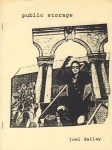
For our readers: Below is a bonus package of Dailey chapbooks. Click on any one to get the gallery view.




Posted in Katrina, Louisiana, New Orleans, poetry, poetry magazine, poetry press, poetry review
Tagged A Poet, Actualism, Al Capone, Alice Notley, Allen Ginsberg, Andrei Codrescu, Anselm Hollo, Aram Saroyan, Audience Ambience Ambulance, BGS Press, Bill Berkson, Biopic, Black Mountain poets, Blank Gun Press, Camille Martin, Charles Olson, Charles Perry, Clark Coolidge, Dave Morice, Duck Martian, Ed Sanders, Exploring Another Leg, Exquisite Corpse, Fell Swoop: The All Bohemian Revue, Fuck Magazine, Fuck You: A Magazine of the Arts, Hank Lazer, How to Wallpaper Like a Pro, Hurricane Katrina, Igneus Press, Intellectuals and LIars, Jack Kerouac, Jack Spicer, Jane Austen, Joe Brainard, Joel Dailey, Keith Abbott, Kevin Killian, Language School, Lavender Ink, Lot M 2, Lower 48, Marcel Duchamp, Mike Tarachow, Milton Berle, Morgan Press, My Psychic Dogs My Life, Nancy, New American Writing, New Orleans, New York School, Not on the Cover, Pentagram Press, Philip Jenkins, poems, poetry, poetry chapbooks, Post Contemporary School, Richard Martin, Rod McKuen, Rolling Stone Magazine, Rumba Train Press, Semiquasi Press, Shockbox Press, Surprised by French Fries, Surrealists, Ted Berrigan, The ABC of Duck, Ugly Duckling Presse, unarmed, Walt Whitman, William Shakespeare
The monostich could inspire a question for poetic Trivial Pursuit: What form (other than prose poetry and vispo) has no line breaks?
The monostich has none because it consists of a single line. In the essay collection A Broken Thing: Poets on the Line, Kimiko Hahn explores this Lilliputian form, both in its literal manifestation—a poem written and intended as a monostich—and as a “found monostich,” the idea of reading a poem with an appreciation for an individual line as “a startling fragment that [has] its own integrity.”
For the latter, Hahn gives examples of such lines to be savoured for their poetic cadence from Denise Levertov’s “A Common Ground”:
grown in grit or fine
[. . .]
new green, of coppery
[. . .]
crumpled wax paper, cartons
[. . .]
curved, green-centered, falling
A single line within Levertov’s poem becomes an imagined monostich, suspended in its own time and space.
Hahn points out that whereas imagery appeals to the visual imagination, cadence involves the ear attuned to the pitch and rhythm of a group of words, and she recounts that in her evolution as a poet she gradually became aware of the qualities of poetic cadence while considering such found monostiches within longer poems.
Barbara Guest comes to mind as another poet who often sculpts her lines with a stand-alone quality, such as the following from Quilts:
where footsteps tremble on quicksand squiggly
[. . .]
third time white like autumn squash
[. . .]
minnows on muslin
One of my works-in-progress contains a section of short poems, “R is the Artichoke of Rose.” I skimmed through it looking for monostiches, certain that there’d be a handful, but was surprised to find only one. The majority are between two and six lines. I’d forgotten that most of the ultra-short poems that were originally written as one line have since been revised into lineated poems.
Why have I avoided the monostich, even in the case of a “flash poem” consisting of two words? I think it is because my ear—and mind—have become attuned to the argument of the sonnet. Although many of the poems in my Sonnets are far from traditional, I can see that the idea of the argument or even simply the development of an idea attracted me to that ancient form. The “if” and “then” structure had its appeal, and if the argument of a sonnet turned out to be illogical or open-ended, then that could become part of the movement of thought, the disruption of the proposition-conclusion folded into the scheme, observing itself in the act of giving the mental slip.
My lone monostich in “R is the Artichoke of Rose” is a parody of a famous line by Emily Dickinson:
I heard a Leafblower—when I died—
If the monostich has an argument, it’s necessarily more subtle, even if it’s on the scale of subject-predicate, clause-clause, or a pithy dialogue with a predecessor.
Below are some more true monostiches, memorable not only because their brevity makes them so easy to remember. Here’s one from Craig Dworkin’s aptly-named Motes:
WILTED TULIPS
split little puppet pulpits tilted spilling dew
The delicate tongue-twister of staccato plosives creates a striking image developing the title: the poetic miniature satisfies both ear and eye.
In John Ashbery’s “37 Haiku,” each unfurls on a single line, and again, these monostiches turn on striking images, as in these two:
Night occurs dimmer each time with the pieces
of light smaller and squarer
A blue anchor grains of grit in a tall sky sewing
In the second monostich, the final word, “sewing,” subtly echoes Lautréamont’s famous description of beauty as “the chance encounter of a sewing machine and an umbrella on a dissection table.” That statement, which became a sort of anthem for surrealists, speaks of the mysterious charm that ensues from the dialogue among disparate images. Perhaps the chance encounter involves some stitching together of such images, and Ashbery’s allusion nicely suggests the marriage of anchor and sandy grit in the sky, which might be reflected in “tall” or oceanic water.
Many of Ron Padgett’s monostiches in “To Francis Sauf Que” exemplify his signature humour. I almost bypassed the one below, but it grew on me. (I’m finding that the effectiveness of some of the more successful monostiches increases exponentially with the thoughts they generate.)
Now I love you again because of these roosters.
Padgett’s fragment appears to be lifted from a narrative; the absence of context gives the line a twist of absurdity. But it also seems to offer a goofy explanation for the mysterious force that compels one person to be attracted to another, in this case perhaps in an on-again-off-again relationship: I’m not sure exactly why I love you again (the speaker seems to say), but these roosters are as good a reason as any. The line has the qualities of both a dramatic assertion and an aphorism.
I don’t think the poem would work as well as a couplet:
Now I love you again
because of these roosters.
The separation of the abstraction (love) from the image (roosters) drains the poem of its humour. It’s funny and poignant precisely because of its seamless, matter-of-fact, droll delivery. The line break is overkill.
Almost none of the more impressive one-liners survives exclusively on abstraction. In the example by Padgett, “love” is paired with a vivid image, “roosters,” which also serves as a kind of punch line to the enigma of love.
A few years ago, issues of Peter O’Toole: A Magazine of One-Line Poems began to surface in Toronto, published by Stuart Ross. It’s the only magazine I know of that specialized in the monostich. Here’s one by Clarice Eckford that nicely captures a particular type of tedium:
WAITING FOR THE BUS
knee-deep in cement
And Dani Couture’s ear- and eye-fest:
Freezer unfrozen, slabs relax in the november electric heat.
And Stuart Ross’s deadpan deflation of vainglory, perhaps describing the imagined triumph of a poet arriving in town for a reading versus the mundane reality:
AND THEY SHALL GREET US WITH ROSES
The cheeseburger broke out of the plastic bag.
Steve Venright’s contributions hinge on spoonerisms:
With his long reach he pulled out the wrong leech.
And Joel Dailey offers a sardonic take on adjusting to the end times:
CELL PHONE BITCH SLAP
The end of the world may require some lifestyle changes
Lastly, one of my own from the magazine:
dead saints dream of the enshrined relics of their flight
At least some of the monostiches above that have titles could arguably be called distiches. But such an argument might be putting too fine a point on the matter. Why shouldn’t monostiches be entitled to titles?
Anyway, it’s New Year’s Eve and I’m not in the mood to split hairs. So here’s a parting monostich for everyone who’s read to the end:
Happy New Year!
Posted in poetry, poetry magazine
Tagged A Broken Thing: Poets on the Line, Camille Martin, chance encounter of a sewing machine and an umbrella on a dissection table, Clarice Eckford, Craig Dworkin, Dani Couture, Denise Levertov, Emily Dickinson, haiku, humor in poetry, Joel Dailey, John Ashbery, Kimiko Hahn, Lautreamont, line break, monostich, Motes, Peter O’Toole: A Magazine of One-Line Poems, poem, poet, poetry, prose poem, Ron Padgett, sonnet, sonnet argument, Steve Venright, Stuart Ross

Posted in poetry, poetry magazine, poetry reading
Tagged Dale Smith, poetry reading, Ryerson University, Susan Briante, White Wall Review
Cole Swensen, from “Stele”

. . . .
Click on the excerpt to read the rest of the poem as well as work by the other contributors.
Camille
Posted in poetry, poetry magazine
Tagged Amy King, Ana Bozicevic, Cole Swensen, esque, poem, poetry, poetry journal, poetry magazine
*
not all slopes
are tragic. . . .
Click on the poem to read the rest of it.
Camille Martin
Posted in poetry, poetry magazine
Tagged Anny Ballardini, Camille Martin, Fieralingue, poem, Poet's Corner, poetry
David edited The Alterran Poetry Assemblage, a literary magazine published from 2000-2005—it’s a treasure trove, and David has taken the trouble to have the contents archived by the National Library of Canada Electronic Collection.
A recent post on his blog consists of links to contributions to The Alterran Poetry Assemblage from Lise Downe, Chris Stroffolino, Lisa Robertson, Charles Alexander, David Dowker, Fiona Templeton, and many more (I’m in there somewhere).
I look forward to future postings!
Camille Martin
Camille Martin
Posted in poetry, poetry magazine
Tagged Camille Martin, poems, poetry, Talking Writing
Michael Mann has just produced a couple of colourful issues of unarmed, his modestly produced little treasures of magazines and chaps. unarmed #62 features a collage by Steve Dalachinsky on the cover:

Included in this issue are one of mine, “The Sword’s Brayer” (a homolinguistic satire on The Lord’s Prayer), as well as poems by Simon Cutts, Joel Dailey, Sheila E. Murphy, Michael Basinski, Vernon Frazer, Nicholas Ravinkar, Tom Weigel, Michael the Mann himself, and many others. Here are a couple of samples from the issue:
39.
by Tom Weigel
The lark sings a shut case
but to be quick there’s nothing I want
only bird friends chatter & congregations
functional stuff without guile
ripe grapes of an old German novella
read at night against a cold snap in Spring
it’s back there with film & the art of letters
picking up the odd piece of scrap iron
the words SILVER FLOSS on a can of sauerkraut
I think of LOVE on a slow walk
among drowsy lilacs away from noise
when the ice cream truck sounds its chimes
down the streets of hopscotch & whiffle ball
past the car mechanic describing a special wrench
* * * * *
“nothing can be more contemptible
than to suppose public records to be true” wm blake (1757-1827)
by Michael Mann
my pockets carry the odor of sharpened coins
and flower-like meanings from the extremities of success
from which the upticked “twist-points” anchor the unknown
a just-never that unfolds in a spectacle of confusions
cat’s eye-bright in its scattering of the warners from the commons
the few communist-saints remain only to wait on our mudflap lady
still my luck holds its tongue in a rhapsody of reticence
a silence more reliable than passion, of lyrics made from time’s
contention that it was once forbidden to forbid
i tarry too with rules of cruelty
my polished shoes the progressive experience
of evolutionary hardware on the rivers of the medes
fearless oil-whatever-the-politics dilutes the absolute
in words perfect for both halting and advancing
the proof of which irrealists must watch through their fingers
an inly response to the unavailing spinozistic distaste for courage
my heroes, our carcerals, and the habits of flesh
“together in one bed (the dears)”
* * * * *
And the chap that came with #62, Change of Address by Jake St. John, features on the back and front covers water colours by Kimball Lockhart:

An excerpt by Jake St. John:
Yesterday
seems far removed
from today
but the leaves
are now falling
from the recently
potted plants
and the photographs
have worn
at the corners
and faded slightly
over the young faces
that have now seen
many years
since the
meticulous crawl
of westward expansion

Sonnets

Codes of Public Sleep
Posted in poetry, poetry magazine, poetry press
Tagged Jake St. John, Michal Mann, Sheila E. Murphy, Steve Dalachinsky, unarmed
Cheers!
Camille Martin
http://www.camillemartin.ca
Posted in poetry, poetry magazine, poetry review
Tagged Camille Martin, James Mc Laughlin, poetry review, Shearsman Books, sonnets, Stride Magazine
“I was excited to find a group of wonderful sonnets from Camille Martin. What I at first dimly suspected has now been affirmed; there is as much vitality, craft, and genuine art being transmitted via the Web as there is being released via print journals. Martin’s sonnets deserve a closer look. I have chosen two of the six to look at . . .”
—Adam Fieled, Stoning the Devil
Click here to read more.
Camille Martin
http://www.camillemartin.ca
Posted in poetry, poetry blog, poetry magazine
Tagged Adam Fieled, Camille Martin, moria, sonnets, Stoning the Devil
Posted in poetry, poetry magazine
Tagged Camille Martin, double sonnet, poetry, Reconfigurations
Posted in poetry, poetry magazine
Tagged Camille Martin, Canadian poetry, Ditch Magazine, double sonnets, poetry
http://www.stridemagazine.co.uk/
Camille Martin
http://www.camillemartin.ca
Posted in poetry, poetry magazine
Tagged Camille Martin, double sonnets, poetry, sonnets, Stride Magazine
my fingers grew long
and tears left the tips of my fingers
the rug dissolved
no things no bodies no separation

Ruth Lepson

Click here for the audio files.
Camille Martin
http://www.camillemartin.ca
Posted in audio poetry, poetry, poetry magazine
Tagged Camille Martin, From East to West, poetry, poetry magazine
 Rogue Embryo
 Rogue Embryo
Joan Retallack’s Little Universes
The Little Universe of Infinite Time
Who can say which of all possible things should happen
next. Many were more or less content as many others ran
shrieking out of houses. Many many ran to hide in forests,
mountains, deserts. Many many many ran toward what
seemed to be safety zones between houses, in mountain
crevasses, across closely guarded borders, in desert mirages
and magical clearings in dark woods. Many more were
unlucky and couldn’t get away. The panel poured clear
water into clean glasses and cleared throats. The theys who
survived couldn’t talk about it themselves because of the
nature of impersonal pronouns. It’s said they took to
looking for meaning among frequently misspelled words.
Of course hope springs eternal in the little universe of
infinite time.
The Little Universe of Ten Minutes
Standing at the far edge of another unsettling interruption,
barely visible, not at all audible. Waving, smiling, pelted by
beams of electrons, photons, and other elementary detritus
streaming out of the inception of this perfectly calibrated
world. Hands thoroughly washed, synaptic pruning all
done. Want only to establish the time of the tragic event. It
was five in the afternoon it was exactly 9:30 am it was
eleven o’clock plus or minus twelve hours. She said come
back next week. I’ll tell you the answer. She had said come
back next week. We hesitate to mention it, but next week
had already happened in the little universe of ten minutes.
Camille Martin
http://www.camillemartin.ca
Share this:
Leave a comment
Posted in poetry, poetry magazine
Tagged American Letters & Commentary, Joan Retallack, The Bosch Notebooks