 Rogue Embryo
- NOLA Boxcars II: “Gathering”
- NOLA Boxcars II: “Contraption dialogue”
- NOLA Boxcars II: “Cross sea”
- NOLA Boxcars II: “Cloud break”
- NOLA Boxcars II: “Twilight orchard”
- NOLA Boxcars II: “Surprise visit”
- NOLA Boxcars II: “Teleology”
- NOLA Boxcars II: “Wakeful”
- NOLA Boxcars II: “Homeward”
- NOLA Boxcars II: “Beyond mountains”
Tag Archives: Camille Martin
“I know I am traveling all the time”: The Twilight Dreams of Artur Lundquist
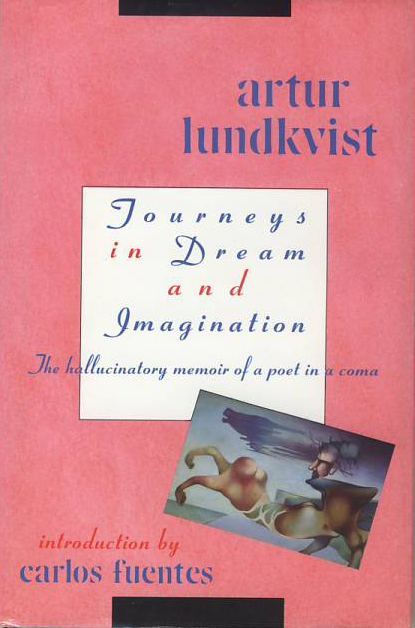
Excerpts from Artur Lundquist’s Journeys in Dream and Imagination (New York: Four Walls Eight Windows, 1991),
then a brief essay.
I know I am traveling all the time, possibly with no interruptions, also with no tremors or noises, soundlessly and softly, and then I am no longer lying in my bed but stepping out into the world where everything is awake, sundrenched, comforting, and I am there clearly as a visitor, and I am quite at ease,
it must be a dream journey I have undertaken, a definite dream journey where all is real precisely the way all journeys ought to be, but maybe one has to be dead in order to journey like that,
by the way, how can I know I am not dead, even though I have no sensation of being dead, and it is as if I rest in a middle zone without feeling either warmth or cold or hunger or any human needs
* * *
No wind, not even the slightest breeze, complete stillness and silence, yet I am traveling or have a definite sense of traveling, but how can it happen without a sound or feeling of movement,
can I travel motionless or glide onwards without the least resistance from the earth or the air, can it be that time has stopped or speed no longer has a meaning, that I have reached the crossroads beyond motion and stillness . . .
but yet I am here, can feel my body and sense my breathing, it is a nothingness that is definite, but without any wind or air or sound whatsoever, as if all but my own being has ceased existing,
it amazes me somewhat, but it actually does not matter, why should I need wind and sound, that which exists does exist nevertheless, and I must be the one perceiving it, and that is surely sufficient to make me alive and capable of perceiving,
I do not know what time has passed, but now I begin hearing something, at first vaguely, then with increasing strength, and soon, I can recognize a distant song by women, a choir like in a church but heard from a distance, the song rises and falls rhythmically, with different voices blending, lighter ones and darker ones,
It is actually not beautiful, but it still makes an impression by its inherent certainty and power, yes, the song bears witness of a conviction that conquers silence and nothingness as if journeying by its own force and conquering all resistance,
I feel that I am again traveling, that immobility and silence no longer reign, but I don not know what the women are singing or what the song means, it is simply there, filling the room which was only silence and emptiness
* * *
The silence is like a fine spiderweb against my face, I cannot rub it off, it is simply there without being tangibly real, it does not flutter like a leaf in the breeze, nor is it entirely immobile, it feels like the impression of a wind that is already becalmed, it is hardly the beginning of the weave and it does not betray a pattern, it is the most insignificant matter, yet it makes itself known
* * *
My dreams are of iron, so strong, so durable, but they soon begin to rust, eventually they fall off like flakes of rust and nothing is left of them, then I shift to dreams of dough so that I might bake and eat them, almost like bread,
suddenly, as I sit at the table in good company, I am nauseated, I do not even have time to stand up and run to the toilet before I spew out a snake that curls out of my mouth, one piece with each spasm, like a birth,
the snake lands in front of me, on the plate that is still empty, it is curled up, mottled, with a zigzag pattern on its back, more beautiful than a sausage and much longer,
the snake raises its head and opens its jaws as if to say something but at that moment, I faint and I do not hear it.
I’m attracted to unusual states of consciousness in the history of literature, such as Hanna Weiner’s poetic conversations with the words that she saw projected, involuntarily, onto surfaces; and those “Kubla Khan’s” written during drug-induced altered states of consciousness. One of the most remarkable poetic records of an altered state of mind is Artur Lundkvist’s Journeys in Dream and Imagination: The hallucinatory memoir of a poet in a coma.
In 1981, at the age of 75, Swedish poet Artur Lundquist had a heart attack while giving a speech on Anthony Burgess. A friend administered artificial resuscitation and he was rushed to the hospital, where he lay in a coma in the intensive care unit for two months, his life sustained by a heart-lung machine. He gradually regained consciousness over the next few months, maintaining awareness for greater and greater periods of time. As soon as he was able to write again or at least to dictate to his wife, he attempted to re-capture the now-elusive dream visions that illuminated the two months of his coma as well as to set down the waking dreams that he experienced during the first year of his convalescence, intense and vivid ones in which his eyes remained open and during which reality mixed with unreality in a half-aware reverie. Such dreams are not uncommon for persons who have experienced a change in breathing patterns, as is the case being on a lung machine (1). Fortunately, Lundquist’s linguistic abilities were rusty but intact, and he was able to document his fantastical visions that arose during this fertile period of dreaming.
The memorable opening of his poetic journal of dreams, “I know I am traveling all the time,” suggests that he’s aware of his altered condition, and that the background noise of his mental state is his impression of traveling, paradoxically in “complete stillness and silence” and “without a sound or feeling of movement.” He exists “without distance in time and space” yet he feels that he is traveling “through time or space.” He can’t tell if he’s “lying in the same place” or “traveling without interruption.” He’s unaware of minutes and hours passing, “yet time is moving somehow.” It’s as though he existed in suspended animation while riding a train. He describes his state of mind during his convalescence as being full of contradictions: moving yet stationary, timeless yet in time, lonely yet also belonging, unaware yet on some level conscious. In this twilight state, while he’s on life support in the hospital, he dreams, sometimes about his own death and sometimes about the annihilation of the earth. Fantasies of nothingness, purposelessness, and oblivion haunt him in his awareness that his own consciousness could easily fritter away and end rather than be revived, and that eventually nothing will be left of the earth and all its life forms: “nothing that can see or feel or think remains in existence.”
His journey is metaphorical as well as viscerally sensed. The point of departure of the journey is a state of suspension in a world of silence and paralysis, as if he were in a cocoon. He seems to be neither conscious nor unconscious, and sometimes, for brief periods, he perceives the objects and people in his hospital room, but he’s helpless to make contact with them. The journey is one of transformation, and his destination is consciousness, the regained ability to speak and read, and ultimately, the ability to write about the journey of his dreams.
Yet he has no sense of destination in his dream journeys. What he has lost—his consciousness of place, of his body in a particular space, situatedness—becomes an obsession in his dreams. In a particularly poetic entry that is reminiscent of Stephen Dedalus’ meditation on place, telescoping from self to universe (2), Lundquist describes a village of farms in some detail, then zooms away:
behind that the forest began, and the moors, the meandering creek and the half-overgrown lake, the cows who grazed without fences, knew the paths and followed them, and returned when it was milking time,
then there was the church village and the whole parish, the district and the county and the whole country, and it was on earth in the universe, below the sun, the moon, and the stars, with years carved into tree trunks without revealing if the world was actually old or still young
Like Dedalus’ list, Lundquist’s image of an ever-expanding view tells of his wished-for certainty of place in an orderly world in which you know exactly where you are, even though there is a mystery about where you’re precisely bookmarked in the age of the world. When he does feel, in his dreams, a strong sense of self, that self feels alien to him: he doesn’t recognize the echo of his own shouting voice. It is absence and loss that most often shape his dreams, as when he envisions a couple buried alive after a strong earthquake, or a living, sentient stone mountain that is being cruelly and terrifyingly quarried by men who are more murderers than miners, or himself as the village idiot, “carry[ing] within [him] something that has never fully blossomed.” He’s in purgatory, a guest lost in a vast hotel, a village hidden in a mist. Corporeality and consciousness are absent or impaired, and desire—for life, for sexuality, for communication—is thwarted since the means necessary to fulfilling these desires are in a liminal state, halfway between action and immobility and unable even to know with certainty whether he is alive or dead.
Journeys in Dream and Imagination is a record of meta-dreams, meditations on Lundquist’s state of consciousness, dreams about the dream state. In the beginning of his journey, his dreams are “of iron, so strong, so durable.” However, this strong state of consciousness gradually starts “to rust,” and the dreams “fall off like flakes of rust” until they vanish entirely. He then switches “to dreams of dough,” which he bakes and eats, “almost like bread” that nourishes him through this period of amorphous half-consciousness. The metaphor of the consumption of dreams describes the interiority of his state of mind, and the next image of vomiting a snake that is also a giving birth to speech seems to signify his ability or desire to engage once more in communication with the world outside his twilight prison. Within his dream state, he sometimes interprets the vision he has just experienced, as when he sees trees growing between his toes and believes that dream to be a good omen, a “sign that life continues to grow inside me.” It is as though his consciousness were trying to solve the puzzle of its own impairment.
The necessarily interior turn during this period when perception of the outer world was subdued or shut off perhaps accounts for his awareness of his body, which he felt to be in a state of flux (the sensation of traveling, for example) and transformation: he has become something of a shapeshifter. In two successive dreams, he is transformed into a giant and then a miniature person, in the manner of Gulliver’s Travels. Proprioception is the brain’s ability to locate the position of the body relative to its own parts as well as to the exterior world. Since altered states of consciousness (during meditation or praying, for example) can change the strength of a person’s feeling of separation from or continuity with exterior space, other people, or objects, I wonder whether Lundquist’s dreams reflect disturbances in his proprioceptive sense of self in relation to others. During his convalescence, his brain was repairing itself—but was it also rehearsing, in a sense, the process of its own repair? Is this what the image of consuming the nourishing bread of his dreams signifies? If reinforcing the lessons of the day in a kind of rehearsal of knowledge is part of the function of dreams, as some neuroscientists studying sleep now believe, what was the purpose of Lundquist’s dreams, if indeed they can be said to have one? Why do so many of them have the feel of meta-dreams about the journey towards consciousness?
Regardless of the purpose of these dreams, it seems likely that Lundquist’s hallucinatory visions, alternately peaceful and nightmarish, represent his fears of being forever in a coma and his hopes of someday rejoining the realm of real people, objects, places. In his dreams, he creates worlds of uncertainty, where nothing can be pinned down as completely familiar and habitual; where communication is problematic or impossible, consciousness is present in some way but still suspended in a timeless, placeless journey; and where he is alien to himself and inhabits a world that is strange and unrecognizable.
His limbo is real and extreme, but there is something oddly familiar about his dilemma dramatized or described in his dreams, something that elicits the feeling that you’ve been there, too, in moments of doubt or frustration, when order dissolves, when thought fails to render its shiny nugget, when self seems irremediably scattered, when you feel alone on a teeming planet that seems to belong to another dimension, when talking to others falters and stumbles, when you no longer know who or why you are, and the world, faced ultimately with demise, seems pointless but stubbornly present. In his meta-dream stories investigating suspended being, the often surreal analogies for these states are almost endlessly inventive. But in them one can also read a description of what it is to be human, or to exist in “negative capability,” as Keats called the ability to live with “uncertainties, Mysteries, doubts without any irritable reaching after fact & reason.”
Part of the pleasure of Lundquist’s record is becoming aware that even in a coma, the mind can cut seemingly endless facets in which to reflect itself and rehearse the dramas—miniscule or vast—of its journey through the interior. If his world seemed to be a solipsistic nightmare from which he couldn’t completely awaken, he peopled that world with rich possibilities and a self-awareness that sometimes comes across as more lucid and knowing—for all its twilight uncertainties—than the consciousness he so desperately wanted back.
(1) I gleaned most of the information in this narrative of Lundquist’s heart attack and recuperation from Carlos Fuentes’ introduction to the book.
(2) He turned to the flyleaf of the geography and read what he had written there: himself, his name and where he was.
Stephen Dedalus
Class of Elements
Clongowes Wood College
Sallins
Country Kildare
Ireland
Europe
The World
The Universe
Camille Martin
http://www.camillemartin.ca
Parallel Universes Redux – St. Joseph’s Altar in New Orleans, a Hybrid Feast
(photo: Camille Martin)

(photo: Camille Martin)
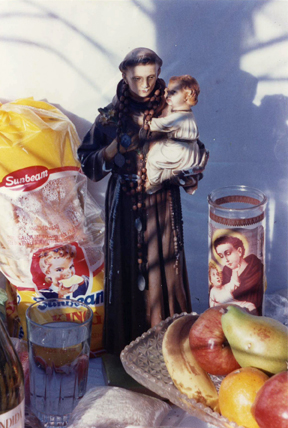
Another time warp in my Louisiana series: a St. Joseph’s Altar created in 2003 on the front porch of a house in Carrollton, the New Orleans neighbourhood where I used to live. The tradition of creating and decorating altars devoted to St. Joseph every year on March 19 was brought to New Orleans by Sicilians and adopted by some African-American devotees of the popular saint in the Catholic pantheon.
Non-meat food offerings embellish the altars and are usually given to the poor at the end of the celebration. Bread offerings are often baked into shapes of carpenters’ tools such as ladders or saws, but this altar keeps it simple and efficient with a loaf of Sunbeam bread. The beads of moisture condensed inside the plastic bag are a typical phenomenon in subtropical New Orleans, which can be warm and muggy even in mid-March.
During the day, people knelt at the altar and prayed. In the second picture, the woman might appear to be reverently bowing her head, but she was actually dismantling the altar at the end of the day: many of the food offerings have been removed, but the rows of candles remain.
The adoption of Sicilian traditions by African Americans in New Orleans is not an unusual type of cultural phenomenon: the blurring of cultural and religious boundaries is the rule rather than the exception in southern Louisiana, which has historically attracted settlers from all over the world looking for opportunities in spite of the prevalence of diseases and natural disasters, and forcibly brought people from Africa as slaves. For many, survival meant mutual aid within their ethnic communities and interdependence among their diverse neighbours.
Louisiana’s “cultural gumbo” is not a cliché for nothing. Louisiana, especially along the Mississippi Delta, was—and is—a mixture of Spanish, French, African-American, Irish, Italian, Native American, Croatian, Cajun, Creole, German, Czech, Hungarian, British, Isleño (from the Canary Islands), Filipino, Mexican, Cuban, Guatemalan, Chinese, Vietnamese, Laotian, Thai, and more.
As a result of intermingling among ethnic and national groups in Louisiana, Germans along the Côte des Allemands, for example, became more French, translating their names from Zweig to Labranche, and from Troxler to Trosclair. Many of the original Louisiana Germans came from the Alsace region, which partly accounts for the ease with which they shared customs with Louisiana’s French. Some Louisiana Germans have become so distanced over time from their origins that they believe their ancestry to be Cajun or French Creole.
African-Americans intermingled and intermarried with French Creoles, Cajuns, Italians, and Native Americans, among others, and survivals of these blends among blacks can be seen in the French Creole language, St. Joseph’s Day altars, Zydeco music, and the customs of the Mardi Gras Indians.
It would be hard to find a group not influenced by black African and Caribbean culture in Louisiana. And the whole world, late in the twentieth century, tried to become Cajun by eating crawfish and dancing to Beausoleil.
Some groups in Louisiana seem to have had more permeable boundaries than others. Croatians, many of whom developed the oyster industry, created relatively close-knit communities with a tendency to preserve their own cultural heritage and not to mingle their customs with those of other groups.
And generally speaking, in the early settlement of North America, French colonists were more likely than British to intermingle their customs and blood with other groups. When I was researching Acadian culture in Nova Scotia, I discovered the extent to which the Acadians and the Mi’kmaqs, for example, had developed a close and interdependent relationship. One manifestation of the friendship between the two groups was of course their not-infrequent intermarriage. Another striking example of the degree to which both groups let down their boundaries was the syncretistic nature of a spring celebration that evolved: the return of the geese came to be celebrated in a hybrid feast blending Easter rituals with the Mi’kmaq Festival of Dreams and Riddles. I can imagine the consternation of the priests.
From the beginning of their settlement in Louisiana, the Cajuns continued to synthesize the customs that they brought from Acadia with the customs they found in their adopted land. A study of Cajun music, for example, shows influences from hillbilly music, blues, and Texas swing. If the Cajuns were viewed by the rest of the United States as unique and isolated, it was only by comparison with that amorphous category called the “mainstream.”
Throughout much of the first half of the twentieth century, the United States government instituted a policy of assimilation of the Cajuns in Louisiana, and until the late 1960s, many aspects of their culture were finally succumbing to decades of this unenlightened approach. Without a boost from the schools, the French language in Louisiana would probably soon have died out, for mine was the first generation of Cajuns, generally speaking, whose first language wasn’t French and who were increasingly unable to speak in the mother tongue of their parents and grandparents. With the advent of CODOFIL (Council for the Development of French in Louisiana), a more enlightened view of Cajun culture and heritage has permeated the curricula of primary and secondary schools of Acadiana, where Francophone teachers from France and Quebec have been hired to teach children the language of their parents.
Ironically, the movement for the preservation of the Cajun heritage threatened to turn a living culture into ossified museum artifacts. Cajun historical villages such as Vermillionville and Acadian Village recreated for visitors “typical” life in nineteenth- and early-twentieth-century Cajun communities, and people flocked to south Louisiana to experience “authentic” Cajun culture. Some forms of historical reflection, however informed or uninformed or misinformed, however laden with stereotypes or invested in historical accuracy, can contribute to the dying of a culture if there is an impetus to petrify it into some notion of its past–especially a past purified of other influences–instead of allowing it to grow, breath, change, and, most importantly, transform and renew itself from contact with other cultures.
One of the consequences of the policy of assimilation was an overall feeling of inferiority on the part of the Cajun people, a conviction that their culture was backwards and their French language less correct that that of their distant Parisian cousins. But pride is not without its pitfalls—pride in some notion of Cajun-ness, of a Cajun purity that never was and never will be. From the moment that the Acadians set foot on the shores of what is now Nova Scotia, they were influenced by the Mi’kmaqs and by the British, with whom they traded and fought. From the time that they settled along the bayous and swamps of the Atchafalaya Basin in Louisiana, they gathered still more influences in their vocabulary, food, customs, stories. Like any migrating group, they brought with and they borrowed from. Purity is an attitude that bears no resemblance to the infinitely re-folded layers of human culture.
Camille Martin
http://www.camillemartin.ca
Posted in Acadian, Cajun, New Orleans, photography
Tagged Acadian, African-Americans in Louisiana, Atchafalaya Basin, Cajun, Camille Martin, CODOFIL, Cote des Allemands, Croatians in Louisiana, cultural assimilation, cultural purity, Festival of Dreams and Riddles, French Creole, Louisiana, Louisiana ethnic groups, Mi'kmaq, New Orleans, photography, St. Joseph's altar, St. Joseph's Day, Zydeco music
On Homunculi, Steam Locomotives, and Hans Clodhopper (interview by rob mclennan)
Please have a look at my “12 or 20 questions” interview just posted on rob mclennan’s blog:
Camille Martin
http://www.camillemartin.ca
http://robmclennan.blogspot.com/2009/09/12-or-20-questions-with-camille-martin.html
Camille Martin
http://www.camillemartin.ca
Majlis Multidisciplinary Arts: “Figure of Speech” concert photos
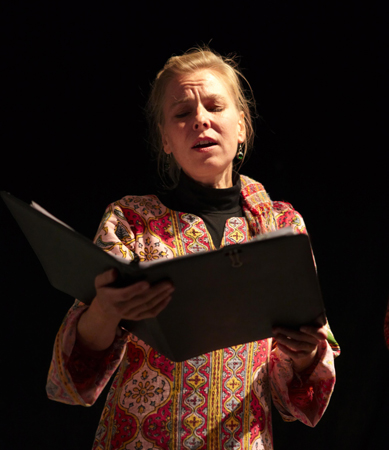
Here are some photos of our multidisciplinary concert
on Saturday, August 29. The performers, in order of
appearance in the photos:

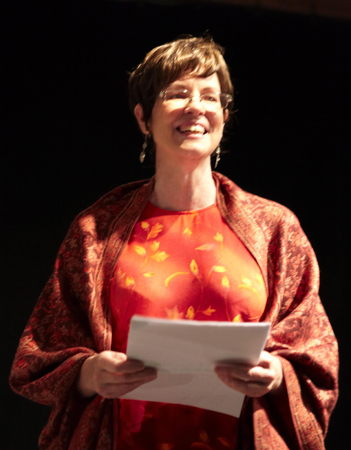


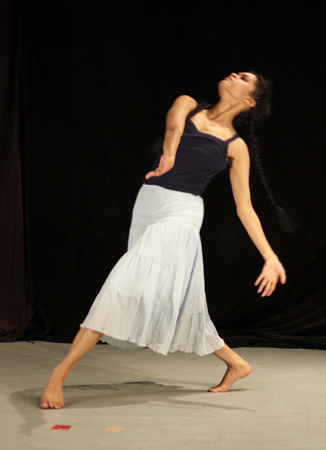
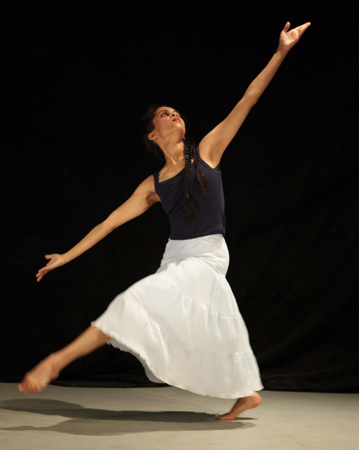


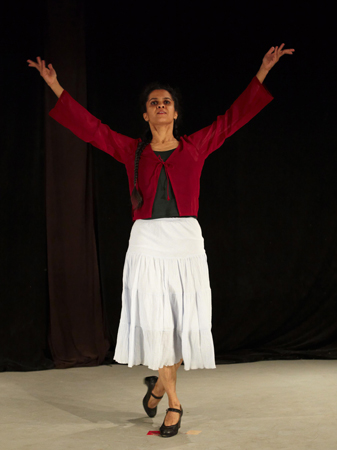


on Saturday, August 29. The performers, in order of
appearance in the photos:
Hallie Fishel-Verrette
John Edwards
Camille Martin
Gauri Vanarase
For my musings on the collaborative experience, please see
yesterday’s post.
Hallie and John performing their setting of “this is the tune
that paper sang” (one of my “nursery rhyme” sonnets, based on
“This is the house that Jack built”):
Photo by: Cameron Ogilvie
Photo by: Cameron Ogilvie
Photo by: Cameron Ogilvie
My solo reading:
Photo by: Cameron Ogilvie
Hallie and I performing a “shadowing” setting of
“if you are somewhere.” I read and Hallie “shadowed”
me by singing the same words:
Photo by: Cameron Ogilvie
Photo by: Cameron Ogilvie
Gauri performing “Folia d’Italiana,” accompanied by
Hallie and John on guitars:
Photo: Cameron Ogilvie
Photo by: Cameron Ogilvie
Photo by: Cameron Ogilvie
Hallie, John, and I performing “Does It Take” (Gauri also
performed in this piece). Hallie hummed and John played
guitar while I read, and Hallie sang the last part of the poem;
Gauri performed a haunting interpretation of the poem:
Photo by: Cameron Ogilvie
Gauri performing “Folia d’españa”:
Photo by: Cameron Ogilvie
Curtain call with Gauri’s red ribbon and heart balloon:
Photos by: Cameron Ogilvie
Mingmar, multidisciplinary muse:
Photo by: Cameron Ogilvie
Camille Martin
http://www.camillemartin.ca
The Majlis Collaborative Experience
The Majlis “Figure of Speech” multidisciplinary experience was intense and rewarding. Tricia Postle, the organizer of the series, selected the members of our motley crew, which consisted of Gauri Vanarase, a kathak/modern dancer; Hallie Fishel-Verrette, a soprano and Baroque guitarist; John Edwards, also a Baroque guitarist; and myself, a far left field experimental poet. The point of such groupings is to throw together people from various disciplines and see what emerges from their collaboration. They gather for a series of rehearsals and then perform a concert on two evenings. Although some of the collaborations are expected to be designed as structured improvisations, our group, according to Tricia, was one of the most rehearsed ones.
Camille Martin
http://www.camillemartin.ca
The performance facility was rustic but warm. Tricia converted what I think used to be a woodworking factory into a performance area. She opened up one side of the building to create a stage, and stretched a large canvas from the roof to a nearby fence to cover the outdoors seating area. It was a nice surprise to find, just down the path between the stage and the restroom, a peach tree full of large ripe peaches.
In rehearsals I worked mostly with Hallie and John, who make up the Renaissance/Baroque duo The Musicians in Ordinary. To get things started before the first rehearsal, I emailed Hallie and John several of my poems that I thought would work well set to music: sonnets inspired by nursery rhymes and my “Poor Souls” sonnet series. I tried to select poems that were based on repetitions of various kinds or at least phrases of a fairly uniform length. And John emailed me samples of some Baroque styles that might work well for turning my poems into songs. At our first rehearsal, Hallie and John had already worked out several song settings of some of my poems and ended up performing five at the concert: “sixpence,” “if all the seas,” and “this is the tune,” “poor souls 1” and “poor souls 3.”
The blend of the poems and Baroque settings with a continuo-type guitar part worked out well. The continuo guitar part provided the structure of a repeated harmonic progression, which is very typical of Baroque composition. John’s repeated harmony gave the composition coherence and also provided opportunities for Hallie to improvise embellishments on the melody based on that harmony.
After that first rehearsal, I remembered having set a Dylan Thomas poem, “We lying by seasand,” to a capella soprano a long time ago, longer than I’d like to admit, as a graduate student at the Eastman School of Music. So I downloaded a music notation program and wrote the melody as best I could remember it. I thought, ok, I wrote this, maybe I can set some of my poems to music.
I knew that for the Majlis concert it would be good to have some pieces that I could perform with Hallie and John in various combinations, so I wrote a “shadowing” piece to perform with Hallie, based on my poem “if you are somewhere.” I’d speak a phrase or sentence, and a half a second later, Hallie would shadow my spoken words with the same words sung to a melody that I had composed. I’d seen this kind of collaboration improvised at a poetry reading in New Orleans to great effect. In performance, it worked out beautifully between Hallie and me.
Hallie and I also performed an “echo” piece based on my double sonnet “where you are when you,” which consists of a series of—I can’t believe I still remember the rhetorical term—aposiopeses, sentences that break off mid-stream. I’d start one phrase and a half-second later, Hallie would echo the same phrase. After we got the hang of the rhythm of the echo effect and the breaking off of the incomplete sentences so that they seemed to end suspended in mid-air, the echoing was very effective in performance.
I composed another collaborative piece in which John accompanied Hallie, who hummed a melody in a series of four-bar phrases. During each four bars, I spoke a sentence or phrase of my sonnet “does it take.” Hallie sang the last two lines of the poem. For the performance, Gauri joined this piece and improvised movements that beautifully expressed the sad nostalgia of the poem.
I wrote three song settings of my poems for Hallie and John to perform: “sometimes i write about cats,” “comatose in paradise,” and “dear perpetrator,” of which they performed the first two for the concert. I had never written for guitar, so there was some guesswork in my notation, but John gamely arranged them for his instrument. It was very moving to hear these songs performed—I got to experience what composers must feel like hearing their works in concert. In performance, the realization of the songs was better than I had imagined them in my mind’s ear as I was writing them. I felt as though I’d returned to an old friend, music, after my piano playing had lain fallow for so many years.
Gauri based one of her dances, which we nicknamed “the hat dance,” on a poem that has a line about putting a new ribbon on a hat. She attached a long red ribbon to a hat and used it to great effect in her dance, which seemed to address the inner conflict and restlessness of the speaker of the poem. The photos that I will soon post show some of the highlights of her choreography.
This collaborative experience allowed me to perform with others, which added one or more layers to what I normally do in a solo reading. But it’s more than just adding layers—it is learning to listen carefully to the phrasing, articulation, inflection, and tone of others to try to mesh your own part with something that is larger than just the sum of the two or three layers of the collaboration: the spoken, the sung, and the strummed. The players become a single creature that just happens to have three voices. And when Gauri joined Hallie, John, and me in “does it take,” it was apparent that she was very aware of what was being spoken and sung so that her improvisation would harmonize with the sounds of the others in the group
The collaboration sounded very classical and traditional in its realization, nothing, for example, like a performance of poet Bruce Andrews and dancer Sally Silvers. In the beginning I had tried to get a little avant-garde action going, but in reality, the collaboration needed to grow from the strengths of each person, and part of the process is finding out what those strengths are and how willing each person is to try things that lie a little beyond their usual practice. At first, I have to admit that I was a little skeptical about setting my poems to Baroque music, but I was very pleasantly surprised at the first rehearsal, on hearing Hallie and John’s rendition of two of my sonnets, to find that the blend sounded natural, even inevitable. I’m delighted that Tricia brought the members of our group together, and I couldn’t be happier with the results of our collaboration, which stretched my usual practice at poetry readings and pushed me to take risks and try new approaches to making poetry happen.
Soon I’ll post some photos from the concert, taken by Cameron Ogilvie, and Tricia will post video clips from last night’s performance, for which I’ll provide the link.
Camille Martin
http://www.camillemartin.ca
Majlis Multidisciplinary Arts: Figure of Speech
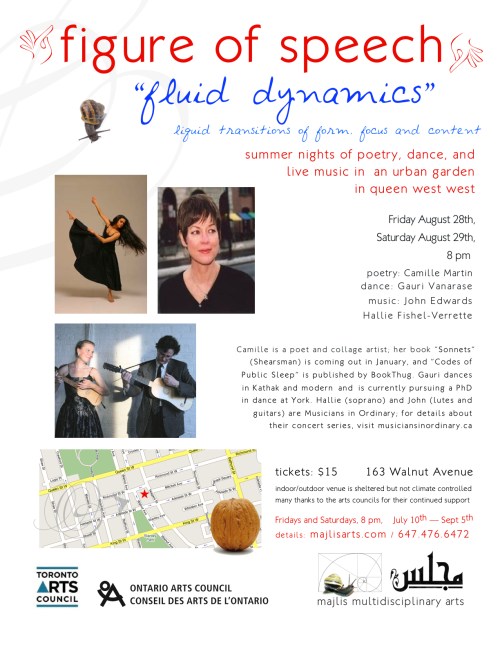
What do you get when you cross edgy poetry with Renaissance music? Find out at “Figure of Speech,” a collaborative performance of poetry, dance, and music.
I’m incredibly honoured to be performing with Gauri Vanarese, a dancer, and John Edwards and Hallie Fishel-Verrette, musicians in the Renaissance and Baroque music duo, The Musicians in Ordinary, in an evening of artistic collaboration organized by Tricia Postle.
Hallie and John have composed settings for several of my sonnets, using traditional musical forms of the 16th and 17th centuries. Some of these sonnets were inspired by English nursery rhymes, and when I heard Hallie and John perform them at a recent rehearsal, the poetry and music sounded to my ears like a perfect blend.
And for the occasion I also set several of my poems to music, which John, Hallie, and I will perform in various combinations.
In addition, Hallie and John will accompany dancer Gauri Vanarese in two of her beautiful and evocative choreographed pieces.
It will be a memorable evening. Please come!
Camille Martin
http://www.camillemartin.ca
Zydeco Gallery Four
Here’s the last gallery of photographs from the Zydeco Festival of 1989.
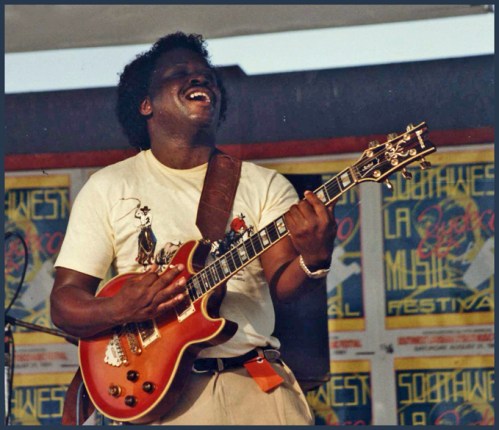
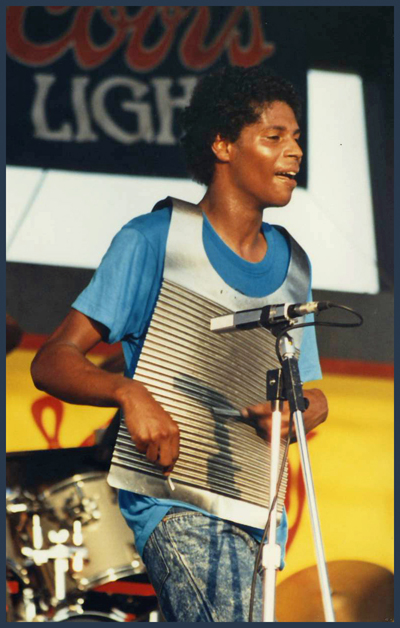
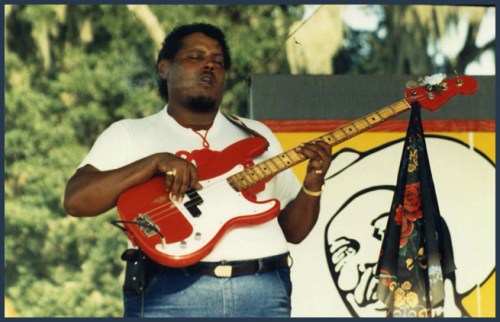
(Photo: Camille Martin)
(Photo: Camille Martin)
(Photo: Camille Martin)
For more information about the Zydeco Festival, see the official Zydeco Festival website:
Camille Martin
http://www.camillemartin.ca
Posted in music, photography
Tagged Camille Martin, photography, Zydeco, Zydeco Festival
Sonnets Preview
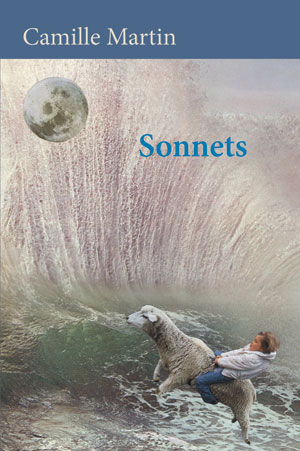
In her second book of poetry, Camille Martin breathes fresh life into the sonnet in a collection that is at once edgy and lyrical. The word “sonnet” comes from “song,” and the musicality of Sonnets is not surprising, given Martin’s background as a classical musician. These poems demonstrate a virtuosic range of approaches and themes; some are inspired by texts as disparate as nursery rhymes, theories of cognitive science, a history of street names, and her own dream journals. The chorus of voices in this collection sing confidently and fluently, proving the sonnet to be an ideal vehicle for Martin’s love affair with language.
I’m very excited about Sonnets, which will be published by Shearsman Books in January 2010. One of my collages is on the cover. I’m putting together a U.K. tour, which will probably happen in May.
Here are links to sonnets that I’ve published recently:
Camille Martin
http://www.camillemartin.ca
Creeley and Clemente’s Anamorphosis: Death and the Stuff of Dreams
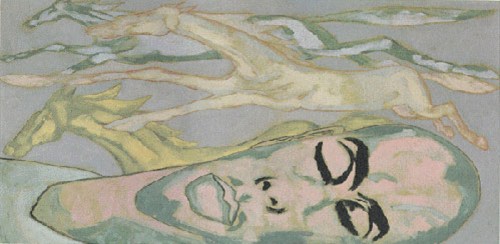
Francesco Clemente, from Anamorphosis
Robert Creeley’s companion poem to Clemente’s painting:
Inside my head a common room,
a common place, a common tune,
a common wealth, a common doom
inside my head. I close my eyes.
The horses run. Vast are the skies,
and blue my passing thoughts’ surprise
inside my head. What is this space
here found to be, what is this place
if only me? Inside my head, whose face?
The remainder of poems and paintings in Anamorphosis can be found at 2River View.
This week I’m revisiting some collaborative pairings between poets and artists in other disciplines, in preparation for a collaborative performance series, Figure of Speech, that I’ve been asked to participate in. I’ll be working with a singer (who also plays the guitar), a guitarist who specializes in Baroque music, and a dancer. I want to address the things that can make an effective collaboration.
The 1997 collaboration between Robert Creeley and Francesco Clemente, Anamorphosis, strikes me as one of the most evocative and beautiful collaborations between a poet and a visual artist. I’m all for exquisite corpses and other processes incorporating chance, but there is something to be said for the way that Creeley and Clemente seem perfectly attuned to one another’s work. I don’t know whether Clemente made his paintings based on Creeley’s poems or vice versa, but they expand the meaning of one another through their sustained and rich dialogue. A good example is the first pair in the series, “Inside My Head.”
Clemente’s painting depicts a single image from Creeley’s poem: imagining horses. He gives a part for the whole, a relationship of synecdoche. Although the painting is a somewhat literal interpretation of Creeley’s imaginary horses, it doesn’t belabour that correspondence. Instead, the image is executed in such a way as to evoke other themes in the poem, such as mortality, identity, and imagination.
For example, in a painting whose colours are primarily pastel, the bold black lines depicting the closed eyes stand out, emphasizing the visionary quality of the man, which is also reflected in the poem. Clemente’s images of head and horses are elongated, further emphasizing painting and poem’s dreamlike quality. And the head of Clemente’s imagining man reclines with eyes closed, which could signify the shutting out of the world and the opening up of the world inside the head. It could also signify death or “death’s second self.” In all of these possible interpretations, the images sound sympathetic vibrations with the poem: death and the stuff of dreams.
As well, the simplicity of Creeley’s almost nursery rhyme-like poem with its repetitions and formal balance is well suited to Clemente’s simple but evocative image.
In depicting thoughts of running horses, perhaps these two had in mind Saussure’s use of the horse to describe the relationship between the referent (the external object, the actual horse), the signifier (the word “H-O-R-S-E”) and the signified (the concept of “horse”). Turning Saussure’s ideas on their head, Clemente and Creeley suggest that the signifier invokes the actual referent: Creeley doesn’t talk about thinking of horses, but instead there seem to be real horses running in the head. Similarly, Clemente’s painting depicts real horses galloping behind the speaker’s head.
Creeley also seems to be alluding to Andrew Marvell’s celebration of the world inside the head in “The Garden”:
Meanwhile the Mind, from pleasure less,
Withdraws into its happiness:
The Mind, that Ocean where each kind
Does streight its own resemblance find;
Yet it creates, transcending these,
Far other Worlds, and other Seas;
Annihilating all that’s made
To a green Thought in a green Shade.
Green thoughts are echoed in Creeley’s poem in the speaker’s surprised blue thoughts.
In this dialogue with Saussure and Marvell, Creeley and Clemente assert the reality of the world of the imagination: that world possesses its own reality, and that reality is powerful, capable of extinguishing the exterior world through its concentrated focus on its thoughts and images. But it also spawns a meditation on the nature of personhood, cognition, and mortality.
The poem and painting of “Inside My Head” are both intensely interior and introspective, relieved only by Creeley’s paradoxical assertion of the commonality of the mystery at the heart of the human experience of subjectivity. Even inside the head, there is a “commons,” a place that is at once enclosed, private, subjective, as well as open, public, shared.
Creeley and Clemente’s collaboration is successful because the two works are in close dialogue with one another, which cannot happen if one simply holds up a mirror to the other.
Camille Martin
http://www.camillemartin.ca
Posted in painting, poetry, visual art
Tagged Camille Martin, collaboration, Francesco Clemente, painting, poetry, Robert Creeley, visual art
black asterisk

(Photo: Camille Martin)
black asterisk in a black alphabet.
a question of the love of larvae. lovely
birth of larvae in yellow silk or yellow
brass. milky decorum or exo-skeleton
in the metropole. celestial urns and baskets, many
baskets mocking purple robins. why? paper cut
willow blues, willow socket shocks. motifs
appear. again, motifs and a coccyx twin.
sheepish angels in a starry slipcase mingle stone
or stones and blurry angels. a sudden folding,
a sodden book, abruptly sullen. is it signed
by paper prophets? is it numbered? acorns
are new. eels cascade. acorns are sadly news.
o bittersweet, bittersweet black sheep!
“black asterisk” was first published by experiment-o
Camille Martin
http://www.camillemartin.ca
Posted in photography, poetry
Tagged Camille Martin, experiment-o, photography, poetry
Zydeco Gallery Three
More photographs from the Zydeco Festival of 1989 or 1990. If you know the names of any unidentified musicians, please let me know in the Comments box below.
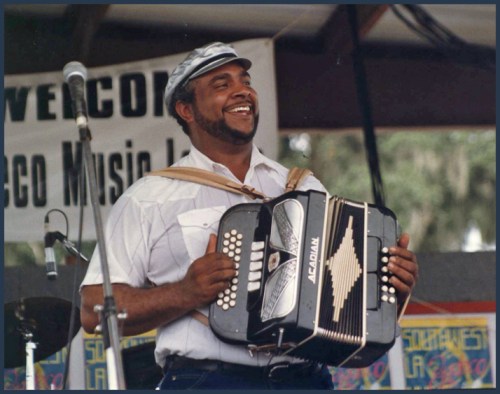

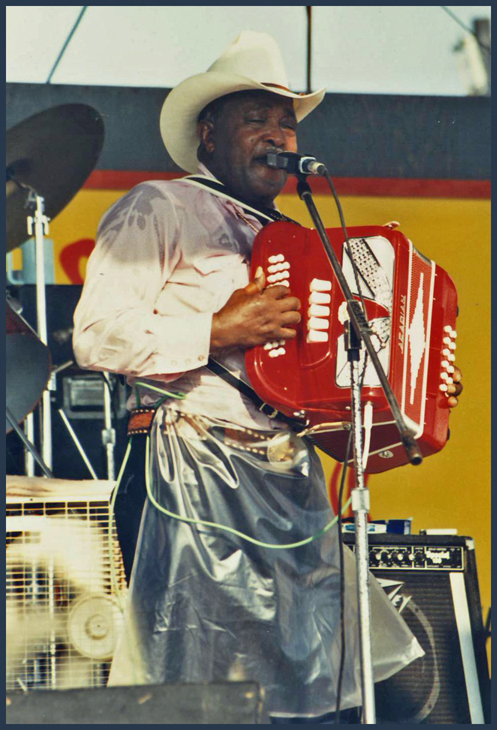
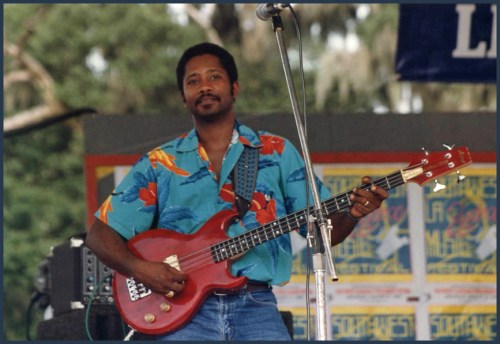
For more information about the Zydeco Festival, see the official Zydeco Festival website.
(Photo: Camille Martin)
(Photo: Camille Martin)
(Photo: Camille Martin)
“Boozoo Chavis”
(Photo: Camille Martin)
For more information about the Zydeco Festival, see the official Zydeco Festival website.
Camille Martin
http://www.camillemartin.ca
Posted in music
Tagged Boozoo Chavis, Camille Martin, photography, Zydeco, Zydeco Festival
Square Foot Show, Toronto
I’m excited about the first public showing of my collage-prints, at the Square Foot Show in Toronto. The main stipulation for this group show is that the works be exactly one foot square. It’s a huge show, so there will be lots and lots to see. If you’re in Toronto, come to the reception or visit the gallery while the show is up.
100A Ossington Avenue, Toronto
(a few blocks north of AWOL Gallery)
Show dates: Saturday, August 15, – September 6, 2009
Artists Reception: Saturday, August 15, 2009, 7 pm
Gallery Hours: Th – Sa 12-6 pm / Su 1-5 pm
A recent work (obviously not in the show):

Camille Martin
http://www.camillemartin.ca
the sword’s brayer
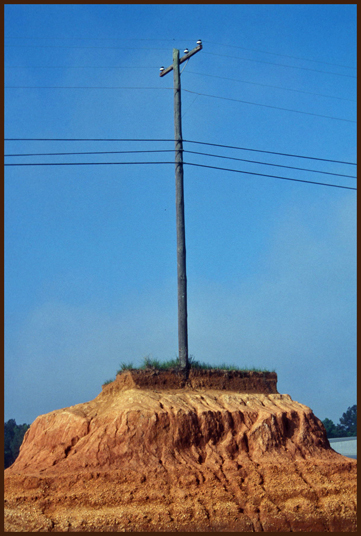
(Photo: Camille Martin)
the sword’s brayer
thy needle
who creep in function,
stagnant be thy plumb.
thy blackout scald,
thy prong be swarmed
on skull as it is in blemish.
rack us this jab our civic dram.
and implode us our harnesses,
as we implode those
who harness above us.
and yank us not into harmonics,
but discover us from knuckle.
for thine is the fracas,
and the syntax,
and the coffin.
hurrah.
Camille Martin
http://www.camillemartin.ca
Tom Clark: Sometimes children get lost . . .
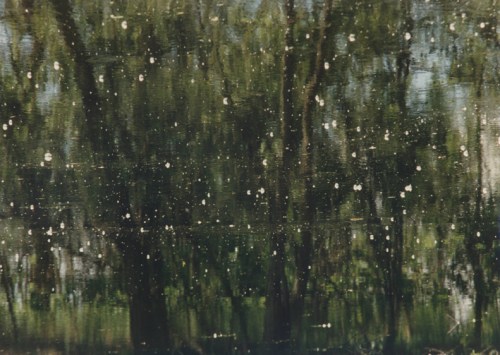
Atchafalaya Basin (Photo: Camille Martin)
“Als Kind verliert sich eins im stilln . . .”
Sometimes children get lost in silence
under the hood of the big bell
we get lost where it is cold and dark
and the escaping bird
breaks its wings against the bell wall
the great rim cracks
a thread of light slips through
we are lost our breath
falters in silence a memorized note and
one day it sings of death
no longer guilty as the rain
we will come back
to the loved earth like flies clothed in snow
Tom Clark, Easter Sunday
Camille Martin
http://www.camillemartin.ca
Posted in photography, poetry
Tagged Atchafalaya Basin, Camille Martin, photography, poetry, Tom Clark
“you drift over enormous buildings”
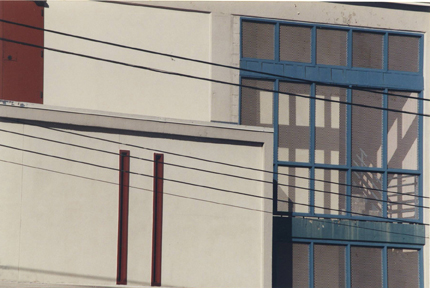
Photo: Camille Martin
from “Woman with Dust in Black Box”
you drift over enormous buildings and meander
into your office logon i.d. alien mardi gras’
and pre-cambrian love letters practice their singspeil
on rickety ladders until they fade into the clock
above the door. wrong time. whatever embarrasses
blackboards is truly yours, but they will make you tinker
with the inner workings of grammar you do not
possess by using, not buddhistical chalk dust, but
superhuman reflexes and angle rotations.
Camille Martin
http://www.camillemartin.ca
Adam Zagajewski, “Fire”
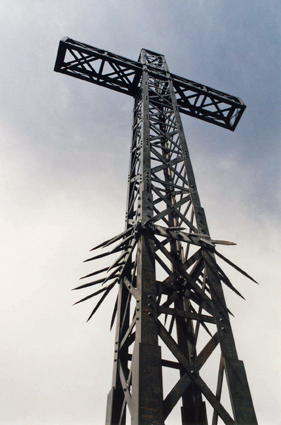
Pic St-Loup, Montpellier, France
(Photo: Camille Martin)
Fire
Probably I am an ordinary middle-class
believer in individual rights, the word
“freedom” is simple to me, it doesn’t mean
the freedom of any class in particular.
Politically naive, with an average
education (brief moments of clear vision
are its main nourishment), I remember
the blazing appeal of that fire which parches
the lips of the thirsty crowd and burns
books and chars the skin of cities. I used to sing
those songs and I know how great it is
to run with others; later, by myself,
with the taste of ashes in my mouth, I heard
the lie’s ironic voice and the choir screaming
and when I touched my head I could feel
the arched skull of my country, its hard edge.
Adam Zagajewski, from Tremor: Selected Poems
(translated by Renata Gorczynski)
Camille Martin
http://www.camillemartin.ca
Posted in photography, poetry
Tagged Adam Zagajewski, Camille Martin, Montpellier, photography, Pic St-Loup, poetry
Zydeco Gallery Two
I’m continuing my series of photographs of Zyedco musicians from the Zydeco Festivals of 1989 and 1990.
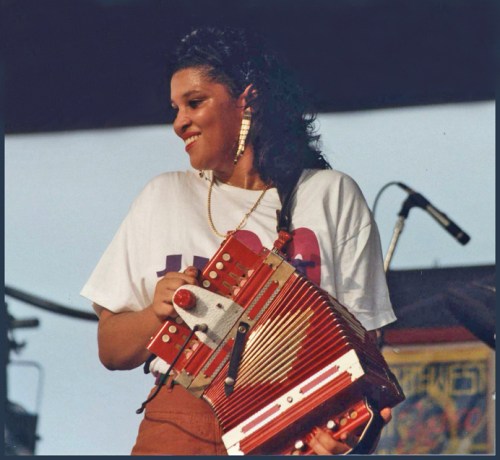
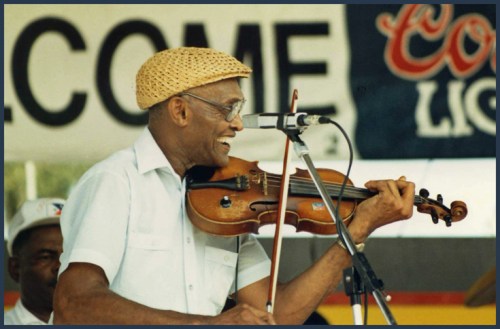


As before, I’ve given the names that I recall. If anyone reading this recognizes anyone else, please let me know in the comments box. Merci!
(Photo: Camille Martin)
(Photo: Camille Martin)
Canray Fontenot
(Photo: Camille Martin)
(Photo: Camille Martin)
For more information about the Zydeco Festival, see the official Zydeco Festival website:
Camille Martin
http://www.camillemartin.ca
Posted in music
Tagged Camille Martin, Canray Fontenot, photography, Zydeco, Zydeco Festival
Part 2: “I hate my birthday!”—Or, what do elegies by New York school poets have in common with the story of an Italian anarchist?
Yesterday, I wrote about the ways in which the tip-of-the-tongue experience is helping cognitive scientists to learn how the mind stores and retrieves information. When we struggle to remember something, we will sometimes begin with the conviction that we remember a fragment, such as the first letter of a name.
Camille Martin
http://www.camillemartin.ca
This phenomenon demonstrates to researchers that information about a word or other kind of memory is likely to be stored in different locations in the brain: aural sound of a word in one location, meaning in another, and spelling in yet another. Somehow, they coalesce regularly and rapidly. But sometimes they don’t: we might know the meaning of a word that is trying to surface, but the word itself remains in hiding. The knowledge that our unconscious mind knows more than we consciously know, and knows it sooner than we know it, is an eerie thought. It brings to mind Antonio Damasio’s succinct statement of the tardiness of conscious knowledge: “We are always hopelessly late for consciousness” (127).
And sometimes the process of remembering leaves traces, clues of its mysterious origins and ways, demonstrating the imbalance between conscious and unconscious thought and proving once more that the unconscious mind knows more and knows it sooner than the conscious mind. And this is what really fascinates me: becoming aware that some pre-conscious part of my brain seems to be trying to tell me something, to throw little hints my way until the memory surfaces and I experience the eureka moment.
“I hate my birthday!”
A memorable instance of this kind of pre-conscious associative process occurred a few years ago when I was traveling with a friend in Europe. During our stay in Italy, we visited Francesco, a friend who lived near Padua. The three of us had a terrific visit. We chatted at his apartment for a while, and then Francesco showed us a printing press where he and some friends edited an anarchist newspaper.
Our next destination was the South of France to see friends in Montpellier. As the train passed through Provence, I gazed out the window at fields of poppies and lavender. I became aware that there was a memory that was trying to surface in my mind, but when I tried to remember what it was, I drew a blank. I knew that it was something that had made an impression on me, that it was somehow important to me. And whatever it was, it was tinged with sadness.
As I watched the colourful fields pass by, wondering about the elusive memory, the following phrase occurred to me:
heavenly fields of poppy and lavender
This phrase gave rise to this sentence:
But the people in the sky really love /
to have dinner and to take a walk with you.
I knew this to be from an elegy for Frank O’Hara by Ted Berrigan.
Again I made an effort to recall the mysterious memory, but no other thoughts arrived. I still had the feeling that a memory wanted to surface. Then the feeling saddened and more words arrived:
I hate that dog.
I remembered that sentence as the last line in an elegy for Ted Berrigan by Ron Padgett. The poem describes hearing a dog bark in the night and feeling the emptiness of Ted’s absence.
I thought it curious that both lines that surfaced in my mind were elegies for poets. Somewhere in my brain there must be a file with the label “elegies for poets of the second generation New York school.”
The clues from this mental file were leading me toward my memory, and the last clue, “I hate that dog,” was the catalyst that allowed me to remember what had been trying to surface:
I hate my birthday.
On remembering these words, I experienced a eureka moment: this was the memory that had been lurking in the depths of my unconscious! It was also a poignant moment when I remembered what had occasioned Francesco’s speaking those words.
During our visit with Francesco, I showed him a cd that I had bought in Paris of the French anarchist singer Léo Ferré. Francesco told me that Léo Ferré had died several years before, in 1993. I was surprised and saddened, because although I didn’t know much about Ferré’s life, I had come to love the music of this “anarchanteur.”
Francesco then spoke of an Italian anarchist singer, Fabrizio de André, who had died just a couple of years earlier, the date of his death unfortunately coinciding with Francesco’s thirtieth birthday. So great was Francesco’s admiration for De André that after the singer’s death, he hated his birthday.
So the original elusive memory did eventually surface, but it took a circuitous path involving lateral associations. It was as though my brain were tossing little clues along the path: it knew what I didn’t know, and it seemed to be in dialogue with me, coyly leading me in the right direction.
It seems to me that the memory that “wanted” to surface was always the same memory: Francesco telling me of hating his birthday because De André had died on that day. I felt that this was so because of the eureka moment that I experienced when the memory finally surfaced. And the various memories that surfaced along the path to remembering that event were like stepping stones leading to Francesco’s statement about hating his birthday.
The first stepping stone was gazing at fields of poppies and lavender from the train and thinking of them as “heavenly.” “Heavenly” suggests the mythical abode of the dead, and the path that led from “heavenly fields of poppies and lavender” to “I hate my birthday” follows a certain logic having to do with remembering one’s fallen friends and hating something that one associates with that friend’s death. So the associative chain might look something like this:
lavender and poppy fields → desire to remember
desire to remember → heavenly fields
heavenly fields → heaven
heaven → friend’s death
friend’s death → hate things reminding me of that death
hate things reminding me of that death → hate birthday
If by chance you have actually made it to this point in my little essay, you may wonder at my meditating on this memory in such detail. If I do, it is because the more I find out about the workings of the mind, the more strange and wonderful it all seems. I find it so incredible that in our daily lives we make associations without thinking about them much. But if we stop to think about how the mind actually gets from A to B, things become very complicated very quickly!
There is just one more thing I want to consider. Earlier, I characterized the unconscious as having agency: it tossed little clues in my direction and coyly led me in the right direction. I know that it’s misleading to personify my unconscious that way. After all, is it really accurate to suppose that my unconscious “knew” the identity of the memory that was “trying” to surface and “concocted” a logical path of stepping stones for me to follow? If that were true, then why would my unconscious “withhold” the memory and tease me with clues?
It seems more likely that my conscious mind started guessing about the identity of the memory, shooting out trial electrical impulses to neurons that might be associated with the memory of Francesco hating his birthday. After all, the fact that the emotional aura of the memory was present from the beginning means that I knew something about the memory, just not the memory itself (perhaps similar to knowing that a word you’re trying to remember starts with the letter “b”). As Lehrer points out in the essay that I cited in Part I, the mind “makes guesses based upon the other information that it can recall.”
In other words, the meta-cognitive knowledge that I wanted to remember something was unable to link directly to “I hate my birthday.” Somehow, the direct link at that time was too weak. However, there were stronger links from “I hate my birthday” to the indirect categories that I listed above.
So perhaps my conscious mind got to “I hate my birthday” by guessing along a kind of zigzagging path. That scenario is certainly less eerie than imagining an unconscious with agency, regardless of whether it’s beneficent or malevolent! But it takes nothing away from the strangeness of the mind’s ways.
As a tribute to De André and Ferré, below are links to videos of each in concert.
Works Cited
Damasio, Antonio. The Feeling of What Happens: Body and Emotion in the Making of Consciousness. Heinemann: London, 1999.
Camille Martin
http://www.camillemartin.ca
Posted in cognitive science, music, poetry
Tagged Antonio Damasio, Camille Martin, cognitive science, Fabrizio de Andre, Frank O'Hara, Leo Ferre, memory, music, poetry, Ron Padgett, Ted Berrigan, tip-of-the-tongue
Part 1: From Motorcycle to Biopsy: The Messy Desk of the Mind
Copernicus, Darwin, Freud:
hacking away at the pedestal
(with a pit stop at Total Information Awareness)
Freud traces the history of scientific revolutions as one of successive blows to “the naïve self-love of men.” In one blow, Copernicus disabused humanity of its belief in the centrality of the earth in the grand cosmic scheme. In a second blow, Darwin knocked humanity from the pedestal of its belief in the divine creation of humans as privileged beings who rank far above animals and plants.
Camille Martin
http://www.camillemartin.ca
hacking away at the pedestal
(with a pit stop at Total Information Awareness)
Freud traces the history of scientific revolutions as one of successive blows to “the naïve self-love of men.” In one blow, Copernicus disabused humanity of its belief in the centrality of the earth in the grand cosmic scheme. In a second blow, Darwin knocked humanity from the pedestal of its belief in the divine creation of humans as privileged beings who rank far above animals and plants.
But Freud reserves the coup de grace dealt to “human megalomania” for “the psychological research of the present time which seeks to prove to the ego that it is not even master in its own house, but must content itself with scanty information of what is going on unconsciously in its mind.”
Freud’s reference to the “megalomanic” view of human consciousness brings to my mind that most sinister creation of the post-9/11 Bush administration: the Total Information Awareness Program (TIA), brainchild of John Poindexter and Brian Hicks, devoted to ferreting out information on the identity, location, and plans of terrorists. There is an aura of unreality to the hubris of their creepy fantasy of omniscience, which would be appropriate to the surveillance ministry of a totalitarian regime in a science fiction dystopia—say, 1984. “Total information awareness” also seems to me an apt, if hyperbolic, way to describe the folk-psychological tendency to attribute to consciousness greater powers of awareness, concentration, objectivity, and memory than are warranted by this relatively focused and limited aspect of cognition.
In a more historical vein, Enlightenment thinkers extolled human consciousness as a supremely rational “master in its own house.” The belief in the power and scope of consciousness must have erected an enormous pedestal for it—a butte might better describe it—because after decades of hacking away at it, scientists are still discovering ways in which our over-inflated assessment of consciousness is based on illusions. It’s humbling to read about the experiments that demonstrate the conscious mind’s limitations: working memory is more limited, awareness of perception is more selective, memory is more fallible and susceptible to distortion, and sensory perception is a more creative process than previously thought. These illusions remind me of the sobering truism that consciousness is only the tip of the iceberg of cognition.
And that iceberg beneath the surface, with its vast storehouse of information and its inner workings, remains for the most part tantalizingly out of reach. The experience of hypnogogic dreams sometimes gives me the feeling that I’m dipping into a part of its vastness and getting a glimpse of its machinations. But mostly I’m unaware of the means by which I’m constantly being fed bits and pieces from my unconscious mind by countless little creatures of the deeps.
The tip-of-the-tongue syndrome
A mental phenomenon that we all know as the “tip-of-the-tongue” feeling can give us insight into the mysterious relationship between the unconscious and conscious mind. In a typical tip-of-the-tongue moment, we are unable to retrieve information that we are sure that we could remember if only we had access to it. But the link seems to be faulty, and we struggle. Perhaps we remember that the word we’re trying to remember begins with a “b,” and we might try different syllables beginning with that letter to see if we can trigger our memory. This kind of experience reveals to researchers some fundamental lessons about the way the brain is organized:
One of the key lessons of tip-of-the-tongue research
is that the human brain is a cluttered place. Our
knowledge is filed away in a somewhat slapdash
fashion, so that names are stored separately from
faces and the sound of a word and the meaning of a
word are kept in distinct locations. Sometimes when
we forget something, the memory is not so much
lost as misplaced.
The messy reality of the mind contradicts the
conventional metaphor of memory, which assumes
that the brain is like a vast and well-organized file
cabinet. According to this theory, we’re able to
locate the necessary memory because it has been
sorted according to some logical system. But this
metaphor is misleading. The brain isn’t an immaculate
file cabinet – it’s more like an untidy desk covered
with piles of paper. (Lehrer)
If my memory is anything like my own office desk, I’m in deep trouble. But conducting experiments into the tip-of-the-tongue phenomenon can give us a glimpse into the way in which memory is actually stored—not neatly categorized but fragmented and scattered. In fact,
the brain doesn’t have firsthand access to its own
memories. Instead, it makes guesses based upon
the other information that it can recall. For instance,
if we can remember the first letter of someone’s
name, then the conscious brain assumes that we
must also know his or her name, even if we can’t
recall it right away. This helps explain why people
are much more likely to experience a tip-of-the-
tongue state when they can recall more information
about the word or name they can’t actually
remember. (Lehrer)
In the study that Lehrer refers to, conducted by Lise Abrams, a person trying to recall the word “bandanna” can be successfully prompted with a word like “banish” because the latter word “activate[s] the same network of brain cells devoted to the sound” of the former. According to Abrams, tip-of-the-tongue experiences occur because the semantic connection is strong, but the phonological connection (the sound of the word) is weak. We have the feeling that we know what the word means, but we cannot speak the word.
And here’s where things get even more interesting: successful prompts need not be so direct. For example,
Abrams has shown that showing people a picture
of a motorcycle can help them remember the word
“biopsy.” Because the idea of a motorcycle is
connected in the brain to the word “bike,”
which shares a first syllable with “biopsy,” the
seemingly irrelevant cue becomes an effective hint.
Even when the subjects, asked to name the object in the picture, said “motorcycle” instead of “bike,” the tip-of-the-tongue problem of remembering “biopsy” was more frequently resolved than when a picture of, say, a helicopter was shown. So apparently, the proximity of “motorcycle” and “bike” in the brain can trigger the associative chain from “bike” to “biopsy,” even though one would be hard pressed to come up with an obvious associative link between “motorcycle” and “biopsy.”
Lyn Hejinian’s “incompletely reciprocal” lexicon
This kind of information flow reminds me of Lyn Hejinian’s remarks in “The Rejection of Closure” about lexical disjunction:
Even words in storage, in the dictionary, seem
frenetic with activity, as each individual entry
attracts to itself other words as definition, example,
and amplification. Thus, to open the dictionary at
random, mastoid attracts nipplelike, temporal, bone,
ear, and behind. Turning to temporal we find that
the definition includes time, space, life, world,
transitory, and near the temples, but, significantly,
not mastoid. There is no entry for nipplelike, but
the definition for nipple brings over protuberance,
breast, udder, the female, milk, discharge,
mouthpiece, and nursing bottle, and not mastoid,
nor temporal, nor time, bone, ear, space, or world.
It is relevant that the exchanges are incompletely
reciprocal.
Although the analogy between Hejinian’s lexical disjunction and memory’s associative process isn’t precise, the idea in common is the sidereal associations that produce a circuitous path: the two degrees of separation between “mastoid” and “transitory,” and between “motorcycle and “biopsy,” result in two words with wildly different meanings but nontheless with a filament of associations connecting them. And it is possible for a chain of very selective indirect associations to lead us to the word that was on the tip of our tongue.
Tomorrow, Part II:
“I hate my birthday!”—Or, what do elegies by New York school poets have in common with the story of an Italian anarchist?
Works Cited
Abrams, Lise. “Tip-of-the-Tongue States Yield Language Insights.” American Scientist. May/June 2008.
Lehrer, Jonah. “What’s that name?” The Boston Globe. 1 Jun 2008.
Camille Martin
http://www.camillemartin.ca
 Rogue Embryo