Tag Archives: Camille Martin

a matter of degree /of unfast night/


experience and language as reciprocal … recognizing
to a matter of degree /of unfast night/

experience awakened: invent and receive … performance /recovered/ that recognizes multiple matters of degrees, an inclusive inventing, embracing also its emptiness–a matter and a transparency, slowly roiling … not /only/ language in the service of experience, experience and discourse timidly asleep together–an alchemy of experience into language, act of descriptive translation … capturing the present concludes it into an idea of the past, a convention of history … language supplying imagination limits the invented experience of language–or rather experience awakened to language … it sweeps itself unawares into a discourse of the clearly immortal even if unfamiliar … rather an unfast, a slow detached feast Continue reading

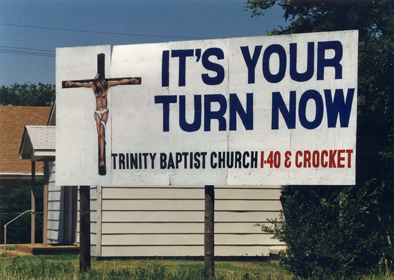
de Sade in Amarillo, Texas

Photo: Camille Martin

Photo: Camille Martin

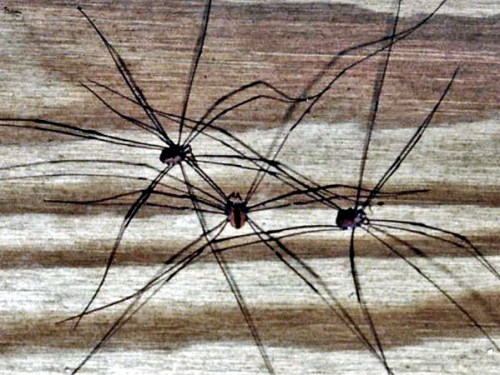
double daddy long legs on plywood

Photo: Camille Martin

Camille Martin’s website

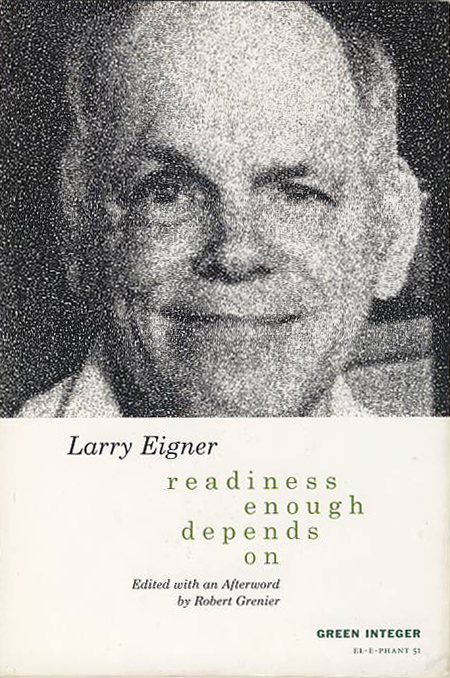
“how many years / without death”: Larry Eigner’s memento mori

five poems from readiness / enough / depends / on,
then a brief essay


                                                                          July 26-7 93

  oblong windows lit
room     a bare bulb
                    over the back steps
                            burning into the night
                        as if it’s all time
                            likewise facing the street

                                countless stars
                                    and a few patches of cloud


                                                                       October 8 94

slight
                                      of a size
   air
                                          possible
 a tree
                                             to live
      stirs
                                                at rest
out
                                                    a while
        the window
                                               while there’s so much
  soon
                                                               on round
    after I’ve
                                                                  earth, sky
          waked up

        to start
                                                                       )birds too
            the morning
                                                                           about as quiet
              there have
                                                                                    as flowers I see
                       been times


                                                                          April 2 78

                        wind huge outside since when
falling asleep alpha rhythms I suppose
                      how many years
                                            without death


                                                                          August 6-8 78

        maybe

words and things among us go
    together enough

      wherever your end is


                                                                          December 2-3 1992
t  h  e    w  h  o  l  e    o  r  c  h  e  s  t  r  a

        risen

                up    into the air

                        for dancing

                                after the storm


        Larry Eigner’s readiness / enough / depends / on, his last collection of poems before his death in 1996, explores the precarious position of the self that inhabits an uncertain place between the sufficient and the dependent, between the assurance of passing from one state to the next and the unknowability of how and when that crossing will play out. Eigner’s “I” is situated on lyric coordinates where it thinks and feels in time and place, though the breadth of the spotlight on the self remains open-ended in order to allow the concrete to be brought into relation to a wider map. Continue reading

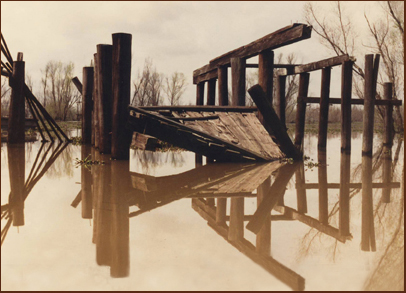
Ruins, Henderson Swamp

Photo: Camille Martin


final act

Photo: Camille Martin


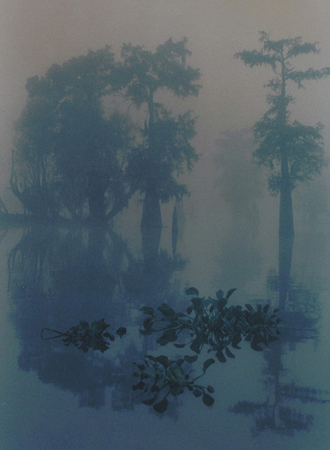
Early Autumn, Henderson Swamp

Fog,-Henderson-Swamp

Photo: Camille Martin


Camille Martin
http://www.camillemartin.ca

U.K., Ireland, & Paris: Launch and reading tour for Sonnets

I recently finalized plans for a launch/reading tour in the U.K., Ireland, and Paris for my second book of poems, Sonnets (Shearsman Books, 2010). Many thanks to curators Tony Frazer (Shearsman), Nathan Thompson (PoAttic), Paul Casey (Ó Bhéal), Scott Thurston (University of Salford), Michelle Noteboom, and Jennifer K. Dick (Ivy Writers) for making these readings and workshop possible. I couldn’t resist including thumbnails of these venues. The itinerary:


Swedenborg Hall
7:30 pm, Tuesday, May 4
Shearsman Reading Series
Swedenborg Hall, Swedenborg House
20/21 Bloomsbury Way, London
This has to be, hands down, the most beautiful hall I will have ever read in.


Jersey Opera House, night
8:00 pm, Thursday, May 6
PoAttic Reading Series
Jersey Opera House, St. Helier, Jersey, U.K.
(OK, not the actual opera stage, but a room called the “Attic” where Nathan says the phantoms live.)


The Long Valley
8:30 pm, Monday, May 10
Ó Bhéal Reading Series
The Long Valley (upstairs), Cork, Ireland
Can’t wait to try their famous sandwiches . . .


University of Salford
6:00 – 8:00 pm, Tuesday, May 11
University of Salford
Reading and two-hour session with students in the MA in Creative Writing: Innovation and Experiment program
Looking forward to meeting the students!


A recent addition to the tour:
Tuesday, May 18
Ivy Writers Reading Series
Le Next
17 rue Tiquetonne, Paris


Camille Martin
http://www.camillemartin.ca

From East to West (audio issue) – new URL

From East to West


Editor PJ just sent me the new URL for From East to West, which just came out with an audio issue. Two of my double sonnets from a work in progress can be viewed (and heard) in this issue:

Click here for the issue.

(For the double sonnets, enter “36” in the page box.)


Click here for the audio files.


Camille Martin
http://www.camillemartin.ca

under the dome

collage: Camille Martin

collage: Camille Martin


Camille Martin
http://www.camillemartin.ca

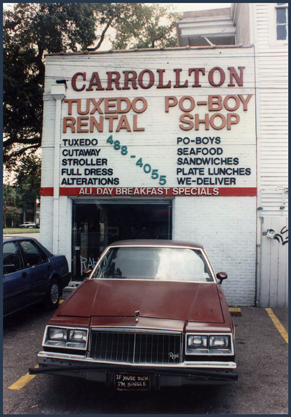
One-Stop Shopping: Tuxedos and Po-Boys

Photo: Camille Martin

Photo: Camille Martin


        Along the road that leads from the Louis Armstrong International Airport to the City of New Orleans is an official sign welcoming visitors to “The World’s Most Interesting City.” That wording must have been composed by a committee of City Hall hacks who, after hours of posturing and heated debate, compromised with the bland descriptor “interesting.” Or maybe it was fifteen minutes and nobody really cared. Whatever. The sign is a wonder of pithy bureaucratic understatement in a city that regularly marries surreal flamboyance and insouciance—just not in City Hall.
        I would still nominate the sign for the Eccentric New Orleans Hall of Fame along with coordinates of surreal mergings and logic-defying oddities. Such sites have been known to render tourists into a prolonged catatonic state of befuddlement. But there they are in their laid-back glory for anyone to see. Cases in point: the Saturn Bar, with its mummy hanging from the solar system, and the Aztec tomb in a Metairie cemetery.
        One of my favourites among such “interesting” places is a psychic convergence of formal wear and fried seafood sandwich, the Carrollton Tuxedo Rental and Po-Boy Shop. It’s like something out of A Confederacy of Dunces. Imagine: with every fifth po-boy you got an extra day of rental. Their grease stain policy must have been lenient.
        Alas, this unassuming landmark of quintessential New Orleans sensibility has gone to eccentric retail heaven, along with the Used Car and Jello Shot Junction. But in its heyday it graced Carrollton Avenue in Mid-City, my old neighbourhood. R.I.P.


Camille Martin
http://www.camillemartin.ca

Audio issue of From East to West

From East to West


Check out the fabulous From East to West, which just came out with an audio issue. Two of my double sonnets from a work in progress can be viewed (and heard) in this issue:

Click here for the issue.

(For the double sonnets, enter “36” in the page box.)


I just heard from PJ, the editor, that the audiofiles are temporarily unavailable while the website migrates to a new url. I’ll repost this when the audiofiles are online again.


Camille Martin
http://www.camillemartin.ca

The Birth of Newton

Collage by Camille Martin

Collage by Camille Martin


more collages
here


Camille Martin
http://www.camillemartin.ca

Decasia: Seeds of destruction

DecasiaClick here to view Decasia on VEOH.

        Decasia is a relentless memento mori that grabs you by your repressed thoughts of death and doesn’t let go. Its visual premise is, on the surface, simple and monomaniacal: it consists entirely of un-retouched clips of old silver nitrate films—documents of ordinary life or melodramatic scenes from silent films—that have deteriorated over decades of neglect. Filmmaker Bill Morrison copied these strips of film, in whatever state of decay he found them, and spliced them together to create a powerful sixty-six minute meditation on impermanence. Experiencing this montage and its compelling soundtrack by Michael Gordon is mesmerizing, and the film continues to haunt long afterwards.
        Decasia’s original incarnation was a symphony by Michael Gordon (of Bang on a Can fame) that was accompanied by an earlier version of Morrison’s film in a live multi-media performance. Morrison later re-edited his film to mesh with the music.
        The opening scene is meditative: slow-motion whirling dervishes whose revolving movement initiates a motif suggesting cyclical change. Morrison continues this motif of circular motion with an archival film tour of a motion film processing centre, in which reels of film revolve on a machine that immerses the strips in tubs of chemicals. After this tour of the the birth and baptism of film, which establishes the metafilmic premise of Decasia, comes a sustained onslaught of images showing its inevitable decay.
        One of the first clips in that onslaught confounds filmed object and image of decay: what appears to be drifting smoke or shapeshifting clouds might also be a morphing milky wash caused by the chemical degradation of silver nitrate. Thus from the start, Morrison collapses object with decay, inviting meditation on the limits of representation: just as life is subject to decay, so is representation also subject to mutability and illegibility. The mimetic pretense of film images allows us to witness something of the objects captured. But those images express their own reality, not just that of the objects, and their decomposition is a reminder of the elusiveness of capture and posterity. They are failed time capsules that carry within them the seeds of their own demise.

Decasia 2

        One of the most compelling illustrations of Decasia‘s dance with mortality is a film of a boxer, perhaps from the 1930s, hitting a punching bag to his right. The image of the boxer has survived, but the right side of the frame has decayed into a fluctuating amorphous cloud, so that the boxer appears to be ineffectually punching a shifting column of ethereality. Even decay is not static but mutable: like life, it’s a process, not a state. And it can be combatted but not halted. Thus is a film of a boxing exercise transformed from quotidian to metaphysical.
        Decasia often gives the illusion that hundred of patterns of various types have been superimposed in rapid succession over a film’s frames. And by showing the films in slow motion, Morrison transforms what might at normal speeds be blips on the screen (and thus not available to the conscious mind) into clearly visible patterns of destruction. For example, a film of the Big Sur coast seems to have been invaded by rapidly shifting giant amoebas, as though a series of slides of the creatures had been overlaid on the film of rocky coastline. Each frame of the film, it seems, was affected by the same chemical process of aging, but in a different configuration. And in a scene in which a Japanese woman in traditional kimono walks past a window, it’s as if hundreds of transparencies of abstract impressionist paintings have been superimposed in rapid succession over the images.
        But the decay comes from the inside out, created by the agents of time and natural processes: decay and image are integrally fused. They render visible what is often forgotten or suppressed: thoughts of impermanence set aside in order get out of bed in the morning, as Morrison points out, without being paralyzed by the ultimate futility of it all.
        To a film archivist or preservationist, being subjected to scene after scene of film in various stages of decomposition might be as nightmarish as a librarian examining rare books warped by flooding. But an expert would not be surprised, as I was, by the variety of forms that decay and time can wreak on film. Blisters, amoeba, specks, amorphous congeries, abstract expressionism: time’s handiwork is endlessly creative, and the marks of impermanence left on these film clips are as impressive as they are relentless, and as beautiful as they are ominous. Decay might render the original images unreadable, but it now plays the lead role, pulsating as if it were itself a life force and not the angel of death. The decay of a film of a burning house takes the form of flames flicking across the fire. Mesmerizing black tornadoes threaten nuns and the children over which they watch walking single file into a schoolroom. Funhouse mirror distortions oddly stretch and contract an automobile of newlyweds. Grim black shadows fall over the image of a miner, unconscious or dead, being carried from a mine. Decay, like the grim reaper, has a smorgasbord of choices.
        I have read more than one review that suggests that Decasia‘s primary purpose is to convey the message that old films are being irretrievably lost to the ravages of time for want of the funds or will to restore them, and to issue a rallying cry to do something about it. That message is unavoidable in a film that is obsessed with (and composed of) the decay of its own medium. However, it seems limiting to view it mainly as propaganda. To tie down the film with such a moral imperative would be as reductive as interpreting Hamlet as a cautionary tale to warn kings not to sleep with their ears exposed. It misses the larger picture.


Decasia 1


Camille Martin
http://www.camillemartin.ca

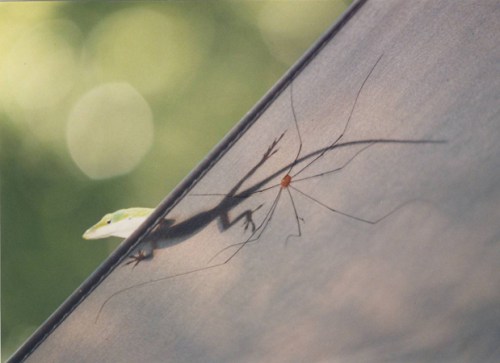
Green Anole, Daddy Long-Legs

Photo: Camille Martin

Photo: Camille Martin


Camille Martin
http://www.camillemartin.ca

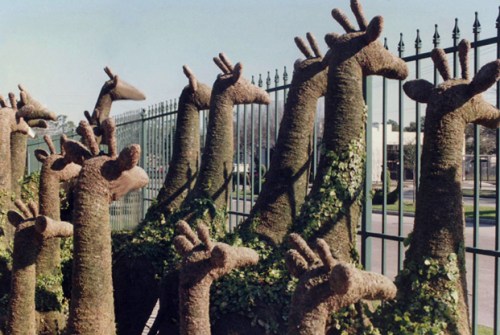
Houston giraffe topiary

Photo: Camille Martin

Photo: Camille Martin


Camille Martin
http://www.camillemartin.ca

Desert Gold

Desert Gold (collage by Camille Martin)

Desert Gold (collage by Camille Martin)


more collages
here


Camille Martin
http://www.camillemartin.ca

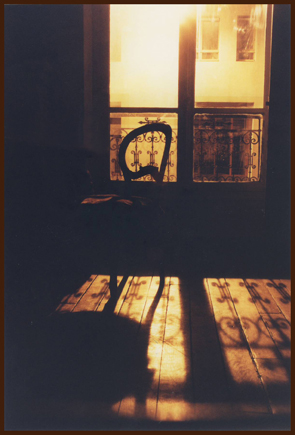
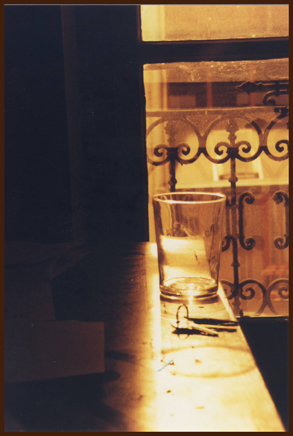
Paris Dusk

Photo: Camille Martin

Photo: Camille Martin


Photo: Camille Martin

Photo: Camille Martin


Camille Martin
http://www.camillemartin.ca

Kiln, Mississippi

Photo: Camille Martin

Photo: Camille Martin

All That Glitters on the Spiderweb: Myth, Race, and Denial

          After living for ten years in upstate New York, where I had never quite felt at home, I decided to return to my hometown of Lafayette, Louisiana, where flowers grew year round, people spoke in the soft, lilting accents of Cajun French, and I could eat crawfish étouffée to my heart’s content. No doubt there was a hefty dollop of romanticized nostalgia in my decision. In any case, I packed up my belongings and drove a big U-Haul south. Three days later, the humidity felt just about the right thickness, and I knew I was home. I took an apartment in Bayou Shadows, a sterile complex probably named by a focus group, and got a job as a secretary in a company that provided tools and labour for offshore oil rigs.
          Over the next few months, I reacquainted myself with the local culture, attending celebrations like the Frog Festival in Rayne, the Cajun Music Festival in Mamou, and of course, Mardi Gras. I also visited Vermilionville, a recreated Cajun village on the banks of Bayou Vermilion showing life in Acadiana from settlement (1760s) to the late nineteenth century. It was recommended to me by my cousin, whose partner had a job demonstrating for the tourists the making of bousillage, a mixture of bayou mud and dried moss that the Cajuns used to plaster their walls. I felt a little sad to see the period costumes, Cajun-style homes and furniture, and farm tools, all authentically recreated and frozen in time.
          When I was growing up, there were still some survivals of this old way, such as the “gar’ soleil” a practical bonnet that my grandmother wore to shade her face from the harsh sub-tropical sun, and the old plow pulled by mules that my grandfather was still using for his cornfields when I was a child. That way of life was gone, though you could still buy Cajun bonnets as a souvenir in the gift shop at Vermilionville. Seeing artifacts from the my culture ossified in a museum, I felt as though a part of my past were now being recaptured, tested for authenticity, and put on display. It was a lesson in impermanence that I was reluctant to learn.
          While I was away in upstate New York, my father had immersed himself in genealogy. He and my mother collected hundreds of photographs and paintings of ancestors, and filled boxes upon boxes of documents photocopied from court records: marriage certificates, wills, contracts. They also collected and framed farm implements such as old cattle brands, correctly assigned to their owners. My father was becoming a kind of living Cajun icon, obsessively collecting the paper trail of his ancestors as a way of holding on to a culture that was swiftly dissipating as assimilation into the “mainstream” took its toll.
          But nostalgia takes its toll on history, and the longing for a lost arcadian past tends to flatten the complex layers of history. What remains is an idealized mythology that takes the form of whatever fantasy nostalgia has invented. Perhaps it’s a vision of happy-go-lucky Cajuns whose unadulterated culture thrived in relative isolation from “les Américains.” Or perhaps it’s a fantasy of the good old antebellum days of oligarchy in the Deep South: wealthy plantations, elegant ballroom manners modeled after European nobility, and ultra-cheap labour. Whatever the fantasy, nostalgia creates a vision of life that used to be simple and pure, uncomplicated by the complexities of cultural hybridity and the inhumanity of slavery. This was another lesson that I was reluctant to learn. After all, I was in search of Cajun authenticity, and I was on the verge of buying into this vision of a lost culture innocent of divisions and contradictions; it was the misty, sunlit, and idealized vision of a lost childhood. Growing up during Jim Crow and witnessing the turmoil of the Civil Rights movement and the first attempts to integrate a society of institutionalized racism left an indelible mark on my psyche. But returning to Cajun country full of wistfulness, on some level I still clung to the belief, despite evidence to the contrary, that racism was not imprinted onto the Cajun social fabric.
          After my move home, I would sometimes drive in the countryside around Lafayette, with no particular destination in mind. I was looking for “authentic” Cajun life in the small towns where life wasn’t self-consciously re-enacted for the benefit of tourists, where life had not become a series of footnotes and framed antique tools. On one of those drives I found myself in St. Martinville, a town where many of the Acadians had first settled after arriving in Louisiana from Acadie, now Nova Scotia, in the 1760s.
          I had been to St. Martinville several times as a child to visit the St. Martin de Tours Catholic Church. To me, it was the quintessential Cajun shrine: an historic eighteenth-century church built by the early Acadian settlers. Next to the church was a statue of a virgin—not Mary, but Evangeline, symbol of the Acadian diaspora.
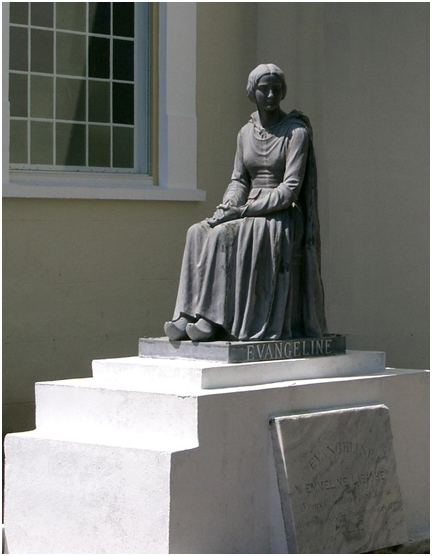
Evangeline Statue

          Evangeline was a character invented by Henry Wadsworth Longfellow in his long tragic poem based on the French Acadian expulsion by the British from Nova Scotia in 1755. Families were often split up as they were forced to hurriedly board ships during “Le Grand Dérangement,” and in Longfellow’s poem, during the loading of the Acadians onto the ships, Evangeline becomes separated from her betrothed, Gabriel. According to one version of the legend, on arriving in Louisiana years later, Evangeline discovers that Gabriel has already married another. After becoming mentally unhinged due to the shock, she dies of a broken heart and is buried under an ancient live oak tree in St. Martinville.
          Even though she is an entirely fictional character, the tourism industry perpetuates the myth that she was based a real person (Emmeline Labiche, another fabricated character) and is actually buried under a live oak near St. Martin de Tours Church.
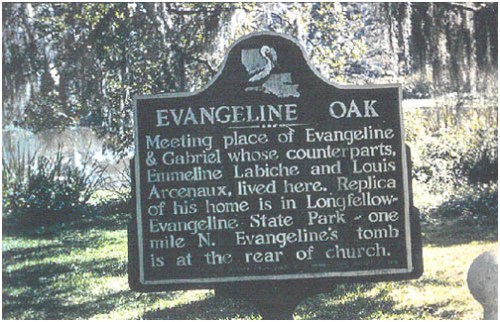
Evangeline Oak

Layers of truth and myth are easily confounded where there is the desire to believe. Of course, there must have been many Evangelines and Gabriels, lovers separated during the expulsion of the Acadians, but none buried under the old oak tree at St. Martin de Tours.
          I sat near the statue of Evangeline, which used to represent to me a fixture of the Cajun imaginary, an icon of the Cajun diaspora. The plaque at the base, translated into English, reads as follows:

* * * * *
Evangeline
Emmeline Labiche
Old Cemetery of St. Martin
In Memory of the Acadians Exiled in 1755
Statue of Evangeline, heroine of the Acadian deportation to Saint Martinsville in Louisiana.
* * * * *

Although there was no mention of a model, I remembered that the statue was in fact a replica of Delores Del Rio, the Mexican-American actress who played the lead role of Evangeline in the 1929 film.

Delores Del Rio

Even Hollywood kitsch merges into the legend and takes on an aura of authenticity. Before the statue knelt two elderly Cajun women solemnly praying before the image of the tragic peasant maiden.
          I walked inside the church, which contained the usual sentimentalized Catholic iconography as well as a simulation of piled-up stones surrounding a statue of Mary, a representation of the Grotto of Lourdes. The stones seemed more simulated than I had remembered as a child, but other than that, the church and grounds were pretty much the way I had known them. It was the kind of place I mentally file as a shrine that is still rooted in a living culture but that, once tourism grew into a serious commodity, became embellished with colourful folklore, complete with sacred landmarks and an empty grave. It seems that the more that fictional accoutrements spring up around a myth, the more credible the tale becomes. Even the locals wanted to believe.
          Next to the church was a little museum. I entered the first floor gift shop and chatted with an affable middle-aged woman behind the counter about the interior of the church. She informed me that “It was a octoroon built the Grotto of Lourdes in the west nave. And do you know, he had never been to Lourdes before?”
          Octoroon? It was bizarre to hear that antiquated word. Here we were, a good thirty plus years from the official end of Jim Crow, and this woman was still using, in all earnestness and without historical context, the long-outdated and legalistic term—common in the nineteenth century—for a person who was one-eight African-American. I felt transported to a different era. Or maybe a Flannery O’Connor story about the absurd underbelly of life in the rural Deep South.
          She then pointed me in the direction of the museum exhibit upstairs, which she said I could see for one dollar. She seemed mysterious about the nature of the exhibit, only saying that “It’ll all explain it when you see it.”
          Expecting an historical display about the church or the Cajun settlement in St. Martinville or some nonsense about the grave of Evangeline, I soon realized that I was about to enter one of those surreal zones—“geo-psychic wonders,” as a friend calls them—that you sometimes come across in South Louisiana. Like the little roadside chapel that I found on one of my countryside excursions, with stained glass windows depicting Houma Indians. Or the Saturn Bar in New Orleans, featuring a painting of the ringed planet on the ceiling along with a dangling mummy and a giant taxidermic turtle—for starters.
          I climbed up the stairs to the museum on the second floor. The first clue was jagged strips of green camouflage cloth festooning the beam at the entrance. The mottled green fabric was crudely decorated with glitter in the shape of spider webs. As I crossed the threshold and walked into a single large room, something told me that this was not going to be a display created by the St. Martinville Historic Society. The entire room was bedizened with lurid, sparkling spiderwebs. Around the perimeter stood department store mannequins in stiff poses, dressed in gaudy eighteenth-century-style satin costumes of purple, green, and gold, the traditional colours of Mardi Gras. Plastic spiders perched on sequinned webs adorned the gowns.
          A placard on the wall explained that these costumes were worn at a recent local Mardi Gras ball whose theme was an 1850 double wedding that took place on a nearby sugar plantation, the Oak and Pine Alley. According to this legend, apparently well-ensconced in the town’s lore, Charles Durand, the wealthy plantation owner and father of two young women engaged to be married, decided to throw the most lavish and memorable wedding anyone had ever seen. He imported spiders from China and set them loose among the live oak trees. On the day of the wedding, he had slaves spray gold and silver dust from bellows onto the spiderwebs, wet from dew, creating a glittering canopy for the ceremony.
          The mannequins’ Mardi Gras ball gowns, a tribute to this wedding steeped in fantasy, seemed a bizarre conflation of Spider Woman, bordello madame, and Bo Peep debutante. At the far end of the room, a mantelpiece decorated in red felt with candelabras at either side served as an altar, complete with a male mannequin dressed in the colourful robes and sashes of a priest, ready to ward off errant spiders with his magic sceptre. In the middle of the room sat a dollhouse model of the plantation house and its oak grove, a kind of fuzz strung between the trees to depict the spiderwebs.
          The unabashed campiness of the “museum exhibit” was hypnotic. Surrounding me were the symbolic fetishes of the legendary wedding—a cheesy fertility shrine in which images of spiders bring good fortune and Cajun rugrats to newlyweds. I lingered among the arachnophile mementos, imagining a future mutated version of the story: locals praying to spider spirits to grant favours, and dangling plastic spiders from their rear-view mirrors. Bridegrooms in Spiderman costumes at ritualistic weddings ravishing Miss Muffet brides. Evangeline would of course join the hagiography of the new syncretistic Catholicism. The sequel to her hallowed tale would tell of spiders interceding on her behalf to roll back the tragic diaspora and deliver her faithful lover Gabriel, whom she’d marry under the oak tree that now marks her tomb amidst showers of gold and silver glitter purchased from the local craft store.
          After my reverie had played itself out, I thought about the woman downstairs, remembering her “octoroon” comment, and suddenly the invisible subtext of the exhibit came into focus. Previous experience told me that this latter-day celebration of plantations in the Deep South, whose owners had amassed huge fortunes from the labour of slaves, was nothing unusual. The at-best unthinking extolling of this dream wedding wasn’t only the result of seeing Gone with the Wind too many times or visiting plantations in which the tour guides attempted to rationalize slavery, minimize the suffering of the slaves, and glorify the expensive mahogany furniture and chandeliers in the roped-off rooms of the mansion.
          Years earlier, I had toured the so-called San Francisco Plantation near New Orleans, open to the public for a fee. Women in large hooped skirts, evoking the stereotype of the Southern belle, served as tour guides. As the guide for my group showed us the kitchen, an outbuilding about a hundred feet from the mansion, she explained that a slave carried the prepared food from that structure along a stone path to the dining room. Especially when the slave was carrying a pie, she said, the master would require the slave to whistle so that he could be assured that the slave wasn’t eating the pie. I heard tittering among the all-white group of tourists. This was a geo-psychic wonder steeped in myth and mired in denial.
          The racist backdrop of commemorations of plantation life such as the spider-wedding fades into invisibility, much like bringing up the suffering of the blacks during the plantation tours was taboo: it would have spoiled the fantasy. I looked back at the display of mannequins and diorama and felt both attracted to its absurdity and repelled by its sanitized history. This was home alright.


Camille Martin
http://www.camillemartin.ca