Category Archives: collage

a collage for the new year


under the dome

collage: Camille Martin

collage: Camille Martin


Camille Martin
http://www.camillemartin.ca

The Birth of Newton

Collage by Camille Martin

Collage by Camille Martin


more collages
here


Camille Martin
http://www.camillemartin.ca

Desert Gold

Desert Gold (collage by Camille Martin)

Desert Gold (collage by Camille Martin)


more collages
here


Camille Martin
http://www.camillemartin.ca

Square Foot Show, Toronto


I’m excited about the first public showing of my collage-prints, at the Square Foot Show in Toronto. The main stipulation for this group show is that the works be exactly one foot square. It’s a huge show, so there will be lots and lots to see. If you’re in Toronto, come to the reception or visit the gallery while the show is up.

100A Ossington Avenue, Toronto
(a few blocks north of AWOL Gallery)
Show dates: Saturday, August 15, – September 6, 2009
Artists Reception: Saturday, August 15, 2009, 7 pm
Gallery Hours: Th – Sa 12-6 pm / Su 1-5 pm

A recent work (obviously not in the show):

mermaid-resized-450


Camille Martin
http://www.camillemartin.ca

Serendipity and the Felon: Jiri Kolar, Emmet Gowin, and the Cognitive Iceberg

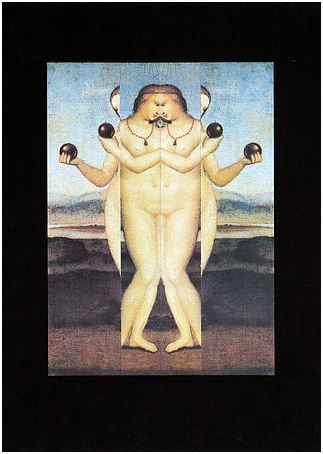
A few days ago, I was searching for images by one of my favourite collage artists, Jiří Kolář, whose last name, pronounced in his native Czech, sounds like “collage” (no doubt an example of true serendipity). I found two images from his series “Three Graces.”
Kolar 1

Kolar 2

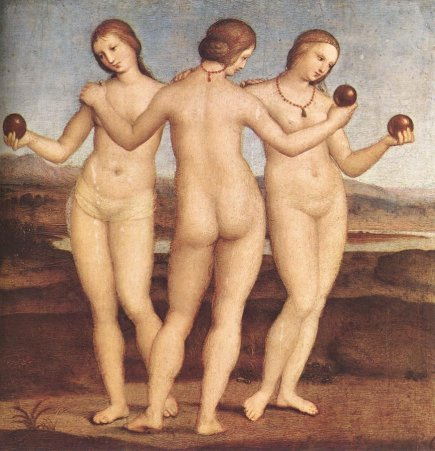
I have admired these since I was first exposed to the work of Kolář at an exhibition at the Albright-Knox Gallery in Buffalo. He uses as source material Raphael’s painting of the Three Graces holding the apples of the Hesperides, which are supposed to grant immortality.
Raphael, Three Graces

The depiction of the three Graces of ancient mythology traditionally shows two facing the viewer and the third in front of them, with her back to the viewer. Kolář seems to be playing with that traditional positioning, manipulating the bodies of the Graces using symmetry and mirror imaging so that the three seem to be merging into two in the first collage, and into one in the second collage.

Around the same time that I was studying these collages, I began thinking of Southern photographers, like Clarence Laughlin, Bellocq, and Emmet Gowin. A search for images by Gowin led quickly to a photograph very familiar to me, Nancy, Danville, Virginia, 1969, featuring a double-jointed girl who intertwines her arms in front of her and delicately holds an egg in each hand.

Gowin

Here’s where the question of serendipity started to surface. I found correspondences between Kolář’s Three Graces panels and Gowin’s Nancy to be striking: both have an otherworldly, delicate quality, and both depict females with oddly manipulated or twisted arms, holding round objects in their hands. I couldn’t help but wonder whether the association was entirely serendipitous or whether my mind had been leading me to Gowin’s photograph by a process of nonconscious association.

It’s possible that the association was fortuitous, but I don’t think that the idea of an associative process unbeknownst to consciousness is too far-fetched to be plausible. I can demonstrate stranger and more involved associative pathways in which my nonconscious mind seems to be feeding me hints, like a criminal toying with a detective, until the detective experiences the eureka moment and the elusive felon once again slips away.

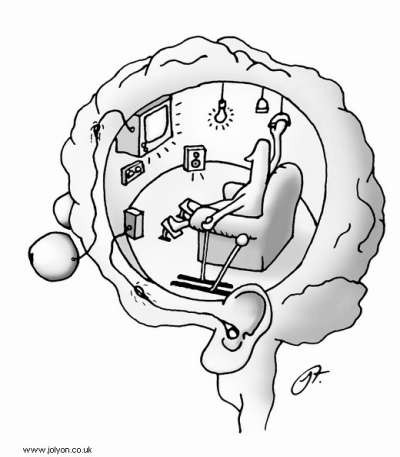
But how can we really know whether a particular association, like my pairing of Three Graces with Nancy, occurred by chance? Neuroscientist Michael Gazzaniga notes that the brain is like an iceberg: upwards of 90% of cognitive functions are not available to conscious awareness. This unavailability of much cognition to consciousness can make it seem as though there were another thinking entity (or perhaps multiple entities) within us, one that knows far more than our imaginary little conscious homunculus knows, and knows it before the homunculus gets clued in. Here’s an outdated depiction of how the mind works, with all processes coming together in a central location to be understood by a central processor (shown here as the homunculus):
homunculus

Of course, there isn’t anything like a little person inside our heads, or anything like a control centre in the brain, a central processing unit where perception and thought come together and the will of the cognitive CEO gets executed. This dualistic fallacy is known as the endless regression of homunculi:
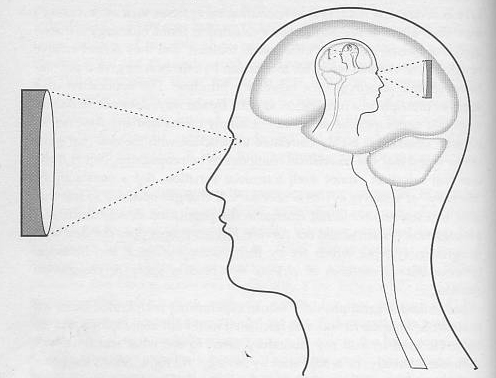
"The endless regression of homunculi. The idea of instruction or information processing requires someone, or something, to read it. But a similar entity is then required to read the resulting messages, and so on, endlessly." Gerald M. Edelman, <em>Bright Air, Brilliant Fire: On the Matter of the Mind</em>, p. 80

"The endless regression of homunculi. The idea of instruction or information processing requires someone, or something, to read it. But a similar entity is then required to read the resulting messages, and so on, endlessly." Gerald M. Edelman, Bright Air, Brilliant Fire: On the Matter of the Mind, p. 80

After we have traced back our mental associations, the realization that something had been brewing in the deeps all along and that, as Antonio Damasio claims, “we are always hopelessly late for consciousness,” is unsettling. But I wouldn’t trade the dialogue with my teasing “felon” for a homunculus, or for serendipity, for that matter. In Kolář’s two collages, merging and symmetry have the effect, not of producing unity, but of accentuating disintegration. In the first collage, disembodied limbs and faces emerge out of nowhere, and in the second collage, the seemingly unified body is in reality disconnected from her head and feet.

Similarly, we can never merge our cognitive Graces or know them completely. That proposition once again buys into the idea of the mind as having a converging point of information, whereas scientists have discounted hierarchical and linear systems in favour of a multiplex system of connections that are “parallel, recursive, feedforward, and feedback” (Richard Cytowic, The Man Who Tasted Shapes, 156).

The idiom “my mind is playing tricks on me” aptly expresses the idea of a divided mind. Kolář’ plays tricks on our eyes with the mirrored image of the Graces merging towards a centre that can never unify them but only further discombobulate them.

I haven’t found a third panel in Kolář”s Three Graces series, but one can imagine that further unification of the image along the mirror’s edge would cause the Graces to vanish into thin air.

Unity is dysfunction, disappearance, stasis. A monotheistic brain cannot create a world.

Discombobulation is function, fertility.

And however mysterious and unavailable to consciousness are the tricks the Graces play on themselves, these tricks enable the mental associations from which we create our worlds. Like the girl holding the eggs in her twisted arms, they affirm creation and bring new realms into being.

Camille Martin
http://www.camillemartin.ca

Camille Martin’s Upcoming Events


Some upcoming events featuring my poetry and art:


Square Foot Show (Toronto)
Three of my collage prints will be exhibited.
100A Ossington Avenue, Toronto
(a few blocks north of AWOL Gallery)
Show dates: Saturday, August 15, – September 6, 2009
Artists Reception: Saturday, August 15, 2009, 7 pm
Gallery Hours: Th – Sa 12-6 pm / Su 1-5 pm

Rainbow Market Square Gallery (Toronto)
Sublime Scraps: The Collage Prints of Camille Martin
Ten of my collage prints will be exhibited.
80 Front Street East between Church and Jarvis
April 1 – April 30, 2010

Publication of Sonnets by Shearsman Books
Late 2009 or early 2010. Stay tuned for book launch information and tour dates. Sonnets will be distributed in Canada, the UK, and the US.

Shearsman Books Reading Series
UK Sonnets launch: early May 2010 (Click here)
Swedenborg Hall, Swedenborg House
20/21 Bloomsbury Way, London, England

Camille Martin
http://www.camillemartin.ca

A False Start: T. S. Eliot, Snoopy, and the Art of the Artist’s Statement

Do I dare to eat a peach? Does starting a blog count as eating a peach?

The third question of the false start: for poets who also practice some other kind of art, what is the relationship between the poetry and the other discipline? In the case of my poetry and collage, are the two in dialogue? I pondered this issue as I struggled to write a meaningful statement about my collages in preparation to contact galleries about a possible exhibition. I thought it relevant to mention my work as a poet, and found myself also making connections about my readings in cognitive science. Here is what I came up with:

* * * * * * *

Artist’s Statement: Camille Martin

I am both a collage artist and a poet. The two media are not mutually exclusive; they inform one another. My approaches to language and images are closely related: I gather materials (in the case of poetry, words or phrases; in the case of collages, backgrounds and cut-out images) and try different combinations until something larger than the juxtaposed elements emerges. After creating the collages, I digitally scan them and create enlarged archival prints on fine art paper mounted on white dibond.

The startling juxtaposition of images is key to my work. Lautreamont, a nineteenth-century writer, described beauty as “the chance encounter of a sewing machine and an umbrella on a dissection table.” That statement, which became a sort of anthem for surrealists, speaks to me of the mysterious charm that ensues from the dialogue among the images that I marry with scissors and glue. The images might start telling a narrative, or their meaning might remain mysterious and absurd.

One thing that we humans do best is to fill in the gaps of seemingly illogical juxtapositions: to “confabulate,” to tell stories in order to explain. Confronted with oddness, the mind rushes to fill the aporia between the unlike images, like water rushing to fill a depression in the earth: a snake levitates in the air, lifting with it a marble staircase; a mountain breaks apart to reveal to a climbing statue a secret city with buildings adorned with feathers; a broken puppet falls from the sky like Icarus; a naked mole rat watches enviously as two mating turtles fly across the night sky. The gaps that we fill with narratives are openings for the creation of our very selves, which is unending.

It is equally possible, confronted with the illogical, to allow the strange gaps to remain a mystery and to experience what the poet John Keats called “negative capability”: the capacity to allow the presence of uncertainties without trying to rationalize them, to allow “mysteries, doubts, without any irritable reaching after fact & reason.” The snake carries the staircase: that reality can exist in its own world, resistant to the attempt of any brain to reason with the oddness of it.

It’s important for me as an artist to allow both possibilities: interpretation and mystery; narrative and an irrationality that resists narrative. The interplay of these two possibilities constitutes for me the richness and playfulness of my work. There is magic and meaning—and poetry—in both states.

* * * * * * *

I recently sent a portfolio to the Women’s Art Resources Centre in Toronto in order to get a critique from a knowledgable artist and curator. I am still basking in her assessment, which was very positive in regards to the art (she writes that she is “impressed with the quality of the execution and the composition of the collage work” – woo-hoo!). Her main suggestion had to do with my artist’s statement: to situate my collages in a more contemporary context in order to place my work in the stream of a more recent tradition. Excellent advice.

Sage advice also from Snoopy, who responded to sourpuss Lucy’s refusal to dance the day away: “Four hundred years from now, who’ll know the difference?” That’s as good a response to Eliot’s weary despair as I’ve ever heard.
. . . . . .

I record here my website address, in what is probably a useless attempt to get Google to index it:

http://www.camillemartin.ca

Camille Martin