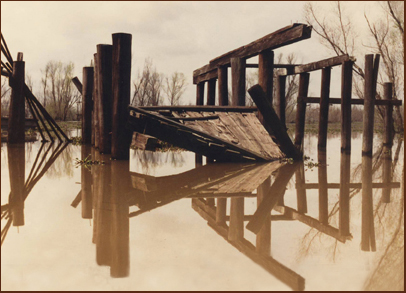
Photo: Camille Martin
Posted in photography
Tagged Atchafalaya Basin, Camille Martin, Henderson Swamp, photography

November 10 marked the sixty-fifth anniversary of the murder of Miklós Radnóti, a Jewish Hungarian poet killed by Hungarian Nazi collaborators during a three-month death march and buried in a mass grave. A year and a half later, when his wife, Fanny, located and exhumed his body, a notebook of his poems was found in his coat pocket. Radnóti had continued to write poetry during his internment in various work camps, his slave labour in a copper mine, and his forced march across his native Hungary, bearing witness to the horrors to which he ultimately succumbed.
As a tribute to him, I’m reproducing six of his poems below. Continue reading

7:30 pm, Tuesday, May 4
Shearsman Reading Series
Swedenborg Hall, Swedenborg House
20/21 Bloomsbury Way, London
This has to be, hands down, the most beautiful hall I will have ever read in.

8:00 pm, Thursday, May 6
PoAttic Reading Series
Jersey Opera House, St. Helier, Jersey, U.K.
(OK, not the actual opera stage, but a room called the “Attic” where Nathan says the phantoms live.)

8:30 pm, Monday, May 10
Ó Bhéal Reading Series
The Long Valley (upstairs), Cork, Ireland
Can’t wait to try their famous sandwiches . . .

6:00 – 8:00 pm, Tuesday, May 11
University of Salford
Reading and two-hour session with students in the MA in Creative Writing: Innovation and Experiment program
Looking forward to meeting the students!

A recent addition to the tour:
Tuesday, May 18
Ivy Writers Reading Series
Le Next
17 rue Tiquetonne, Paris
Posted in poetry, poetry reading
Tagged Camille Martin, Ivy Writers Reading Series, O Bheal, PoAttic, Shearsman Books, Shearsman Reading, sonnets

Click here for the audio files.
Camille Martin
http://www.camillemartin.ca
Posted in audio poetry, poetry, poetry magazine
Tagged Camille Martin, From East to West, poetry, poetry magazine

Photo: Camille Martin
Posted in New Orleans, photography
Tagged Camille Martin, New Orleans, photography, po-boy, tuxedo
I just heard from PJ, the editor, that the audiofiles are temporarily unavailable while the website migrates to a new url. I’ll repost this when the audiofiles are online again.
Camille Martin
http://www.camillemartin.ca

Letter
Marseilles
This brilliant artifical knee, spring-hinged with small birds’ bones, is too late, and the books on metallurgy, hydroponic farming, and beekeeping were sent to the wrong country.
The money belt is useless (unless a sailor will buy it)—the room costs 10 francs a day, with doctors, and I haven’t stood up in weeks. Huge varicose veins map my treks through the Sudan, where hot winds dry up white men from the inside. A year there ages one as much as four elsewhere.
At night I smell the harbor and thick, yellow moon-light falls across my bed. I sleep no more than an insect.
Give me the news.
Rimbaud
Inside Cheese
The aged gouda had grown complex, its acoustics swollen to visibility, and the sunny complexion inherited from a northern polder was laced with the whispers of photons cruising the waxy mantle of layered gloss left by each demented glance that had fallen from eyes on the brink of sleep. The brink was lurid and echoed the roar of termites from a nearby windmill. Time and again the prodigious sails swooped out of the sky like an amusement park on fire, and with each revolution the lattice lost molecules to robot bacteria whose cousins had long since polished milk to a half life in the low gear rotunda.
Alan Bernheimer, Cafe Isotope (Berkeley: The Figures, 1980)
Camille Martin
http://www.camillemartin.ca
 Click here to view Decasia on VEOH.
Decasia is a relentless memento mori that grabs you by your repressed thoughts of death and doesn’t let go. Its visual premise is, on the surface, simple and monomaniacal: it consists entirely of un-retouched clips of old silver nitrate films—documents of ordinary life or melodramatic scenes from silent films—that have deteriorated over decades of neglect. Filmmaker Bill Morrison copied these strips of film, in whatever state of decay he found them, and spliced them together to create a powerful sixty-six minute meditation on impermanence. Experiencing this montage and its compelling soundtrack by Michael Gordon is mesmerizing, and the film continues to haunt long afterwards.
Decasia’s original incarnation was a symphony by Michael Gordon (of Bang on a Can fame) that was accompanied by an earlier version of Morrison’s film in a live multi-media performance. Morrison later re-edited his film to mesh with the music.
The opening scene is meditative: slow-motion whirling dervishes whose revolving movement initiates a motif suggesting cyclical change. Morrison continues this motif of circular motion with an archival film tour of a motion film processing centre, in which reels of film revolve on a machine that immerses the strips in tubs of chemicals. After this tour of the the birth and baptism of film, which establishes the metafilmic premise of Decasia, comes a sustained onslaught of images showing its inevitable decay.
One of the first clips in that onslaught confounds filmed object and image of decay: what appears to be drifting smoke or shapeshifting clouds might also be a morphing milky wash caused by the chemical degradation of silver nitrate. Thus from the start, Morrison collapses object with decay, inviting meditation on the limits of representation: just as life is subject to decay, so is representation also subject to mutability and illegibility. The mimetic pretense of film images allows us to witness something of the objects captured. But those images express their own reality, not just that of the objects, and their decomposition is a reminder of the elusiveness of capture and posterity. They are failed time capsules that carry within them the seeds of their own demise.

One of the most compelling illustrations of Decasia‘s dance with mortality is a film of a boxer, perhaps from the 1930s, hitting a punching bag to his right. The image of the boxer has survived, but the right side of the frame has decayed into a fluctuating amorphous cloud, so that the boxer appears to be ineffectually punching a shifting column of ethereality. Even decay is not static but mutable: like life, it’s a process, not a state. And it can be combatted but not halted. Thus is a film of a boxing exercise transformed from quotidian to metaphysical.
Decasia often gives the illusion that hundred of patterns of various types have been superimposed in rapid succession over a film’s frames. And by showing the films in slow motion, Morrison transforms what might at normal speeds be blips on the screen (and thus not available to the conscious mind) into clearly visible patterns of destruction. For example, a film of the Big Sur coast seems to have been invaded by rapidly shifting giant amoebas, as though a series of slides of the creatures had been overlaid on the film of rocky coastline. Each frame of the film, it seems, was affected by the same chemical process of aging, but in a different configuration. And in a scene in which a Japanese woman in traditional kimono walks past a window, it’s as if hundreds of transparencies of abstract impressionist paintings have been superimposed in rapid succession over the images.
But the decay comes from the inside out, created by the agents of time and natural processes: decay and image are integrally fused. They render visible what is often forgotten or suppressed: thoughts of impermanence set aside in order get out of bed in the morning, as Morrison points out, without being paralyzed by the ultimate futility of it all.
To a film archivist or preservationist, being subjected to scene after scene of film in various stages of decomposition might be as nightmarish as a librarian examining rare books warped by flooding. But an expert would not be surprised, as I was, by the variety of forms that decay and time can wreak on film. Blisters, amoeba, specks, amorphous congeries, abstract expressionism: time’s handiwork is endlessly creative, and the marks of impermanence left on these film clips are as impressive as they are relentless, and as beautiful as they are ominous. Decay might render the original images unreadable, but it now plays the lead role, pulsating as if it were itself a life force and not the angel of death. The decay of a film of a burning house takes the form of flames flicking across the fire. Mesmerizing black tornadoes threaten nuns and the children over which they watch walking single file into a schoolroom. Funhouse mirror distortions oddly stretch and contract an automobile of newlyweds. Grim black shadows fall over the image of a miner, unconscious or dead, being carried from a mine. Decay, like the grim reaper, has a smorgasbord of choices.
I have read more than one review that suggests that Decasia‘s primary purpose is to convey the message that old films are being irretrievably lost to the ravages of time for want of the funds or will to restore them, and to issue a rallying cry to do something about it. That message is unavoidable in a film that is obsessed with (and composed of) the decay of its own medium. However, it seems limiting to view it mainly as propaganda. To tie down the film with such a moral imperative would be as reductive as interpreting Hamlet as a cautionary tale to warn kings not to sleep with their ears exposed. It misses the larger picture.

Camille Martin
http://www.camillemartin.ca
Posted in experimental film
Tagged Bill Morrison, Camille Martin, Decasia, experimental film, film, Michael Gordon

Gilbert Sorrentino, from The Orangery
Variations 2
The pale moon sails out blank.
Green fruit in the trees and
in the green trees oranges.
They are limes they
are oranges. The n is a kind
of fly that lands on
nothing. The birds flash
in morning silver light.
glitter and buzz of
the transparent.
flash of green.
handful of silver coins
caught by the girl the
comedienne. Madame Mystère.
Imitation of the Chinese
Dry crackle of leaves
blown erratically over the rusty grass.
Ice thin and fine a crystal
luminous in the bleached sunlight.
The birds are gone save for the blue dazzle
of the jays.
Thin smoke white against azure.
The roof tiles blue and ochre
across the lake. I stand alone
shivering in the wind
sweeping from the mountains.
Where is she?
Where is she who gave me the orange
from Persia in summer long ago?
Villanette
The harsh words ice and chaste
are good American, they sing
of death and winter, waste.
Frozen chics depart in haste
for Florida. (They don’t bring
the harsh words, ice and chaste.)
Sun dumb, they smell and taste
fluffy orange frappes, here’s nothing
of death and winter waste.
Cakes oozing with lime paste
yet in the news a chilling sting:
the harsh words Ice and Chaste.
These harsh words: “ICE AND CHASTE.”
“DEATH AND WINTER.” “WASTE.”
Camille Martin
http://www.camillemartin.ca
from Abracadabra by Kimberly Lyons
New York: Granary Books, 2000.
The Concise History of Painting
The cones and cubes of an ideal town
rise across the lake
of brown-rumpled water
perfumed by egrets
and moths. And I fell asleep
briefly yesterday by the file cabinet
and had a dream, like a spasm.
Masses of clouds move sternly over
the ocean.
I suck on my violet duck.
I hit my spoon with the floor.
Call out to the
shadow of a saint
who has fallen under his horse
Abracadabra
We watch together
black collide with white.
This is not the night
falling around snow
or a mailbox swallowing
our letter
frozen dark air around ice cubes
the white sink caps
wet black pantyhose
like a lake seen
from the
small window of a train.
The window of a face
on film
big kosher salt in a small black pan
Camille Martin
http://www.camillemartin.ca
 Rogue Embryo



 Rogue Embryo
Joan Retallack’s Little Universes
The Little Universe of Infinite Time
Who can say which of all possible things should happen
next. Many were more or less content as many others ran
shrieking out of houses. Many many ran to hide in forests,
mountains, deserts. Many many many ran toward what
seemed to be safety zones between houses, in mountain
crevasses, across closely guarded borders, in desert mirages
and magical clearings in dark woods. Many more were
unlucky and couldn’t get away. The panel poured clear
water into clean glasses and cleared throats. The theys who
survived couldn’t talk about it themselves because of the
nature of impersonal pronouns. It’s said they took to
looking for meaning among frequently misspelled words.
Of course hope springs eternal in the little universe of
infinite time.
The Little Universe of Ten Minutes
Standing at the far edge of another unsettling interruption,
barely visible, not at all audible. Waving, smiling, pelted by
beams of electrons, photons, and other elementary detritus
streaming out of the inception of this perfectly calibrated
world. Hands thoroughly washed, synaptic pruning all
done. Want only to establish the time of the tragic event. It
was five in the afternoon it was exactly 9:30 am it was
eleven o’clock plus or minus twelve hours. She said come
back next week. I’ll tell you the answer. She had said come
back next week. We hesitate to mention it, but next week
had already happened in the little universe of ten minutes.
Camille Martin
http://www.camillemartin.ca
Share this:
Leave a comment
Posted in poetry, poetry magazine
Tagged American Letters & Commentary, Joan Retallack, The Bosch Notebooks