A rare opportunity to see a substantial collection of oils and pastels by Miro Malish, Czech-Canadian surrealist:

A rare opportunity to see a substantial collection of oils and pastels by Miro Malish, Czech-Canadian surrealist:
Posted in art gallery, painting, visual art
Tagged Canadian artists, Czech artists, Miro Malish, painting, pastels, visual arts
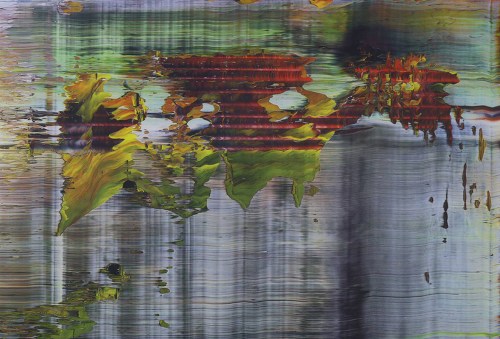
Gerhard Richter: Detail, 858-4
Scale
The
The red vowels, how they spill
then spell a sea of red
And the bright ships—
are they not ghost ships
And the bridge’s threads
against flame-scarred hills
And us outside
by other worlds
So
So the promise of happiness?
he asked a frog
then swallowed the frog
And the buzz of memory?
he asked the page
before lighting the page
And by night the sliding stars
beyond the night itself
A
A table erased
It is not realism makes possible the feast
Grey face turned away
Jam jar of forget-me-nots
Girl with gold chain
cinching her waist
But is it true
And what will become of us
As
As if the small voices—
one-erum two-erum
pompalorum jig
wire briar broken lock
then into and into
the old crow’s nest—
and so when young,
before all the rest
Crease
Crease in the snowy field
of evening within us
How the owl stares
and startles there
fashioning mindless elegy
So the remembered world’s
songs and flooded paths
This heap of photographs
This
This perfect half-moon
of lies in the capital
Crooks and fools in power what’s new
and our search has begun for signs of spring
Maybe those two bluebirds
flashing past the hawthorn yesterday
Against that, the jangle of a spoon in a cup
and a child this day swept out to sea
But
But the birth and death of stars?
The birds without wings,
wings without bodies?
The twin suns above the harbor?
The accelerating particles?
The pools of spilled ink?
Pages turning themselves
in The Paper House?
Soon
Soon the present will arrive
at the end of its long voyage
from the Future-Past to Now
weary of the endless nights in cheap motels
in distant nebulae
Will the usual host
of politicians and celebrities
show up for the occasion
or will they huddle out of sight
in confusion and fear
Camille Martin
http://www.camillemartin.ca
Posted in poetry, visual art
Tagged art, Gerhard Richter, Michael Palmer, painting, poetry, Richter 858
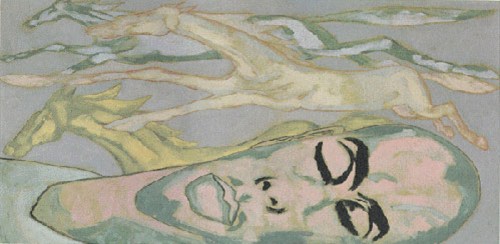
Francesco Clemente, from Anamorphosis
inside my head. I close my eyes.
The horses run. Vast are the skies,
and blue my passing thoughts’ surprise
inside my head. What is this space
here found to be, what is this place
if only me? Inside my head, whose face?
The remainder of poems and paintings in Anamorphosis can be found at 2River View.
This week I’m revisiting some collaborative pairings between poets and artists in other disciplines, in preparation for a collaborative performance series, Figure of Speech, that I’ve been asked to participate in. I’ll be working with a singer (who also plays the guitar), a guitarist who specializes in Baroque music, and a dancer. I want to address the things that can make an effective collaboration.
The 1997 collaboration between Robert Creeley and Francesco Clemente, Anamorphosis, strikes me as one of the most evocative and beautiful collaborations between a poet and a visual artist. I’m all for exquisite corpses and other processes incorporating chance, but there is something to be said for the way that Creeley and Clemente seem perfectly attuned to one another’s work. I don’t know whether Clemente made his paintings based on Creeley’s poems or vice versa, but they expand the meaning of one another through their sustained and rich dialogue. A good example is the first pair in the series, “Inside My Head.”
Clemente’s painting depicts a single image from Creeley’s poem: imagining horses. He gives a part for the whole, a relationship of synecdoche. Although the painting is a somewhat literal interpretation of Creeley’s imaginary horses, it doesn’t belabour that correspondence. Instead, the image is executed in such a way as to evoke other themes in the poem, such as mortality, identity, and imagination.
For example, in a painting whose colours are primarily pastel, the bold black lines depicting the closed eyes stand out, emphasizing the visionary quality of the man, which is also reflected in the poem. Clemente’s images of head and horses are elongated, further emphasizing painting and poem’s dreamlike quality. And the head of Clemente’s imagining man reclines with eyes closed, which could signify the shutting out of the world and the opening up of the world inside the head. It could also signify death or “death’s second self.” In all of these possible interpretations, the images sound sympathetic vibrations with the poem: death and the stuff of dreams.
As well, the simplicity of Creeley’s almost nursery rhyme-like poem with its repetitions and formal balance is well suited to Clemente’s simple but evocative image.
In depicting thoughts of running horses, perhaps these two had in mind Saussure’s use of the horse to describe the relationship between the referent (the external object, the actual horse), the signifier (the word “H-O-R-S-E”) and the signified (the concept of “horse”). Turning Saussure’s ideas on their head, Clemente and Creeley suggest that the signifier invokes the actual referent: Creeley doesn’t talk about thinking of horses, but instead there seem to be real horses running in the head. Similarly, Clemente’s painting depicts real horses galloping behind the speaker’s head.
Creeley also seems to be alluding to Andrew Marvell’s celebration of the world inside the head in “The Garden”:
Meanwhile the Mind, from pleasure less,
Withdraws into its happiness:
The Mind, that Ocean where each kind
Does streight its own resemblance find;
Yet it creates, transcending these,
Far other Worlds, and other Seas;
Annihilating all that’s made
To a green Thought in a green Shade.
Green thoughts are echoed in Creeley’s poem in the speaker’s surprised blue thoughts.
In this dialogue with Saussure and Marvell, Creeley and Clemente assert the reality of the world of the imagination: that world possesses its own reality, and that reality is powerful, capable of extinguishing the exterior world through its concentrated focus on its thoughts and images. But it also spawns a meditation on the nature of personhood, cognition, and mortality.
The poem and painting of “Inside My Head” are both intensely interior and introspective, relieved only by Creeley’s paradoxical assertion of the commonality of the mystery at the heart of the human experience of subjectivity. Even inside the head, there is a “commons,” a place that is at once enclosed, private, subjective, as well as open, public, shared.
Creeley and Clemente’s collaboration is successful because the two works are in close dialogue with one another, which cannot happen if one simply holds up a mirror to the other.
Posted in painting, poetry, visual art
Tagged Camille Martin, collaboration, Francesco Clemente, painting, poetry, Robert Creeley, visual art
 Rogue Embryo
 Rogue Embryo