St. Joe Brick Works, located on the Pearl River in Louisiana, has produced (in the company’s words) “good, honest bricks” for buildings and sidewalks since 1891, using an antiquated colonial method. An Irish immigrant nicknamed St. Joe founded the eponymous brickmaking company.
The beloved brick gave rise to a local expression indicating surprise. Example: “When I scored that Zulu coconut, you coulda hit me in the head with a St. Joe brick!”
Over the decades, some old brick sidewalks in New Orleans have been buried by soil, covered in concrete, or broken up by the muscular roots of live oak trees.
More of these historic sidewalks are being unburied, or else replaced by new bricks from the still-functioning St. Joe factory.
A yellow “Mardi Gras bead dog” guards a brick sidewalk in the Leonidas neighborhood . . .
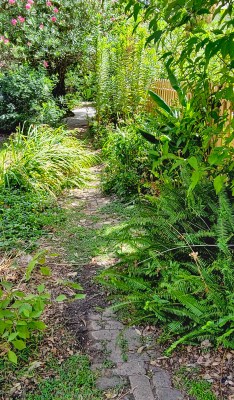
Uptown straight and narrow . . .
Sun-dappled bricks, mottled bark of stewartia trees
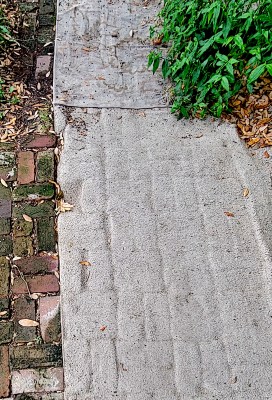
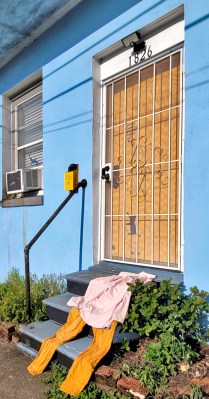
No idea why someone covered this sidewalk in fabric, but I was drawn to the bricks’ texture outlined by wet cloth after a rain.
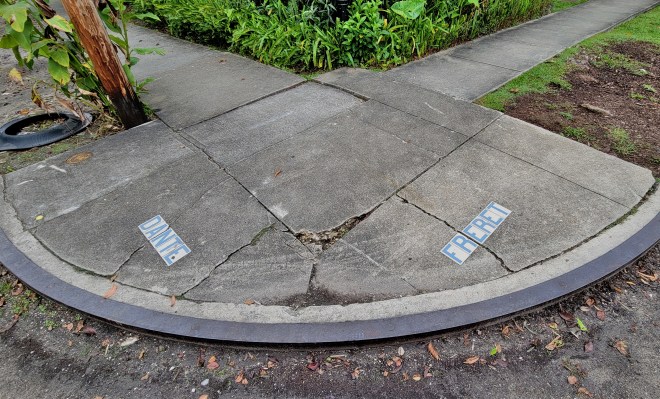
Blue-and-white tiled street names embedded in New Orleans sidewalks add to the historic charm of the city. The tiles with their characteristic fonts were manufactured in Belgium in the late nineteenth century.
Below: the tiles on the corner of Dante and Freret Streets in the Leonidas neighborhood
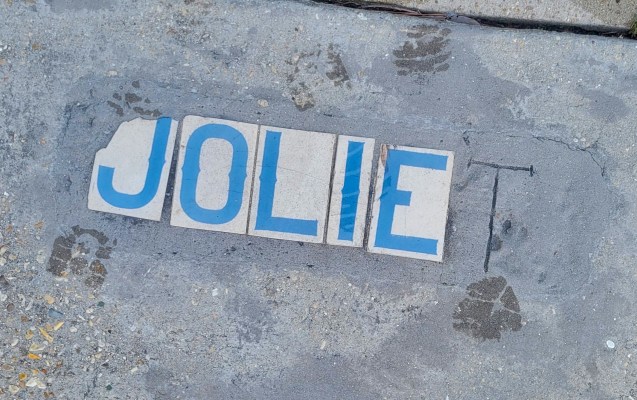
Over the decades, these appealing tiles have deteriorated—many are cracked and have missing letters, or else they have disappeared entirely. Below is an easy fix for a missing letter on Joliet Street. At least there was an attempt to approximate the font!
Below, the “E” tile is missing for Elm Street.
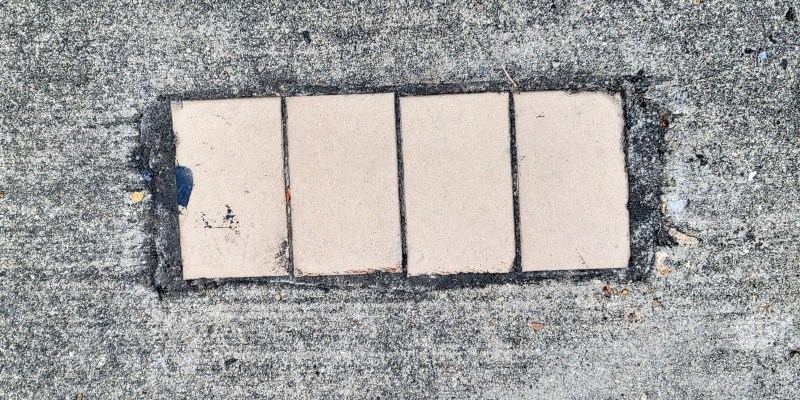
Contractors laying new concrete sidewalks can incur hefty fines if they don’t remove and replace these historic tiles. Were the blank tiles below on Fern Street a contractor’s idea of thumbing his nose at City Hall’s requirements?
Click here for more information about these tiles, which are in danger of gradually disappearing.
Most older homes in New Orleans are raised on concrete blocks due to the possibility of flooding.
Over many decades, objects find their way under the house: old bottles and jars, faucets, building supplies, tools, toys, combination locks, faucets, marrow bones, and random bits of plastic and metal.
Years ago, I visited a friend who had crawled under his house, excavated such objects, and attached them to his backyard fence. It was impressive display of quotidian artefacts.
During a recent visit to my partner in New Orleans, I conducted a “dig” under his house and created our own archaeological fence. Some bottles and jars dated to the late nineteenth century.
Gratitude to Joel Dailey for indulging my desire to play archaeologist and for letting me decorate his fence! Not to mention tolerating the dirt that came from this project . . .
New Orleans has been roasting under a broiler. To quote a woman interviewed on a local TV station to describe a conflagration: “It was raging like the devil in heat!”
Yesterday the temperature rose to 100° (46°C), heat index 116° (46°C). But not even such intense heat can wilt the irrepressible humor of the denizens of The Big Easy.
Here are some of NOLA’s responses to Johnny Carson’s immortal query: “How hot is it, you ask?”
Melting point in the Marigny . . .
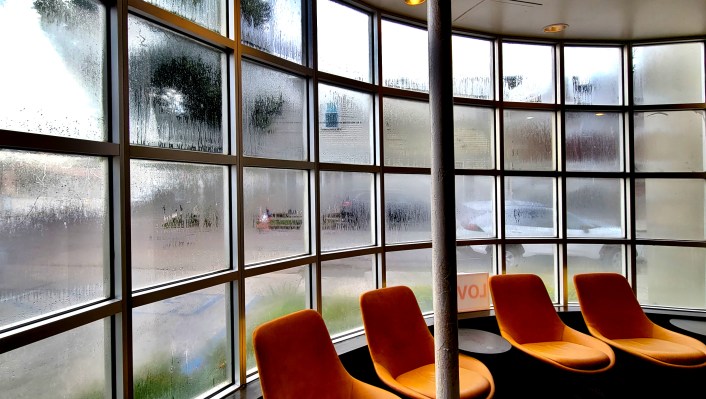
How do you really know it’s way hot? By the condensation on the windows inside the Starbucks on Maple Street . . .
But Moo-MOO, the beloved lady cat of Freret Street, always knows where to find a cool, shady spot for a nap . . .
This post is the first in a series of photographs that I took in New Orleans.
During my recent visit in July, I looked forward to walking through the Lower Carrollton and Leonidas neighbourhoods (near the bend in the Mississippi River) and taking photographs. The record-setting heat had driven people from the streets, which were eerily deserted. Folks were either at work or hunkering down at home to stay cool. So street photography was limited, especially in the harsh light of noon and the oppressive heat.
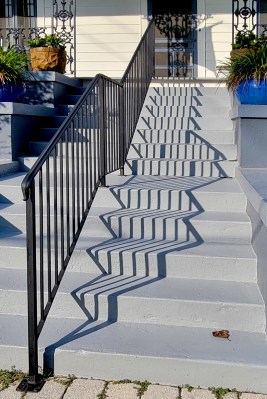
The best time to walk was in the late afternoon, when the cicadas begin their long mesmerizing buzzing, and the early morning. Fortunately, those are the “golden hours,” when the slanting sunlight creates striking shadows and saturated colours. Such illumination of the houses and wrought iron reveals quietly magical scenes. Here are a few . . .






















 Rogue Embryo